Ucrete Flooring Saudi Arabia Sika PU Cement

Sika Ucrete · Polyurethane cement flooring · KSA

Ucrete Flooring in Saudi Arabia — Sika PU Cement Floors for Industrial Kitchens, Cold Rooms and Food Plants

Ucrete flooring is a heavy-duty polyurethane cement floor screed, made by Sika, laid at 4–12 mm for rooms that combine hot washdown, chemicals, impact and freezer temperatures. SolidDrops supplies and installs Ucrete flooring in Saudi Arabia — Jeddah, Riyadh, Dammam and all over KSA — selecting the grade from the Sika data sheets, not from a brochure.

Reviewed by the SolidDrops technical team · Last updated 9 September 2026 · Figures below are quoted from the Sika GCC product data sheets (UD 200 v03.01, MF v03.01, HF 60 RT v02.03, HF 100 RT v01.02) and the Sika DP10 4 mm system data sheet.

−40 to +150 °Cservice range, UD 200 at 12 mm
4–12 mmscreed thickness across the range
< 24 hreturn to service at +8 °C
HACCP · Halalplus Eurofins Indoor Air Comfort Gold

Ucrete flooring at a glance

PropertyValueStandard / source
Material typePolyurethane cement (PU cement) heavy-duty floor screedSika Ucrete PDS
Thickness range across the range4 mm (DP10 4 mm, MF) to 12 mm (UD 200, TZ)Sika PDS / SDS
Highest service temperature+130 °C continuous, +150 °C occasional spillage (UD 200 at 12 mm)Sika Ucrete UD 200 PDS
Lowest service temperature−40 °C (UD 200 at 9 mm and 12 mm)Sika Ucrete UD 200 PDS
Compressive strength (28 days, +23 °C)48–55 N/mm² depending on gradeEN 13892-2
Slip resistanceR10 (MF, HF 60 RT, HF 100 RT flow-applied) · R11 (UD 200, DP10, HF 100 RT trowelled) · up to R13 textured finishes availableDIN 51130
Fire classificationClass Bfl-s1 (UD 200, MF, HF 100 RT)EN 13501-1
Return to service< 24 hours at +8 °C; 4 hours at +10 °C with Sika Ucrete Accelerator (UD 200)Sika Ucrete UD 200 PDS
Food-safety approvalsHACCP suitability (test report I-PE-769-SA-2-RG06b) · Halal, HCE certificate 21453-2/1/1/Y1 · Eurofins Indoor Air Comfort Gold, EN 16516Sika PDS
Application temperature (ambient and substrate)+5 °C to +25 °C (UD 200) · +12 °C to +25 °C (MF, HF 60 RT) · +12 °C to +30 °C (DP10) · ambient +8 °C to +35 °C, substrate +8 °C to +30 °C (HF 100 RT)Sika PDS / SDS
Supply and installation in KSASolidDrops — Jeddah, Riyadh, Dammam, Jubail, Makkah, Medina, Tabuk[email protected] · +966 50 213 1112
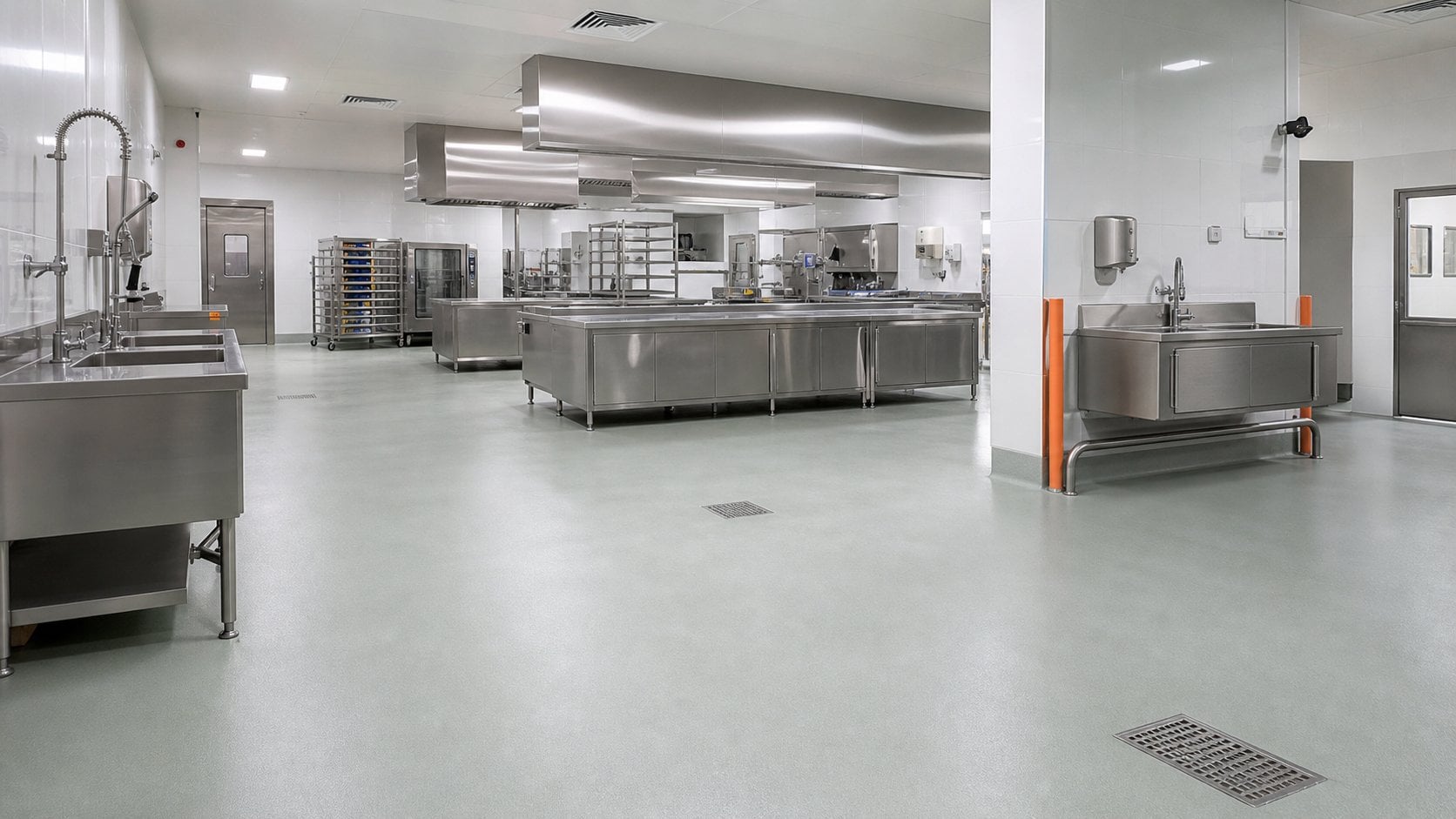
Ucrete PU cement flooring for an industrial kitchen in Saudi Arabia with cove base and drains
A Ucrete-type PU cement floor in an industrial kitchen: coved skirting, falls to drain, textured finish.

What Ucrete flooring is and why food plants specify it

Ucrete is a polyurethane cement flooring system that has been in continuous use since 1969 and is now manufactured and supplied by Sika. The chemistry is a polyurethane resin bound with cement and graded aggregate, trowelled or flow-applied as a screed 4–12 mm thick. That thickness is the whole point. A 300-micron epoxy coating sits on the concrete; a 9 mm Ucrete screed becomes part of it, and a screed that thick can absorb the heat of a 120 °C steam clean without cracking away from the slab.

Three properties make it the default specification for wet food areas. It is fully resistant to hot discharge and steam cleaning in the right thickness, with specifications available up to 150 °C. It carries independent food-safety approvals — HACCP suitability, Halal certification and Eurofins Indoor Air Comfort Gold — so it can be installed and used in a food-handling area without tainting product. And it is cleanable to the same standard as stainless steel, which is what a QA manager at a dairy or a central kitchen actually cares about at the audit.

In Saudi Arabia that translates to a short list of rooms: central production kitchens (المطابخ الصناعية) for hotels and catering companies, cold rooms and blast freezers (غرف التبريد) at logistics hubs in Jeddah, Riyadh and Dammam, dairy and juice lines, bakeries, meat and poultry processing, seafood plants on the Red Sea and Gulf coasts, and pharmaceutical washdown rooms. If the floor sees hot water, fat, organic acid and a forklift in the same shift, it is a Ucrete room.

Cross-section of a Ucrete UD 200 floor build-up in Saudi Arabia showing 9 mm screed, RG cove, FRP wall panel, anchor groove, primer and stainless channel drain
The wet-area build-up SolidDrops details for Saudi kitchens and food plants: UD 200 at 9 mm, RG cove to an FRP wall panel, anchor grooves at free edges, fall to a stainless channel drain.

Ucrete grades compared: UD 200, MF, HF 60 RT, HF 100 RT and DP

Every grade is the same chemistry at a different thickness and texture, and the thickness sets the temperature limit. Choose the grade from the room's hottest discharge and coldest storage temperature, then adjust texture for the cleaning method. The figures below are taken directly from the current Sika data sheets.

GradeThicknessService temperatureCompressive strength (EN 13892-2)Slip (DIN 51130)Typical room
Sika Ucrete UD 2006, 9 or 12 mm6 mm: −25 to +80 °C
9 mm: −40 to +120 °C
12 mm: −40 to +130 °C (+150 °C occasional spillage)
52–55 N/mm²R11Wet production, cook lines, fryers, CIP areas, freezer thresholds
Sika Ucrete MF4–6 mm−15 to +70 °C (at 6 mm)48–53 N/mm²R10Dry process, packing lines, clean rooms, warehouses
Sika Ucrete HF 60 RT~6 mm, flow-applied−25 to +80 °C48–54 N/mm²R10 (PTV 40–45 wet, EN 13036-4)Large fast-track areas, wet and dry process rooms
Sika Ucrete HF 100 RT~9 mm, flow-applied−40 to +120 °C54 N/mm²R10 flow-applied, R11 trowelled (PTV 40–45 wet, EN 13036-4)Large wet process halls needing the 9 mm temperature rating on a tight programme
Sika Ucrete DP10 / DP20 / DP304, 6 or 9 mm systems4 mm: −15 to +70 °C (spillage and discharge)54 N/mm² (DP10 4 mm)R11 (PTV 45–50 wet); DP20 and DP30 carry progressively more defined profilesWet, greasy, slip-critical floors: dishwash, ramps, wet kitchens
Chart of Ucrete service temperature range by grade and thickness: UD 200 at 12, 9 and 6 mm, HF 100 RT, HF 60 RT, MF and DP10 from Sika data sheets
Thickness sets the temperature limit. Read the room's hottest discharge off the right-hand end of each bar.

Sika Ucrete UD 200

6–12 mm · R11 · up to +150 °C spillage · Bfl-s1

The heavy-duty, lightly textured screed and the grade most Saudi food plants end up with. At 9 mm it takes full steam cleaning; at 12 mm it handles 130 °C continuously. Consumption is 12.5, 19 and 25 kg/m² at 6, 9 and 12 mm. Returns to service in under 24 hours at +8 °C, or 4 hours at +10 °C with the accelerator. Available in nine colours including red, grey, green, cream and blue.

Sika Ucrete MF

4–6 mm · smooth · R10 · +70 °C max

The smooth, heavy-duty screed for dry process areas — packing halls, pharmaceutical support rooms, chemical stores and warehouses where abrasion and spillage matter more than hot washdown. It also serves as the base coat under the DP systems. Consumption 6–8 kg/m² at 3 mm and 10–12 kg/m² at 5 mm.

Sika Ucrete HF 60 RT

~6 mm · flow-applied · R10 · −25 to +80 °C

A flow-applied version of the 6 mm screed for large new-build and refurbishment areas where programme is tight. Same HACCP, Halal and Indoor Air Comfort Gold approvals as UD 200, with a lightly textured finish. Must be protected from water and condensation for 24 hours after laying.

Sika Ucrete HF 100 RT

~9 mm · flow-applied · R10/R11 · −40 to +120 °C · Bfl-s1

The 9 mm flow-applied screed: the same −40 °C to +120 °C rating as UD 200 at 9 mm, but pumped and flowed for large halls on a short shutdown. Compressive strength 54 N/mm², consumption 19–22 kg/m², return to traffic 16–24 hours at +8 °C. Its data sheet also carries the widest application window in the range — ambient up to +35 °C and substrate up to +30 °C — which matters on a Saudi site. HACCP, Halal and Indoor Air Comfort Gold certified.

Sika Ucrete DP10 / DP20 / DP30

4–9 mm systems · defined profile · R11+

Broadcast systems built from a Ucrete BC or MF base, F 5 aggregate broadcast and a TC encapsulation top coat, giving a defined, controllable anti-slip profile. DP10 is the lightest profile, DP30 the most aggressive. Specify where wet floors, oil and sloped ramps meet foot traffic.

Sika Ucrete RG (coving and render mortar)

Vertical grade · coves, plinths, upstands

The hygienic render and coving mortar that forms the floor-to-wall radius, machine plinths and kerb faces so there is no 90° dirt trap. Older specifications may still name it Ucrete WR; the current Sika range lists RG. The cove is where hygiene floors pass or fail an audit, so it is detailed and priced as its own line item.

TZ, IF, HPQ, CR 460 and antistatic versions

Specialist grades on request

Ucrete TZ is a smooth, hygienic heavy-duty resin terrazzo for showpiece production halls; IF is the iron-armoured finish for extreme impact; HPQ is a flow-applied coloured-quartz system; CR 460 is the matching chemical-resistant joint filler. UD 100 AS, MF 40 AS and the DP AS systems provide antistatic performance for pharmaceutical and electronics rooms.

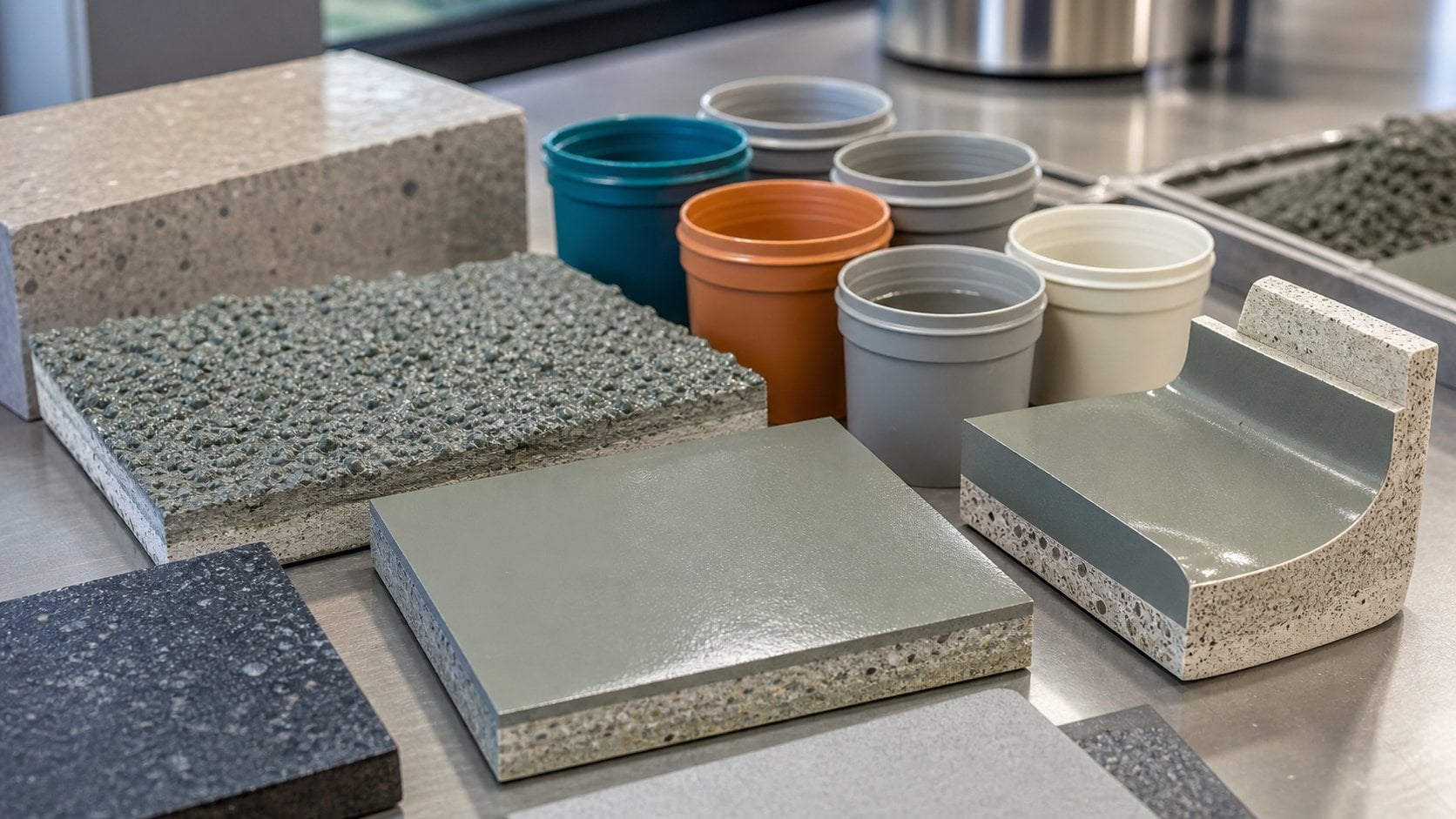
Ucrete flooring product samples showing smooth and slip resistant PU cement finishes
Smooth (MF), lightly textured (UD 200) and defined-profile (DP) samples: texture is chosen by cleaning method, not by look.

Which Ucrete grade for which Saudi facility?

The selection rule is simple once the room's exposure is known: match thickness to temperature first, texture to cleaning method second, and never choose a grade by the name a competitor's quote used. This is the matrix SolidDrops works from at survey stage.

Room or processGoverning stressRecommended directionDetail to price
Central production kitchen, hotel or cateringBoiling water discharge, fat, daily hot washdownUD 200 at 9 mm (R11)RG coves, channel drains, fall to drain
Fryer line, cook-chill, retort areaDischarge above 120 °C, thermal shockUD 200 at 12 mmMovement joints with CR 460, plinths
Cold room, chiller corridorCondensation, −20 °C storage, cleaning at thresholdUD 200 at 9 mm (rated to −40 °C)Threshold transition, insulated slab prep
Blast freezerContinuous sub-zero, occasional steam defrostUD 200 at 9–12 mmCuring programme before chilling the room
Dishwash, pot-wash, wet slip-critical floorsDetergent, standing water, foot trafficDP20 or DP30 at 6 mmTexture mock-up before full lay
Dairy, juice, beverage fillingLactic and citric acid, CIP chemicals, hot rinseUD 200 at 9 mm, or HF 100 RT flow-applied for large hallsChemical resistance confirmation from Sika technical service for the CIP concentration in use
Dry packing, pharma support, warehouseAbrasion, pallet trucks, cleanabilityMF at 4–6 mm (smooth)Line marking, kerb protection
Meat, poultry, seafood processingBlood, fat, brine, 80 °C washdown, knives and trolleysUD 200 at 9 mm, DP30 on rampsDrain falls, stainless gullies, FRP wall junction
Decision flow for choosing a Ucrete grade in Saudi Arabia: hot discharge, freezer and slip questions leading to UD 200, DP, MF or HF 60 RT
Three questions decide the grade. Print this and take it to the site walk.
Where Ucrete is not the answer. A dry showroom, an air-conditioned office corridor or a warehouse that is only ever swept does not need a 9 mm PU cement screed; a self-levelling epoxy or a PU coating does the job at a fraction of the material cost. SolidDrops will say so at survey. The comparison is worked through room by room in our epoxy vs PU cement flooring guide for Saudi Arabia.

Installing Ucrete in Saudi heat: the constraint nobody quotes

Most Ucrete data sheets set a maximum application temperature of +25 °C for ambient air and substrate (UD 200, MF, HF 60 RT), or +30 °C for the DP systems; only HF 100 RT allows ambient up to +35 °C with the substrate still capped at +30 °C. A slab in a Dammam or Riyadh plant in July sits well above that from mid-morning onwards, and a material at +25 °C maximum poured onto a 38 °C slab will lose working time, trap heat and can blister. It is the first thing SolidDrops checks when asked to look at a failed PU cement floor in the Kingdom, and it is a programme problem, not a product problem.

Chart of maximum application temperatures for Ucrete UD 200, MF, HF 60 RT, DP10 and HF 100 RT from Sika data sheets, showing the +25 to +35 °C ceiling relevant to Saudi Arabia
The Ucrete data sheets cap substrate temperature at +25 °C to +30 °C and ambient at +25 °C to +35 °C. In a Saudi summer the pour is planned around that ceiling, not hoped past it.

The fix is planning. Wet-area floors in KSA are laid in night shifts or in enclosed, air-conditioned rooms with the AHU running ahead of the pour; material is stored conditioned (UD 200 material temperature +10 °C to +25 °C, MF +18 °C to +25 °C) and never left on a loading dock; substrate temperature is checked with a surface thermometer before every mix, not assumed. The pay-off is the return-to-service figure — under 24 hours at +8 °C on the data sheet, faster in a conditioned room — which makes an overnight relay of a working kitchen realistic if the sequence is right.

Where a large hall has to be floored in summer, HF 100 RT's wider window is often the deciding factor between the two 9 mm options. Two more site conditions matter here. Coastal slabs in Jeddah, Jubail and Dammam carry moisture and salts, so the substrate is tested and primed as the Sika system requires, and hollow or contaminated screeds are removed rather than overlaid. And existing tiled kitchens are almost never a sound base: tiles, grout and the bedding below them come up, the concrete is mechanically prepared, and only then is the Ucrete build-up priced.

How a Ucrete floor is installed — survey to handover

Six-step Ucrete installation sequence used by SolidDrops in Saudi Arabia: survey, substrate removal, shot-blast and anchor grooves, coves and drains, screed, cure and handover
The six stages every SolidDrops Ucrete programme follows, room by room.
  1. Room survey and exposure scheduleRecord city, room use, area, drain positions, hottest discharge, coldest storage, cleaning chemicals and concentrations, traffic type and the shutdown window. The exposure schedule fixes the grade and thickness before anything is priced.
  2. Substrate assessmentConcrete strength, moisture, contamination, cracks and falls are checked. Weak layers, old coatings and tiles are removed. Sika's data sheets exclude cracked or unsound substrates and polymer-modified concrete that can expand when sealed, so repairs are specified as a separate line where needed.
  3. Mechanical preparation and detailingShot-blast or scarify to a clean, open profile; cut anchor grooves at free edges, drains and doorways so the screed is keyed into the slab rather than feathered; form falls to drains where they are missing.
  4. Coves, plinths and drainsRG coving mortar is applied to the floor-to-wall junction, machine plinths and kerbs; stainless channel or gully drains are set and sealed; junctions with FRP wall panels and Polysto kerbs are coordinated so the hygiene envelope is continuous.
  5. Priming and screed applicationPrimer where the system requires it, then the Ucrete screed is mixed, placed and trowelled (or flowed for HF 60 RT and HF 100 RT) to the specified thickness in one continuous operation, room by room, inside the data-sheet temperature window.
  6. Curing, joints and handoverMovement joints are cut and filled with CR 460; the floor is protected from water and condensation for the period the data sheet requires (24 hours for HF 60 RT); return to traffic is confirmed against the data sheet (under 24 hours at +8 °C, 4 hours with accelerator where used). Handover includes the cleaning method, chemical limits and the slip class delivered.
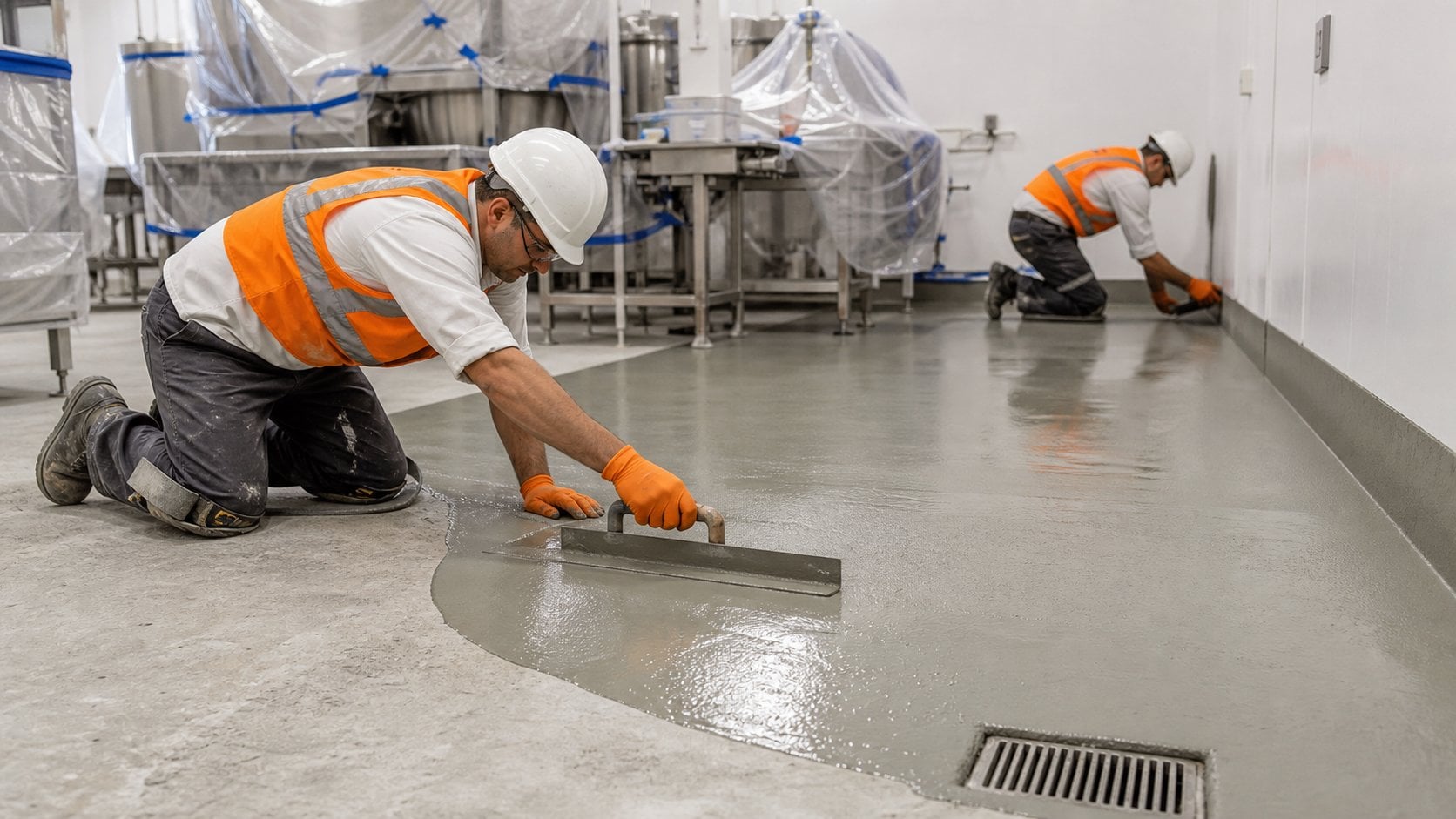
PU cement flooring installation in KSA with cove base and hygienic drain detailing
Cove base and drain detailing during a PU cement installation in KSA — the stage that decides the hygiene audit.

SolidDrops handles this as one package — supply, preparation, coving, screed, joints and drains coordination — or as material supply with technical support to an appointed applicator, whichever the project structure needs. Material comes from the Sika range SolidDrops supplies in Saudi Arabia.

Ucrete vs epoxy for a wet kitchen or cold room

Epoxy flooring is a resin coating or self-levelling layer, usually 0.3–3 mm, that performs well in dry, temperature-stable rooms. Ucrete is a 4–12 mm cementitious urethane screed. The difference shows the first time a fryer is drained.

CriterionUcrete polyurethane cementEpoxy flooring
Hot discharge and steam cleaningRated to +120 °C at 9 mm, +130 °C at 12 mm (UD 200)Thin films are typically not rated for hot discharge or steam cleaning
Freezer and cold-room useRated to −40 °C (UD 200 at 9–12 mm)Depends on product; thermal cycling stresses thin coatings
Thermal shockThermal expansion 4 × 10⁻⁵ /°C (ASTM C531), designed for rapid temperature changeThin coatings are not designed for repeated thermal shock
Food-safety approvalsHACCP, Halal HCE, Eurofins Indoor Air Comfort GoldProduct-specific; many general-purpose epoxies carry none
Slip resistanceR10 to R13 available, defined profiles (DP)Achievable with broadcast aggregate
Best fit in KSAKitchens, food and beverage, cold stores, pharma washdownWarehouses, showrooms, workshops, car parks, dry production
Comparison graphic of Ucrete polyurethane cement versus epoxy flooring on heat, freezer service, thickness, food-safety approvals and slip resistance
Where the two systems part company. Epoxy remains the right choice for dry, temperature-stable rooms.

For the room types where either could be argued — a dry bakery packing hall, a chilled distribution corridor — SolidDrops prices both so the client sees the real gap. The wider context for food plants is covered on our food factory and industrial kitchen flooring page and, for sub-zero rooms, on cold room and freezer flooring in Saudi Arabia.

Where Ucrete is specified across Saudi Arabia

The Kingdom's food, hospitality and cold-chain build-out has produced a steady run of rooms that need a PU cement floor rather than a coating. These are the sectors SolidDrops is asked to survey most often, and what the floor has to survive in each.

Hotel and central production kitchens

Makkah, Madinah, Jeddah, Riyadh

Pilgrim-season volumes mean cook lines, dishwash and pot-wash that run around the clock with boiling-water discharge and daily hot washdown. UD 200 at 9 mm with RG coves and channel drains, DP30 in dishwash where standing water and detergent meet foot traffic.

Dairy, juice and beverage plants

Riyadh, Al Kharj, Jeddah, Dammam

Lactic and citric acids, caustic and acid CIP cycles, hot rinses and forklift traffic in filling halls. UD 200 at 9 mm, or HF 100 RT flow-applied where a large hall has to be floored in a short shutdown; chemical resistance for the CIP concentration confirmed with Sika technical service.

Meat, poultry and seafood processing

Jeddah, Dammam, Jubail, Tabuk

Blood, fat and brine on the floor, 80 °C washdown at shift end, trolleys and knives. UD 200 at 9 mm with DP30 on ramps and a continuous hygiene envelope into FRP wall panels and Polysto kerbs.

Cold rooms, blast freezers and cold-chain logistics

Riyadh, Jeddah, Dammam industrial cities

Storage at −20 °C and below, condensation at thresholds, steam defrost. UD 200 at 9–12 mm is rated to −40 °C; the floor is cured fully before the room is chilled and the threshold transition is detailed as its own item. See our cold room and freezer flooring page.

Bakeries and confectionery

All major cities

Hot ovens beside wet mixing rooms, sugar and fat residues, cleaning at the end of every shift. UD 200 at 9 mm in the wet zone and MF at 4–6 mm in dry packing, so the client does not pay for 9 mm where 4 mm does the job.

Pharmaceutical and chemical washdown rooms

Riyadh, Jubail, Yanbu

Solvent and acid splash, autoclave discharge, strict cleanability. UD 200 or MF depending on wet or dry service; UD 100 AS, MF 40 AS and the DP AS systems where an antistatic floor is specified.

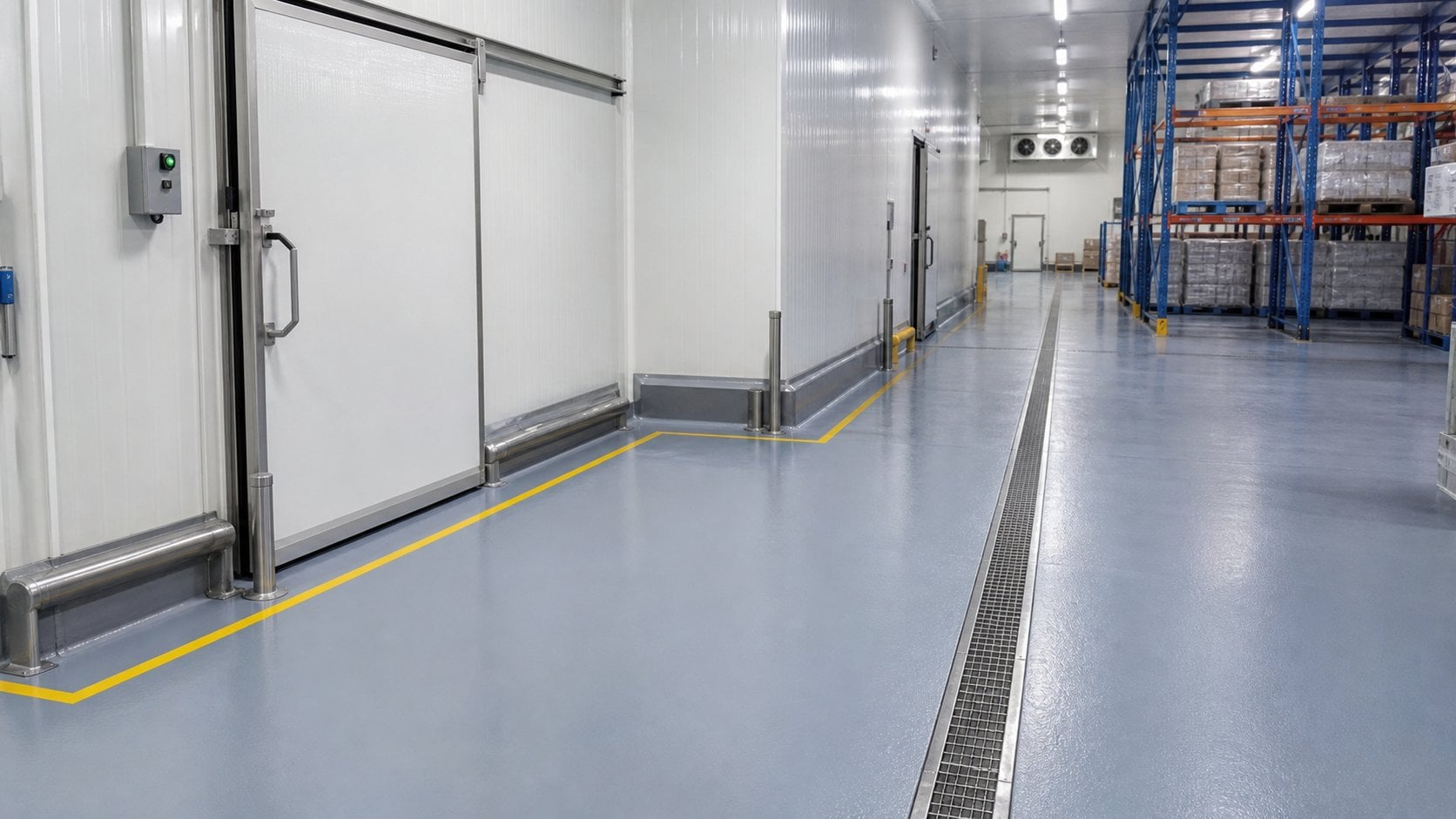
Cold room flooring in Saudi Arabia with Ucrete style PU cement floor and drainage channel
Cold-room floor with channel drain: UD 200 at 9 mm is rated to −40 °C.

Why PU cement floors fail — and how the specification prevents it

Ucrete itself rarely fails; the floor around it does. Failed PU cement floors in Saudi Arabia almost always trace to one of five causes, and each one is closed off at specification or programme stage rather than on site.

1. Poured outside the temperature window

Substrate above the +25 °C to +30 °C data-sheet limit shortens working time and traps heat. Prevented by night-shift or conditioned-room programming and a surface thermometer check before every mix.

2. Laid over tiles or unsound screed

Hollow bedding, contaminated grout and moisture under old tiles debond any overlay. Sika excludes cracked or unsound substrates; the tiles come up and the concrete is prepared and repaired first.

3. Too thin for the discharge temperature

A 6 mm floor rated to +80 °C under a fryer draining at 120 °C will not last. Thickness is chosen from the hottest discharge in the exposure schedule, never from the cheapest quote.

4. Feathered edges and missing anchor grooves

A screed that thins out to nothing at a drain or doorway lifts under thermal movement. Anchor grooves at free edges, drains and thresholds key the screed into the slab.

5. Water on the floor too early

The data sheets require protection from damp, condensation and water contact for 24 hours (HF 60 RT). Cleaning crews are held off until return-to-service is confirmed, not assumed.

Cleaning and maintaining a Ucrete floor

A correctly laid Ucrete floor is cleanable to the same standard as stainless steel, which means the hygiene routine already in place for the plant's equipment applies to the floor. The practical rules are simple. Chemical compatibility is confirmed for the actual cleaning products and concentrations in use (Sika's data sheets direct unusual chemical exposures to Sika technical service, and SolidDrops handles that request for the client). Textured grades are cleaned with a method that reaches the profile — a rotary scrubber or pressure washer rather than a mop alone — because a defined-profile floor that is only mopped loses its slip value to trapped fat. Steam cleaning is used only on the thickness rated for it: 9 mm and 12 mm UD 200. And joints filled with CR 460 are inspected at the plant's routine maintenance interval so that a failed sealant is replaced before it becomes a hygiene finding.

Ucrete floors are described by Sika as delivering extended service life under heavy load and aggressive conditions with proper maintenance. SolidDrops provides the cleaning and chemical-limit sheet at handover so the QA team has it for the next audit.

Specification clause for consultants

The clause below is the starting point SolidDrops offers consultants and contractors writing a BOQ or specification for a Ucrete floor in Saudi Arabia. Bracketed items are set from the exposure schedule; the figures are from the Sika data sheets and should be checked against the current issue for the project.

Heavy-duty polyurethane cement flooring — [room / area reference]
  1. Supply and install Sika Ucrete [UD 200 / MF / HF 60 RT / HF 100 RT / DP20 / DP30] polyurethane cement floor screed at a nominal thickness of [6 / 9 / 12] mm, colour [from Sika range], to provide service resistance from [−25 / −40] °C to [+80 / +120 / +130] °C in accordance with the manufacturer's current product data sheet.
  2. Minimum compressive strength [52] N/mm² at 28 days to EN 13892-2; slip resistance class [R11 / R12 / R13] to DIN 51130; reaction to fire class Bfl-s1 to EN 13501-1.
  3. System to carry HACCP suitability, Halal certification and Eurofins Indoor Air Comfort Gold (EN 16516) documentation, submitted before installation.
  4. Substrate: sound concrete, mechanically prepared by shot-blasting or scarifying, free of laitance, contamination and existing coatings or tiles; moisture and soundness tested and recorded; primed where required by the system data sheet.
  5. Anchor grooves cut at all free edges, drains, thresholds and day joints; movement joints formed and filled with Sika Ucrete CR 460.
  6. Coving: Sika Ucrete RG render and coving mortar at all floor-to-wall junctions, plinths and kerbs to a [50 mm] radius and [100 / 150] mm height, sealed to [FRP wall panel / wall finish].
  7. Application within the manufacturer's stated ambient, substrate and material temperature limits; installer to record substrate temperature at each mix. Floor protected from water and traffic until return-to-service is confirmed against the data sheet.
  8. Installer to be a supplier-supported applicator; SolidDrops to provide data sheets, method statement, handover cleaning and chemical-limit sheet.

What to send for a Ucrete quotation

A PU cement quotation priced from square metres alone will be wrong, because thickness, coving, drains and preparation move the number more than the area does. Send these once and the quotation comes back complete:

  • City and facility type — kitchen, dairy, meat, bakery, cold store, pharma, chemical.
  • Room-by-room areas with the hottest discharge and coldest storage temperature for each.
  • Photos of the existing floor, drains, wall junctions and any coating or tile failure.
  • Cleaning method and chemicals (with concentrations for CIP or caustic washdown).
  • Traffic — trolleys, pallet trucks, forklifts — and the shutdown window available.
  • Drawings, BOQ or a consultant specification if one exists.

Consultants and contractors can request the Sika data sheets, system build-ups and a specification clause for the chosen grade through our site visit and quotation service.

Ucrete flooring questions from Saudi consultants, owners and contractors

What is Ucrete flooring?

Ucrete flooring is a heavy-duty polyurethane cement floor screed manufactured by Sika and used since 1969 in food, beverage, pharmaceutical and chemical plants. It is laid at 4–12 mm, resists hot discharge up to +150 °C in its thickest grade, carries HACCP, Halal and Eurofins Indoor Air Comfort Gold approvals, and is specified where an epoxy coating would fail under heat, chemicals or impact.

Who supplies and installs Ucrete flooring in Saudi Arabia?

SolidDrops supplies and installs Sika Ucrete flooring across Saudi Arabia, including Jeddah, Riyadh, Dammam, Jubail, Makkah, Medina and Tabuk. We survey the room, select the grade from the Sika data sheets, prepare the substrate, form coves and drains, lay the screed and hand over with the cleaning and chemical limits documented. Contact [email protected] or +966 50 213 1112.

Is Ucrete suitable for cold rooms and freezers?

Yes. Sika Ucrete UD 200 is rated for service from −40 °C at 9 mm and 12 mm thickness, and from −25 °C at 6 mm, which covers chillers, cold rooms and blast freezers. The critical details are the threshold transition, curing the floor fully before the room is brought down to temperature, and managing condensation during cleaning.

Which Ucrete grade should I use for an industrial kitchen?

For a central or hotel production kitchen with hot washdown, Sika Ucrete UD 200 at 9 mm is the usual choice: it is rated to +120 °C, R11 slip resistance and 52–55 N/mm² compressive strength. Use DP20 or DP30 where dishwash areas and ramps need a more defined anti-slip profile, and RG coving mortar at every floor-to-wall junction.

How much does Ucrete flooring cost in Saudi Arabia?

Cost is driven by thickness (a 12 mm UD 200 floor uses 25 kg/m² of material against 12.5 kg/m² at 6 mm), the amount of substrate repair and tile removal, linear metres of coving, drain and joint detailing, the slip texture, and whether the work is done in night shifts. SolidDrops prices from a room survey and the exposure schedule; request a quotation with your room list and photos.

How long before a Ucrete floor can be used?

The Sika data sheets give return to traffic in under 24 hours at a substrate temperature of +8 °C for UD 200, MF and HF 60 RT (16–24 hours for HF 100 RT), and 4 hours for UD 200 at +10 °C when Sika Ucrete Accelerator is used. In a conditioned Saudi plant room this makes an overnight relay of a working kitchen achievable when preparation is done in advance.

Can Ucrete be laid over existing tiles?

Not as standard. Sika excludes cracked or unsound substrates, and tiled kitchen floors typically hide hollow bedding, contaminated grout and moisture. The reliable route is to remove the tiles and bedding, mechanically prepare the concrete, repair it, and lay the Ucrete system on a sound, primed slab. SolidDrops assesses this at survey before quoting.

Is Ucrete HACCP and Halal certified?

Yes. The Sika Ucrete UD 200, MF, HF 60 RT, HF 100 RT and DP data sheets cite HACCP suitability (test report I-PE-769-SA-2-RG06b), Halal certification from Halal Certification Europe (certificate 21453-2/1/1/Y1) and Eurofins Indoor Air Comfort Gold to EN 16516, and the material is non-tainting even during application in food-handling areas.

Is Ucrete the same as Sikafloor PurCem or Mapefloor CPU?

They are the same family — polyurethane cement flooring — but not the same product. Ucrete is Sika's heavy-duty polyurethane cement brand with a record dating to 1969 and its own data sheets, approvals and temperature ratings; PurCem and Mapefloor CPU are other manufacturers' PU cement ranges. SolidDrops supplies more than one, and selects by the data sheet that meets the room's exposure schedule.

How do you clean and maintain a Ucrete floor?

With the plant's normal hygiene chemicals, once compatibility with the concentrations in use is confirmed, using a rotary scrubber or pressure washer on textured grades so the profile is actually cleaned. Steam cleaning only on 9 mm and 12 mm UD 200. Joints filled with CR 460 are checked at routine maintenance. SolidDrops issues a cleaning and chemical-limit sheet at handover.

Reviewed by the SolidDrops technical team · Last updated 9 September 2026 · Technical figures quoted from Sika GCC product data sheets: Ucrete UD 200 (July 2024, v03.01), Ucrete MF (July 2024, v03.01), Ucrete HF 60 RT (December 2024, v02.03), Ucrete HF 100 RT (May 2026, v01.02) and the Sika Ucrete DP10 4 mm system data sheet. Always confirm the current data sheet for the project.

Ucrete and PU cement flooring glossary

The terms a consultant, QA manager or contractor will meet in a Ucrete specification, each in one sentence.

Polyurethane cement (PU cement)
A floor screed made from polyurethane resin bound with cement and graded aggregate, laid at 4–12 mm, that resists heat, chemicals and impact better than thin resin coatings.
Ucrete
Sika's heavy-duty polyurethane cement flooring range, in use since 1969, supplied and installed in Saudi Arabia by SolidDrops.
Service temperature
The range of temperatures a cured floor can carry in use; for Ucrete it depends on thickness, from −15 °C to +70 °C at 4 mm up to −40 °C to +130 °C at 12 mm.
Thermal shock
Rapid temperature change on the floor surface, such as boiling-water discharge or steam cleaning on a cool slab, which cracks or debonds thin coatings.
Exposure schedule
A room-by-room record of hottest discharge, coldest storage, chemicals, cleaning method and traffic that fixes the grade and thickness before pricing.
Application temperature window
The ambient, substrate and material temperature limits on the data sheet within which the screed must be mixed and laid — +25 °C to +30 °C maximum for Ucrete.
Slip resistance class (DIN 51130)
A rating from R9 to R13 for a floor's slip resistance on a ramp test; Ucrete grades range from R10 (MF) to R13 (textured finishes).
Pendulum test value (PTV)
A wet slip measurement to EN 13036-4; 40–60 PTV in the wet is available across the Ucrete textured finishes.
Cove
A radiused floor-to-wall junction formed in Ucrete RG mortar so there is no 90° corner where dirt collects.
Anchor groove
A groove cut into the slab at free edges, drains and doorways so the screed is keyed into the concrete rather than feathered out.
Defined profile (DP)
A Ucrete system in which broadcast aggregate is sealed under a top coat to give a controlled anti-slip texture in grades DP10, DP20 and DP30.
HACCP suitability
Independent test evidence that a flooring product is appropriate for use in a Hazard Analysis and Critical Control Points food-safety environment; cited on the Ucrete data sheets as test report I-PE-769-SA-2-RG06b.
Return to service
The time after laying before a floor can take traffic; under 24 hours at +8 °C for UD 200, MF and HF 60 RT (16–24 hours for HF 100 RT), or 4 hours with Sika Ucrete Accelerator.
Bfl-s1
The reaction-to-fire classification for flooring under EN 13501-1 carried by Ucrete UD 200, MF and HF 100 RT.

Need a Ucrete floor for a kitchen, cold room or food plant in Saudi Arabia?

Send SolidDrops the room list, temperatures, cleaning chemicals and photos. We will return the grade, thickness, coving and drain details and a complete quotation — for supply and installation, or for supply with technical support to your applicator.

WhatsApp +966 50 213 1112 Email [email protected] Contact page

SolidDrops · Saudi Arabia (Western Region head office, Jeddah) · Serving Jeddah, Riyadh, Dammam, Jubail, Makkah, Medina, Tabuk and all over KSA · +966 50 213 1112 · [email protected]

WhatsApp contact iconChat Online
1

What we need to recommend the right Ucrete or PU cement floor

Best suited forIndustrial kitchens, food factories, wet processing areas, cold rooms and hot-washdown zones.
System selection checksTemperature, chemicals, cleaning method, drainage, slip profile, impact, substrate and shutdown window.
For a faster quotationSend the city, approximate area, photos, drawings or BOQ, current condition and required completion date.
Start Ucrete and PU cement flooring enquiry WhatsApp project details