
100% Solids Epoxy Floor Coating
Factories, warehouses, workshops and service zones needing a durable, cleanable resin finish with no solvent shrinkage.
Send for review: Area, traffic, substrate moisture, chemical exposure and required finish.
Authorised Eco-Fix distributor | Saudi Arabia · المملكة العربية السعودية · GCC · Africa
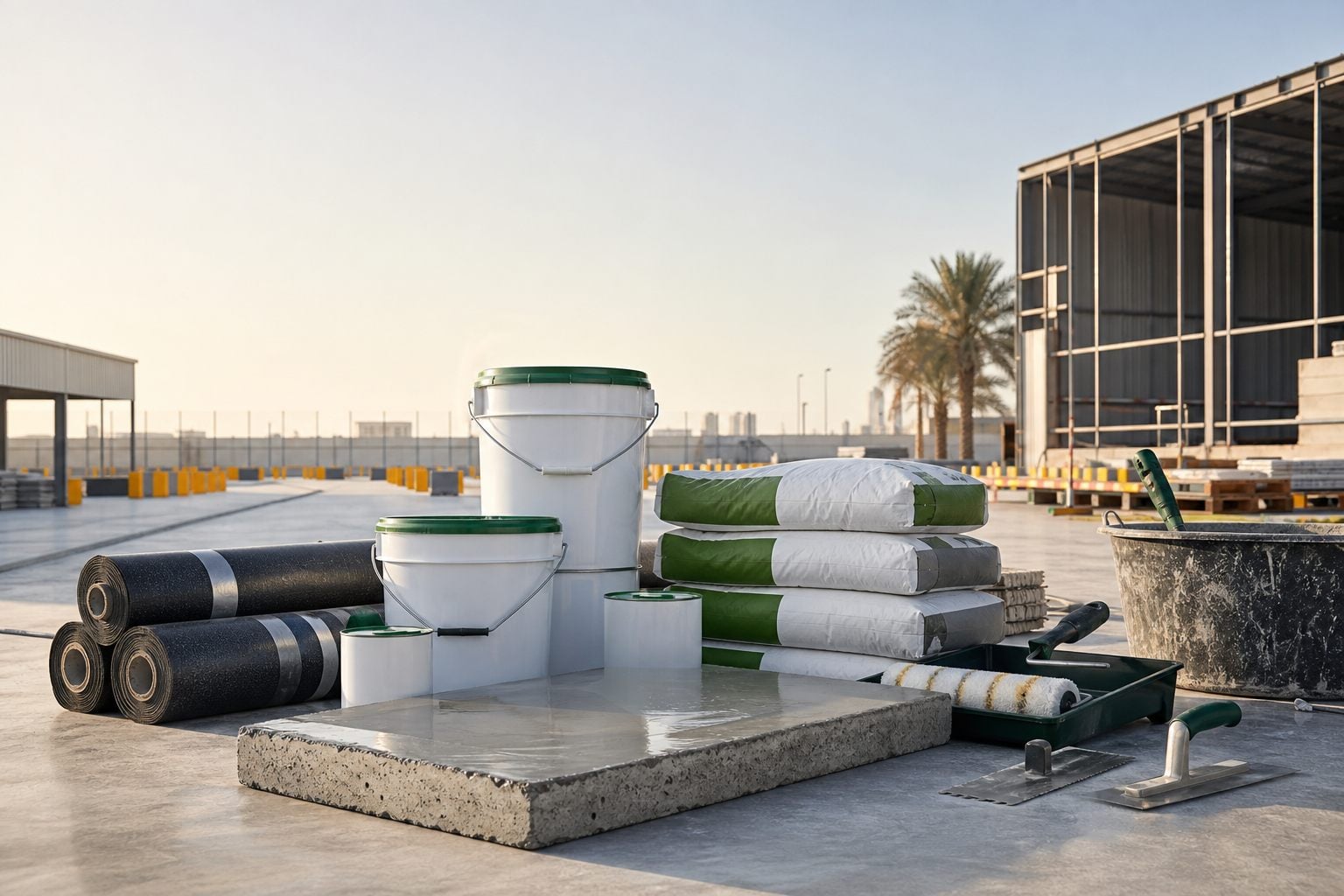
Eco-Fix is a range of construction chemicals covering epoxy systems, waterproofing membranes, cementitious repair and grouting, tile systems, sealants, protective coatings and ancillaries. SolidDrops is an authorised Eco-Fix distributor in Saudi Arabia, supplying 35 products across six families to contractors and consultants in Jeddah, Riyadh, Dammam and across the Kingdom, with export inquiries reviewed for the GCC and Africa.
Direct answer
Eco-Fix is a construction chemicals brand whose range is built around the six jobs that decide whether a concrete structure stays dry and serviceable: resin flooring and bonding, waterproofing, concrete repair and grouting, tile fixing, joint sealing and surface protection, and the ancillaries that make those systems work. SolidDrops supplies the Eco-Fix range in Saudi Arabia as an authorised distributor and reviews each inquiry against the BOQ, the substrate and the exposure before recommending a product.
Material selection starts with the job condition, not the product name. A roof in Riyadh, a water tank in Jubail, a basement in Jeddah and a chemical room in Yanbu can each need a different waterproofing, epoxy, cementitious, grout or sealant route.
| Brand | Eco-Fix construction chemicals |
|---|---|
| Supplier in KSA | SolidDrops, authorised Eco-Fix distributor |
| Product families | Epoxy systems · Waterproofing systems · Cementitious repair and grouting · Tile systems · Sealants and protective coatings · Admixtures and ancillaries |
| Products on this page | 35 |
| Cities served | Jeddah, Riyadh, Dammam, Jubail, Makkah, Madinah, Tabuk |
| Export inquiries | GCC, Middle East and Africa, reviewed case by case |
| Documentation | Current TDS, SDS and submittal support on request |
| Pricing basis | Quoted per BOQ, quantity, system build-up and delivery city |
| Contact | +966 50 213 1112 · [email protected] |
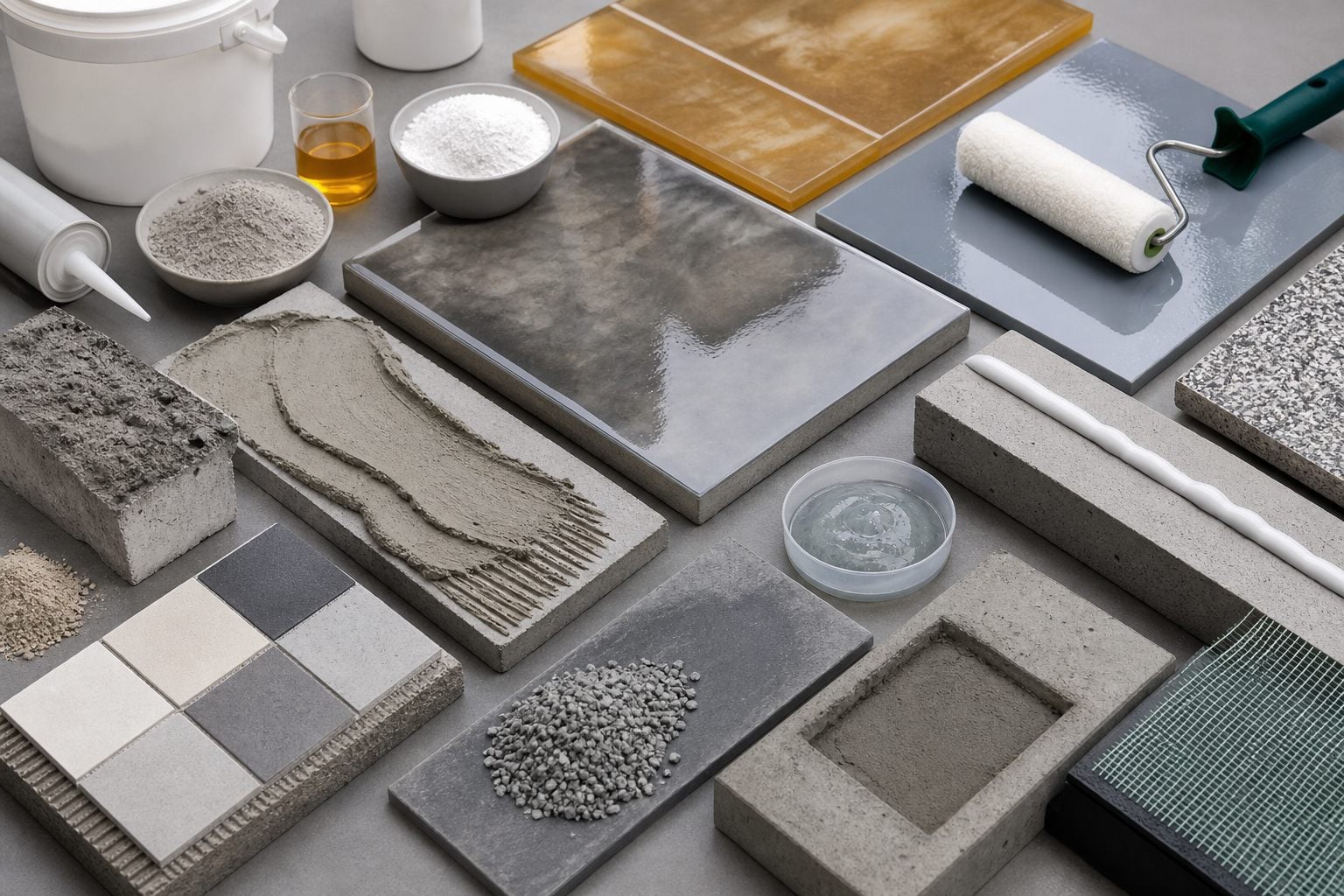
Start with the project condition
Choose the site condition first, then open the product family and compare it with your BOQ line, photos and specification clause. Every family below links to the products SolidDrops supplies for it.
The full Eco-Fix range
Thirty-five products, organised by the job they do rather than by chemistry alone. Each card states where the product fits and what to send so the review starts from real site data instead of a product name.
Epoxy Systems · 10 products
An epoxy system is a two-part resin and hardener that cures into a hard, chemically resistant layer bonded to prepared concrete. Eco-Fix epoxy products cover the whole floor build-up: a primer or moisture sealer to lock down the slab, a 100% solids coating or self-levelling layer for the wearing surface, a mortar screed where thickness and impact matter, and novolac or ESD grades for chemical plants and electronics areas. The injection resin, adhesive, grout and bonding agent handle the structural side: cracks, anchors, base plates and the joint between old and new concrete.
Epoxy fails on damp, weak or contaminated concrete, not on its own. Most floor complaints SolidDrops reviews trace back to a missed moisture test, a slab that was coated too young, or a chemical exposure that was never written into the inquiry. Send those three facts first and the product choice usually follows.
Factories, warehouses, workshops and service zones needing a durable, cleanable resin finish with no solvent shrinkage.
Send for review: Area, traffic, substrate moisture, chemical exposure and required finish.
Concrete preparation before resin floors, toppings or coatings where bond strength and residual moisture control decide the life of the system.
Send for review: Concrete age, moisture reading, surface profile and next system layer.
Structural and non-structural crack filling where low-viscosity penetration is required to restore monolithic behaviour.
Send for review: Crack width, movement, water presence, access side and engineer requirement.
Bonding concrete, steel, stone or repair components where high adhesion and gap-filling are needed.
Send for review: Material type, contact area, load, temperature and curing window.
Anchor bases, machine foundations, drains, chemical rooms and areas exposed to aggressive liquids.
Send for review: Chemical list, temperature, joint size, load and cleaning method.
Smooth, cleanable floors for production, storage, laboratories and light industrial areas where flatness and hygiene matter.
Send for review: Flatness need, slip profile, traffic type, colour and downtime.
Heavy-duty floors, patching and levelling where thickness, impact resistance and point loads are the driver.
Send for review: Thickness, impact load, repair depth, substrate condition and edge details.
Electronics assembly, data rooms, clean areas and controlled static environments with a specified resistance range.
Send for review: Resistance requirement, testing method, earthing plan and facility use.
Chemical plants, battery rooms, bunds, sumps and high-exposure industrial zones where standard epoxy softens or stains.
Send for review: Chemical concentration, contact time, temperature and containment details.
Bonding fresh repair mortar, screed or topping to existing concrete so the new layer acts with the old.
Send for review: Open time, concrete profile, repair thickness and application temperature.
Waterproofing Systems · 10 products · العزل المائي
A waterproofing system is the combination of a main membrane, its primer, its detailing at joints and penetrations, and the protection layer over it. Eco-Fix covers the four main waterproofing chemistries used in Saudi Arabia: liquid-applied PU, acrylic and polyurea; sheet bituminous membranes, torch-on and self-adhesive; cementitious slurries and flexible 2K coatings for tanks and wet rooms; and crystalline admixtures for concrete that must resist water from within. Waterplug and swellable waterstop close the gaps that membranes cannot reach.
Match the product to water pressure, movement, UV exposure, substrate condition and drainage design. A roof under Riyadh sun, a below-grade wall in Dammam and a shower in a Makkah hotel are three different problems, and one membrane rarely solves all three well.
Roofs, balconies, wet areas and complex details where a joint-free liquid membrane is required.
Send for review: UV exposure, movement, slope, drainage and topcoat need.
Roofs, foundations and protected waterproofing details where a sheet membrane is specified in the BOQ.
Send for review: Layer build-up, torch access, protection board, slope and detail drawings.
Bathrooms, kitchens, water-retaining structures and mineral substrates before tiles or finishes.
Send for review: Positive or negative pressure, tile finish, dampness and cure time.
Concrete mixes for basements, tanks and below-grade structures requiring waterproofing within the concrete itself.
Send for review: Concrete mix design, water pressure, joint treatment and pour sequence.
Fast-curing protective waterproofing for decks, tanks, roofs and industrial concrete where downtime is short.
Send for review: Spray access, equipment access, substrate prep, traffic and UV topcoat.
Maintenance roofs and exposed areas where a flexible, reinforced, water-based coating is preferred.
Send for review: Existing coating, cracks, ponding water, roof slope and warranty expectation.
Foundations, retaining walls and details where flame-free application is preferred or torches are not permitted.
Send for review: Primer condition, substrate smoothness, laps, protection and backfilling sequence.
Wet rooms, balconies, pools and concrete details that need crack-bridging movement under a tiled finish.
Send for review: Movement, tile adhesive compatibility, crack width and water exposure.
Active leaks, water seepage and urgent plugging in concrete or masonry before the main waterproofing goes on.
Send for review: Leak location, flow rate, pressure, access and follow-up waterproofing system.
Construction joints, pipe penetrations and concrete joints exposed to water, sealing by swelling on contact.
Send for review: Joint size, concrete cover, water pressure and installation restraint.
Cementitious Repair and Grouting · 4 products
Cementitious repair materials reinstate concrete that has spalled, cracked, honeycombed or lost cover, and grouts fill the gap between a machine or column base plate and the concrete beneath it. Eco-Fix covers the four routes a structural repair usually needs: a polymer-modified R4 mortar for hand or spray repair, a pourable micro-concrete for large volumes behind formwork, a non-shrink precision grout for base plates and anchors, and a self-levelling underlayment where the floor must be flat before a finish goes down.
Coating over weak or hollow concrete is the most expensive shortcut on a repair job, because the coating fails with the concrete under it. Repair first, then waterproof or coat.
Structural repairs to columns, slabs, beams, walls and damaged concrete edges where an R4-class mortar is specified.
Send for review: Repair depth, reinforcement condition, exposure, class requirement and curing.
Base plates, machines, steel columns, bearing plates and anchor pockets needing full contact under load.
Send for review: Gap depth, load, flow need, plate size and temperature.
Large-volume concrete repair behind formwork where hand packing is not practical or reinforcement is congested.
Send for review: Pour depth, access, reinforcement congestion, formwork and strength class.
Floor levelling before vinyl, tiles, epoxy, carpet or other finishes where the slab is out of tolerance.
Send for review: Required thickness, final floor type, substrate profile and moisture.
Tile Systems · 3 products
A tile system is the adhesive, the grout and the waterproofing beneath them working as one assembly. Eco-Fix supplies a C2TES1 adhesive for porcelain, ceramic and stone, an epoxy grout for hygiene and chemical exposure, and a CG2 cementitious grout for general joints. Tile failures in Saudi wet rooms and pools are usually not the tile: they are a rigid adhesive over a flexible membrane, a cementitious grout in a chemically cleaned kitchen, or corners and drains that were never detailed. Pair the tile products with the flexible 2K waterproofing and the PU joint sealant when the area is wet.
Ceramic, porcelain and stone tile installation where improved adhesion, slip resistance, extended open time and deformability are needed.
Send for review: Tile size, substrate, wet exposure, open time and deformability.
Food, healthcare, commercial kitchens, pools and areas requiring chemical-resistant, stain-resistant, cleanable joints.
Send for review: Joint width, chemical exposure, cleaning method, colour and hygiene need.
General tile joints in residential, commercial and wet-area projects where an improved cementitious grout is specified.
Send for review: Joint width, water exposure, colour, traffic and maintenance requirement.
Sealants and Protective Coatings · 4 products
Sealants close movement joints; protective coatings slow down the carbonation, chloride ingress and UV weathering that shorten the life of exposed concrete. Eco-Fix supplies a one-component PU joint sealant, an anti-carbonation coating for facades and car park soffits, an aliphatic PU topcoat that keeps colour under Saudi UV, and a silane-siloxane sealer that repels water without changing the look of the concrete or stone. On coastal projects in Jeddah, Jubail and Dammam, surface protection is routinely the difference between a ten-year and a twenty-year maintenance cycle.
Movement joints, floor joints, wall joints and perimeter sealing where the joint must flex and stay bonded.
Send for review: Joint width, movement, substrate, UV exposure and traffic.
Concrete facades, bridges, parking structures and exposed concrete where CO₂ ingress and reinforcement corrosion must be slowed.
Send for review: CO₂ exposure, crack bridging, colour, substrate repair and coating thickness.
Exposed floors, decks and waterproofing systems needing UV-resistant colour stability and a cleanable surface.
Send for review: UV exposure, slip profile, base system and traffic.
Concrete, block, stone and mineral surfaces needing water repellency without a visible film.
Send for review: Porosity, appearance requirement, test patch and exposure.
Admixtures and Ancillaries · 4 products
Ancillaries are the products that rarely appear as a BOQ headline but decide whether the main system performs: a bonding agent that ties a repair to its parent concrete, a fairing coat that gives a membrane a smooth base, a curing compound that stops a new slab drying out under a 45 °C afternoon, and a dry-shake hardener that makes a warehouse slab last. SolidDrops includes them in the material take-off so they are not value-engineered out on site.
Bond coats, repair mortars, screeds and cementitious mixes needing improved adhesion and reduced permeability.
Send for review: Mix design, substrate, exposure, thickness and bonding method.
Surface smoothing of blowholes and honeycombing before coating, paint, membrane or architectural finish.
Send for review: Surface profile, finish quality, thickness and coating compatibility.
Fresh concrete slabs, repair areas and external pours where curing control is needed and water curing is impractical.
Send for review: Concrete type, curing standard, finish compatibility and removal need.
Industrial slabs needing abrasion resistance, dust reduction and a stronger wearing surface from day one.
Send for review: Traffic load, slab pour sequence, colour, finishing method and curing plan.
Product names on this page follow the Eco-Fix range as supplied by SolidDrops. Final suitability must be confirmed against the current Eco-Fix product data sheet, substrate condition, project specification and application method.
Specification reference
The values below are industry-typical ranges and standard classifications that Saudi consultants commonly write into BOQs for these product types. They are given so a tender line can be read correctly, not as Eco-Fix product data. Confirm the actual figure for any Eco-Fix product against its current TDS before it enters a submittal.
Industry-typical ranges — confirm against the Eco-Fix TDS
| Product type | Typical build-up or dosage | Classification commonly referenced | What changes it on site |
|---|---|---|---|
| 100% solids epoxy floor coating | Two coats over primer; wearing layer typically in the range of 0.3–0.5 mm per coat | Project spec; slip and chemical resistance per client requirement | Substrate profile, moisture, chemical list, traffic |
| Self-levelling epoxy | 2–3 mm nominal, over primer | Project spec; flatness tolerance per finish requirement | Slab flatness, downtime, colour, slip profile |
| Epoxy mortar screed | 4–9 mm nominal, trowel-applied over primer | Project spec; impact and point-load requirement | Repair depth, edge details, impact load |
| PU liquid waterproofing membrane | Two or more coats to a nominal total dry film thickness commonly specified between 1.5 and 2.0 mm, plus UV topcoat where exposed | Project spec; roof warranty terms | Slope, ponding, UV exposure, reinforcement at details |
| Bituminous torch-on membrane (SBS/APP) | Sheet thickness commonly 3–4 mm, single or double layer per spec | SBS (elastomeric) or APP (plastomeric) modification per spec | Torch access, protection board, laps, slope |
| Cementitious / flexible 2K waterproofing | Two coats, brush or spray, to the total thickness stated in the TDS | Positive or negative side pressure per design | Substrate dampness, tile finish, corners, drains |
| Crystalline admixture | Dosed as a percentage of cement weight per the TDS, added at batching | Mix design approval by the concrete supplier | Mix design, joint treatment, pour sequence |
| Polymer-modified repair mortar | Layer thickness per the TDS, applied in lifts | EN 1504-3 class R4 (structural) | Repair depth, reinforcement condition, curing |
| Non-shrink precision grout | Gap depth per plate design; flowable or pourable consistency | Non-shrink cementitious grout per project spec (ASTM C1107 is commonly cited) | Gap depth, load, temperature, flow distance |
| Tile adhesive | Notched-trowel bed per tile size; back-buttering for large format | EN 12004 class C2TES1 | Tile size, wet exposure, substrate movement |
| Cementitious tile grout | Joint width per tile layout | EN 13888 class CG2 | Water exposure, traffic, cleaning method |
| Anti-carbonation coating | Two coats to the dry film thickness stated in the TDS | CO₂ diffusion resistance per EN 1504-2 is commonly requested | Crack bridging need, porosity, colour |
| Silane-siloxane sealer | One or two flood coats to saturation; test patch first | Hydrophobic impregnation per EN 1504-2 is commonly requested | Porosity, appearance, exposure |
| Concrete curing compound | Sprayed as soon as bleed water disappears | ASTM C309 is commonly cited | Finish compatibility, removal need, wind and heat |
None of the ranges above are Eco-Fix product figures. SolidDrops will send the current Eco-Fix TDS for the exact thickness, coverage, pot life, cure time and test data for the product you shortlist.
Local conditions
The same product behaves differently in Jeddah humidity, Riyadh dry heat and Eastern Province ground. These are the conditions SolidDrops checks before recommending a route.
Summer surface temperatures on an exposed roof or slab run far above the air temperature, and every resin product loses working time as it gets hotter. Epoxy and PU pot life shortens, torch-on membranes soften, and cementitious products lose water faster than they can hydrate. On most summer jobs this means mixing smaller batches, working early morning or at night, shading material stock, and following the TDS temperature limits rather than the calendar. A curing compound on fresh concrete is not optional in July.
Jeddah, Jubail, Dammam and Yanbu combine heat with high humidity. Epoxy applied when the substrate is close to the dew point can blush, lose gloss and bond poorly, and moisture trapped under a membrane finds its way out as blisters. Measure substrate temperature, air temperature and relative humidity before the first coat, and choose a moisture-tolerant primer where the slab cannot be dried.
Below-grade concrete in the Eastern Province and along both coasts sits in ground water that carries sulphates and chlorides. That drives the waterproofing choice towards crystalline admixtures, protected sheet membranes and swellable waterstops at every joint, and it makes surface protection of exposed concrete worth its line in the BOQ. Reinforcement corrosion found during a repair survey should be treated before the R4 mortar goes on.
Fine dust settles on prepared surfaces within minutes and kills adhesion, so priming follows preparation closely. UV degrades aromatic PU and bituminous surfaces that are left unprotected, which is why an aliphatic topcoat or a protection layer belongs in the roof build-up. Day-to-night temperature swings open and close roof cracks and joints, and only a crack-bridging or elastomeric system tolerates that movement for long.
Application areas
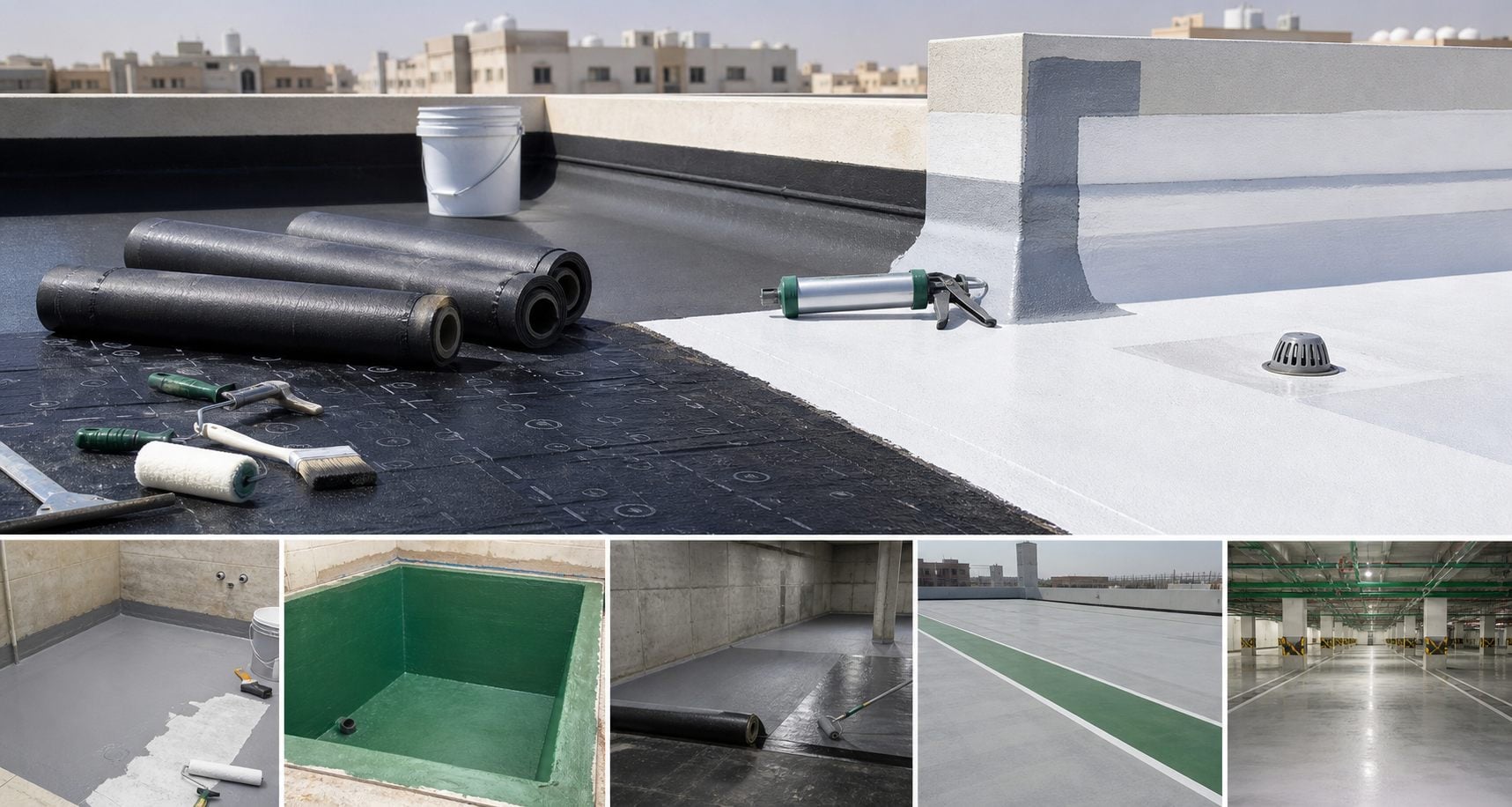
The same product family behaves differently on a roof, in a tank, in a basement, in a wet room, on a car park deck or in a chemical room. These are the application areas where SolidDrops reviews Eco-Fix materials most often.
PU liquid membrane, fibre-reinforced acrylic, torch-on and self-adhesive bituminous membranes, polyurea and aliphatic UV topcoats. Drainage, slope and upstand detailing decide the outcome as much as the membrane.
Cementitious slurry, flexible 2K waterproofing, C2TES1 adhesive and hygiene-grade epoxy grout. Corners, pipe penetrations and drains are detailed before the main coat.
Crystalline admixture, cementitious waterproofing, self-adhesive membrane, swellable waterstop, injection resin and joint treatment, chosen by the side of the wall the water pushes from.
Epoxy primer, 100% solids epoxy, self-levelling epoxy, epoxy mortar screed, novolac coating, chemical-resistant grout and PU topcoat, sized to the chemical list and the traffic.
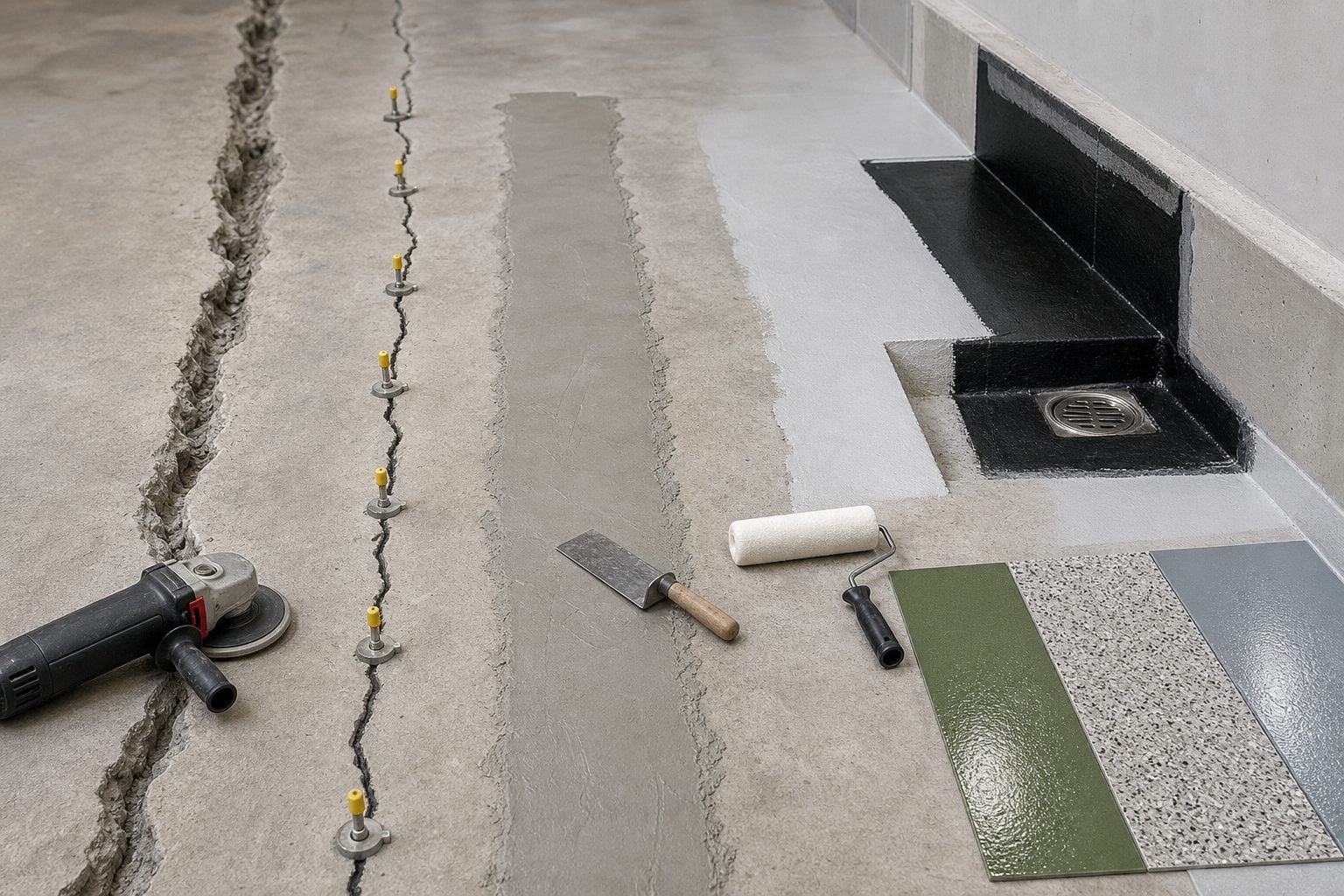
Crack injection, deck waterproofing, polyurea, PU joint sealant, protection layers and drainage detailing. See the car park waterproofing and flooring guide for the full build-up.
R4 repair mortar, micro-concrete, non-shrink grout, epoxy adhesive, bonding agent and curing compound, in that order, with reinforcement treatment where the survey finds corrosion.
Selection guidance
A product name without substrate photos, BOQ, exposure and application area is rarely enough to select the right material. This table shows how SolidDrops narrows the route.
| Project condition | Likely Eco-Fix route | Key decision factors | Common mistake to avoid |
|---|---|---|---|
| Active leakage or seepage | Rapid-setting waterplug, crack injection, cementitious waterproofing follow-up | Water pressure, access, crack movement, final waterproofing layer | Stopping the leak without treating the full path of water ingress |
| Roof with UV and thermal movement | PU membrane, acrylic reinforced coating, polyurea or bituminous membrane, with UV topcoat or protection | UV exposure, slope, ponding water, reinforcement and protection | Using a rigid system on moving cracks or poor drainage |
| Tank, wet room or tiled area | Cementitious slurry, flexible 2K, C2TES1 adhesive and epoxy or CG2 grout | Water pressure, tile finish, corners, drains and cure time | Ignoring corners, penetrations and drain details |
| Chemical or industrial floor | 100% solids epoxy, novolac epoxy, epoxy grout or mortar screed over epoxy primer | Chemicals, concentration, temperature, traffic and cleaning | Choosing only by coating colour instead of chemical exposure |
| Damaged concrete or base plate | R4 repair mortar, micro-concrete, precision grout or epoxy bonding agent | Repair depth, load, reinforcement, formwork and curing | Coating over weak or hollow concrete before repair |
| Facade or exposed concrete protection | Anti-carbonation coating, silane-siloxane sealer, fairing coat | Porosity, crack bridging, appearance and weather exposure | Skipping surface preparation and test patches |
| Below-grade wall with ground water | Crystalline admixture in the mix, self-adhesive or torch-on membrane outside, swellable waterstop at joints | Side of pressure, backfill sequence, joint count, sulphate and chloride exposure | Relying on one membrane with untreated construction joints |
Comparison
Contractors often ask for “waterproofing” or “epoxy” as if each were one product. The chemistry decides what the material tolerates, and the table below is the short version of the conversation SolidDrops has on most inquiries.
| Chemistry | Best for | Limits to plan around | Typical Saudi use |
|---|---|---|---|
| Epoxy (coating, self-levelling, screed, novolac) | Hard, chemically resistant, cleanable floors; bonding; crack injection; grouting | Rigid, so it needs a sound dry substrate; aromatic epoxy chalks and yellows under UV; short pot life in heat | Warehouses, factories, workshops, chemical rooms, labs, machine bases |
| Polyurethane, liquid PU and polyurea | Joint-free elastomeric waterproofing over roofs, decks and details; movement tolerance | Moisture-sensitive during cure; aromatic grades need an aliphatic UV topcoat; polyurea needs spray plant and trained applicators | Roofs, balconies, podiums, car park decks, tank exteriors |
| Cementitious (slurry, flexible 2K, crystalline) | Mineral substrates, tanks, wet rooms, negative-side pressure, tiled finishes, integral waterproofing | Limited crack bridging in rigid grades; needs curing and protection from rapid drying in heat | Water tanks, bathrooms, kitchens, pools, basements, lift pits |
| Bituminous (torch-on, self-adhesive) | Roofs and foundations where a sheet membrane is specified; predictable thickness; proven under protection layers | Laps and details are the weak point; torch-on needs hot-work permits; soft under sustained UV without protection | Flat roofs, raft foundations, retaining walls, planters |
For a deeper comparison of resin floors, read the SolidDrops epoxy flooring guide. For membrane systems by application, the waterproofing overview, cementitious waterproofing page and polyurea coating guide cover each chemistry in more detail.
Method
Most waterproofing and flooring failures happen before the main product is opened. This is the order SolidDrops asks applicators to follow, whatever the family.
Sound the concrete for hollows, map cracks and leaks, and record substrate moisture, temperature and humidity. A moisture test on a slab that will receive epoxy is not optional.
Grind, shot-blast or scabble to an open, laitance-free profile, then remove dust. Preparation is the single largest factor in adhesion, and the item most often cut from the programme.
Plug active leaks with waterplug, inject structural cracks, reinstate spalls with R4 mortar or micro-concrete, and fair blowholes so the membrane or coating has a continuous base.
Apply the primer matched to the main system and the substrate condition, and observe its overcoat window. Priming late or over dust undoes the preparation.
Build up the membrane, coating or screed to the specified thickness, and detail corners, upstands, penetrations and joints with reinforcement, sealant or waterstop as the drawings require.
Add the UV topcoat or protection layer, cure cementitious products against rapid drying, and flood-test or inspect before the area is covered or handed over.
Inquiry checklist
Clear inquiry details reduce wrong recommendations, quotation delays and on-site changes. Four items are enough to start.
City, project type, zone, square metres, linear metres, volume or number of units.
Concrete age, cracks, dampness, dusting, previous coating, leakage and photos.
Water pressure, UV, chemicals, temperature, traffic, impact, hygiene and cleaning regime.
BOQ, drawings, specification clause, finish requirements, delivery need and target schedule.
How SolidDrops works
The review stays practical: understand the site, match the family, confirm the details, then support the quotation, submittal or BOQ response.
Send city, photos, BOQ, drawings, area, condition and exposure by WhatsApp or email.
Match the need to the Eco-Fix epoxy, waterproofing, cementitious, grout, tile, sealant or ancillary family.
Review substrate, moisture, movement, primer, finish layer, cleaning regime and specification clause.
Build the material take-off from actual area, thickness, TDS coverage and a wastage factor for the site.
Issue the current Eco-Fix TDS and SDS, method guidance and the documents the consultant asks for.
Move to quotation, supply, site review or application support as the project needs.
Consultant and procurement support
A complete Eco-Fix inquiry identifies the application, quantity, substrate, exposure, required system build-up, project documents and delivery city. That gives contractors, consultants and procurement teams a clear basis for comparing epoxy, waterproofing and cementitious repair materials in Saudi Arabia.
Include the BOQ line item, drawings, application area, measured quantity, required thickness or number of layers, finish and project city.
Identify the specification clause, approval template and the current TDS, SDS or product-specific documents required for the selected route.
Share concrete age, moisture or leakage condition, cracks, joints, water pressure, UV, chemicals, temperature, traffic and cleaning method.
Confirm access, work sequence, shutdown window, delivery location and target date so packaging, coverage and application constraints can be reviewed.
| Review stage | Information to confirm | Why it affects the recommendation |
|---|---|---|
| Tender or budget review | BOQ description, area, system thickness, finish and delivery city | Defines the comparison basis and prevents unlike systems from being priced as equivalents. |
| Technical submittal | Specification clause, substrate, exposure, required standards and document list | Checks whether the proposed product family and build-up fit the stated project requirement. |
| Application planning | Preparation method, repairs, primer, layers, details, cure window and protection | Links material selection to the full system instead of treating one product as a standalone solution. |
| Quantity and delivery | Measured area, coverage basis, wastage, pack size, work phases and location | Supports a realistic material take-off and delivery discussion. |
Final consumption, compatibility, curing, packaging and suitability must be checked against the current Eco-Fix product data sheet, approved specification and actual site conditions.
Beyond Saudi Arabia
Saudi Arabia is the main service area. Export inquiries are reviewed case by case once the scope, logistics and documentation are clear, because construction chemicals travel less simply than most building materials.
Resin, cementitious and bituminous products each have a shelf life, a storage temperature range and packaging that must survive a sea or road journey through summer heat. Before SolidDrops can review an export inquiry, it needs the destination country and port, the product list with quantities, the required delivery terms, and any import documentation the buyer’s authority asks for, such as certificates of origin, SDS in a specific format or third-party inspection. Consolidating several families into one shipment usually makes more sense than shipping one product alone.
Inquiries from the UAE, Qatar, Kuwait, Bahrain and Oman are the most common, followed by East and North African projects where a Saudi supply source shortens lead times. Send the same information as a Saudi inquiry, plus destination, delivery terms and documentation requirements, and SolidDrops will confirm whether the products, quantities and timing can be supported. Where they cannot, it will say so rather than delay the project.
Why buy Eco-Fix through SolidDrops
SolidDrops is a Saudi-based contractor and supplier supporting industrial, commercial and residential projects across the Kingdom, with flooring, waterproofing, FRP panels, construction chemicals, pigments and fire alarm supply under one account.
Eco-Fix products supplied through SolidDrops come with the current TDS and SDS, and questions on suitability go back to the range’s technical documentation rather than a guess.
Every inquiry is priced from the BOQ line, the measured area, the system build-up and the delivery city, so two contractors quoting the same tender are compared on the same basis.
SolidDrops also installs epoxy flooring, waterproofing and sports flooring, so material advice comes from a team that has to make the same systems work on site.
Jeddah, Riyadh, Dammam, Jubail, Makkah, Madinah and Tabuk are served directly, with other cities and export destinations reviewed on request.
TDS, SDS, method guidance and the documents consultants ask for are issued with the quotation so the submittal is not held up after award.
If a product is not the right one for the exposure, or a quantity or delivery date cannot be met, SolidDrops says so before the order, not after.
Related SolidDrops products and services
Eco-Fix materials usually sit inside a larger package: a resin floor over a repaired slab, a roof membrane under a PU foam system, or a car park deck with joints, drains and traffic coating. These pages cover the rest of that package.
FAQ
Answers for contractors, consultants, owners, facility managers and procurement teams preparing an inquiry.
Yes. SolidDrops supplies the Eco-Fix range in Saudi Arabia as an authorised distributor and issues the current Eco-Fix TDS and SDS with each quotation. Inquiries are handled from Jeddah, Riyadh and Dammam and cover Jubail, Makkah, Madinah, Tabuk and other cities on request.
Thirty-five products across six families: epoxy systems, waterproofing systems, cementitious repair and grouting, tile systems, sealants and protective coatings, and admixtures and ancillaries. The full list is on this page, organised by the job each product does.
Saudi Arabia is the main service focus, including Jeddah, Riyadh, Dammam, Jubail, Makkah, Madinah and Tabuk. GCC, Middle East and Africa inquiries are reviewed when the project scope, destination, delivery terms and documentation requirements are clear.
Start with the substrate, the direction and pressure of the water, movement, UV exposure, chemical exposure, traffic and the finish that goes on top. Epoxy suits dry, rigid, chemically exposed floors; cementitious suits mineral substrates, tanks and tiled wet rooms; PU, polyurea and bituminous membranes suit roofs and decks that move. The comparison table on this page covers the trade-offs.
PU liquid membrane, fibre-reinforced acrylic coating, torch-on or self-adhesive bituminous membrane and spray-applied polyurea, finished with an aliphatic PU UV topcoat or a protection layer where the roof is exposed. The choice depends on slope, ponding, UV, foot traffic and whether hot work is permitted.
They are European standard classifications. R4 is the structural repair mortar class under EN 1504-3. C2TES1 is a cementitious tile adhesive with improved adhesion (C2), reduced slip (T), extended open time (E) and deformability (S1) under EN 12004. CG2 is an improved cementitious tile grout under EN 13888. Confirm each Eco-Fix product’s declared class on its TDS.
Only once the slab has cured and dried enough to pass the moisture test in the TDS. Fresh concrete releases water for weeks, and epoxy applied too early blisters or debonds. Where the programme cannot wait, an epoxy moisture sealer primer is reviewed, and the substrate moisture reading is the deciding number.
Heat shortens pot life and working time for epoxy and PU, softens bituminous membranes, and dries cementitious products before they hydrate. Work early or at night, keep material stock shaded, mix smaller batches and stay inside the temperature limits on the TDS. SolidDrops will confirm the application window for the shortlisted product.
No fixed prices are listed because waterproofing, epoxy and repair material costs change with quantity, system build-up, delivery location, surface condition, packaging and documentation. Quotations are prepared from the BOQ.
The project city, area or quantity, drawings or BOQ, photos, substrate condition, water or chemical exposure, traffic type, required finish, specification notes and contact details. WhatsApp +966 50 213 1112 or email [email protected].
Yes, provided the product family matches the application. Roofs, tanks, basements, wet rooms, podiums and car parks each need different detailing, preparation, protection and inspection steps, and this page routes each of them to the right family.
The BOQ or specification clause, drawings, project city, application area, quantity, substrate condition and exposure. SolidDrops issues the current Eco-Fix TDS, SDS and any product-specific documents the consultant requests; the final submittal pack depends on the approved system.
Measured area, specified thickness or number of layers, substrate roughness and porosity, cracks and details, application method, expected wastage and the coverage stated on the current TDS. Final quantities are reviewed against the actual site and approved build-up.
No. Active water flow, crack movement, positive or negative pressure, joints, penetrations, drainage and substrate condition often need separate repair, detailing, main waterproofing and protection steps. Assess the leak path and exposure before selecting the system.
Compare the specified chemistry and use, substrate and exposure suitability, system thickness, test or approval requirements, compatible primer and topcoat, application conditions, current documentation and whole-system quantity, not unit price alone.
SolidDrops is both a supplier and a contractor. Epoxy flooring, waterproofing and sports flooring installation are offered alongside Eco-Fix material supply, and site review or application support can be arranged where the project needs it.
Glossary
Short definitions of the terms that appear in BOQs, TDS documents and on this page.
Specification and documentation
This page is commercial and selection guidance from an Eco-Fix distributor, not a substitute for a project specification. Final suitability must be checked against the current Eco-Fix TDS and SDS, substrate preparation requirements, project BOQ and site exposure. Useful public references include the ICRI concrete repair and surface-preparation guidelines and the ASTM standards library.
Request review
Share the project city, BOQ, drawings, photos, area, quantity, exposure and target schedule. SolidDrops will route the inquiry to the right Eco-Fix family, confirm quantities and issue the TDS and SDS with the quotation.
 Chat Online
Use this feature to chat with our agent.