
22 Sep Waterproofing in Jubail: Bunding, Tank Farms and Turnarounds
Waterproofing in Jubail: Bunding, Tank Farms and Turnarounds
Waterproofing in Jubail is mostly a containment job. In a city built around refineries, petrochemical plants and desalination, the priority is keeping process liquid inside a bund and keeping rain and groundwater out of structures — specified against chemical exposure and installed inside a turnaround window.
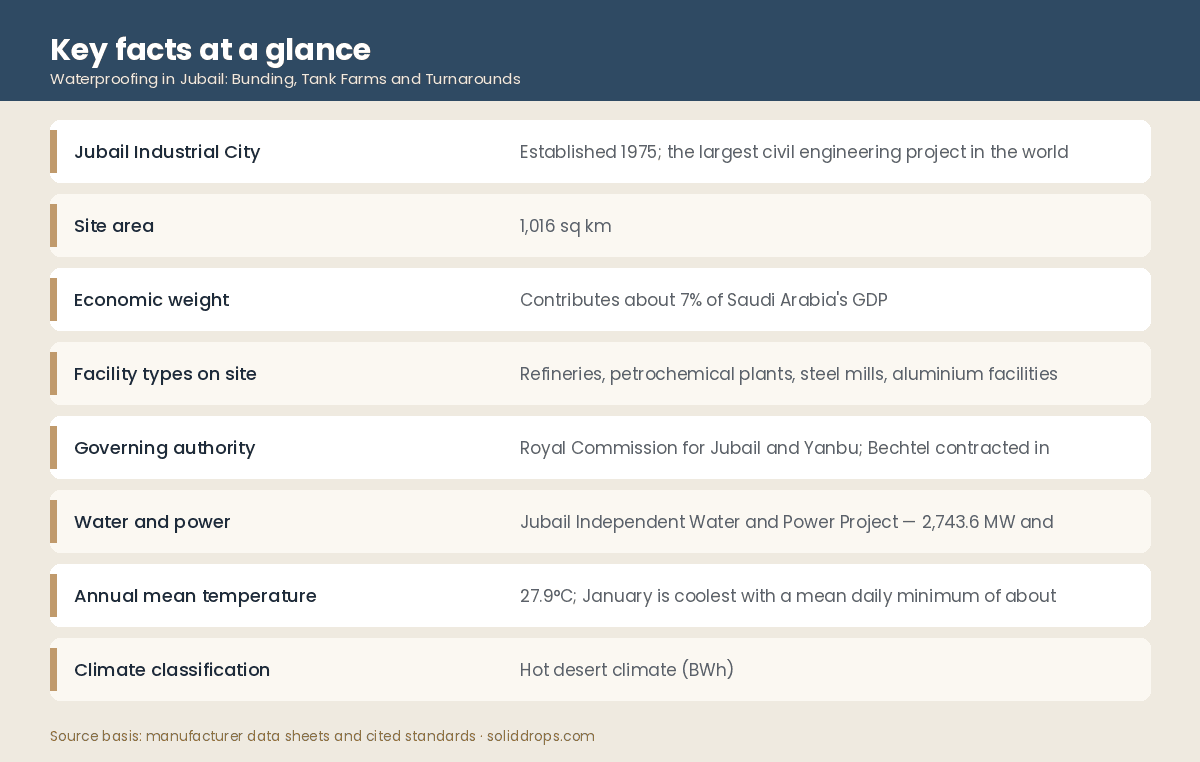
| Property | Value | Basis / standard |
|---|---|---|
| Jubail Industrial City | Established 1975; the largest civil engineering project in the world at the time | Wikipedia, Jubail |
| Site area | 1,016 sq km | Wikipedia, Jubail |
| Economic weight | Contributes about 7% of Saudi Arabia's GDP | Wikipedia, Jubail |
| Facility types on site | Refineries, petrochemical plants, steel mills, aluminium facilities and desalination plants | Wikipedia, Jubail |
| Governing authority | Royal Commission for Jubail and Yanbu; Bechtel contracted in 2004 for Jubail II, a $3.8 billion expansion | Wikipedia, Jubail |
| Water and power | Jubail Independent Water and Power Project — 2,743.6 MW and 800,000 m³ of water daily | Wikipedia, Jubail |
| Annual mean temperature | 27.9°C; January is coolest with a mean daily minimum of about 8°C | Wikipedia, Jubail |
| Climate classification | Hot desert climate (BWh) | Wikipedia, Jubail |
Why is waterproofing in Jubail a containment problem?
Waterproofing in Jubail rarely starts with a leaking roof. It starts with a bund that has to hold a spill, a tank foundation that has to stay dry under a structure nobody can move, or a trench that has to keep process liquid out of the ground. Jubail Industrial City covers 1,016 sq km and contains refineries, petrochemical plants, steel mills, aluminium facilities and desalination plants. On that kind of site, the layer we install is as much an environmental control as a building fabric.
The consequence for specification is direct. A roof membrane is selected against weather; a bund lining is selected against a named chemical at a named concentration and temperature, with a stated contact duration. Those are different questions, and the answer to the second one lives on a manufacturer’s chemical resistance chart, not in a general product brochure.
Scale matters too. The city was established in 1975 as the largest civil engineering project in the world at the time, and contributes around 7% of Saudi Arabia’s GDP. A shutdown on an asset of that weight is measured in production value, which is why the programme drives the specification here.
Bunds and secondary containment: what the lining has to do
A bund is a structure with two jobs that pull in opposite directions. It has to survive continuous outdoor exposure — heat, UV, rain, wind-blown sand — and it has to remain intact after a chemical release it may never actually see.
- Define the chemical case first. Product, concentration, service temperature, spill temperature and the required containment duration. Without those five, no resistance chart can be read, and a lining chosen on a general claim of chemical resistance is unverified.
- Design the floor-to-wall junction. The base-of-wall fillet is where a bund lining almost always fails. It carries movement between slab and wall and it is where liquid collects. Reinforced detailing here is not optional.
- Deal with the penetrations. Pipe supports, earthing points, drain valves and sump connections each break the lining. Each needs a designed termination rather than a site-improvised one.
- Decide how it will be tested. Holiday (spark) testing on a lining, water testing on a bund, and a written record of both. On an industrial asset the test regime is part of the deliverable.
Tank farms add the foundation question. Ringwalls and tank bases sit on a structure that cannot be inspected again once the tank is in service, so the waterproofing and the corrosion protection have to be right before the tank goes back on. That is a turnaround item by definition.
Plant roofs and buried structures
Above the process areas, Jubail roofs are unusually complicated. Substations, control rooms, compressor houses and analyser shelters carry cable entries, duct penetrations, equipment plinths and access walkways on relatively small roof areas. The ratio of detail to field is high, and detail is where thermal movement concentrates.
Two things follow. First, liquid-applied systems tend to suit these roofs better than sheet, because they follow complex geometry without a seam at every change of direction. Second, the roof cannot usually be surveyed properly without a permit, so the survey itself has to be planned into the outage rather than treated as a preliminary.
Below grade, the picture is less certain and we treat it accordingly. General Gulf literature describes coastal sabkha ground with a high water table and chloride exposure across this zone, but our research pass did not retrieve a Jubail-specific citation for groundwater level or ground chemistry. We therefore do not publish a figure. What goes into a Jubail below-grade specification instead is site data: boreholes, a standing water level, and chloride and sulfate analysis of the groundwater. The system families available are compared in our waterproofing systems guide.
Which Jubail assets carry the work
Process and tank farm areas
Bunds, sumps, trenches, ringwalls and tank foundations across refinery and petrochemical plots. Chemical resistance and containment integrity govern, and access is permit-controlled.
Utility and water assets
Desalination and power facilities, including the Jubail Independent Water and Power Project, which generates 2,743.6 MW and 800,000 m³ of water daily. Basins, channels, tanks and plant buildings, where the lining is often holding clean water in rather than keeping dirty water out.
Buildings and infrastructure
Substations, control rooms, workshops, warehouses and site infrastructure, built and expanded under the Royal Commission for Jubail and Yanbu, which contracted Bechtel in 2004 for the $3.8 billion Jubail II expansion.
The three groups run on different rules. A warehouse roof can be done on a weekend. A bund inside a live process plot needs an isolation, a permit and often the unit down. A scope that mixes all three needs phasing rather than a single mobilisation.
Which system suits which Jubail element?
| System | Best for in Jubail | Key local limit |
|---|---|---|
| Chemical-resistant resin lining | Bund floors and walls, trenches, sumps under defined chemical exposure | Only valid against the specific chemical, concentration and temperature on the resistance chart |
| Spray polyurea | Large containment areas and tank linings where a short outage demands fast return to service | Needs trained spray crews, controlled substrate moisture, and permit cover for the equipment |
| Liquid PU membrane | Plant roofs with dense penetrations, cable entries and equipment plinths | Not a chemical containment product; substrate temperature governs pot life in summer |
| Cementitious system | Water-retaining structures, basins, pits and clean water assets | Little movement accommodation alone; potable contact needs product approval |
| Positive-side tanking | Buried structures where boreholes confirm a standing head | Must precede backfill; specify only once groundwater chemistry is measured |
Where the element is a floor as well as a containment surface, the heavy-duty flooring families overlap with this table — see our polyurethane concrete flooring guide for the systems that handle thermal shock and chemical attack underfoot.
Turnaround scope to price?
Send the chemical duty, element drawings and outage dates. We work back from your window, not from a catalogue.
Planning around the turnaround window
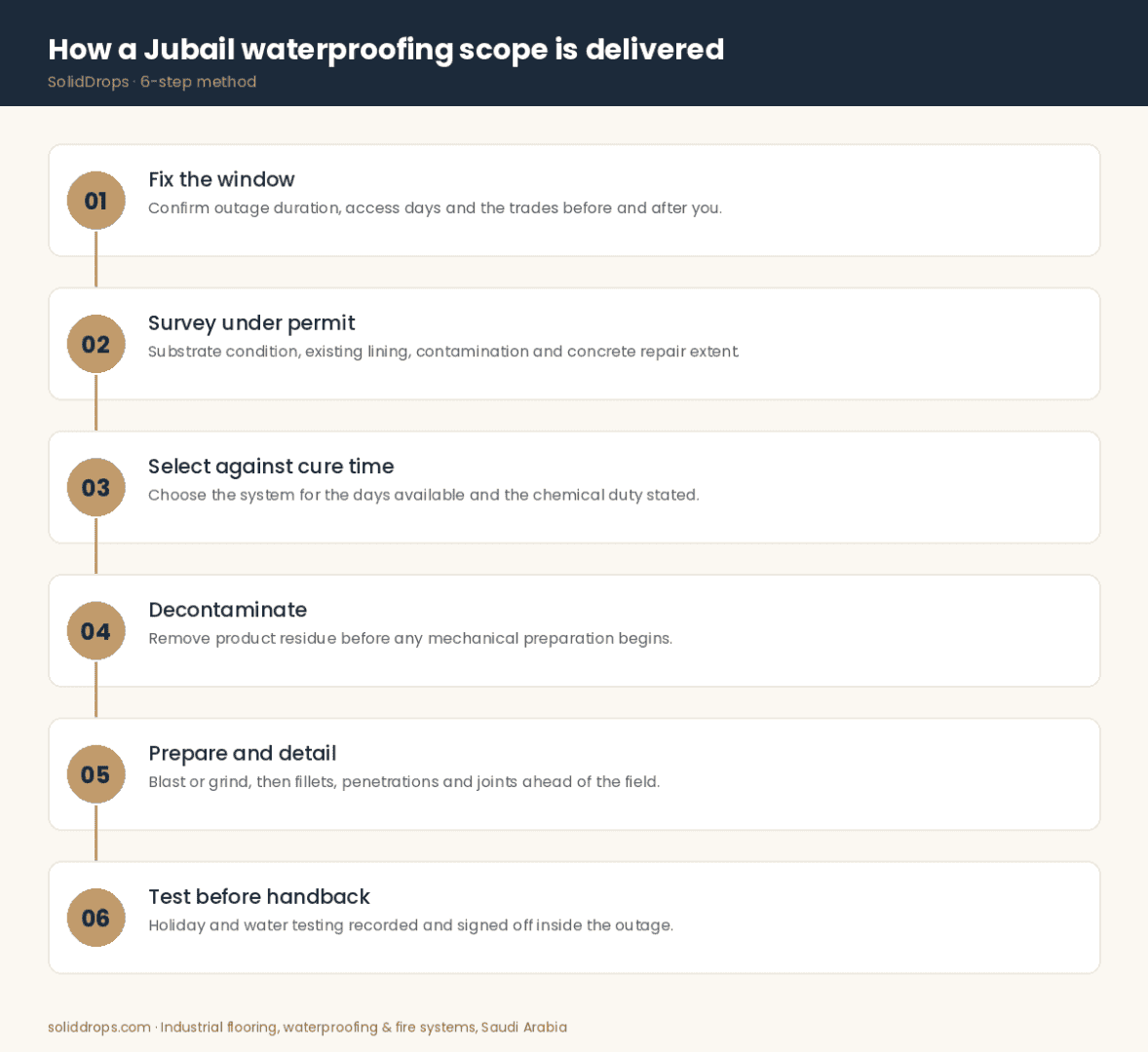
On a live plant the programme is fixed before the specification is. A turnaround has a start date, a duration and a queue of trades ahead of you, and a coating that needs seven days to cure does not fit into a five-day slot regardless of how well it performs.
- Get the window in writing early. Duration, the days you actually have access, and which trades precede and follow you on the same surface.
- Survey under permit before the outage. Substrate condition, existing lining type, contamination and the extent of concrete repair, established while the unit is still running where access allows.
- Work back from the cure schedule. Select the system against the time available, not the other way round. Fast-cure chemistry exists precisely for this constraint.
- Plan decontamination as its own task. An old bund floor carries product residue. Cleaning and decontamination precede any mechanical preparation and often take longer than the coating.
- Prepare, prime and detail. Blasting or grinding, then the base-of-wall fillet, penetrations and joints ahead of the field.
- Test before handback. Holiday testing and, where the element allows, a water test — recorded and signed off inside the outage.
Summer scheduling is its own constraint. Jubail has a hot desert climate with an annual mean of 27.9°C, and January is the coolest month with a mean daily minimum around 8°C. On a summer turnaround, substrate temperature controls pot life, so night shifts and shaded material storage are planned in from the start rather than improvised in week two.
What goes wrong on Jubail industrial assets
- A lining specified against the wrong case. Chosen for the stored product at ambient, then exposed to a hot spill or a cleaning chemical nobody listed. The resistance chart was read against an incomplete brief.
- Base-of-wall fillet omitted or under-detailed. The single most common containment failure. A lining that stops at a square internal corner cracks there.
- Decontamination underestimated. Residue left in the concrete bleeds back through and destroys adhesion days after the coating looks finished.
- Cure time squeezed to fit the outage. Handing back a lining before it has cured puts it into service with unreacted material and no chemical resistance.
- Penetrations improvised on site. Pipe supports and drain connections sealed with whatever is in the van, rather than the designed termination detail.
- No test record. Without holiday or water testing documented at handback, nobody can tell later whether the lining was sound on day one.
Each of these is avoidable at specification stage. None of them is avoidable once the unit is back up.
What drives waterproofing cost in Jubail
Nothing here is priced from a rate card. The industrial variables dominate, and several have nothing to do with the material.
- Permit regime and access. Hot work, confined space, isolation, standby cover, escorted access and site induction requirements.
- Outage length. A short window drives crew size, shift patterns and often a faster, costlier chemistry.
- Decontamination and substrate repair. Residue removal, spalled concrete repair and profile correction before any lining goes down.
- Chemical duty. A lining for a defined aggressive exposure is a different material class from a general waterproofing membrane.
- Testing and documentation. Holiday testing, water testing, adhesion pull-offs, dry film thickness records and a handback dossier.
- Mobilisation and site logistics. Plant movement into a live process plot, laydown area, and the travel that the scale of the industrial city implies.
Send the chemical duty, the element drawings, the outage dates and the test regime required, and a quotation can be built against the real scope.
Who supplies and installs waterproofing in Jubail
SolidDrops supplies and installs waterproofing and containment lining systems in Jubail — chemical-resistant resin linings, spray polyurea, liquid PU, cementitious systems, tank and sump linings, joint treatment and associated construction chemicals — for process areas, tank farms, utility assets, plant buildings and buried structures.
The starting point on an industrial asset is the duty and the window: what the surface will be exposed to, and how long the plant can be without it. Product selection follows those two answers. Our city page, flooring and waterproofing support in Jubail, sets out the service scope and the enquiry route, and epoxy flooring in Jubail covers the floor systems that usually fall inside the same shutdown.
Send scope, chemical duty and outage dates to [email protected] or call +966 50 213 1112 to arrange a survey in الجبيل.
Frequently asked questions
What waterproofing works best for petrochemical facilities in Jubail?
There is no single answer without the chemical duty. Bunds and trenches under defined chemical exposure need a resin lining selected from a resistance chart against the product, concentration, temperature and contact duration. Plant roofs suit liquid PU. Water-retaining assets suit cementitious systems. The duty statement comes before the product.
How is bund lining different from roof waterproofing?
A roof membrane is selected against weather; a bund lining is selected against a named chemical at a stated concentration, temperature and contact duration, and it must remain intact after a release. Bunds also need a reinforced base-of-wall fillet, designed penetration terminations, and holiday or water testing recorded at handover.
Does Jubail have high groundwater near the coast?
General Gulf literature describes coastal sabkha ground with a high water table and chloride exposure across this zone, but our research pass did not retrieve a Jubail-specific citation for groundwater level or ground chemistry. We do not publish a figure. Below-grade specifications are written from site boreholes, a standing water level and groundwater analysis.
How do you fit waterproofing into a plant turnaround?
Work back from the window. Confirm the duration and access days in writing, survey under permit before the outage where possible, plan decontamination as its own task, then select the system against the cure time available rather than choosing the product first. Testing and handback documentation are scheduled inside the outage, not after it.
What causes containment lining failure in chemical plants?
Most failures trace to the brief or the programme. Common causes are a lining specified against an incomplete chemical case, an omitted or under-detailed base-of-wall fillet, decontamination that left residue in the concrete, cure time squeezed to fit an outage, and penetration terminations improvised on site instead of detailed.
How much does industrial waterproofing cost in Jubail?
No rate is published because the industrial variables dominate. Permit regime, outage length, decontamination and concrete repair, the chemical duty class of the lining, the testing and documentation standard, and mobilisation into a live process plot all move the figure. Send chemical duty, drawings and outage dates and request a quotation.
Who does waterproofing in Jubail Industrial City?
SolidDrops is a supplier and installer of waterproofing and containment lining systems in Jubail, covering bunds, trenches, sumps, tank farms, utility assets, plant roofs and buried structures. Enquiries go to [email protected] or +966 50 213 1112, and a permit-controlled survey normally precedes any recommendation.
Industrial waterproofing support in Jubail
Supplier and installer of containment linings, tank linings and plant roof waterproofing in Jubail.
 Chat Online