
Jet Fuel Resistant Joint Sealant KSA X-Seal FR200
X-Seal FR200 Jet Fuel Resistant Joint Sealant in Saudi Arabia Two-part fuel-resistant sealant for concrete joints in airports, fuelling areas, ports and industrial pavements
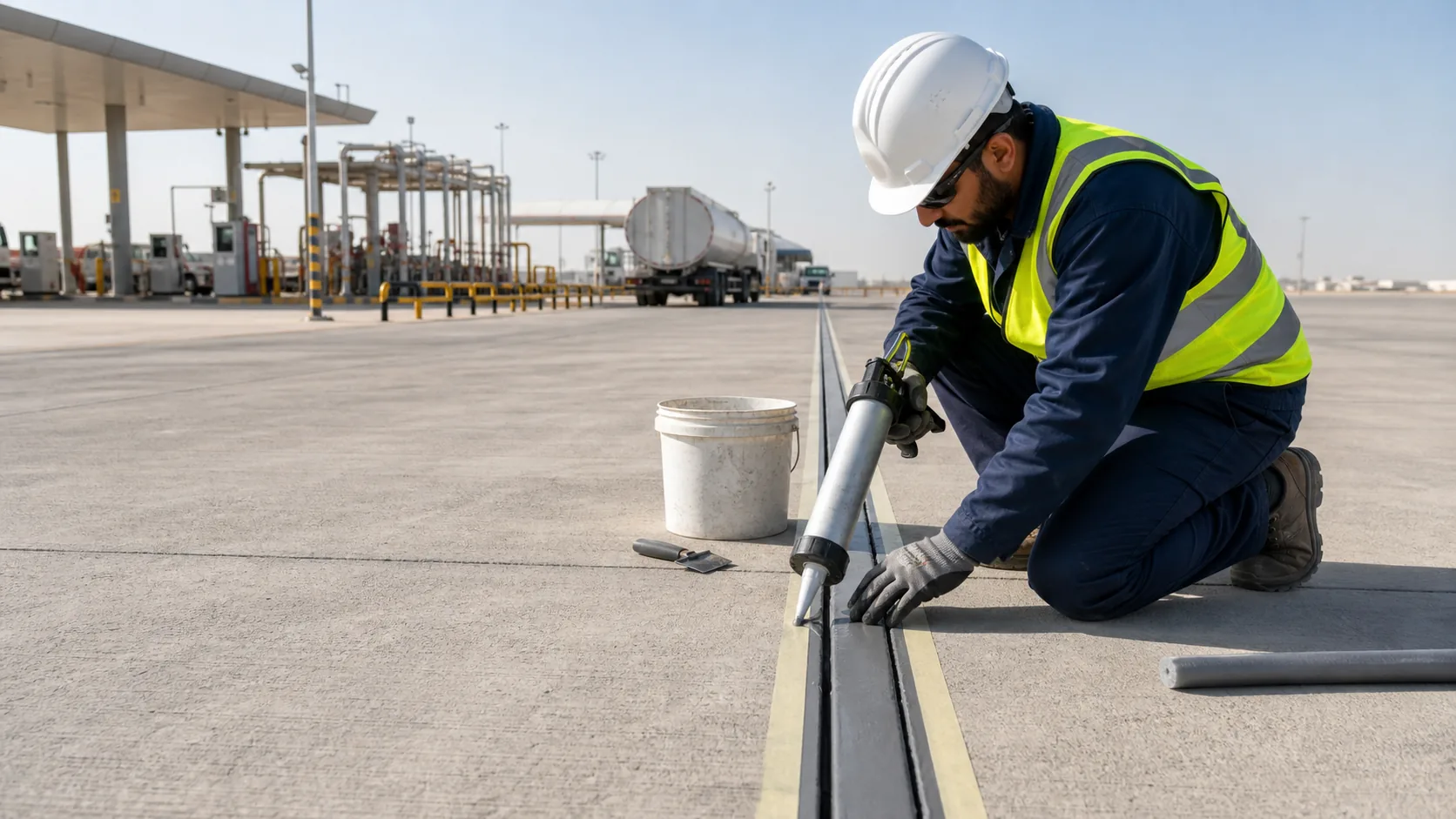
X-Seal FR200 is a two-part jet fuel resistant joint sealant supplied across Saudi Arabia for concrete joints exposed to petrol, aviation fuel, diesel, hydraulic fluid and Skydrol. It seals joints 5 to 50 mm wide, accommodates 25% movement to BS 6093, and reaches initial cure in 4 hours at 25°C.
- Joint width
- 5 – 50 mm3/16" to 2"
- Movement
- 25% MAFButt joints, BS 6093
- Initial cure
- 4 hoursat 25°C
- Service temp.
- −40 → +130°C+260°C intermittent
- Grades
- Gun & pouring2.5 L / 4 L / 20 L
مانع تسرب الفواصل المقاوم لوقود الطائرات في السعودية
X-Seal FR200 هو مانع تسرب للفواصل الخرسانية من مكوّنين، مقاوم لوقود الطائرات، مخصص للفواصل المعرّضة للبنزين ووقود الطيران والديزل والكيروسين والزيوت والسوائل الهيدروليكية والسكايدرول. يناسب الفواصل بعرض من ٥ إلى ٥٠ مم، ويستوعب حركة بنسبة ٢٥٪ وفق معيار BS 6093، ويبدأ التصلّب خلال ٤ ساعات عند درجة حرارة ٢٥ مئوية، ويكتمل خلال ٣ أيام. يُورَّد في جدة والرياض والدمام والجبيل ومكة المكرمة والمدينة المنورة وتبوك وباقي مناطق المملكة. أرسل أبعاد الفاصل وإجمالي الأمتار الطولية للحصول على عرض سعر. اتصل على +966 50 213 1112.
Overview
What X-Seal FR200 is and where it belongs
A fuel-resistant joint sealant is a sealant that keeps its elasticity and bond after repeated contact with hydrocarbons, instead of softening, swelling or debonding the way a standard polyurethane does. That is the whole reason FR200 exists.
Fuel is what kills ordinary joint sealants on an apron or a workshop slab. Diesel and aviation kerosene creep into the bead, plasticise it, and within a season or two the sealant has gone soft at the surface, picked up grit, and torn away from one joint face. X-Seal FR200 is formulated for exactly that exposure: concrete joints subject to attack from fuels, chemicals and biodegradation, where petrol, aviation fuel, hydraulic fluid or Skydrol spillage is expected rather than accidental.
The second failure mode in Saudi Arabia is the sun. Outdoor joints in Riyadh or Jubail take UV, ozone and a daily thermal swing that works the bead back and forth for years. FR200 is formulated with a high level of ozone resistance, tested to ASTM D1149, which supports its UV and weathering performance on exposed pavement. For airside and open-yard joints in the Kingdom that matters more than any headline figure on the datasheet.
Specify it when
- Fuel, oil, hydraulic fluid or Skydrol spillage is expected on the joint
- The joint is 5–50 mm wide and needs up to 25% movement accommodation
- The joint is outdoors and takes UV, ozone and thermal cycling
- Traffic runs over the joint and the bead must be recessed and supported
- VOC limits apply — SCAQMD Rule 1168 and LEED VOC limits are met
Look at something else when
- The joint is narrower than 5 mm or wider than 50 mm
- Movement exceeds 25% of joint width — redesign the joint, don't oversize the sealant
- The joint will be permanently immersed before full cure is reached
- Ambient is below 5°C or the substrate is wet — application is not permitted
- The substrate is asphalt — priming and detailing need to be confirmed first
Technical data
X-Seal FR200 technical specifications
Figures below are the published product properties. Confirm against the current datasheet and MSDS before you write them into a submittal — X-Calibur revises datasheets periodically.
| Property | Value | Reference |
|---|---|---|
| Movement accommodation factor | 25% (butt joints) | BS 6093 |
| Joint width range | 5 mm – 50 mm (3/16" – 2") | Joint design |
| Width-to-depth ratio | 1½:1 to 1:1 | Joint design |
| VOC content | < 100 g/L | SCAQMD Rule 1168 |
| Application temperature | 0°C to 60°C | Ambient / substrate |
| Mixed sealant temperature | 10°C to 40°C | Mixing |
| Working time after mixing | 45 minutes at 25°C | Application |
| Initial cure | 4 hours at 25°C | Cure |
| Full cure | 3 days at 25°C | Cure |
| Service temperature (continuous) | −40°C to +130°C | In service |
| Service temperature (intermittent) | −40°C to +260°C | CRD-C 526-92 |
| Colour | Black or grey | Standard range |
| Packaging — pouring grade | 4 L and 20 L | Supply |
| Packaging — gun grade | 2.5 L | Supply |
| Shelf life | 12 months | Below 25°C, shaded, dry |
| Mix ratio | Full Part A into full Part B | Do not part mix |
| Primer | X-Seal FR200 Primer | Required for maximum performance |
| Equipment cleaner | X-Shield Solvent S | Cleaning |
Chemical resistance
Resistant to spillage of the following. Spillage is not the same as immersion — the sealant must not be fully immersed until full cure is achieved.
- Petrol
- Aviation fuel
- Diesel
- Kerosene
- Lubrication oils
- Hydraulic fluid
- Skydrol
- White spirit
Have the joint dimensions in front of you? Send width, depth and total metres and you get the grade, the litres and the price back — not a brochure.
Send my joint detailsCompliance
Standards and specifications FR200 is referenced against
Consultants writing a specification usually need the clause references before anything else. These are the standards the product is referenced against — quote them in your submittal alongside the current datasheet.
- ASTM C920Type M, Grade P, Class 25, Use T
- BS 5212:1990Types N, F & FB
- BS 6093Movement accommodation
- ASTM D5329Performance requirements, Type I
- ASTM D5893Performance requirements, Type SL
- ASTM D7116Jet-fuel-resistant pavement joint sealant
- ASTM D1149Ozone resistance
- ASTM D1519Melting temperature
- US Fed Spec SS-S-200EFederal specification
- USCOE CRD-C 526-92Corps of Engineers
- SCAQMD Rule 1168VOC limits — also meets LEED VOC limits
- DCL Green Building RegsGreen building compliance
Matching FR200 to what the specification asks for
Most fuel-resistant sealant specifications in the Kingdom are written around a handful of requirements. This is how FR200 answers each of them.
| If the specification calls for | X-Seal FR200 published property |
|---|---|
| ASTM C920 Class 25 elastomeric sealant | Referenced to ASTM C920, Type M, Grade P, Class 25, Use T |
| A fuel-resistant pavement joint sealant | Resists spillage of petrol, aviation fuel, diesel, kerosene, lubrication oils, hydraulic fluid, Skydrol and white spirit |
| 25% movement accommodation | 25% in butt joints, referenced to BS 6093 |
| Self-levelling material for horizontal joints | Pouring grade, supplied in 4 L and 20 L |
| Low-VOC material or a LEED VOC credit | VOC below 100 g/L; meets SCAQMD Rule 1168 and LEED VOC limits |
| Ozone and weathering resistance | High ozone resistance, referenced to ASTM D1149 |
| High-temperature service on exposed pavement | −40°C to +130°C continuous; −40°C to +260°C intermittent (CRD-C 526-92) |
| Formaldehyde-free materials | Formaldehyde free |
| British Standard sealant classification | Referenced to BS 5212:1990, Types N, F and FB |
A note on airfield specifications
Airfield work is often written around FAA Item P-605 and the ASTM specifications it calls up, and the sealant type permitted varies by the clause your consultant has used. FR200 is referenced against ASTM D5893 Type SL and ASTM D7116 among the standards listed above. Send us the actual specification clause rather than the standard number alone, and we will tell you plainly whether FR200 answers it or whether you need a different product type.
Formaldehyde free
FR200 is formaldehyde free and meets SCAQMD Rule 1168 and LEED VOC limits, which is what green-building and indoor-air submittals normally ask for. If your project is chasing LEED credits, say so in the inquiry and the VOC documentation goes out with the quotation.
For consultants and estimators
Ready-to-use specification clause
Written from the published FR200 properties only. Copy it into your specification, adjust the joint sizes to your drawings, and send it back to us with the BOQ quantity — we will price it against the clause as written.
FUEL RESISTANT JOINT SEALANT

1.  Supply and install a two-part, fuel-resistant elastomeric joint sealant
    to all movement and pavement joints indicated, in areas subject to
    spillage of petrol, aviation fuel, diesel, kerosene, lubrication oils,
    hydraulic fluid, Skydrol or white spirit.

2.  The sealant shall be referenced against ASTM C920 Type M, Grade P,
    Class 25, Use T; BS 5212:1990 Types N, F and FB; ASTM D5329 Type I;
    ASTM D5893 Type SL; ASTM D7116; and USCOE CRD-C 526-92.

3.  VOC content shall not exceed 100 g/L, complying with SCAQMD Rule 1168
    and LEED VOC limits. The material shall be formaldehyde free.

4.  The sealant shall accommodate 25% movement in butt joints to BS 6093
    and shall be suitable for joints from 5 mm to 50 mm in width.

5.  Movement joints shall be formed to a sealant width-to-depth ratio
    between 1.5:1 and 1:1. The base of the joint shall be debonded using
    siliconized debonding tape laid over the joint filler board so that
    movement is accommodated across the full width of the sealant.

6.  Joint faces shall be sound, dry and free from contaminants, prepared by
    grit blasting, grinding or wire brushing to a rough clean surface, and
    primed with the manufacturer's primer. The sealant shall be applied
    once the primer is touch dry and within 3 hours of priming; surfaces
    left longer than 3 hours shall be re-primed.

7.  Where joints are subject to vehicular traffic the sealant shall be
    fully supported and recessed below the pavement surface so that it does
    not extrude above the surface during movement cycles.

8.  Ozone resistance shall be demonstrated to ASTM D1149. Service
    temperature shall be −40°C to +130°C continuous and −40°C to +260°C
    intermittent to CRD-C 526-92.

9.  The sealant shall not be applied in rain or wet conditions, or at
    temperatures below 5°C, and shall not be fully immersed until full cure
    is achieved.

10. Acceptable product: X-Seal FR200, or approved equal. All work to the
    manufacturer's current product data sheet and method statement.
Send us the clause your consultant actually wrote. We will confirm in writing whether FR200 answers it, or tell you which product type does. That answer is free either way.
Get the clause reviewedDetailing
Joint design: the four rules that decide whether the seal survives
More fuel-resistant sealants fail from bad joint geometry than from bad material. Get these four right and the bead does the job it was specified for.
1. Size the bead to the ratio
Movement joints should be designed to a sealant width-to-depth ratio between 1½:1 and 1:1. A bead that is too deep for its width cannot stretch — it tears at the bond line instead of extending.
2. Debond the base
To accommodate movement across the full width of the sealant, the bead must be debonded at the base of the joint. Use siliconized debonding tape laid over the joint filler board. Three-sided adhesion is the classic cause of early joint failure.
3. Recess it under traffic
Concrete pavement joints carry vehicles. The sealant must be fully supported and recessed so it never extrudes above the pavement surface during a movement cycle — once a tyre catches a proud bead, the joint is finished.
4. Prime the joint faces
For maximum performance, joint edges must be primed with X-Seal FR200 Primer. Apply the sealant once the primer is touch dry and within 1 to 3 hours. If more than 3 hours pass, re-prime before sealing.
Troubleshooting
Why fuel-resistant joints fail early — and what it costs to redo them
When a fuel-exposed joint fails inside two years, the material is rarely the reason. These are the failures we are called out to look at, in the order we see them.
-
The bead is stuck to the bottom of the joint
Three-sided adhesion. A sealant bonded to both faces and the base cannot stretch — it is held on three sides, so movement tears it internally or rips it off a face. This is the single most common cause of early joint failure, and it is invisible until the joint opens.
Fix: debond the base with siliconized debonding tape over the joint filler board, every time.
-
The bead is too deep for its width
A deep, narrow bead has no room to extend. The strain concentrates at the bond line and the sealant peels off the joint face at the first cold night. Crews default to filling the joint to the top because it looks finished.
Fix: design to a width-to-depth ratio between 1½:1 and 1:1, and control depth with the filler board and tape.
-
The bead sits proud of the pavement
On a trafficked slab, a bead level with or above the surface gets caught by tyres, tracked equipment and sweeper brushes. Once an edge lifts, water and fuel get behind it and the rest follows within a season.
Fix: finish the sealant slightly recessed and fully supported wherever vehicles cross the joint.
-
The joint faces were never properly prepared or primed
Laitance, curing compound, old sealant residue, dust or damp on the joint face all prevent adhesion. Fuel then wicks straight down the bond line. Wiping a joint with a rag is not preparation.
Fix: grit blast, grind or wire brush to a rough clean surface, then prime the faces with X-Seal FR200 Primer.
-
The priming window was missed
Primer has a working window. Sealant must go in once the primer is touch dry and within 1 to 3 hours. On a summer afternoon in Jeddah or Dammam a crew can lose that window while waiting on material or access, and nobody notices because the primer still looks fine.
Fix: run the window against a clock. Past 3 hours, re-prime before sealing.
-
Mixed material was used after it had gone off
Mixed FR200 has 45 minutes at 25°C. Material pushed into a joint at the end of a long batch has already started to cure and will not wet the primed face properly, so it debonds later even though the visible bead looks sound.
Fix: mix to the crew's placing rate, not to the size of the pail. Never part mix a unit.
-
The joint moves more than the sealant can take
FR200 accommodates 25% movement in butt joints. Where a slab layout puts more movement than that through one joint, no sealant in that class will survive — the joint itself needs redesigning or the movement needs redistributing.
Fix: check calculated movement against joint width before selecting the sealant, not after.
Already had a joint fail on you? Send photos of the failed bead and the joint edges. The failure mode is usually readable from a photograph, and knowing it changes what you should specify next.
Send failure photosEstimating tool
Joint sealant quantity calculator
Enter your joint dimensions and total run. Tabulated joint sizes return the published consumption figure exactly; any other size is worked out on the same basis, width × depth ÷ 1000 litres per metre run.
- Per metre run
- 0.30litres / m
- Total sealant
- 150litres
- Pouring grade
- 8× 20 L pails
- Gun grade
- 60× 2.5 L units
Estimate only, excluding primer. Wastage is your own allowance and is not a published figure. Confirm final quantities against the current datasheet, the approved joint detail and site-measured dimensions.
BOQ line item
Generated from the figures above, ready to drop into a bill of quantities or a material take-off. It updates as you change the inputs.
—
Want this priced? Your figures carry across to the inquiry form automatically. Add the city and the exposure and it goes straight to the technical desk.
Price this quantity| Joint size (mm) | Litres per metre run | Metre run per litre |
|---|---|---|
| 10 × 10 | 0.10 | 10.00 |
| 13 × 13 | 0.17 | 5.92 |
| 15 × 15 | 0.22 | 4.44 |
| 20 × 15 | 0.30 | 3.33 |
| 20 × 20 | 0.40 | 2.50 |
| 25 × 20 | 0.50 | 2.00 |
| 25 × 25 | 0.62 | 1.60 |
| 30 × 25 | 0.75 | 1.33 |
| 30 × 30 | 0.90 | 1.11 |
Method
How X-Seal FR200 is applied
A summary only. X-Calibur issues detailed method statements per application — read the current method statement and MSDS with this before any work starts. This is an industrial product for trained operatives.
-
Prepare the joint
Joints must be accurately formed, with edges sound, dry and free from contaminants. Prepare the faces by grit blasting, grinding or wire brushing to leave a rough, clean surface. Check the joint is formed to the required depth and that any expansion joint filler is tightly packed in place. For joints in asphalt, get priming and detailing advice before you start.
-
Prime the joint faces
Apply X-Seal FR200 Primer to the joint sides with a clean, dry paint brush, working it into the substrate. Then debond the base of the joint with siliconized debonding tape laid over the joint filler board.
-
Watch the priming window
Apply the sealant once the primer is touch dry, and within 1 to 3 hours of priming. Past 3 hours, re-prime the surfaces. On a hot Jeddah afternoon this window is the step crews most often lose track of — set it against the clock, not against how the primer looks.
-
Mix the two components
Add the entire contents of Part A (curing agent) to Part B (base component). Never part mix. Mix with an X-Seal mixing paddle on a slow-speed drill for one minute, scrape the sides down, then mix for three minutes more. Mixed sealant temperature should sit between 10°C and 40°C.
-
Place the sealant
Apply with a sealant gun designed for pouring grade sealants, or direct from the can. The bead should finish slightly recessed. Use the mixed material within 45 minutes at 25°C. On large projects, mixing and installation can run through a low-pressure proportioning pump with a static mixer; hot application through specialised heated pumps can speed cure, and is recommended only for very large projects at low ambient temperatures.
-
Clean down and protect
Clean equipment with X-Shield Solvent S. Initial cure is 4 hours at 25°C and full cure 3 days at 25°C. Do not apply in rain or wet conditions or below 5°C, and do not fully immerse the joint until full cure is reached.
Selection
Gun grade or pouring grade?
Both grades are the same fuel-resistant chemistry. The choice is about joint orientation and the size of the run.
| Grade | Packaging | Typically used for |
|---|---|---|
| Pouring grade | 4 L and 20 L | Horizontal pavement and floor joints, where the material is poured or gunned and levels itself into the joint. The usual choice for airport pavements, yards and long external runs. |
| Gun grade | 2.5 L | Shorter runs, patch and repair work, and joints where a self-levelling material would run away from where you need it. |
If FR200 is not the right fit
Not every fuel-exposed joint needs a fuel-resistant sealant, and not every fuel-resistant problem is a joint. Where the whole slab takes hydrocarbon exposure rather than just the joint, look at a fuel-resistant flooring system instead. Where the issue is structural movement rather than sealing, the guide to building expansion joint systems covers the alternatives. And if the slab itself is spalling or cracking around the joint, that is a repair question first — see concrete floor problems, causes and repairs in KSA. Sealing a joint in a slab that is failing buys you one season.
Send the site photos and we will say plainly if FR200 is the wrong product for what you are describing.
Applications in the Kingdom
Where fuel-resistant joints show up on Saudi projects
Airports and aviation areas
Fuel-exposed joints at fuelling locations, taxiways, paved service lanes and apron zones. This is the exposure FR200 was formulated around — jet fuel and Skydrol together, outdoors, under traffic.
Fuel stations and workshops
Highway fuelling stations and maintenance workshops, where joints take diesel, oils and hydraulic fluid alongside equipment movement and frequent aggressive cleaning.
Ports, wharfage and logistics yards
External pavement joints where weather, vehicle loading and occasional chemical contact all act on the same bead. In Jubail and Jeddah, add coastal exposure to that list.
Industrial plants and containment
Slab and pavement joints in plants, wastewater structures, roads and walkways where exposure, movement and housekeeping requirements all bear on sealant selection.
Where we supply, and what changes by city
Coverage is Kingdom-wide, but the site conditions that affect a fuel-resistant joint are not the same everywhere. FR200's published application window is 0°C to 60°C, with no application in rain or below 5°C, and a priming window of 1 to 3 hours — those three limits are what the local conditions below actually bear on.
- Riyadh الرياض
Inland, with a wide day-to-night temperature swing that works a pavement joint hard through the year. Airport, logistics and industrial slabs make up most FR200 enquiries here.
- Jeddah جدة
Coastal humidity plus summer heat. The 1-to-3-hour priming window is the thing crews lose here — surfaces come up to temperature fast and access rarely runs to plan.
- Dammam & Jubail الدمام والجبيل
Eastern Province heavy industry and port pavement, where fuel and chemical exposure, coastal air and constant vehicle loading act on the same bead at once.
- Makkah & Madinah مكة والمدينة
Access windows are the constraint more than the weather. Sequencing around pilgrimage periods decides how much joint you can prepare, prime and seal in one visit.
- Tabuk تبوك
North-west, with genuinely cool winter nights. Watch the 5°C floor on application, and note that hot application through heated pumps exists precisely for large projects at low ambient temperatures.
Working with SolidDrops
What you get when you send the inquiry
A grade and quantity recommendation
Send joint width, depth and total metres and you get back the grade, the estimated litres, primer quantity and pack breakdown, then the price.
Submittal and documentation support
Current datasheet, MSDS and the standards references your consultant will ask for, packaged for the submittal. Say if the project is chasing LEED and the VOC documentation goes with it.
An honest answer on fit
If your joint is outside the 5–50 mm range, moving more than 25%, or sitting in a slab that needs repair first, we will tell you that before quoting rather than after.
Supply across the Kingdom
Inquiries handled from Jeddah, Riyadh, Dammam, Jubail, Makkah, Madinah, Tabuk and other Saudi project locations, alongside our wider construction chemicals supply in KSA.
What happens after you send it
You send the joint
Dimensions, total metres, city and the exposure. A photo of the joint edges answers more than a paragraph does.
We review it technically
Grade, quantity, primer, and a check that your joint geometry and movement are inside what FR200 can actually do.
You get the answer in writing
Quotation with the pack breakdown, plus the datasheet, MSDS and standards references your consultant will ask for at submittal.
How the figures on this page were sourced
Every number here — cure times, temperature limits, joint widths, movement accommodation, consumption rates and the standards list — is reproduced from the published X-Seal FR200 product data. Nothing has been rounded, inferred from a similar product, or filled in where the data was silent.
Where the source says nothing, this page says nothing. That is why you will not find a price, a stated service life, a lead time or a project list on it: those were not in the product data, and inventing them would be the fastest way to get a figure quoted back to us on site.
Page content last reviewed . Product data sheets are revised periodically — confirm you hold the current version before any figure goes into a submittal.
Terminology
Joint sealing terms, defined
The words that turn up in fuel-resistant sealant specifications, in plain language. These are the definitions we use when reviewing a joint detail with a consultant.
- Movement accommodation factor (MAF)
- The movement accommodation factor is the percentage of a joint's width that a sealant can absorb without failing. X-Seal FR200 has an MAF of 25% in butt joints, referenced to BS 6093. A 20 mm joint can therefore take 5 mm of movement.
- Three-sided adhesion
- Three-sided adhesion is what happens when a sealant bonds to the base of a joint as well as to both faces, leaving it no room to stretch. It is the most common cause of early joint failure and is prevented by debonding the base.
- Debonding tape (bond breaker)
- Debonding tape is a strip laid across the base of a joint so the sealant cannot bond there. FR200 joints use siliconized debonding tape over the joint filler board, which lets the bead move across its full width.
- Width-to-depth ratio
- The width-to-depth ratio is the relationship between how wide a sealant bead is and how deep. FR200 movement joints are designed between 1½:1 and 1:1 — a bead deeper than it is wide concentrates strain at the bond line and tears.
- Pot life (working time)
- Pot life is the window between mixing a two-part sealant and the point where it can no longer be placed properly. Mixed FR200 must be used within 45 minutes at 25°C; material pushed in later will not wet the primed face.
- Skydrol
- Skydrol is a phosphate-ester aviation hydraulic fluid used in commercial aircraft, and it attacks many ordinary sealants. FR200 is listed as resistant to Skydrol spillage, which is why it appears in airport apron and fuelling-area specifications.
- Pouring grade and gun grade
- Pouring grade is a self-levelling form for horizontal joints, supplied in 4 L and 20 L. Gun grade is a stiffer form for shorter runs and repairs, supplied in 2.5 L. Both are the same fuel-resistant chemistry.
- Priming window
- The priming window is the period after priming during which the sealant must be applied. For FR200 that is once the primer is touch dry and within 1 to 3 hours; past 3 hours the joint faces have to be primed again.
- Recessed bead
- A recessed bead sits slightly below the pavement surface rather than flush or proud. Recessing is required wherever traffic crosses the joint, so tyres and sweeper brushes cannot catch an edge and tear the sealant out.
- Butt joint
- A butt joint is a joint where two slabs meet edge to edge and movement acts across the joint width. FR200's 25% movement figure is quoted for butt joints, which is the geometry most pavement and movement joints use.
Questions
X-Seal FR200 — frequently asked questions
What is a jet fuel resistant joint sealant?
A jet fuel resistant joint sealant is a sealant that keeps its elasticity and adhesion after repeated contact with aviation fuel and other hydrocarbons. X-Seal FR200 resists spillage of petrol, aviation fuel, diesel, kerosene, lubrication oils, hydraulic fluid, Skydrol and white spirit, which is why it is specified for airport fuelling areas and fuel-exposed pavement joints.
What joint widths can X-Seal FR200 seal?
From 5 mm (3/16") to 50 mm (2") wide. Movement joints should be designed to a sealant width-to-depth ratio between 1½:1 and 1:1, with the bead debonded at the base of the joint so it can move across its full width. Outside that width range, the joint needs a different detail.
How long does X-Seal FR200 take to cure?
Initial cure is 4 hours at 25°C and full cure is 3 days at 25°C. Mixed material must be used within 45 minutes at 25°C. Do not fully immerse the joint until full cure is reached. On very large projects at low ambient temperatures, hot application through specialised heated pumps can be used to speed cure times.
How much FR200 do I need per metre of joint?
Multiply joint width by depth and divide by 1000 to get litres per metre run. A 20 × 15 mm joint uses 0.30 litres per metre, and a 25 × 25 mm joint uses 0.62 litres per metre. The quantity calculator on this page runs the figure and the pack breakdown for your total length.
Does X-Seal FR200 need a primer?
Yes — for maximum performance the joint edges must be primed with X-Seal FR200 Primer, brushed into the substrate on the joint sides. Apply the sealant once the primer is touch dry and within 1 to 3 hours. If more than 3 hours elapse, re-prime the surfaces before sealing.
Is X-Seal FR200 suitable for outdoor pavements in Saudi Arabia?
It is formulated with a high level of ozone resistance, tested to ASTM D1149, which supports UV and weathering durability on exposed pavement. Listed service temperature is −40°C to +130°C continuous and up to +260°C intermittent under CRD-C 526-92. Application temperature range is 0°C to 60°C, and it must not be applied in rain or below 5°C.
Which standards is X-Seal FR200 referenced against?
ASTM C920 Type M Grade P Class 25 Use T, BS 5212:1990 Types N, F and FB, ASTM D5329 Type I, ASTM D5893 Type SL, ASTM D7116, ASTM D1149 for ozone resistance, ASTM D1519, US Fed Spec SS-S-200E, USCOE CRD-C 526-92, SCAQMD Rule 1168 and DCL Green Building Regulations. Movement accommodation is referenced to BS 6093.
What information does SolidDrops need to quote FR200?
Project city, joint width and depth, total linear metres, substrate condition, expected traffic, the exact fuel or chemical exposure, cleaning method, preferred grade and target schedule. Photos, drawings or a BOQ speed the review considerably. Send it through the inquiry form or on WhatsApp.
How much does X-Seal FR200 cost in Saudi Arabia?
We quote per project rather than publishing a rate, because the same length of joint can differ several-fold on price. Consumption alone swings from 0.10 litres per metre on a 10 × 10 mm joint to 0.90 on a 30 × 30 mm joint. Condition of the existing joint, preparation method, access restrictions, grade, primer and documentation scope all move the figure. Send the six items listed under what drives cost and you get a real number back.
Can X-Seal FR200 be applied over an existing failed sealant?
No. Joint edges must be sound, dry and free from contaminants before sealing. Existing sealant, laitance and fuel-contaminated material have to be removed and the faces prepared by grit blasting, grinding or wire brushing to a rough clean surface, then primed. Sealing over a failed bead traps the original failure underneath and it reappears within a season.
Can X-Seal FR200 be used in asphalt joints?
For joints in asphalt, priming and joint detailing advice should be confirmed before work starts rather than assumed from the concrete detail. Send the substrate type and the joint detail with your inquiry and we will confirm the correct approach for that specific joint.
How should X-Seal FR200 be stored, and what is the shelf life?
Shelf life is 12 months when stored below 25°C in shaded, dry conditions. In a Saudi summer that means a conditioned store, not a site container — material left in an uncooled container on a Jubail site will not see out its stated shelf life. Check the batch date on delivery and rotate stock.
Which Saudi cities does SolidDrops supply?
Inquiries are handled across the Kingdom, including Jeddah, Riyadh, Dammam, Jubail, Makkah, Madinah, Tabuk and other Saudi project locations. Tell us the city in the inquiry so the quotation and delivery arrangements are routed correctly.
Budgeting
What actually moves the price on a fuel-resistant joint
We do not publish a rate, because a rate quoted without the joint detail is meaningless — the same 500 metres can differ several-fold depending on the items below. These are what we ask about, and why.
Joint size — the biggest single factor
Consumption scales with cross-sectional area, so a 30 × 30 mm joint uses 0.90 litres per metre against 0.10 for a 10 × 10 mm joint. Nine times the material over the same run. Get the dimensions measured before you budget anything.
Condition of the existing joint
A newly formed joint needs preparation. An old joint contaminated with fuel, packed with grit and holding failed sealant needs that removed first, and the removal is frequently a bigger line than the sealant.
Preparation method and access
Grit blasting a live apron under airside escort at night is a different job from grinding joints in an empty warehouse. Tell us the access restrictions early — they change the programme more than the material does.
Grade, primer and pack breaks
Pouring grade comes in 4 L and 20 L, gun grade in 2.5 L. Primer is a separate line. A quantity that lands just over a pack break costs the same as one comfortably inside it, so the take-off matters.
Documentation required
A supply-only order and a full submittal package with method statements, MSDS, standards references and LEED VOC documentation are not the same scope. Say which one you need.
Project city and delivery
Delivery into Riyadh, Jeddah, Dammam, Jubail, Makkah, Madinah or Tabuk is routed differently. Naming the city in the inquiry saves a round trip of emails.
Give us those six things and you get a real number. Joint size, condition, access, grade, documentation and city. The form below asks for exactly this.
Get a real numberThe business case
What sealing the joint twice actually costs
The sealant is the cheap line. On a fuel-exposed joint most of the installed cost is access, preparation and lost operating time — and a redo pays for all of it again.
Think about what it takes to seal 500 metres of apron joint. Grit blasting under airside escort, a closed fuelling lane, a night shift, a supervisor, plant on site, and the documentation to get any of it approved. Against that, the material is a modest fraction. Now fail the joint in year two because the bead was bonded to the base of the joint, and every one of those lines repeats — except the survey, because by then you know the quantity. That is why joint detailing is worth arguing about at submittal stage rather than at handover.
We do not publish a rate, so the calculator below uses your figures. Nothing in it is a SolidDrops price or a claim about how long FR200 lasts — the service life and failure year are your own planning assumptions, and the arithmetic just shows what they imply.
- Sealed once, correctly
- —whole-life cost over the design period
- Failed and redone
- —including every repeat mobilisation
- Cost of getting it wrong
- —the avoidable part
- Cost per metre per year
- —done right vs redone
Your figures only. Service life and failure year are your planning assumptions, not published FR200 properties — the product data sheet does not state a service life. SolidDrops does not publish an installed rate; we quote the material against your joint detail and quantity.
Request a quotation
Send your joint details — get a grade, a quantity and a price
Fill this in and it opens a prepared message to our technical team on WhatsApp, with your figures already in it. Nothing is stored on this page. Prefer email? [email protected]
 Chat Online