
24 Sep Waterproofing in Madinah: Dry Heat, Tanks and Basements
Waterproofing in Madinah: Dry Heat, Tanks and Basements
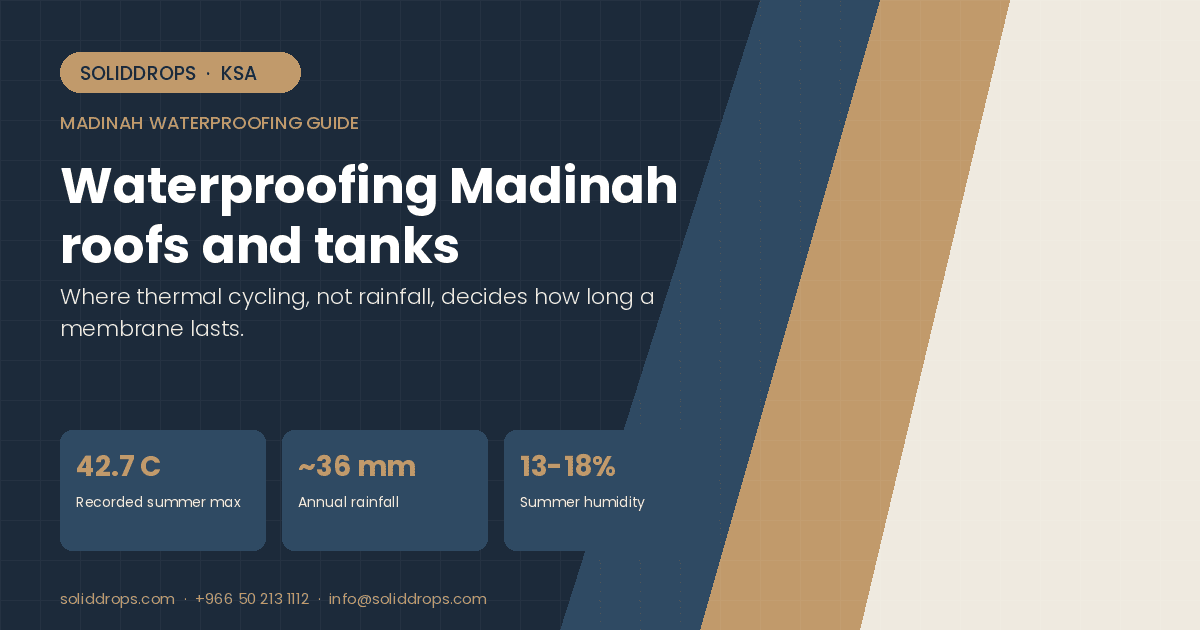
Waterproofing Madinah buildings is a heat problem before it is a water problem. With around 36 mm of rain a year and summer maximums near 42.7 C, membranes here age through thermal cycling and ultraviolet exposure rather than storm loading. The critical elements are exposed roofs, water tanks and basements.
| Property | Value | Basis / standard |
|---|---|---|
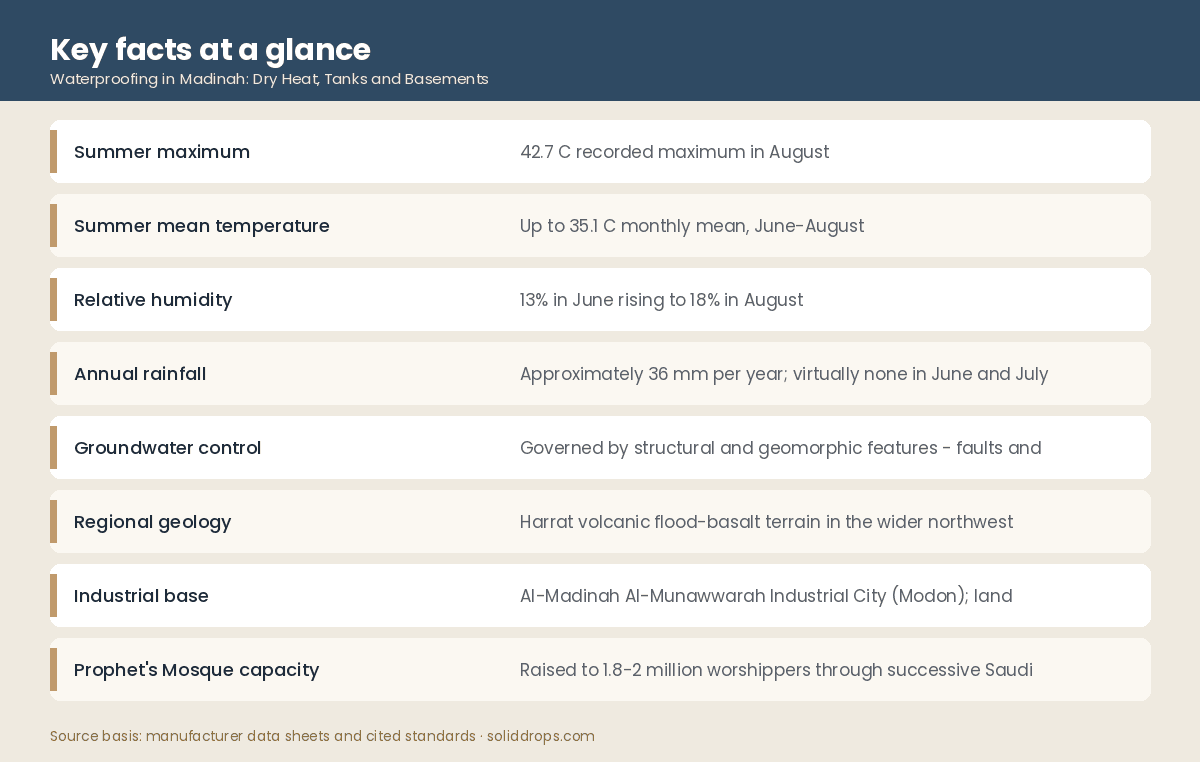
| Summer maximum | 42.7 C recorded maximum in August | climate-data.org, Medina station record |
| Summer mean temperature | Up to 35.1 C monthly mean, June-August | climate-data.org, Medina station record |
| Relative humidity | 13% in June rising to 18% in August | climate-data.org, Medina station record |
| Annual rainfall | Approximately 36 mm per year; virtually none in June and July | climate-data.org, Medina station record |
| Groundwater control | Governed by structural and geomorphic features – faults and wadi channels | Arabian Journal of Geosciences, Madinah groundwater study |
| Regional geology | Harrat volcanic flood-basalt terrain in the wider northwest | Peer-reviewed Harrat Khyber groundwater hydrochemistry study |
| Industrial base | Al-Madinah Al-Munawwarah Industrial City (Modon); land allocated for a 33,433 m2 factory | Modon; Construction Week Online |
| Prophet's Mosque capacity | Raised to 1.8-2 million worshippers through successive Saudi expansions | Saudipedia; Saudi Press Agency reporting |
Why is heat, not rain, the main stressor on a Madinah membrane?
Madinah receives roughly 36 mm of rain a year, and in June and July effectively none. A membrane here spends almost its entire service life dry. That removes one failure mechanism and puts all the load on another: the daily thermal cycle.
Summer monthly means reach 35.1 C, with a recorded maximum of 42.7 C in August. Air temperature is only part of it. An exposed dark roof in still, dry air runs well above ambient by mid-afternoon, then radiates to a clear night sky and drops sharply. Every day, deck and membrane expand and contract against each other.
What that does, in order of how quickly it shows: loss of flexibility in bituminous sheets, chalking and film thinning on unprotected liquid coatings, creep and eventual splitting at laps and terminations, and fatigue cracking where the membrane bridges a structural movement joint that was detailed as if it never moved.
The specification response is a reflective or protected surface, a system with genuine elongation retained after heat ageing, and movement joints carried through the membrane rather than coated over.
What does 13 per cent humidity do to application?
Relative humidity in Madinah runs from about 13 per cent in June to 18 per cent in August. That is very dry air, and it changes how liquid systems behave on site.
- Flash-off is rapid. Solvent and water leave a wet film quickly, so a coating can appear touch-dry while the body underneath is still curing. Applying the next coat on that reading traps the lower layer.
- Cementitious systems lose water to the air, not to hydration. A cementitious tank coating or wet-area membrane laid in dry heat without curing protection will shrink-crack. It needs a curing membrane, damp hessian or controlled shade.
- Workable time shortens. Two-part chemistry accelerates with substrate temperature; batch sizes that suit a mild morning are wrong by 11:00.
- Airborne particles. A tacky film collects whatever the dry air is carrying, so screening the working area is not optional on a resin system.
The usable window in high summer is early morning, ending when the substrate passes the product’s stated maximum, not when the crew wants lunch.
What do the ground and groundwater mean for basements in Madinah?
Groundwater in Madinah city is reported as controlled by structural and geomorphic features, principally faults and wadi channels, rather than a simple uniform water table. The wider northwest of the Kingdom sits on harrat volcanic flood-basalt terrain, and the groundwater chemistry of those basalts has been studied in the region.
Two design consequences follow. First, conditions can differ sharply between plots a short distance apart, one sitting near a wadi channel and the next on competent ground. A plot-specific site investigation is worth more than any regional assumption, and the waterproofing designer should read it before choosing between a tanked structure and a drained cavity.
Second, rock and basalt substrates change the excavation and the blinding. Where the dig is in hard ground, the blinding surface a sheet membrane is laid on may be rougher than the membrane manufacturer assumes, so a regulating layer or a bonded system that tolerates it becomes the sensible choice.
Do not carry a coastal specification inland. Madinah is not a sabkha site, and the chloride-driven detailing used in Dammam or Jubail is answering a different question.
Why do water tanks deserve their own specification here?
In a city with almost no rainfall, stored water is the building’s lifeline, and the tank is where waterproofing earns its money. Potable tanks, fire reserves and irrigation tanks all fail in similar ways.
- Lining must be certified for potable contact where the tank is for drinking water; confirm the certification on the product data sheet before it is ordered, not after.
- Construction joints and the wall-to-base kicker are the usual leak points, so waterstops and a detailed corner fillet belong in the drawing.
- A tank that is partly emptied in summer exposes the upper lining to hot dry air and the lower to water: two different exposures on the same surface, with a waterline that moves.
- Access for cleaning and inspection is a design item. A lining that cannot be inspected will not be maintained.
- Fill-and-drop testing before commissioning is the only proof that matters. Schedule it; do not leave it to the handover week.
Roof-level tanks add thermal movement, sitting on a deck already cycling.
Which buildings in Madinah need waterproofing most?
Industrial and warehouse roofs
Al-Madinah Al-Munawwarah Industrial City hosts Modon-allocated plots, including land allocated for a 33,433 m2 factory. Large single-span roofs, long runs, heavy thermal movement, little routine inspection.
Hospitality and its plant
The Prophet’s Mosque capacity has been raised to 1.8-2 million worshippers through successive expansions, and the surrounding accommodation stock is sized to that demand. Roof plant decks, tanks and back-of-house wet areas follow.
Healthcare and laboratory buildings
Continuous operation, no tolerance for a leak into a clinical space, and wet areas that must be tanked under the floor finish.
Basements and car parks
Ground conditions vary plot by plot; a parking deck over occupied space needs a traffic-grade system, not a roof membrane.
Large-span factory roofs are most often left until they leak. An annual inspection costs a fraction of a recoat after the insulation has been soaked.
Which waterproofing system suits which element in Madinah?
| Element | Typical system family | The local limit to check |
|---|---|---|
| Large exposed industrial roof | Single-ply sheet or reinforced liquid membrane with reflective finish | Retained elongation after heat ageing; movement provision over long spans |
| Hotel roof plant deck | Reinforced liquid-applied polyurethane | Detail density around plinths; surface temperature ceiling during application |
| Potable water tank | Certified potable-contact lining system | Certification on the data sheet; curing protection against rapid moisture loss |
| Fire and irrigation tanks | Cementitious or epoxy tank lining | Moving waterline exposure; joint and kicker detailing |
| Basement raft and walls | Tanking sheet or bonded membrane per the site investigation | Plot-specific ground and groundwater conditions; blinding quality over rock |
| Parking deck over occupied space | Trafficable polyurethane deck coating | Wheel loads plus thermal movement; falls and outlet positions |
| Kitchen and clinical wet areas | Wet-area membrane below the screed and finish | Continuity at thresholds and around gullies; cleaning chemistry |
The material comparison behind these families is set out in our waterproofing systems guide for Saudi Arabia.
Industrial roof or water tank in Madinah due for assessment?
We survey the substrate, not the symptom, and tell you whether an overlay will hold.
How should a Madinah waterproofing programme be sequenced?
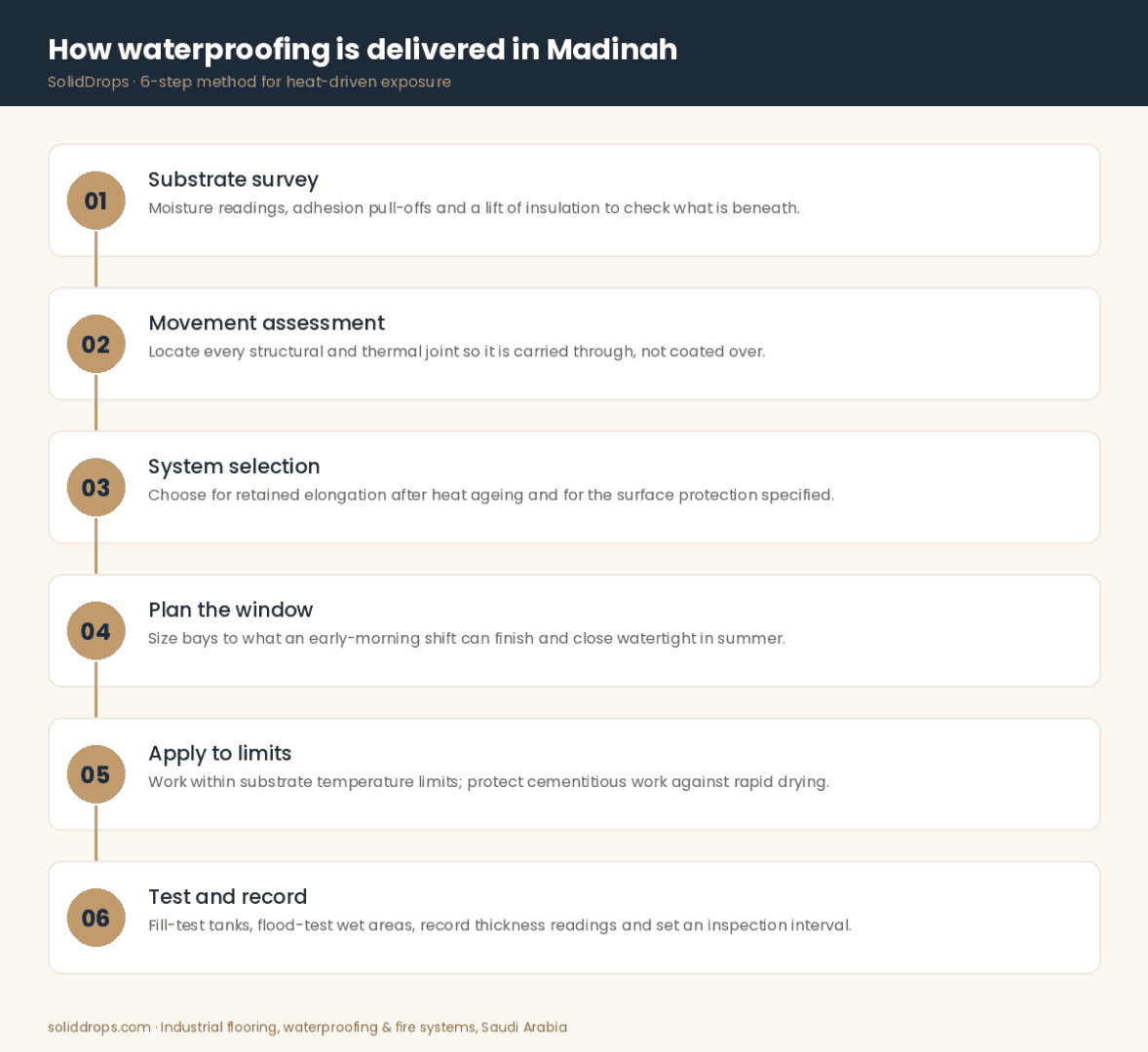
Survey the substrate, not the symptom. Moisture readings, adhesion pull-offs on any existing coating and a check of every movement joint tell you whether an overlay is possible. On an industrial roof, lift a sample of insulation: wet insulation under a sound-looking membrane is common, and it has to come out.
Then sequence around three constraints specific to the city.
- Visitor seasons. Accommodation and service buildings near the Haram operate at high occupancy through Ramadan and Hajj, and access, deliveries and noisy work are restricted. Book the window early.
- Summer application limits. From June onward the usable daily window narrows to the early hours. Plan bay sizes to what a morning can actually finish and close watertight.
- Operating plant. Factory and warehouse roofs can rarely be shut down, so work proceeds in bays over live operations with protection below.
Makkah’s programme problem is different again – volume of storm water rather than heat – and our Makkah waterproofing guide covers it.
What goes wrong on Madinah roofs?
The recurring faults on survey here are heat-driven, and they are predictable.
- Unprotected dark membranes. Left without a reflective topcoat or ballast, they chalk, harden and lose elongation years earlier than the data sheet suggests.
- Movement joints coated over. The membrane is asked to stretch across a joint that is moving several millimetres daily. It splits, always along the joint line.
- Coatings applied too thin on hot substrates. Heat lowers viscosity, the material runs off high points, and the measured dry film thickness at the ridge is half the specification.
- Cementitious work cured by evaporation. Map cracking across a tank wall or screed, visible within days.
- Rain dismissed entirely. Thirty-six millimetres a year is not zero, and blocked outlets with no working fall still put water inside when it does rain.
- Tank linings never inspected. Because access was not designed in.
Our roof waterproofing inspection checklist covers what an annual inspection should record.
What drives waterproofing cost in Madinah?
SolidDrops prices each project against a defined scope and publishes no rates. The variables that move a Madinah figure:
- Roof area against detail count. A plain 8,000 m2 factory roof and a cluttered 800 m2 hotel plant deck can land at similar totals.
- Whether wet insulation must be removed. This is the single largest swing on an industrial re-roof.
- Surface protection. A reflective or ballasted finish adds cost up front and buys service life in this climate.
- Tank certification and testing. Potable-grade linings and fill tests carry their own programme time.
- Season. Summer working means short daily windows and more shifts for the same area.
- Access. Occupied hospitality buildings, live factories and restricted delivery routes add time rather than material.
A roof plan, an area take-off and photographs of the current condition are enough for us to price real scope rather than an assumption.
Who supplies and installs waterproofing in Madinah?
SolidDrops supplies and installs waterproofing systems in Madinah – المدينة المنورة – covering roofs, basements, water-retaining structures, parking decks and wet areas for industrial, hospitality, healthcare and commercial buildings, including work in and around the Madinah industrial city.
Our flooring and waterproofing support page for Madinah sets out the service scope and enquiry route, and epoxy flooring in Madinah covers the finishes that sit above a tanked floor in kitchens, plant rooms and workshops.
Send the building type, elements in scope, area and access window to [email protected], or call +966 50 213 1112. We survey, recommend a system in writing, and say where an existing membrane can be overlaid and where it cannot. Where a floor finish sits over the waterproofing, our cement self levelling and floor preparation guide explains how the layers are made compatible.
Frequently asked questions
Why does roof waterproofing matter in Madinah if it barely rains?
Because membranes here fail from heat, not water. With summer maximums reaching 42.7 C and around 36 mm of rain a year, a roof ages through daily thermal expansion, ultraviolet exposure and loss of elongation. When rain does arrive, a membrane already hardened and split at the laps has nothing left to give.
What is the best roof waterproofing for Madinah's climate?
A system that keeps flexibility after heat ageing and carries a reflective or protected surface. Reinforced liquid polyurethane suits detail-heavy plant decks; single-ply sheet often suits large plain industrial roofs. The deciding factors are detail density, movement joint layout and substrate condition, which the survey establishes.
Does low humidity affect waterproofing application in Madinah?
Yes. Humidity of 13 to 18 per cent in summer means rapid flash-off, so liquid coatings feel dry while curing continues underneath, and cementitious products lose water to the air instead of hydrating. Use curing protection on cementitious work, keep batch sizes small, and work within the product’s substrate temperature limits.
How should water tanks be waterproofed in Madinah?
With a lining certified for the tank’s duty, potable contact included where relevant, and with waterstops and a proper fillet at the wall-to-base junction. Protect cementitious linings from rapid drying during cure, design inspection access, and prove the tank with a fill-and-drop test before commissioning rather than at handover.
Can basements be tanked in Madinah's ground conditions?
Yes, but the design should follow the plot’s own site investigation. Madinah groundwater is reported as controlled by faults and wadi channels rather than a uniform table, so conditions vary over short distances. Where excavation is in hard ground, check the blinding quality the sheet membrane will be laid on.
When is the best time to waterproof a roof in Madinah?
Autumn through spring gives full working days. From June the usable window narrows to early morning, because substrate temperature passes most products’ application ceiling by late morning. Access during Ramadan and Hajj is the other constraint for buildings near the Haram, so book the window well ahead.
How much does waterproofing cost in Madinah?
It depends on area against detail count, whether wet insulation has to be removed, the surface protection specified, tank certification and testing, and access to an occupied or operating building. There is no meaningful square-metre rate. Send drawings and photographs to [email protected] for a scoped quotation.
Who supplies and installs waterproofing in Madinah?
SolidDrops is a supplier and installer of waterproofing systems in Madinah, covering roofs, basements, water tanks, parking decks and wet areas for industrial, hospitality, healthcare and commercial buildings. Contact [email protected] or +966 50 213 1112.
Waterproofing support for Madinah projects
Supplier and installer for roofs, tanks, basements and wet areas. [email protected] · +966 50 213 1112
 Chat Online