
10 Sep Waterproofing in Saudi Arabia: How to Choose the Right System
Waterproofing in Saudi Arabia: How to Choose the Right System
Waterproofing in Saudi Arabia means selecting a system against the exposure it will face: heat, UV, coastal humidity, sand, roof exposure and structural movement. Sheet membranes such as PVC and EPDM, liquid PU, spray polyurea and cementitious coatings each suit different elements. The substrate and the detailing decide whether any of them last.
| Property | Value | Basis / standard |
|---|---|---|
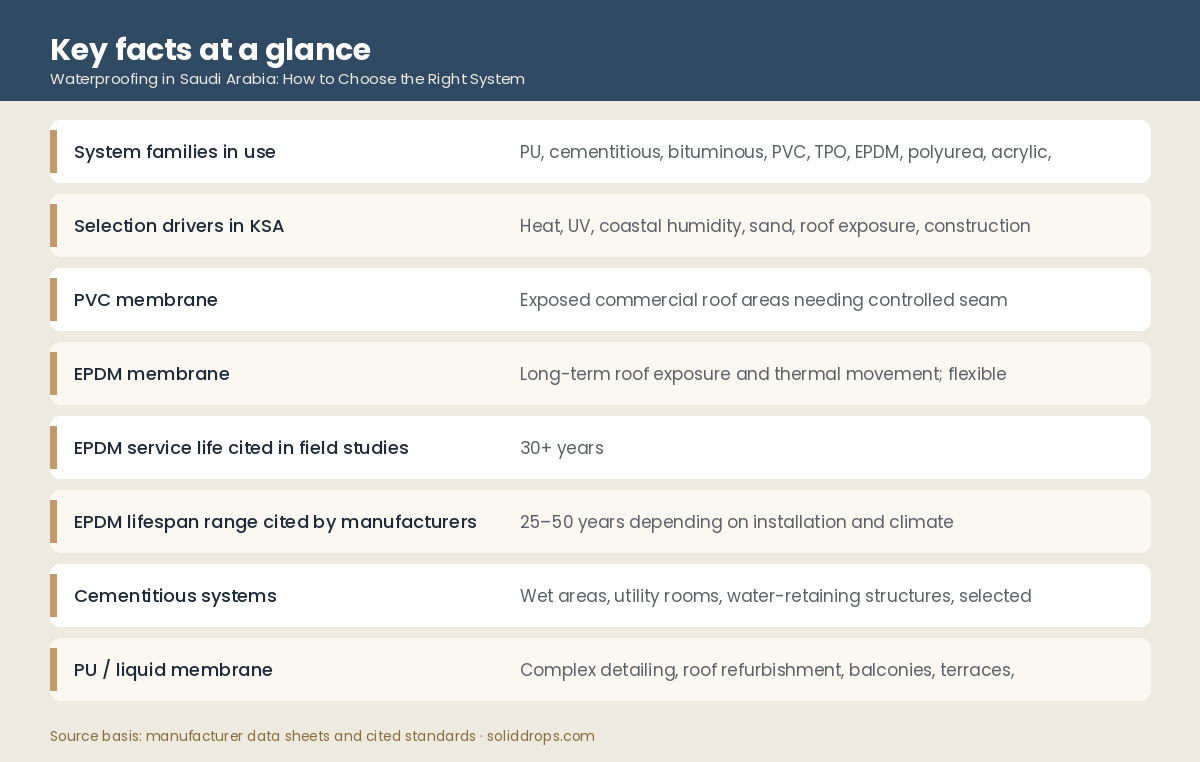
| System families in use | PU, cementitious, bituminous, PVC, TPO, EPDM, polyurea, acrylic, epoxy tank lining, crystalline, joints and waterstops | SolidDrops waterproofing scope |
| Selection drivers in KSA | Heat, UV, coastal humidity, sand, roof exposure, construction movement | SolidDrops system selection guidance |
| PVC membrane | Exposed commercial roof areas needing controlled seam treatment | SolidDrops system selection guide |
| EPDM membrane | Long-term roof exposure and thermal movement; flexible | SolidDrops system selection guide |
| EPDM service life cited in field studies | 30+ years | Roofing Magazine, EPDM service life |
| EPDM lifespan range cited by manufacturers | 25–50 years depending on installation and climate | Manufacturer published range |
| Cementitious systems | Wet areas, utility rooms, water-retaining structures, selected below-grade | SolidDrops system selection guide |
| PU / liquid membrane | Complex detailing, roof refurbishment, balconies, terraces, podiums | SolidDrops system selection guide |
| Polyurea | Fast-curing, spray-applied, for demanding exposure needing speed | SolidDrops system selection guide |
| Reference frameworks | ICRI technical guidelines, ASTM standards, manufacturer TDS/SDS, Saudi Building Code | Industry references used in specification |
What does waterproofing actually cover on a Saudi project?
Waterproofing in Saudi Arabia is not one product; it is a decision about which barrier suits a specific element under a specific exposure. On a single mixed-use building the correct answer can change four times between the basement raft and the roof plant deck. The families in regular use here are polyurethane and liquid membranes, cementitious coatings, bituminous sheets, PVC and TPO single-ply, EPDM and rubberised asphalt, spray polyurea, acrylic coatings, epoxy tank linings, crystalline admixtures and surface treatments, insulation and foam systems, and the joint sealants and waterstops that tie them all together.
That last category is the one most often left off a bill of quantities and the one that causes most of the water ingress. A membrane rarely fails in the middle of a field area. It fails at an upstand, a drain outlet, a pipe penetration, a movement joint or a kicker joint at the base of a wall — the places where two materials meet and somebody had to make a decision on site.
Selection has to account for Saudi heat, UV, coastal humidity, sand, roof exposure and construction movement. Those six conditions are the specification brief. Everything else — brand, colour, thickness, application method — follows from them.
Where does each system belong in a building?
The quickest way to sanity-check a waterproofing specification is to walk the building from the bottom up and ask what each element is exposed to.
- Below grade — rafts, retaining walls and basement joints face hydrostatic pressure and, in coastal and sabkha ground, aggressive salts. Cementitious systems, membranes and joint treatment work together here; see our note on basement and retaining wall joints.
- Wet areas — bathrooms, kitchens, plant rooms and utility spaces suit cementitious waterproofing under tile, with detailing at drains and thresholds doing most of the work.
- Water-retaining structures — tanks and reservoirs need a lining rated for continuous immersion and, if potable, for contact with drinking water. Epoxy tank linings and cementitious systems dominate.
- Roofs — exposed commercial roofs favour single-ply PVC or EPDM; refurbishment over complex existing detail favours liquid PU. Our commercial roof guide covers the decision.
- Podiums, terraces and balconies — buried or trafficked membranes with protection layers, since the barrier cannot be inspected once landscaping is on top.
- Car park decks — trafficked deck coatings that carry vehicle loads and turning shear as well as water; see car park deck systems.
How is a waterproofing system built up?
Every system, whatever the chemistry, is the same five ideas in a different order.
Substrate. Sound, clean concrete or screed with the correct falls. Falls are structural, not decorative: a flat roof laid dead level will pond, and ponded water on any membrane in Saudi summer conditions accelerates degradation and finds every weakness in a seam. Where levels need correcting before the barrier goes down, that is a preparation package in its own right — the same logic set out in our cement self levelling guide.
Primer. Chosen for the substrate and the membrane above it, not chosen by habit. Damp-tolerant primers exist and are specified where drying time cannot be achieved.
Detailing first. Upstands, outlets, penetrations, corners and joints are reinforced before the field area is applied. Reinforcement fabric or preformed corners at these points is what separates a system that lasts from one that leaks in the first rain.
Field membrane. Applied to the specified dry film thickness or sheet lap. Wet film gauges during application, not guesses afterwards.
Protection and finish. Screed, insulation, protection board, ballast or a trafficable coating, depending on what happens above the membrane. A perfect membrane damaged by a following trade is a failed membrane.
Between each of those steps sits a hold point and, ideally, a flood test. Our roof inspection checklist sets out what to look for.
PVC vs EPDM vs cementitious vs PU vs polyurea: a comparison
The table below compares the five system families most often shortlisted on Saudi projects. It compares roles, not brands, and the figures are limited to what published sources support.
| System | Form | Best suited to | Key strength | Watch points |
|---|---|---|---|---|
| PVC single-ply | Sheet membrane, hot-air welded seams | Exposed commercial roof areas | Controlled, testable seam treatment and weather resistance | Seam quality is operator-dependent; compatibility with bitumen and some insulations |
| EPDM | Sheet membrane, bonded or ballasted | Long-term exposed roofs with thermal movement | Flexibility and lifecycle durability; 30+ years cited in field studies, 25–50 years quoted by manufacturers depending on install and climate | Seam and detail work is the limiting factor; puncture risk during following trades |
| Cementitious | Brush, roller or spray-applied slurry | Wet areas, utility rooms, water-retaining structures, selected below-grade | Bonds directly to concrete and masonry; suits immersion | Limited crack-bridging and no UV role; not for exposed movement-prone decks |
| PU / liquid membrane | Liquid-applied, cures to a continuous film | Complex detailing, roof refurbishment, balconies, terraces, podiums | Continuous coverage around penetrations without seams | Film thickness control and substrate dryness are critical; needs skilled application |
| Polyurea | Spray-applied, plural component, hot spray | Demanding exposure where speed matters | Very fast cure and continuous coverage | Specialist plant and trained crews; unforgiving of poor preparation; see our polyurea page |
Nothing on that table is a ranking. A PVC roof over a warehouse in Dammam and a PU refurbishment over a fifteen-year-old villa roof in Jeddah are both correct answers to different questions. The fuller side-by-side sits on our system selection guide.
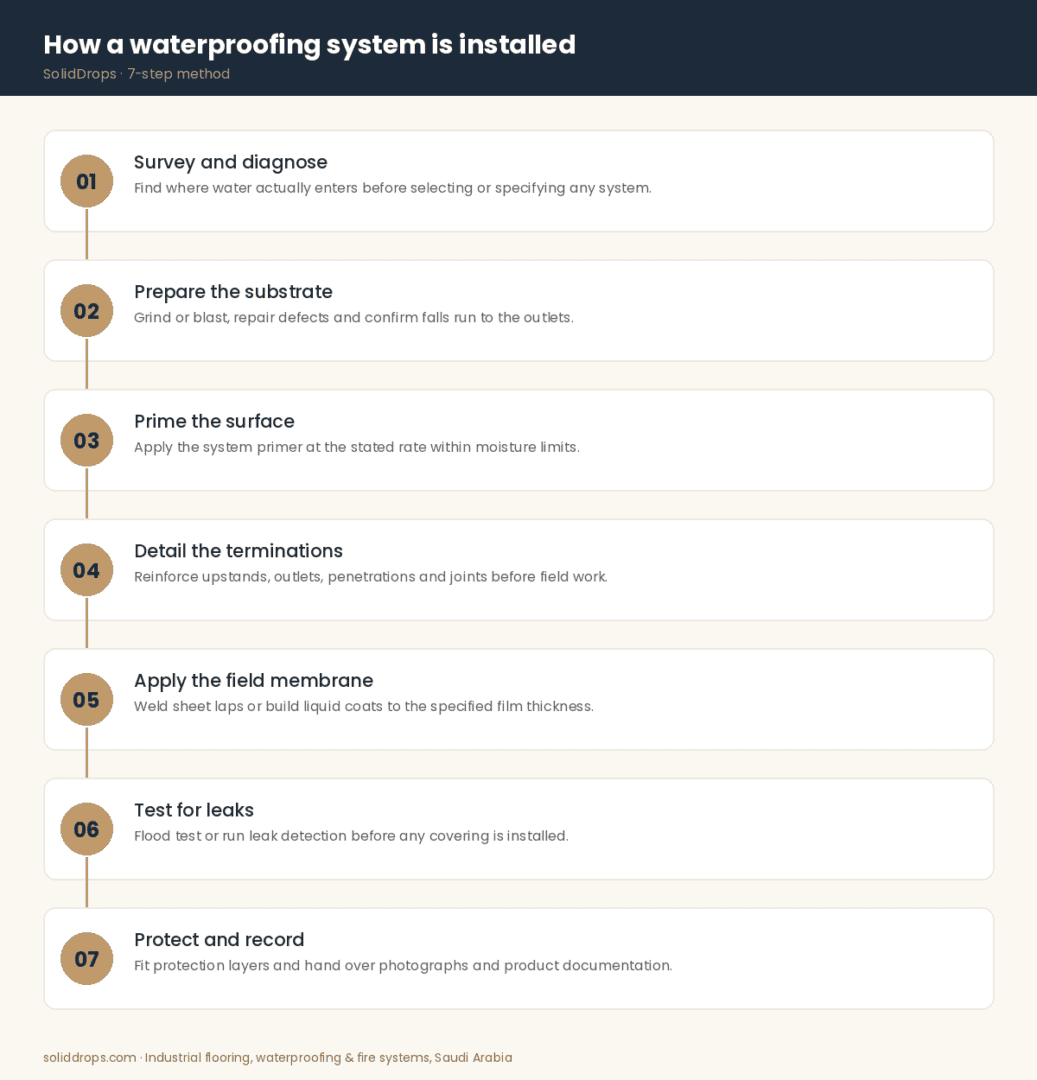
How is waterproofing installed and inspected?
Sequence matters more than product choice, because a well-chosen membrane installed out of sequence will still leak.
- Survey and diagnose. On refurbishment, find where water is entering before deciding what to install. Ingress at a parapet is not solved by recoating a field area.
- Prepare the substrate. Grind or blast, repair spalls and blow-holes, confirm falls to outlets, and treat cracks and joints to the design.
- Prime. To the manufacturer’s system, at the stated rate, on a substrate within the stated moisture limits.
- Detail the terminations. Upstands, outlets, penetrations and movement joints, reinforced and dressed before any field work.
- Apply the field membrane. Sheet laid and welded with seam probing, or liquid applied in the specified number of coats with wet-film thickness checks.
- Test. Flood test where geometry allows, or electronic leak detection on decks that will be covered. Test before anything is buried, never after.
- Protect and hand over. Install protection, screeds or finishes, and record the as-built system with photographs and product data.
ICRI technical guidelines and the ASTM standards library are the reference points for detailing and repair practice, alongside the manufacturer’s own TDS and SDS. The Saudi Building Code sets the national framework the design has to satisfy.
Have a leak you cannot trace?
Send photographs and drawings and we will tell you what needs surveying before anyone specifies a membrane or prices a repair.
What drives waterproofing cost in Riyadh, Jeddah and Dammam?
Rates vary too widely to publish honestly, because two roofs of identical area can differ by a factor of several in price. These are the variables that move the number.
- System type and thickness. A single-coat acrylic and a two-coat reinforced PU are not the same work, and neither is a hot-spray polyurea needing plural-component plant on site.
- Substrate condition. Preparation, repairs and falls correction are frequently a larger share of the cost than the membrane itself.
- Detail density. Count the outlets, upstands, pipe penetrations and joints. A plant deck crowded with equipment plinths costs far more per square metre than an open roof.
- Access and working hours. Occupied buildings, night work, craning material to height, confined tank entry.
- Removal of existing layers. Stripping old bitumen, screed or tiling, and disposing of it.
- Testing and documentation. Flood testing, leak detection surveys and as-built records where a consultant requires them.
- Location. Mobilisation to Jubail, Tabuk, Makkah or Medina against a Riyadh or Jeddah base.
Send drawings, photographs and a description of any current leaks, and request a quotation.
Why does waterproofing fail in Saudi conditions?
Failures here follow a pattern, and the pattern is rarely about the chemistry.
Ponding. Falls that were never built correctly, or outlets set above the finished level. Standing water on a hot roof is a permanent load case no membrane is specified for.
Thermal movement. Surface temperatures on an exposed dark roof swing hard between afternoon and pre-dawn, every day, for years. Rigid systems with poor crack-bridging split at the points of restraint — parapets, upstands, changes of level.
UV. Systems that were specified for buried or covered use, then left exposed because the protection layer was value-engineered out, embrittle and craze.
Sand. Windblown sand abrades exposed coatings, blocks outlets and creates the ponding described above. Roof drainage in KSA needs a cleaning regime, not just a design.
Substrate moisture. Applying a vapour-tight membrane over a slab that has not dried leads to blistering and disbonding, sometimes months later.
Detailing shortcuts. Terminations dressed without reinforcement, laps below the specified width, membrane stopped short at a drain flange. These are the leaks that show up in the first serious rain in Jeddah.
What this means for projects in Saudi Arabia
The environment changes the weighting of the selection criteria rather than the criteria themselves. In Riyadh, the dominant stresses are thermal cycling, UV and dust; crack-bridging capability and UV stability move to the top of the list, and roof drainage needs maintenance access. On the Red Sea coast at Jeddah and on the Gulf at Dammam and Jubail, humidity, salt-laden air and aggressive ground conditions carry more weight, and substrate drying times stretch out — which changes the programme more than most contractors allow for.
Application temperature is its own constraint. Liquid and spray systems have stated substrate temperature limits, and a roof slab in July will exceed them by mid-morning. Night and early-morning application windows are normal practice here, not an exception, and the programme should be written that way from the start.
Below-grade work in coastal and sabkha ground needs the specification to address salts and the water table, not only water. And on any building where the barrier will be buried under landscaping, screed or paving, the testing regime matters more than the product: العزل المائي — waterproofing that cannot be inspected after handover must be proven before it is covered.
Who supplies and installs waterproofing in Saudi Arabia?
SolidDrops supplies and installs waterproofing systems across Saudi Arabia — roofs, wet areas, tanks, basements, podium decks and car parks — from Jeddah, serving Riyadh, Dammam, Jubail, Makkah, Medina and Tabuk. The scope covers survey and diagnosis, substrate preparation, detailing, membrane installation, testing and handover documentation.
Because we work across several system families rather than a single product line, the specification can follow the exposure instead of the stock list. On refurbishment we start with a survey; on new build we prefer to be involved before the falls are cast, because that is the cheapest moment to fix a drainage problem.
Where flooring and waterproofing meet — plant rooms, kitchens, car park decks, sports facilities — the two packages are coordinated so neither trade compromises the other. See our waterproofing services and the gym flooring guide where wet zones sit alongside training areas.
To start a discussion, send drawings and photographs to [email protected] or call +966 50 213 1112.
Frequently asked questions
What is the best waterproofing system for the Saudi Arabia climate?
There is no single best system. Selection follows the exposure: heat, UV, coastal humidity, sand, roof exposure and structural movement. Exposed commercial roofs often suit PVC or EPDM, complex refurbishment suits liquid PU, wet areas and tanks suit cementitious systems, and demanding fast-turnaround work suits spray polyurea. The element and its exposure decide.
How long does roof waterproofing last in Saudi heat?
Service life depends on the system, the quality of installation and the exposure. EPDM membranes are cited at 30-plus years in field studies, with manufacturers quoting a 25 to 50 year range depending on installation and climate. Liquid and coating systems vary widely; take life expectancy from the manufacturer and protect the membrane from UV and ponding.
Is polyurea better than polyurethane for waterproofing?
They serve different situations. Polyurea is spray-applied, cures very fast and suits demanding exposure where speed and continuous coverage matter, but needs specialist plant and trained crews. Liquid PU suits complex detailing, refurbishment, balconies and podiums and is applied more conventionally. Substrate preparation matters more to both than the choice between them.
What is cementitious waterproofing used for?
Cementitious systems are used in wet areas, utility rooms, water-retaining structures such as tanks, and selected below-grade applications on concrete and masonry. They bond directly to the substrate and tolerate immersion. They are not intended for exposed decks subject to significant movement or UV, where a flexible membrane is the correct choice.
Do I need waterproofing for basements in Saudi Arabia?
Yes, wherever the structure sits below ground level or below the water table. Basement work has to address hydrostatic pressure, construction and movement joints, and in coastal or sabkha ground the salts present in groundwater. Joints, kickers and penetrations need designed treatment; they are where below-grade water ingress usually begins.
What causes waterproofing failure in KSA?
The common causes are ponding from incorrect falls or blocked outlets, thermal movement cracking at upstands and restraints, UV degradation of systems left exposed without protection, sand abrasion and drainage blockage, applying membranes over substrates that have not dried, and shortcuts in detailing at outlets, penetrations and terminations.
How much does waterproofing cost in Riyadh?
Cost depends on the system and thickness specified, substrate condition and preparation required, the density of details such as outlets and penetrations, access and working hours, removal of existing layers, and testing and documentation requirements. We quote against drawings and a site inspection rather than publishing rates that would be meaningless without them.
Which waterproofing is best for water tanks?
Water-retaining structures need a lining rated for continuous immersion, and for potable water a product approved for contact with drinking water. Epoxy tank linings and cementitious systems are the usual routes. Confirm the approval documentation, surface preparation standard and cure period before filling, and plan for confined-space access during application.
Specifying waterproofing for a KSA project?
SolidDrops supplies and installs roof, tank, basement, podium and wet-area waterproofing in Riyadh, Jeddah, Dammam, Jubail, Makkah, Medina and Tabuk.
 Chat Online