
21 Sep Waterproofing in Dammam: Heat, Humidity and Tanking
Waterproofing in Dammam: Heat, Humidity and Tanking
Waterproofing in Dammam is governed by heat and moisture acting together. July highs average 45.2°C, rainfall of 87.3mm a year arrives concentrated in winter, and the Gulf coast adds humidity. On industrial buildings, the thermal cycle on an exposed roof does more damage over time than the rain does.
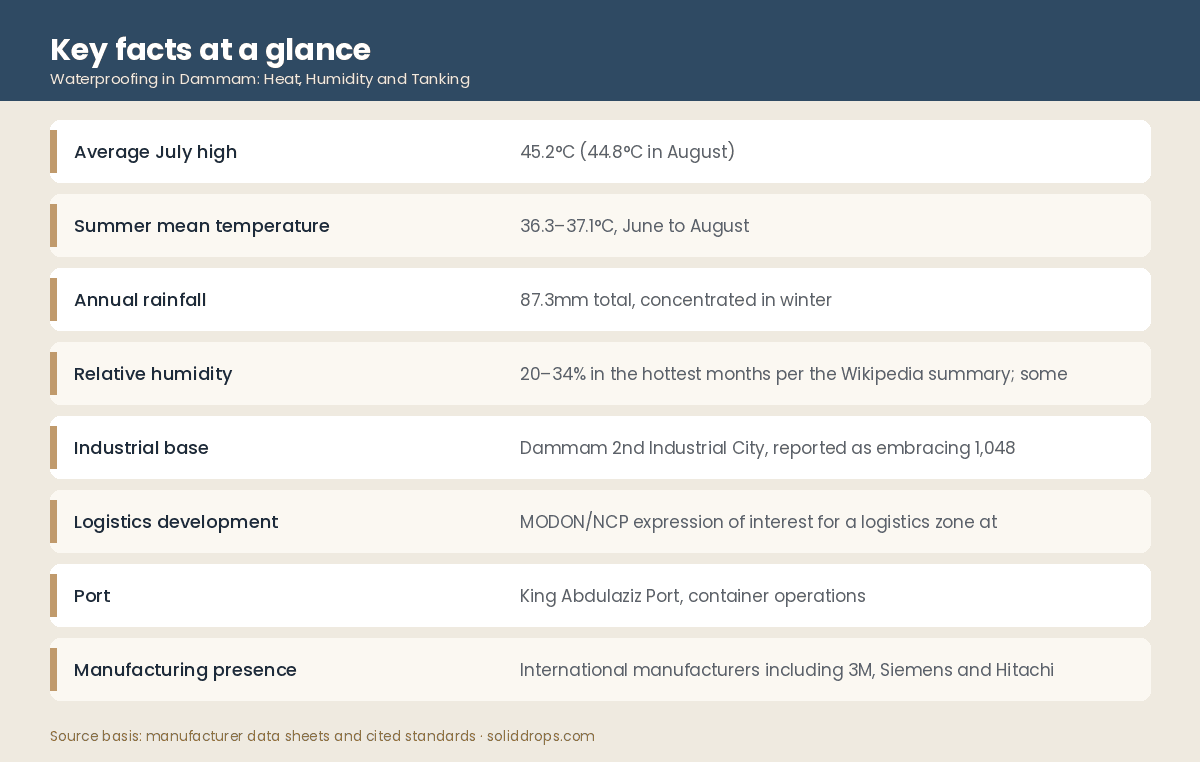
| Property | Value | Basis / standard |
|---|---|---|
| Average July high | 45.2°C (44.8°C in August) | Wikipedia, Dammam climate summary |
| Summer mean temperature | 36.3–37.1°C, June to August | Wikipedia, Dammam climate summary |
| Annual rainfall | 87.3mm total, concentrated in winter | Wikipedia, Dammam climate summary |
| Relative humidity | 20–34% in the hottest months per the Wikipedia summary; some sources show a wider seasonal range up to about 58% | Wikipedia, Dammam; weather-and-climate.com |
| Industrial base | Dammam 2nd Industrial City, reported as embracing 1,048 factories locally and internationally | Modon news release |
| Logistics development | MODON/NCP expression of interest for a logistics zone at Dammam 2nd Industrial City | National Center for Privatization |
| Port | King Abdulaziz Port, container operations | Wikipedia, King Abdulaziz Port |
| Manufacturing presence | International manufacturers including 3M, Siemens and Hitachi Energy; economy dominated by petroleum administration | Wikipedia, Dammam |
What makes waterproofing in Dammam different from inland work?
Waterproofing in Dammam has to hold up under two loads that rarely peak at the same time. Summer brings average July highs of 45.2°C and August highs of 44.8°C, with June-to-August means of 36.3–37.1°C. Rain, by contrast, is a winter event: 87.3mm across the year, concentrated in the cooler months.
That split matters. The membrane spends the hot half of the year doing nothing except surviving, and the wet half doing the job it was bought for. Most of the ageing happens in the season when nobody is looking at the roof. By the time a winter leak appears, the failure was set in place the previous August.
Humidity is the third variable and the one the record treats with least certainty. The Wikipedia summary for الدمام gives 20–34% relative humidity in the hottest months, while other sources show a wider seasonal range reaching around 58%. Where a figure is that unsettled, we do not design to it — we measure dew point on site and work to the reading.
How the Dammam thermal cycle attacks a membrane
A dark exposed roof in an Eastern Province summer runs well above the shade air temperature, then loses that heat overnight. Repeat the cycle daily for a decade and three things happen to the system.
- Movement concentrates at the details. The field of a roof expands and contracts fairly uniformly; the restraint is at upstands, kerbs, plant plinths and column penetrations. Those junctions absorb the strain, and they are where splits appear first.
- Plasticisers and topcoats deplete. Exposed membranes lose surface material under combined heat and UV. A system specified with a sacrificial reflective coat performs as designed only while that coat is maintained on a cycle.
- Adhesion is tested twice a day. Any pocket of trapped moisture under a membrane expands when the deck heats and contracts as it cools, working the bond loose from underneath. This is why a moisture reading before application is not a formality.
The practical response is straightforward and mostly about sequencing. Application windows move to night and early morning through summer because substrate temperature, not air temperature, governs pot life and cure. Material is stored shaded and ventilated. And on a roof that will stay exposed, the specification names the re-coat interval rather than leaving it to the facility team to discover.
What we know, and do not know, about the ground
This section is deliberately cautious. Eastern Province coastal geology is widely described in regional literature as sabkha-prone, with the salinity and low bearing capacity that go with it. Our research pass did not retrieve a Dammam-specific citation for groundwater level or sabkha extent, so we do not publish one, and we do not carry a Jubail or Jeddah figure across and label it Dammam.
What a specifier can act on instead is a testing sequence. Before a tanking system is chosen for a basement, pit or retaining wall in Dammam, three things should exist on paper:
- A standing water level from boreholes, read over enough time to show whether it is stable or seasonal.
- A chemical analysis of the groundwater for chloride and sulfate, which determines both the concrete specification and whether the waterproofing is also being asked to serve as corrosion protection.
- A moisture condition survey of the existing structure where the work is refurbishment rather than new build.
With those three, the choice between a positive-side tanking membrane, a cementitious system and crystalline treatment is an engineering decision. Without them it is a guess dressed as a specification. The system families themselves are compared in our waterproofing systems guide.
Which Dammam buildings need this
Dammam’s demand is industrial and operational rather than residential, and it clusters around a few asset types.
Factory and warehouse roofs
Dammam 2nd Industrial City is reported by Modon as embracing 1,048 factories locally and internationally. Large exposed roof areas over production space, where a winter leak stops a line rather than staining a ceiling.
Tanks, pits and sumps
Process water tanks, fire water storage, lift pits and drainage sumps. These are containment structures, so the lining is holding water in as often as keeping it out.
Logistics and port-adjacent buildings
King Abdulaziz Port container operations and the logistics zone planned at Dammam 2nd Industrial City bring large-footprint buildings with continuous operation and short access windows.
The tenant mix shapes the specification as much as the building does. International manufacturers including 3M, Siemens and Hitachi Energy operate in the city, and facilities of that type typically arrive with their own inspection, documentation and permit-to-work requirements. A method statement that satisfies a warehouse owner will not always satisfy a manufacturing quality system.
Which system suits which Dammam element?
| System | Best for in Dammam | Key local limit |
|---|---|---|
| Sheet membrane (PVC, EPDM) | Large industrial roof areas where daily thermal movement is the governing load | Detail and seam quality at plinths and penetrations decides service life |
| Liquid PU membrane | Roof refurbishment, plant decks, complex detailing around process equipment | Pot life shortens at high substrate temperature; summer work moves to night |
| Cementitious system | Tanks, pits, sumps, wet areas and internal water-retaining structures | Little movement accommodation on its own; needs joint treatment alongside |
| Spray polyurea | Tank and sump linings, and roofs needing rapid return to service | Substrate moisture and dew point must be controlled; trained crews required |
| Positive-side tanking | Basements and retaining walls where boreholes confirm a standing head | Must precede backfill; specify only after groundwater chemistry is known |
| Reflective topcoat | Any exposed roof where summer surface temperature is the ageing driver | A maintenance item on a cycle, not a permanent layer |
Comparison across the families is set out in our system selection guide.
Planning a shutdown in Dammam?
Send roof areas, access restrictions and the window you have. We survey with your facility team before specifying.
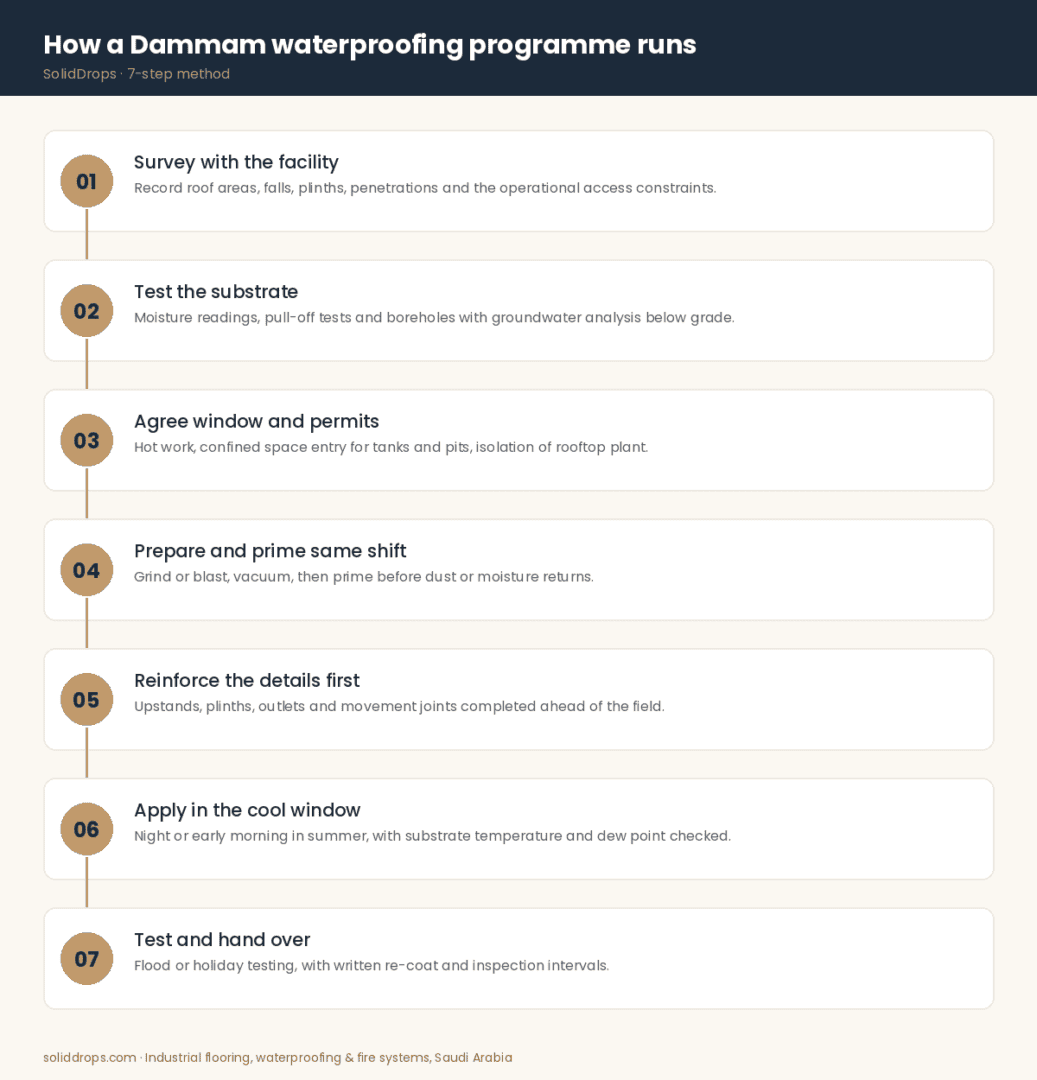
How a Dammam waterproofing programme should run
Plan the programme around two calendars: the plant’s and the weather’s. Roof work is best completed before the winter rainfall window rather than during it, and heavy application work is best kept out of the July and August peak unless night shifts are agreed in advance.
- Survey with the facility team. Roof areas, falls, outlets, plant plinths and every penetration, recorded alongside the operational constraints on access.
- Test the substrate. Moisture readings, adhesion pull-offs and, for buried elements, boreholes with groundwater analysis.
- Agree the window and the permits. Hot work, confined space entry for tanks and pits, and isolation of any plant on the roof.
- Prepare mechanically and prime in the same shift. Grinding or blasting, vacuum extraction, then priming before the surface picks up moisture or dust.
- Complete the details first. Upstands, plinths, outlets and movement joints reinforced and inspected before the field is closed.
- Apply in the cool window. Substrate temperature checked against the data sheet range and against dew point, every shift.
- Test, document, hand over. Flood or holiday testing as the element allows, plus written re-coat and inspection intervals.
For tanks and sumps the confined-space element usually drives the programme more than the coating does. Ventilation, gas testing, standby cover and cure-time occupancy restrictions have to be in the schedule from the start.
What goes wrong on Dammam industrial buildings
- Summer application without substrate temperature control. Material mixed to a data sheet written at 20–25°C, applied to a deck far hotter, gives short working time, poor wetting and pinholes.
- Details left to the field crew. Plant plinths and pipe penetrations on an industrial roof are where thermal movement concentrates. Where they are coated as part of the general area rather than reinforced as details, they split first.
- Moisture trapped under a new membrane. Re-covering a wet deck without drying or a vented build-up puts a blister programme into the roof on day one.
- Tank linings recoated without diagnosis. A leaking tank is sometimes a structural crack, sometimes a joint, sometimes a failed lining. Coating over the first two does not fix them.
- Ground assumptions carried from another city. Specifying tanking for a Dammam basement on the strength of published conditions elsewhere in the Eastern Province, rather than site boreholes.
The pattern is consistent: the material is rarely the problem. Conditions during application and detailing at discontinuities account for most of what we are asked to investigate.
What drives waterproofing cost in Dammam
Pricing follows the survey, and no rate is published here. The variables that move a Dammam figure are largely operational.
- Shutdown and access windows. Night shifts, weekend working and phased handover of roof bays around continuous production.
- Permits and confined space. Tank, pit and sump work carries ventilation, gas testing and standby provision.
- Substrate condition. Falls correction, crack repair, spalled concrete repair and drying time before application.
- Detail density. Process roofs with plinths, ducts and pipe runs cost more per square metre than clear warehouse decks.
- Testing and documentation. Pull-off testing, flood testing, and the documentation standard required by a manufacturing quality system.
- Mobilisation distance. Work across the wider Eastern Province carries plant movement and travel that city-centre work does not.
Send drawings, roof areas, photographs and any known access restrictions, and request a quotation against the real scope.
Who supplies and installs waterproofing in Dammam
SolidDrops supplies and installs waterproofing systems in Dammam and across the Eastern Province — sheet membranes, liquid PU, polyurea, cementitious systems, tank and sump linings, joint treatment and associated construction chemicals — for factories, warehouses, logistics buildings, plant rooms and buried structures.
Work on industrial assets starts from the operational constraint, not the product catalogue: what can be taken out of service, for how long, and what has to be documented. Below grade, it starts from borehole data. Our city page, flooring and waterproofing support in Dammam, sets out the service scope, and epoxy flooring in Dammam covers the floor systems that usually sit under the same shutdown.
Send scope and drawings to [email protected] or call +966 50 213 1112 to arrange a survey.
Frequently asked questions
What waterproofing is best for Dammam's climate?
It depends on the element. Large industrial roofs with daily thermal movement suit sheet membranes; refurbishment and detail-heavy plant decks suit liquid PU; tanks, pits and sumps suit cementitious systems or polyurea linings. On any exposed roof, the reflective or UV-stable topcoat and its re-coat interval matter as much as the base system.
Does Dammam have high groundwater problems?
Regional literature describes Eastern Province coastal geology as sabkha-prone, but our research pass did not retrieve a Dammam-specific citation for groundwater level or sabkha extent. We therefore treat it as a site measurement: boreholes, a standing water level read over time, and chloride and sulfate analysis before any tanking system is specified.
Can waterproofing be applied during a Dammam summer?
Yes, with the window shifted. July highs average 45.2°C and August 44.8°C, so substrate temperature rather than air temperature governs pot life and cure. Work moves to night and early morning, material is stored shaded and ventilated, and dew point is checked by instrument each shift rather than estimated from the forecast.
How long does roof waterproofing last in Eastern Province heat?
Service life depends on the system and on whether the maintenance cycle is kept. The governing variable on an exposed Dammam roof is usually the sacrificial surface coat, which depletes under heat and UV. A roof re-coated on schedule with details inspected annually behaves very differently from one left untouched between leaks.
What causes waterproofing failure in industrial buildings?
Most failures we investigate trace to application conditions or detailing rather than the material. Common causes are application to a deck above the data sheet temperature range, trapped moisture under a new membrane, details at plant plinths and penetrations coated as general area rather than reinforced, and re-lining a tank without diagnosing whether the leak is structural.
How much does waterproofing cost in Dammam?
No rate is published because scope sets the price. Shutdown and access windows, confined space permits for tanks and pits, substrate repair and drying time, detail density on process roofs, the documentation standard a manufacturing quality system requires, and mobilisation distance across the Eastern Province all move the figure. Request a quotation against your scope.
Who does waterproofing in Dammam industrial city?
SolidDrops is a supplier and installer of waterproofing systems in Dammam and the wider Eastern Province, covering factory and warehouse roofs, tanks, pits, sumps, plant rooms and buried structures. Enquiries go to [email protected] or +966 50 213 1112, and a survey with the facility team normally precedes any recommendation.
Waterproofing support in Dammam
Supplier and installer of industrial roof, tank, pit and below-grade waterproofing across the Eastern Province.
 Chat Online