
20 Sep Waterproofing in Jeddah: Storm Water, Salt and Humidity
Waterproofing in Jeddah: Storm Water, Salt and Humidity
Waterproofing in Jeddah is specified against three separate loads, not one. Storm rainfall that has been recorded at several times the 59.5mm annual average; summer humidity of 53–59% with September dew points above 27°C; and sabkha ground with salt content that attacks concrete and reinforcement. Each needs a different answer.
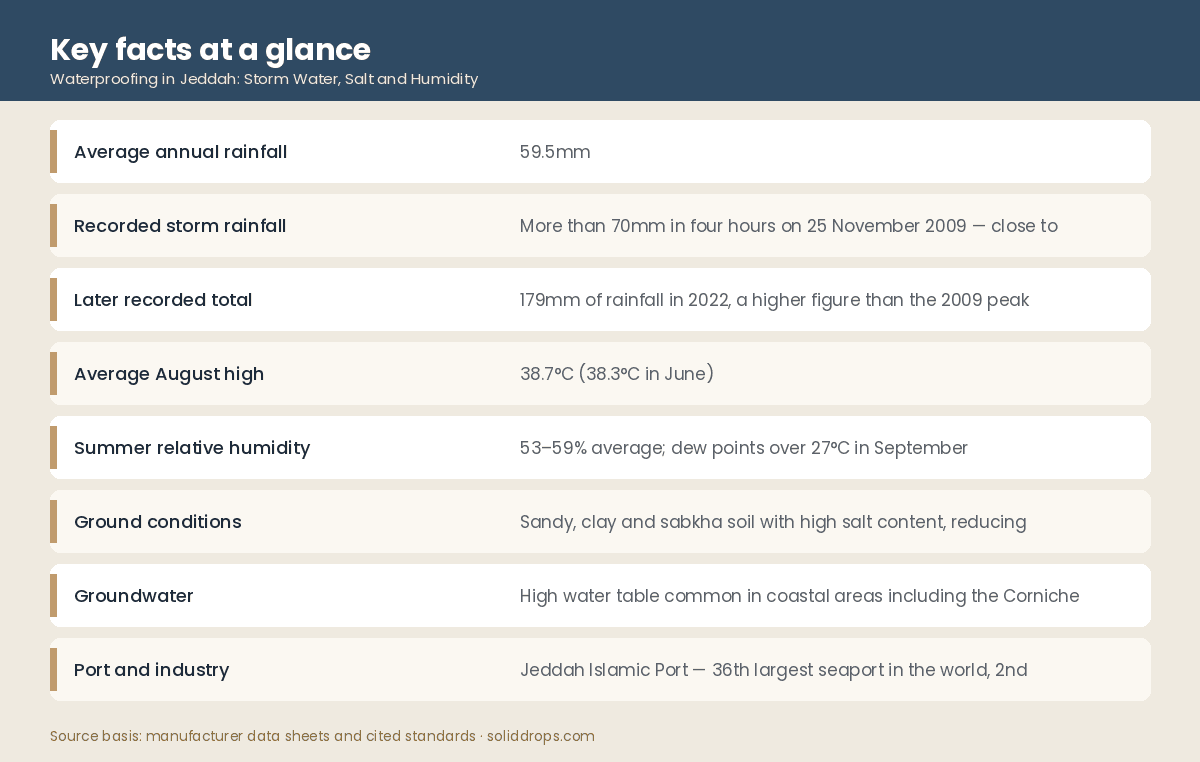
| Property | Value | Basis / standard |
|---|---|---|
| Average annual rainfall | 59.5mm | Wikipedia, Jeddah climate summary |
| Recorded storm rainfall | More than 70mm in four hours on 25 November 2009 — close to double the annual average | 2009 Jeddah floods record |
| Later recorded total | 179mm of rainfall in 2022, a higher figure than the 2009 peak | Arab News via PressReader |
| Average August high | 38.7°C (38.3°C in June) | Wikipedia, Jeddah climate summary |
| Summer relative humidity | 53–59% average; dew points over 27°C in September | Wikipedia, Jeddah climate summary |
| Ground conditions | Sandy, clay and sabkha soil with high salt content, reducing bearing capacity and causing corrosion | Asas Lab, soil nature in Jeddah |
| Groundwater | High water table common in coastal areas including the Corniche and South Jeddah | Groundwater rise vulnerability mapping, Jeddah |
| Port and industry | Jeddah Islamic Port — 36th largest seaport in the world, 2nd busiest in the Middle East; industrial district 4th largest in Saudi Arabia | Wikipedia, Jeddah |
Why is waterproofing in Jeddah a storm problem, not a rainfall problem?
Jeddah’s average annual rainfall is 59.5mm. That number tells you almost nothing useful, because the city’s rain does not arrive as an average. On 25 November 2009 more than 70mm fell in four hours — close to double the whole year’s average in a single afternoon. In 2022 the recorded total reached 179mm, higher than the 2009 peak.
A drainage system and a roof sized around the annual figure will be overwhelmed by the event figure. That is the central design decision here: the waterproofing layer on a Jeddah roof or podium has to behave as a temporary tank liner for a few hours, not as a shedding surface. Overflow provision, upstand height and outlet capacity are the items that decide whether a building takes water in, and they are decided long before anyone opens a drum.
We are describing recorded meteorology, not attributing a cause or a remedy to anyone. What the record justifies is a design assumption: in جدة, size the detail for the storm, not for the year.
What coastal humidity does to application in Jeddah
Jeddah summers average 53–59% relative humidity, with September dew points above 27°C. That combination changes how a coating behaves on site far more than the 38.7°C August high does.
- Dew point governs the start time. A slab or roof deck sitting below the dew point carries a film of moisture the eye cannot see. Epoxy and polyurethane primers applied onto it lose adhesion or blush. The rule on our Jeddah sites is a substrate temperature at least 3°C above the measured dew point, checked with an instrument at the start of each shift and again after any break.
- Night work is not automatically the answer. In Riyadh, moving to night shifts solves a heat problem. On the Jeddah coast the same move can walk a crew straight into the worst dew point of the 24 hours. The window has to be chosen against readings, not habit.
- Moisture-tolerant chemistry earns its place. Where the programme cannot wait for a slab to dry, moisture-tolerant primers and cementitious systems are the honest choice rather than forcing a product outside its stated conditions.
Enclosed spaces make this worse. A basement or tank interior in September holds warm, saturated air with nowhere to go, and cure conditions inside bear no relation to the weather report. Dehumidification and forced ventilation belong in the method statement for those areas.
What the ground and water table mean below grade
Jeddah soil is documented as a mix of sandy, clay and sabkha material with high salt content, which reduces bearing capacity and drives corrosion. A high groundwater table is common in the coastal areas, including around the Corniche and in South Jeddah, where it makes excavation difficult. Chloride and sulfate attack on concrete and reinforcement is a recognised risk in this ground.
Three consequences for a below-grade specification follow directly.
- Design for pressure, not damp. Where the standing water level sits above the slab, the structure is holding back a head of water permanently. A negative-side coating applied internally is fighting hydrostatic pressure from the wrong face; the durable answer is a tanking system on the positive side, installed before the structure is backfilled.
- Treat the waterproofing as corrosion protection. In salt-bearing ground, keeping chloride-carrying water away from the reinforcement is the waterproofing layer’s second job. A crack that would be cosmetic inland is a corrosion pathway here.
- Detail the joints as the weak point. Construction joints, kickers and service penetrations are where tanking fails. Waterstops and joint treatment are specified as part of the system, not bought separately at the end.
The wider system comparison sits in our waterproofing systems guide.
Which Jeddah buildings carry the exposure
The city’s building stock puts specific elements in the firing line.
Port and logistics buildings
Jeddah Islamic Port is the 36th largest seaport in the world and the second busiest in the Middle East. Warehouses and handling buildings around it combine large roof areas, salt-laden air and almost no tolerance for closure.
Industrial estates
Jeddah’s industrial district is the fourth largest in Saudi Arabia, and the Jeddah 3rd Industrial City sits within it. Process roofs, wash-down floors and bunded areas all need water managed rather than merely repelled.
Waterfront and podium developments
Programmes such as Jeddah Central place landscaped and trafficked decks over occupied space, close to the sea and to a high water table.
Older stock matters too. Buildings put up before storm loading was treated as a design case often have shallow parapet upstands and a single outlet per roof bay. On those, a refurbishment that only replaces the membrane and leaves the drainage alone repeats the original fault in a newer material.
Which system suits which Jeddah element?
| System | Best for in Jeddah | Key local limit |
|---|---|---|
| Positive-side tanking membrane | Basements and retaining walls in the coastal high-water-table belt | Has to be installed before backfill; retrofitting from inside is a compromise, not an equivalent |
| Cementitious system | Wet areas, tanks, lift pits, internal plant rooms | Accommodates little movement on its own; pair with joint treatment |
| Liquid PU membrane | Roof refurbishment, detail-heavy plant roofs, balconies and terraces | Dew point governs application; needs a UV-stable topcoat if exposed |
| Sheet membrane (PVC, EPDM) | Large port and logistics roof areas with thermal movement | Wind uplift and seam detailing near the coast are the governing risk |
| Spray polyurea | Podium decks and tank linings needing rapid return to service | Surface moisture and dew point must be controlled; trained spray crews required |
Selection between these families across the Kingdom is compared in our system selection guide. The Jeddah weighting is different from the inland weighting: storm loading and chloride exposure move up, dust moves down.
Roof or basement leak in Jeddah?
Send roof areas and photographs of outlets, parapets and any damp patch below grade. The survey comes first.
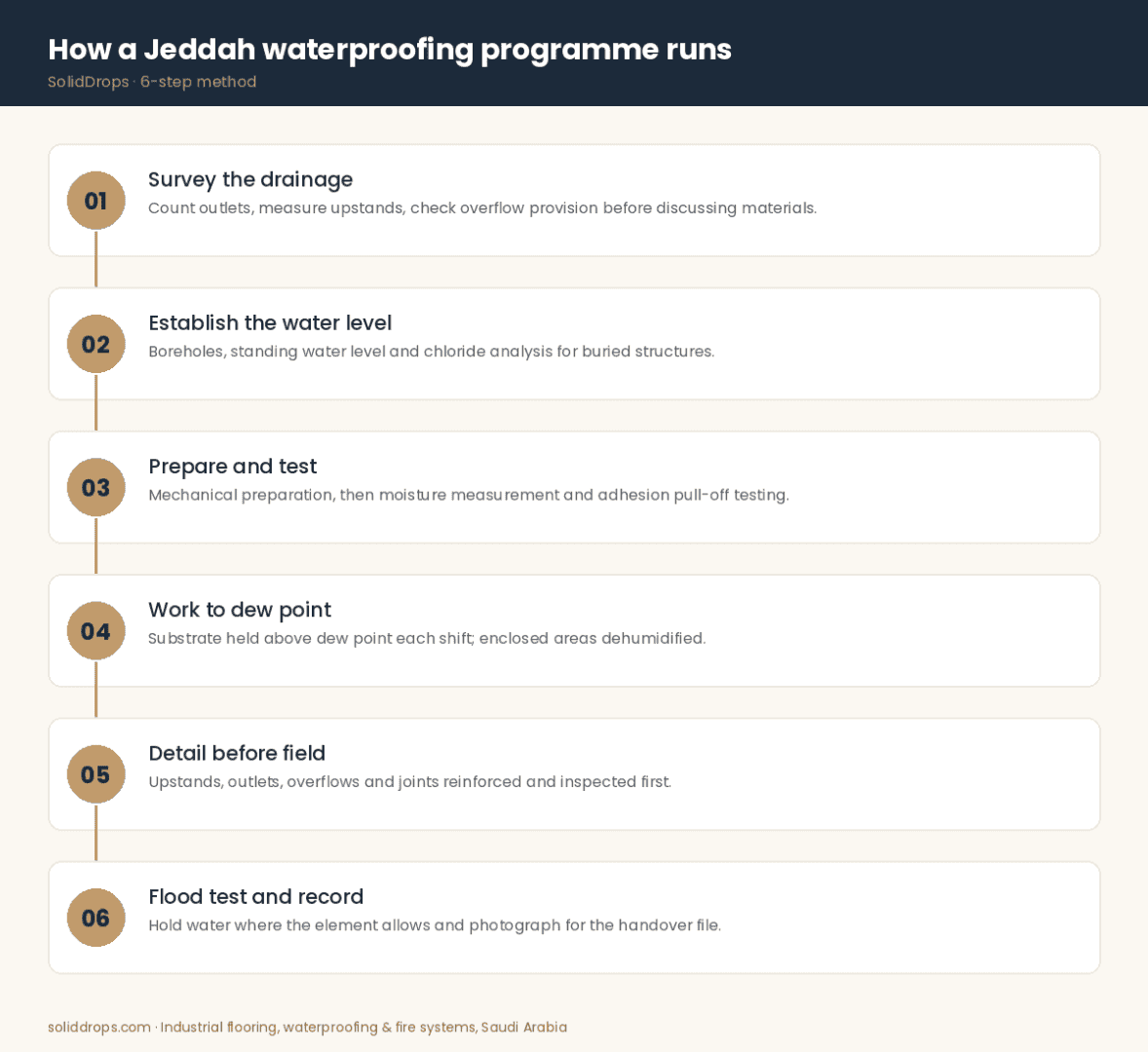
How a Jeddah waterproofing programme should run
Sequence the work against the calendar as much as the drawing. Jeddah’s rain arrives in winter, so roof refurbishment on a live building is better completed before that window than started inside it. A roof stripped back to deck in November is a liability.
- Survey the drainage first. Count outlets, measure upstand heights, check for overflow provision. This is the storm-capacity assessment, and it comes before any material discussion.
- Establish the water level below grade. Boreholes and a standing water level, plus chloride and sulfate analysis where the structure is buried.
- Prepare and test the substrate. Mechanical preparation, then moisture measurement and pull-off testing rather than a visual judgement.
- Work to dew point readings. Substrate temperature at least 3°C above dew point at the start of every shift; enclosed areas dehumidified.
- Complete details ahead of the field. Upstands, outlets, overflows, penetrations and movement joints, reinforced and inspected before the main area is closed.
- Flood test and record. Where the element allows, hold water and photograph the result as part of the handover file.
Access planning in Jeddah usually means night or weekend work around port and logistics operations, and a material delivery route that survives city traffic restrictions.
What goes wrong on Jeddah buildings
- Drainage sized for the average. Outlets and overflows adequate for 59.5mm a year, faced with a storm event, back up. The membrane is then blamed for a hydraulic failure.
- Upstands too low to hold a temporary head. If the roof is going to pond for a few hours, the upstand has to be taller than the pond. Many are not.
- Internal tanking used against external pressure. A coating applied to the inner face of a basement wall in the coastal belt is being pushed off its substrate by the water it is meant to stop.
- Coating applied below dew point. Blush, poor adhesion and pinholing that appear weeks later as blisters, traced back to a shift that started before anyone took a reading.
- Chloride ignored in repair work. Patching spalled concrete without addressing contaminated cover concrete puts the repair on a corroding substrate.
None of these is a material defect. All of them are decisions made before or during installation, which is why a specification that does not name the test conditions is an incomplete specification.
What drives waterproofing cost in Jeddah
Pricing follows the survey. The variables that move a Jeddah figure most are these:
- Drainage and overflow upgrades. Additional outlets, raised upstands and overflow scuppers are structural work that often accompanies a roof re-cover.
- Below-grade access. Whether a retaining wall can be tanked from the positive side or only treated internally changes both the system and the excavation cost.
- Dewatering and ground conditions. Excavation in the high-water-table coastal belt carries dewatering that a dry inland site does not.
- Environmental control. Dehumidification, forced ventilation and dew point monitoring in enclosed areas are priced scope.
- Operational restrictions. Port, logistics and hospitality buildings often permit only night or weekend work.
- Testing and documentation. Flood tests, adhesion pull-offs, moisture readings and a photographic handover file.
- Mobilisation distance. Sites on the industrial fringes or along the coast north and south of the city carry more plant movement.
Send roof areas, drawings and photographs of outlets and parapets, and request a quotation against the actual scope.
Who supplies and installs waterproofing in Jeddah
SolidDrops supplies and installs waterproofing systems in Jeddah — positive-side tanking, cementitious systems, liquid PU, sheet membranes, polyurea linings, waterstops and joint treatment — for port and logistics buildings, industrial estates, commercial towers and waterfront developments.
Our approach on the coast starts with two measurements: the drainage capacity of the element and, below grade, the standing water level with a chemical analysis of the groundwater. Product selection follows those numbers. The service scope and enquiry route are on our city page, flooring and waterproofing support in Jeddah, and the floor side is covered in epoxy flooring in Jeddah.
Send drawings and photographs to [email protected] or call +966 50 213 1112 to arrange a Jeddah site visit.
Frequently asked questions
Why does Jeddah get flooding when annual rainfall is so low?
Because the rain is concentrated. The average annual figure is 59.5mm, but more than 70mm was recorded in four hours on 25 November 2009, and a 179mm total was recorded in 2022. Drainage and roofs sized around the annual average are faced with event rainfall several times larger, over a few hours.
How do you waterproof a basement with high groundwater in Jeddah?
Establish the standing water level and groundwater chemistry by borehole first. Where the level sits above the slab, the structure holds a permanent head, so a positive-side tanking system installed before backfill is the durable answer. Joints, kickers and service penetrations need waterstops and joint treatment specified as part of the same system.
Does sabkha soil affect waterproofing in Jeddah?
It affects what the waterproofing has to protect. Jeddah soil includes sandy, clay and sabkha material with high salt content that reduces bearing capacity and drives corrosion, and chloride and sulfate attack on concrete and reinforcement is a documented risk. The membrane’s second job is keeping salt-bearing water away from the steel.
Which waterproofing membrane suits Jeddah's climate?
The element decides. Large port and logistics roofs with thermal movement suit sheet membranes; refurbishment and detail-heavy roofs suit liquid PU; tanks, wet areas and lift pits suit cementitious systems; podium decks needing fast return to service suit polyurea. Dew point control during application matters as much as the family chosen.
Can waterproofing be applied during Jeddah's humid season?
Yes, with instrument control. Summer humidity averages 53–59% and September dew points exceed 27°C, so substrate temperature is kept at least 3°C above the measured dew point at the start of each shift. Enclosed basements and tanks need dehumidification and forced ventilation written into the method statement.
How much does waterproofing cost in Jeddah?
No rate is published because the survey sets the price. Drainage and overflow upgrades, whether a wall can be tanked from the positive side, dewatering in the coastal belt, environmental control in enclosed areas, night or weekend access around port operations, testing scope and mobilisation distance all move the figure. Ask for a priced survey.
Who does waterproofing near the Jeddah Corniche?
SolidDrops is a supplier and installer of waterproofing systems across Jeddah, including the coastal belt where a high groundwater table is common. Work covers roofs, podium decks, basements, retaining walls, tanks and wet areas. Contact [email protected] or +966 50 213 1112; a survey normally precedes any system recommendation.
Waterproofing support in Jeddah
Supplier and installer of roof, podium, tank and below-grade waterproofing systems across Jeddah.
 Chat Online