
19 Sep Waterproofing in Riyadh: Roofs, Tanks and Basements
Waterproofing in Riyadh: Roofs, Tanks and Basements
Waterproofing in Riyadh is driven less by how much rain falls than by how it falls. Annual totals are around 100mm, but that water arrives in short storms onto flat roofs that drain slowly. Add near-continuous UV, wide daily temperature swings and dust, and the detailing decides everything.
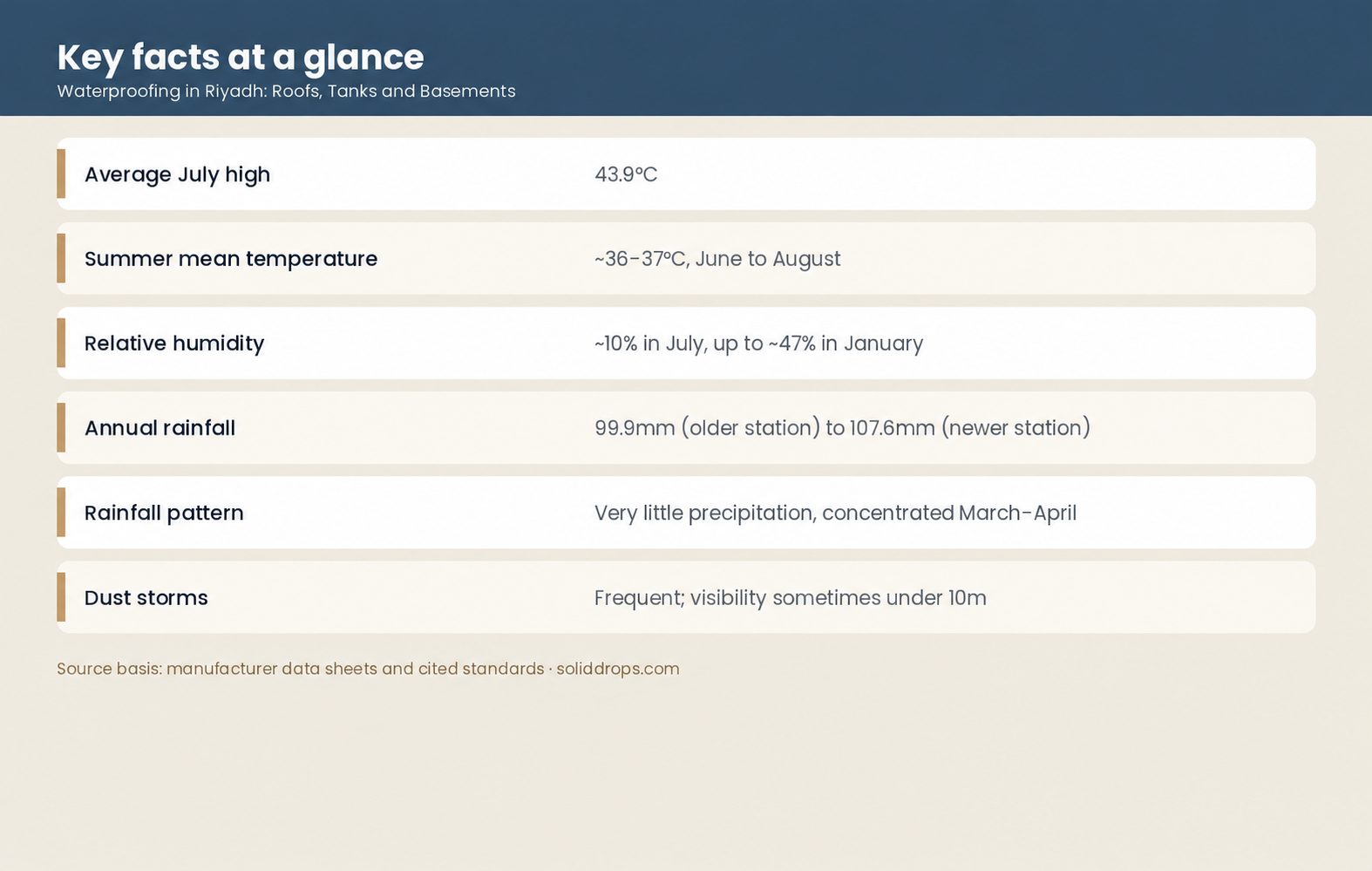
| Property | Value | Basis / standard |
|---|---|---|
| Average July high | 43.9°C | Wikipedia, Riyadh climate summary |
| Summer mean temperature | ~36–37°C, June to August | Wikipedia, Riyadh climate summary |
| Relative humidity | ~10% in July, up to ~47% in January | Wikipedia, Riyadh climate summary |
| Annual rainfall | 99.9mm (older station) to 107.6mm (newer station) | Wikipedia, Riyadh climate summary |
| Rainfall pattern | Very little precipitation, concentrated March–April | Climate of Saudi Arabia |
| Dust storms | Frequent; visibility sometimes under 10m | Climate of Saudi Arabia |
Does a city with 100mm of rain a year need waterproofing?
Yes, and the reason is distribution rather than total. Waterproofing in Riyadh deals with roughly 99.9mm to 107.6mm of rain a year depending on which station you read, concentrated into March and April. A year’s water can reach a roof across a handful of afternoons, so a membrane is asked to hold a standing pool for hours, then bake dry.
The second load is constant and invisible. Average July highs sit at 43.9°C, June to August means around 36–37°C, and relative humidity drops to roughly 10% in July. Exposed membranes age under ultraviolet light every day of the year, not only the short wet weeks. By the time rain arrives the membrane is older than its calendar age suggests.
So the failures we are called to in الرياض are rarely dramatic. They are a slow loss of surface, a split at a movement joint, a lifted upstand behind a parapet — and then one storm that finds all three at once.
What Riyadh's climate does to the material on site
Heat compresses the working window. Liquid-applied polyurethane and epoxy products have pot lives quoted at 20–25°C on the technical data sheet; at a surface temperature well above that, the same mix stiffens in the bucket. Substrate temperature, not air temperature, governs this, and a dark roof deck in July sits far above the shade reading. Crews that mix full kits at midday waste material.
Three practical consequences follow, and they are the ones we set out at survey stage:
- Shift the application window. Early morning and evening work keeps substrate temperature inside the range the data sheet was written for. Night application is routine on large Riyadh roofs during summer.
- Control material storage. Drums left on an unshaded roof deck all day are not the product the manufacturer tested. Shaded, ventilated storage is a specification item, not a courtesy.
- Watch the dust, not the humidity. At around 10% relative humidity, condensation is rarely the problem it is on the coast. Airborne dust is. Frequent dust storms, with visibility sometimes under 10 metres, will settle a fine film on a primed deck within an hour and destroy adhesion.
Winter is a different job. Humidity climbs to roughly 47% in January, and the dew point can catch a cold deck at dawn.
What the ground under Riyadh means for below-grade work
Riyadh sits on an inland plateau, and that changes the below-grade conversation compared with the Eastern Province or the Red Sea coast. Our research pass found no Riyadh-specific documentation of sabkha ground or a persistent high groundwater table, so we do not assume one. What we do instead is treat groundwater as a measured quantity rather than an inherited assumption: boreholes, a standing water level, and a chemical analysis of the groundwater before anyone writes a tanking specification.
That discipline matters because the failure mode in a dry city is counter-intuitive. Basements here leak less often from a rising table and more often from water the building itself makes and holds — a leaking buried tank, a cracked drainage run, irrigation over a podium, a car park wash-down with nowhere to go.
Two rules follow. Find the source before choosing a system; tanking applied over an active leak from a services penetration only moves the damp patch two metres sideways. And where groundwater chemistry is unknown, close the gap with testing rather than a product assumption. The principles are set out in our waterproofing systems guide.
Which Riyadh buildings need this most
Three building types account for most of the waterproofing work we are asked to price in the city.
Large-span industrial roofs
Warehouses and factories in and around Riyadh 2nd Industrial City carry wide flat or low-fall roof areas. Long spans mean thermal movement, and thermal movement means joints that have to stay flexible after years of UV.
Water tanks and plant rooms
Buried and rooftop storage tanks, pump rooms and utility spaces. A tank lining is a potable-water or containment decision as much as a waterproofing one, and it is inspected far less often than a roof.
Podium decks and landscaped slabs
Mixed-use and public realm projects put soil, irrigation and paving over occupied space. The membrane becomes unreachable the day the landscaping goes in.
Which system suits which Riyadh element?
| System | Best for in Riyadh | Key local limit |
|---|---|---|
| Liquid PU membrane | Roof refurbishment over existing falls, complex plant-room roofs, upstands and penetrations | Pot life shortens sharply at high substrate temperature; needs a UV-stable topcoat if left exposed |
| Sheet membrane (PVC, EPDM) | Large-span industrial roofs where thermal movement is the governing load | Seam and upstand quality decides the result; wind uplift detailing at parapets is critical |
| Cementitious system | Wet areas, plant rooms, water tanks, buried structures | Not a movement-accommodating layer on its own; needs joint treatment alongside |
| Spray polyurea | Fast turnaround on occupied buildings, tank and pit linings | Requires trained spray crews and controlled surface conditions; dust during application is fatal to adhesion |
| Reflective / UV topcoat | Any exposed membrane where surface temperature is the main ageing driver | Consumable — it is a maintenance item on a cycle, not a permanent layer |
The comparison between these families across the Kingdom is set out in more depth in our system selection guide. What changes in Riyadh is the weighting: UV and thermal cycling dominate, standing water is intermittent but severe, and salt exposure is not the driver it is on either coast.
Leak on a Riyadh roof?
Send roof areas, drawings and photographs of the parapet and outlets. We survey before we specify.
How a Riyadh waterproofing programme should run
Survey a Riyadh roof twice where the programme allows: once dry, to read the details, and once under flood test, to see where water goes. Flat roofs here are often nominally to falls and functionally flat. Ponding marks — the ring of dust left when a pool evaporates — are the most useful thing on the deck, because they show the low points that will hold water during the March rains.
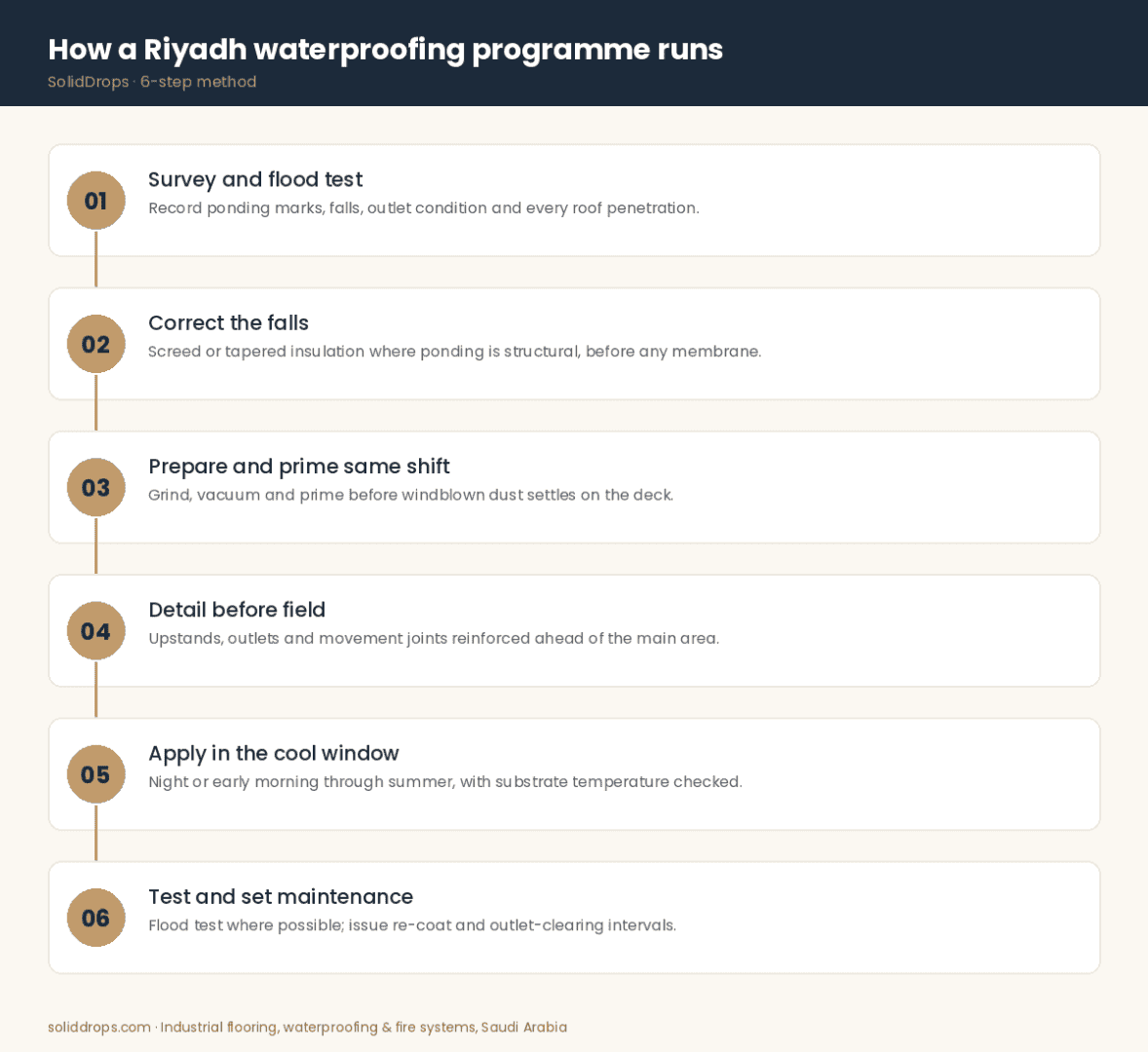
From there the sequence is conventional but the constraints are local:
- Survey and flood test. Record ponding, falls, outlet condition and every penetration. Photograph the parapet junction along its full length.
- Fix the falls first. Where ponding is structural, a screed or tapered insulation correction goes in before any membrane. Waterproofing does not drain a roof.
- Prepare and dust-manage. Grind or blast, vacuum, then prime within the same shift. A dust storm between preparation and priming means preparation again.
- Detail before field. Upstands, outlets, pipe penetrations and movement joints are completed as reinforced details before the main area goes down.
- Apply in the right window. Early morning, evening or night through summer, with substrate temperature checked, not assumed.
- Test and hand over. Flood test where the element allows, with written maintenance intervals.
Access is the other planning item. Warehouse and plant roofs usually need a shutdown or weekend window, with crane time landing alongside the material delivery.
What goes wrong on Riyadh roofs
The same four faults account for most of the leaks we are asked to investigate in the city, and none of them are a failure of the membrane in the field.
- Parapet upstands terminated short. A membrane taken 100mm up a parapet and stopped with a bead of sealant will survive years of dry weather and fail in the first storm that drives water sideways. The termination needs a mechanical detail and a proper chase or counter-flashing.
- Outlets blocked with sand. An outlet that drains fine in still conditions blocks in the first minutes of a storm, and the roof becomes a shallow tank.
- UV-exposed membrane never re-coated. Liquid systems are specified with a UV-stable topcoat, then left. Years later the base layer is chalked and brittle, and the owner is told the membrane failed early.
- Waterproofing used to correct falls. Building up a liquid membrane to fill a pond creates a thick, slow-curing, differentially stressed patch that cracks along its edge.
All four are detailing and maintenance issues, which is why a re-coat and outlet-clearing interval belongs in the handover document.
What drives waterproofing cost in Riyadh
We quote against a survey, not a rate card. The variables below move a Riyadh price more than the membrane family does.
- Substrate condition and falls correction. If ponding has to be designed out with screed or tapered insulation, that work can exceed the membrane cost.
- Detail density. A plant room roof with forty penetrations is a different job from a clear warehouse deck of the same area.
- Access and shutdown. Night working, crane time, hot-work permits and live-facility restrictions all carry cost.
- Season and window length. Summer application shifted to night hours changes crew productivity; work squeezed into a short shutdown changes crew size.
- Mobilisation distance. Sites on the outer industrial fringes of Riyadh carry more travel and plant movement than city-centre work.
- Testing and warranty scope. Flood testing, adhesion pull-offs and any manufacturer-backed system warranty add scope that has to be priced.
Send drawings, roof areas and photographs of the parapet and outlets, and a quotation can be built against the actual scope.
Who supplies and installs waterproofing in Riyadh
SolidDrops supplies and installs waterproofing systems in Riyadh — liquid PU and polyurea, sheet membranes, cementitious systems, tank linings, joint treatment and associated construction chemicals — for industrial, commercial and public-realm buildings across the city and the surrounding industrial areas.
The work starts with a survey rather than a product recommendation: reading falls and details on a roof, establishing the groundwater position by measurement below grade. Our city page, flooring and waterproofing support in Riyadh, sets out the service scope, and epoxy flooring in Riyadh covers the floor side where the packages meet at plant rooms and wash-down areas.
Send roof areas, drawings and photographs to [email protected] or call +966 50 213 1112. A site visit is the fastest way to turn a leak report into a defensible specification.
Frequently asked questions
Why do buildings in Riyadh leak when it hardly rains?
Because the rain arrives in concentrated bursts. Riyadh sees roughly 100mm a year, mostly in March and April, landing on flat roofs that drain slowly and outlets that collect windblown sand. Meanwhile the membrane has been ageing under UV and 43.9°C July highs all year. The storm does not cause the failure; it finds it.
What is the best roof waterproofing system for Riyadh?
It depends on the roof. Large-span industrial decks where thermal movement dominates suit sheet membranes; refurbishment over existing falls and detail-heavy plant roofs suit liquid PU; tanks and wet areas suit cementitious systems or polyurea linings. In every case a UV-stable topcoat and a re-coat interval matter more in Riyadh than the base choice.
Does Riyadh have a high groundwater table?
Riyadh is an inland plateau city, and our research pass found no Riyadh-specific documentation of sabkha ground or a persistent high water table, unlike the coastal cities. Groundwater should be established by borehole and standing water level on each site rather than assumed before a tanking specification is written.
Can waterproofing be applied during a Riyadh summer?
Yes, with the application window shifted. Substrate temperature, not air temperature, governs pot life and cure, so summer work moves to early morning, evening or night, with shaded material storage. The larger summer risk is dust: a dust storm between surface preparation and priming means preparing the surface again.
How long does roof waterproofing last in Riyadh?
Service life depends on the system, the exposure and whether the maintenance cycle is kept. In Riyadh the governing variable is usually the UV-exposed surface, which is a consumable layer. A roof that is re-coated on schedule and has its outlets cleared before the spring rains behaves very differently from one left untouched.
How much does waterproofing cost in Riyadh?
We do not publish rates, because the substrate decides the price. Falls correction, detail density around penetrations, access and shutdown conditions, night working in summer, mobilisation distance to outer industrial areas, and the testing and warranty scope all move the figure. Send drawings and photographs and request a quotation against the actual scope.
Who does waterproofing in Riyadh?
SolidDrops is a supplier and installer of waterproofing systems in Riyadh, covering roofs, podium decks, water tanks, plant rooms and below-grade elements for industrial, commercial and public-realm buildings. Enquiries go to [email protected] or +966 50 213 1112, and a survey normally precedes any system recommendation.
Waterproofing support in Riyadh
Supplier and installer of roof, tank, deck and below-grade waterproofing systems across Riyadh.
 Chat Online