
12 Sep Epoxy Flooring in Riyadh: Heat, Dust and Site Conditions
Epoxy Flooring in Riyadh: Heat, Dust and Site Conditions
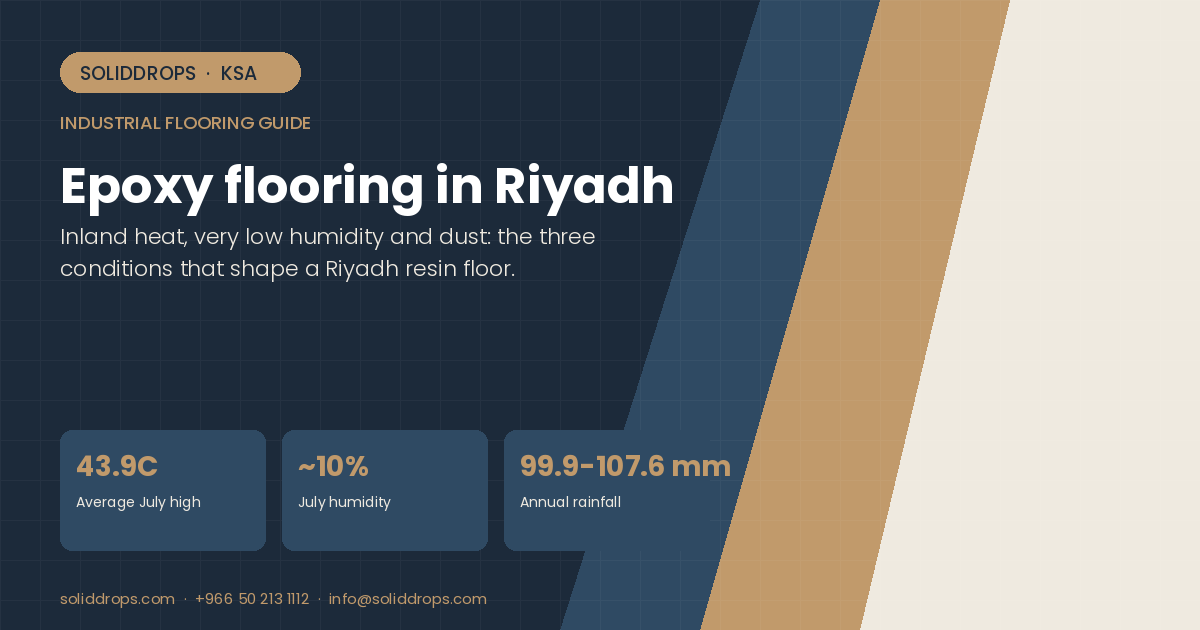
Epoxy flooring in Riyadh is governed by dry inland heat rather than coastal salt. July highs average 43.9C, summer humidity sits near 10%, and dust is constant. That combination shortens pot life, speeds surface cure and makes airborne dust, not moisture, the usual reason a floor fails inspection.
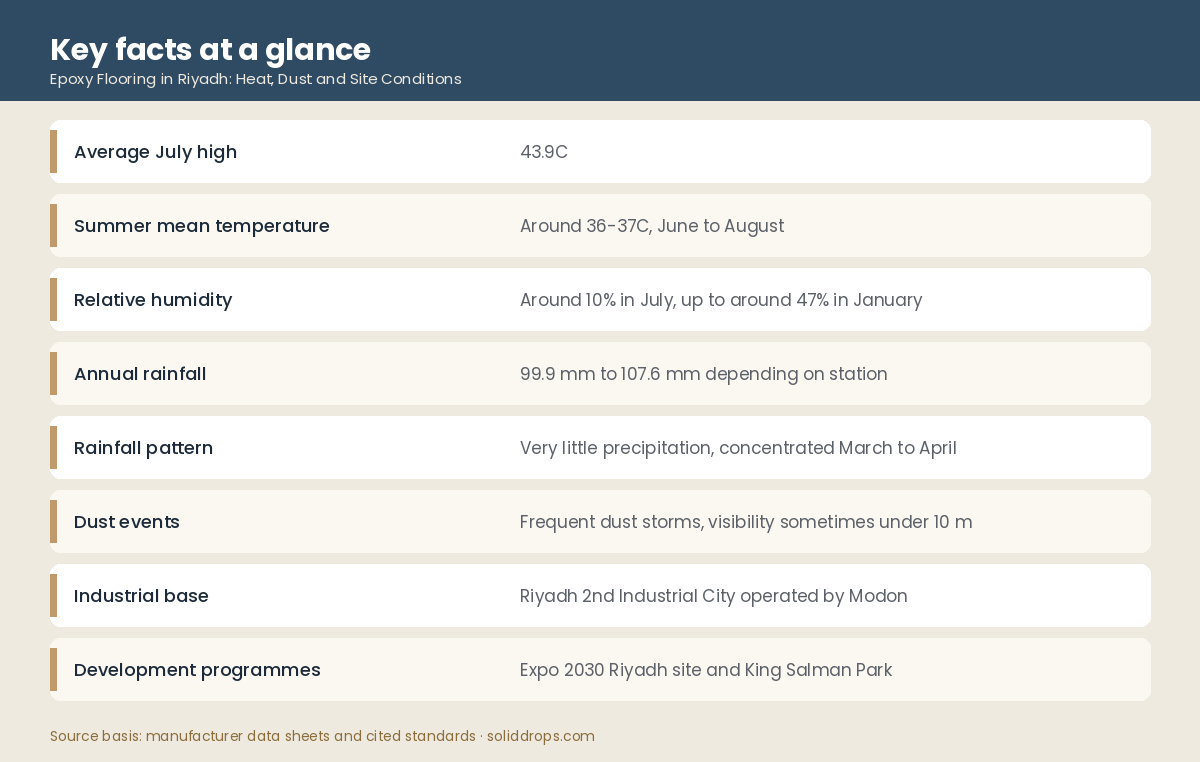
| Property | Value | Basis / standard |
|---|---|---|
| Average July high | 43.9C | Wikipedia, Riyadh climate table |
| Summer mean temperature | Around 36-37C, June to August | Wikipedia, Riyadh climate table |
| Relative humidity | Around 10% in July, up to around 47% in January | Wikipedia, Riyadh |
| Annual rainfall | 99.9 mm to 107.6 mm depending on station | Wikipedia, Riyadh climate table |
| Rainfall pattern | Very little precipitation, concentrated March to April | Wikipedia, Climate of Saudi Arabia |
| Dust events | Frequent dust storms, visibility sometimes under 10 m | Wikipedia, Riyadh |
| Industrial base | Riyadh 2nd Industrial City operated by Modon | Modon industrial cities register |
| Development programmes | Expo 2030 Riyadh site and King Salman Park | Expo 2030 Riyadh; Vision 2030 project pages |
Why is epoxy flooring in Riyadh a different problem from a coastal job?
Epoxy flooring in Riyadh is specified on an inland plateau, and that removes the biggest variable a resin floor faces elsewhere in the Kingdom. No salt-laden sea air drifts through an open shutter, no chloride cycle drives the slab, and no condensation film forms on cold concrete at dawn. Heat, dryness and dust replace all of it.
So most Riyadh failures are handling failures, not environmental ones. A floor here rarely delaminates because the climate attacked it. It delaminates because the material went off faster than the crew could work it, or because the prepared surface picked up fine dust between vacuuming and priming.
A specifier arriving from a Jeddah or Dammam project brings a moisture-first checklist. In الرياض that checklist still earns its place, but the controlling risks sit elsewhere: material temperature at the mixer, the length of the working window, and how clean the substrate stays before the primer lands.
What does Riyadh's climate do to the application window?
The numbers are unforgiving in summer. July highs average 43.9C, with mean summer temperatures around 36-37C from June to August. Relative humidity sits near 10% in July and only reaches around 47% in January. Resin chemistry reacts to both.
Heat drives the exotherm. A two-part epoxy mixed well above its data-sheet reference temperature gels faster, sometimes dramatically, and the crew loses the time it needs to spread, back-roll and de-aerate. On a large warehouse bay that shows up as roller marks, visible joints between mixes and trapped air.
Very low humidity works the other way and is often underestimated. It speeds surface skinning on thin films, which can lock in a texture before the film has levelled, and it worsens static dust pick-up on freshly ground concrete.
- Store materials in a conditioned area, not a site container in full sun.
- Mix smaller batches than the data sheet’s maximum and keep a second mixer running.
- Move heavy pours to night or early morning through June to August.
- Record slab surface temperature, not only air temperature, at the start of each bay.
Winter is the easier season for a large Riyadh pour, which is exactly why the good crews are booked out then.
How does Riyadh dust change preparation and finish?
Riyadh sees frequent dust storms, with visibility sometimes dropping under 10 m. Even on a clear day, fine airborne particulate is a permanent feature of an inland site. Resin bonds to what is actually on the surface, and if that is a monolayer of dust, the bond is to the dust.
Treat the building envelope as part of the flooring scope. Doors, shutters and any open facade line get sheeted before grinding starts, and the sheeting stays up until the topcoat is hard enough to walk. Positive pressure inside the work zone does more than extra vacuuming ever will.
Sequencing matters as much as sealing. Preparation and priming belong in one continuous operation on the same shift, so no prepared area sits open overnight. Where a bay must be held, light re-abrasion before priming is cheaper than arguing about adhesion afterwards.
Dust shapes the finish too. Smooth, light-reflective coatings show settled dust and tyre marks quickly in a building with constant shutter movement; a mid-tone colour with a light texture stays presentable far longer between cleans.
What should you check in the slab before specifying?
Riyadh sits inland, away from the coastal ground conditions that dominate the Eastern Province and the Red Sea coast. No Riyadh-specific sabkha or high-water-table data sits behind this guide, so it assumes neither. That is not the same as saying slab moisture is irrelevant.
Two moisture sources turn up regularly on inland projects, and neither is climatic. The first is a slab poured without an effective damp-proof membrane, or with one punctured during service installation. The second is process water: wash-down bays, chiller condensate, tank rooms and vehicle wash areas that load a slab from above and keep it loaded.
Run the standard checks anyway. Take relative humidity readings in the slab before the system is fixed, note the age and history of the concrete, and core or scan where a screed of unknown build-up sits over structural concrete. Above the system’s stated limit, the answer is a moisture-tolerant primer or a vapour-suppressant layer, chosen against manufacturer data rather than habit. The plot’s geotechnical report always outranks a regional generalisation.
Which Riyadh buildings are actually specifying resin floors?
Riyadh’s industrial base is anchored by Riyadh 2nd Industrial City, one of the estates operated by Modon, the Saudi Authority for Industrial Cities and Technology Zones. These estates hold light manufacturing, assembly, food production and distribution sheds, and the flooring brief changes sharply between them.
The city’s development programmes add a second stream. The Expo 2030 Riyadh site and King Salman Park are both published programmes with large back-of-house, plant room, parking and service areas, and those spaces are where resin floors normally sit in a mixed-use development.
Distribution sheds
Large uninterrupted bays, reach-truck traffic, racking legs, aisle marking and constant shutter movement.
Light manufacturing units
Machine bases, point loads, localised oil and coolant, and a floor zoned by activity rather than coated uniformly.
Food production areas
Wash-down, thermal shock at door lines, coving and drainage falls, with hygiene ahead of gloss.
Car parks and plant rooms
Deck movement, slip performance on ramps, and legible line marking under artificial light.
The building type sets the system. The city sets the programme and the site rules.
Which epoxy system suits which Riyadh floor?
| System | Best for in Riyadh | Key local limit |
|---|---|---|
| Roller-applied epoxy coating | Warehouse and distribution bays, parking decks, dust-proofing a sound slab on a tight programme | Thin films skin fast in summer heat and low humidity; needs the cleanest possible substrate |
| Self-levelling epoxy screed | Showrooms, assembly halls and inspection areas where flatness and appearance are graded | Shortest working window of the three in summer; plan as a night pour and pre-condition material |
| Epoxy or urethane mortar screed | Loading aprons, machine bays, food areas and any floor taking impact or wash-down | Heavier prep and joint detailing; longer possession of the bay, which fights a live logistics operation |
| Anti-static or ESD build-up | Electronics assembly, control rooms and server spaces in the industrial cities | Very dry air raises charge generation; verification is by measured resistance, not product name |
Depth on the systems themselves is in our epoxy flooring guide for Saudi Arabia and, for conductive build-ups, the ESD flooring guide. Use those for thickness and resistance data; use this page for the Riyadh conditions that constrain the choice.
Planning a Riyadh floor around summer heat?
Send the slab details and your available working hours and our technical team will map the system against the programme.
How should a Riyadh floor be programmed?
Programme is where Riyadh jobs are won or lost. Rainfall is negligible, at roughly 99.9 mm to 107.6 mm a year depending on the station and concentrated in March and April, so weather rarely stops work in a closed building. Heat and occupancy do.
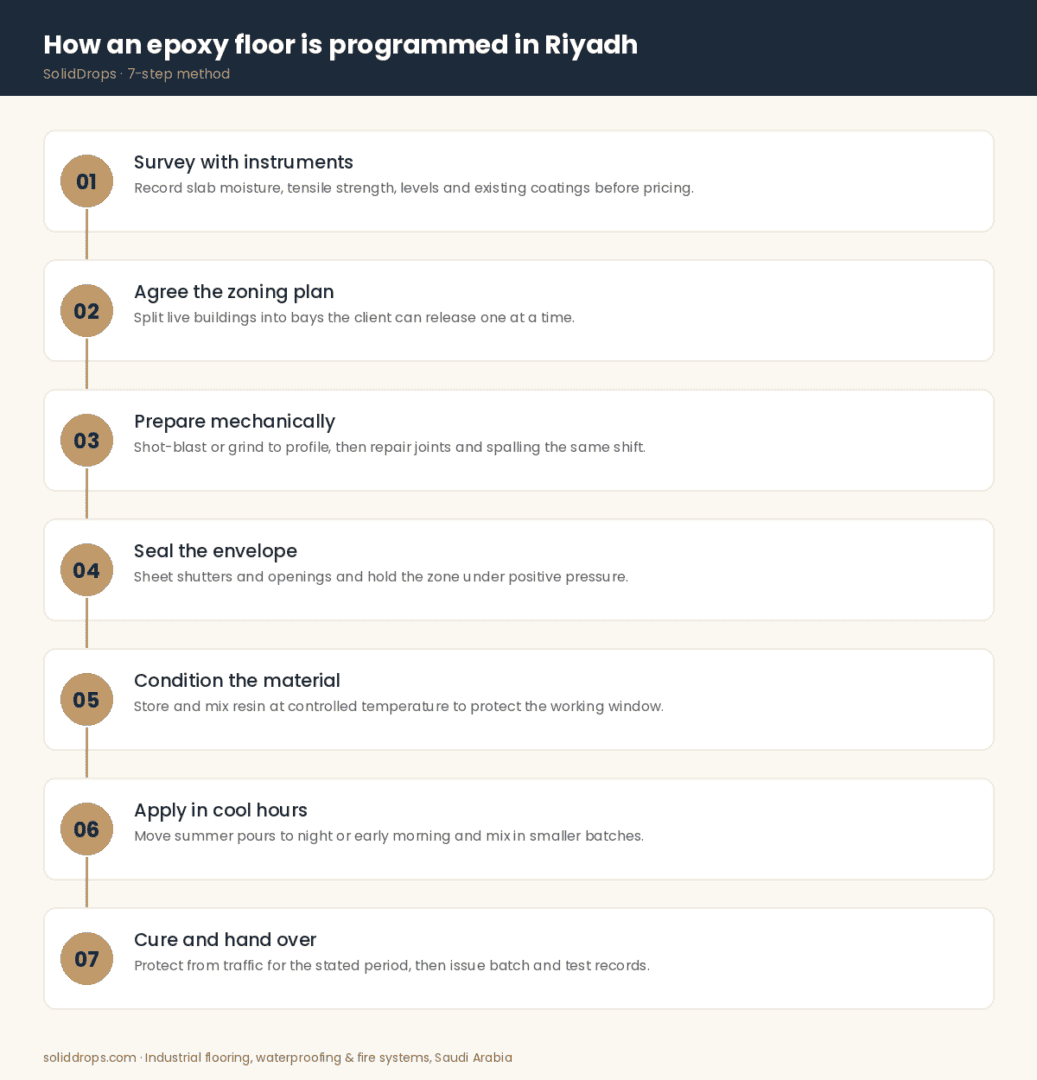
- Survey with instruments. Slab moisture, surface tensile strength, existing coating identification and levels, recorded before the system is priced.
- Agree the zoning plan. Split a live warehouse into bays released one at a time, with stock moves scheduled by the client rather than assumed.
- Prepare mechanically. Shot-blast or grind to the profile the system needs, then repair joints, cracks and spalling before the shift closes.
- Seal the envelope. Sheet shutters and openings, hold positive pressure, and keep it through cure.
- Apply in the cool hours. From June to August, plan main pours for night or early morning and condition material before it reaches the mixer.
- Cure without traffic. Protect from foot and wheel loads for the stated periods, and hold racking back.
- Hand over with records. Batch numbers, wet film checks, temperatures and any adhesion or resistance testing, issued as one package.
What goes wrong on Riyadh floors, and how do you avoid it?
The recurring defects on inland projects cluster into a short list, and none of them are exotic.
- Dust at the bond line. A prepared surface left open, or sheeting taken down early. It shows as patchy adhesion and edge peeling at shutter lines.
- Short pot life mishandled. Full-size batches mixed at ambient summer temperature, then applied slowly. It shows as ropey texture, lap marks and trapped air.
- Thermal movement ignored at the door line. A floor running from a shaded interior onto a sunlit apron needs a movement detail, not a continuous coating.
- Traffic returned too soon. A floor that feels hard has not reached chemical cure. Reach trucks print their wheels into an under-cured film permanently.
- Coating specified where a screed was needed. A 300-micron film under a pallet corner or a steel wheel fails quickly. Match the build-up to the point loading.
The March and April rain window deserves one note. Totals are small, but the rain arrives fast, and an uncovered apron or a ramp under construction can take standing water.
What drives the cost of epoxy flooring in Riyadh?
SolidDrops quotes against a site, not a price list. These variables move a Riyadh figure more than the resin itself does.
- Substrate condition. A sound power-floated slab and a spalled, oil-contaminated one need different preparation plant, and preparation is usually the largest single line.
- System build-up. Coating, self-levelling screed and mortar screed are different orders of material volume and labour.
- Working hours. Night and weekend shifts through summer add cost but often shorten the total programme by protecting quality.
- Access and phasing. A floor released in six small bays around live racking costs more per square metre than one empty building.
- Mobilisation. Riyadh has a deep contractor base, but plant for specialist build-ups may still travel, and a site inside a controlled industrial estate adds permit time.
Send drawings, slab information and operating hours, then request a quotation.
Who supplies and installs epoxy flooring in Riyadh?
SolidDrops supplies and installs epoxy flooring in Riyadh for warehouses, factories, showrooms, workshops and parking areas, working with owners, consultants, contractors and facility teams. Scope covers system selection, concrete preparation, application and handover records; أرضيات إيبوكسي is the term most Riyadh clients use when the enquiry arrives in Arabic.
The day-to-day offer sits on our epoxy flooring in Riyadh page, and projects that also need roof, basement or wet-area protection are covered by flooring and waterproofing support in Riyadh.
The useful first step is a site visit with a moisture meter and a pull-off tester rather than a phone quotation. Contact [email protected] or +966 50 213 1112 with the building type, the slab age and the hours the floor can be released.
Frequently asked questions
Is epoxy flooring good for Riyadh heat?
Yes, once cured. A cured epoxy floor is untroubled by Riyadh’s 43.9C average July highs inside a covered building. The heat is an application problem, not a service one: it shortens pot life and working time. The answer is night pours through June to August and conditioned material storage.
How does dust affect an epoxy floor installation in Riyadh?
Dust is the leading adhesion risk on inland sites, and Riyadh sees frequent dust storms with visibility sometimes under 10 m. Resin bonds to whatever sits on the surface. Seal shutters and openings, hold the work zone under positive pressure, and never leave a prepared bay open overnight.
Does Riyadh need moisture testing if it barely rains?
Yes. Rainfall of roughly 99.9 mm to 107.6 mm a year has little to do with slab moisture. A missing or damaged damp-proof membrane, or process water from wash-down and tank areas, loads concrete regardless of climate. Test before the system is fixed.
Which epoxy system suits a Riyadh warehouse?
For a sound slab carrying forklift traffic, a roller-applied epoxy coating handles dust-proofing and marking on a short programme. Where pallet corners, steel wheels or impact are involved, a mortar or self-levelling screed is the correct build-up. Point loading decides it, not floor area.
When is the best time of year to install epoxy flooring in Riyadh?
Winter and the shoulder months are easier, because mean summer temperatures of 36 to 37C from June to August compress the working window. Summer work is practical with night shifts and material conditioning, but it has to be planned that way at tender, not improvised.
How much does epoxy flooring cost in Riyadh?
There is no single rate. Cost is driven by substrate condition, system build-up, working hours, phasing around live operations, continuous area and access into controlled industrial estates. Send drawings, slab information and available working hours to [email protected] and request a quotation.
Who installs epoxy flooring in Riyadh?
SolidDrops supplies and installs epoxy flooring in Riyadh for industrial, logistics, commercial and parking projects, covering system selection, preparation, application and handover records. Enquiries go to [email protected] or +966 50 213 1112, and a site survey normally precedes any firm proposal.
Talk to a flooring specifier in Riyadh
SolidDrops supplies and installs epoxy flooring across Riyadh, with site survey, moisture testing and handover records included in scope.
 Chat Online