
10 Sep Epoxy Flooring in Saudi Arabia: A Specifier’s Guide
Epoxy Flooring in Saudi Arabia: A Specifier's Guide
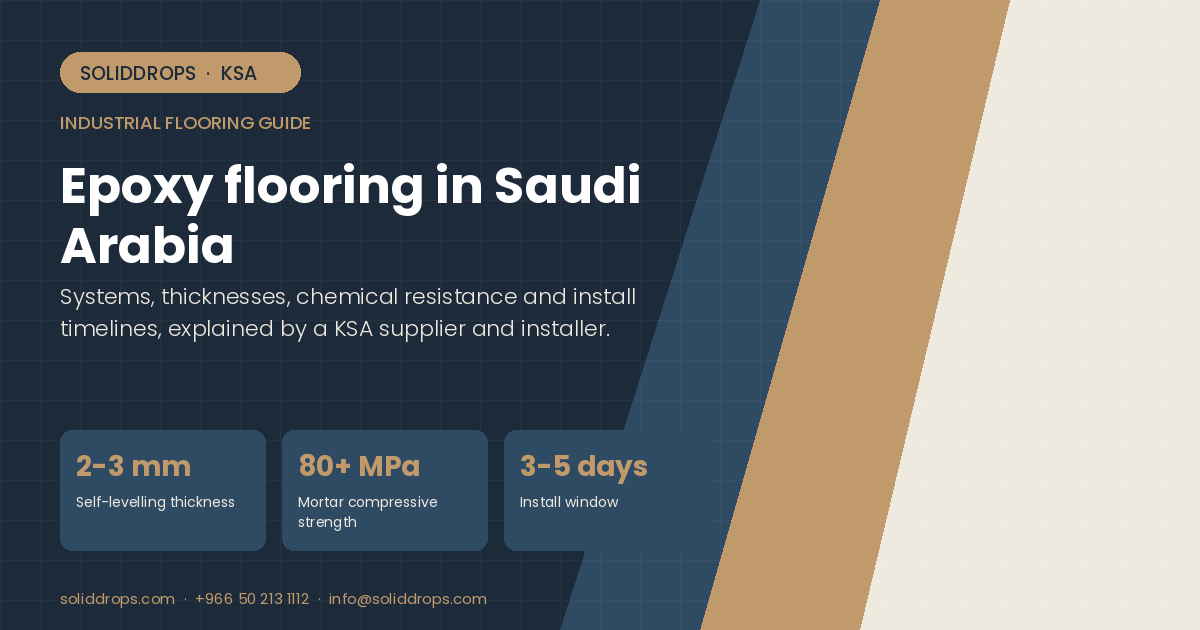
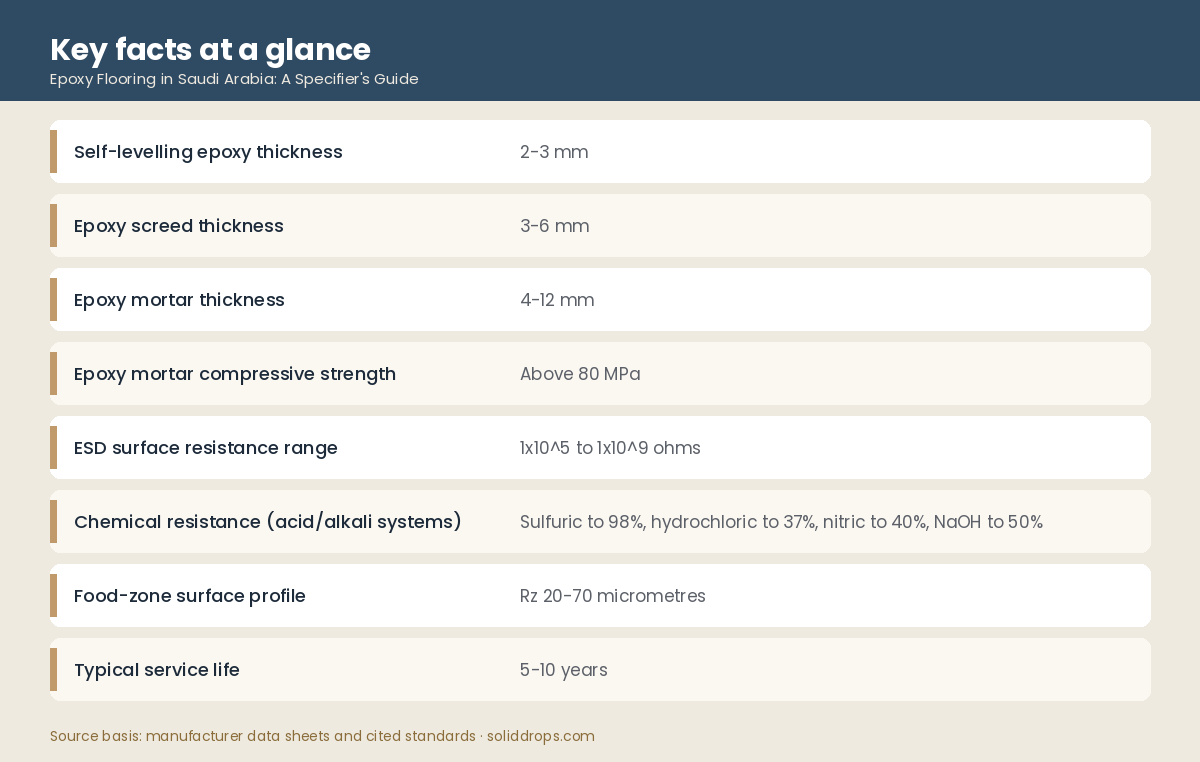
Epoxy flooring in Saudi Arabia is a resin system applied over prepared concrete, built up from roughly 2-3 mm as a self-levelling floor to 4-12 mm as a mortar. It suits warehouses, factories, workshops and clean production areas, and is chosen for chemical resistance, cleanability and load-bearing wear.
| Property | Value | Basis / standard |
|---|---|---|
| Self-levelling epoxy thickness | 2-3 mm | SolidDrops industrial epoxy system data |
| Epoxy screed thickness | 3-6 mm | SolidDrops industrial epoxy system data |
| Epoxy mortar thickness | 4-12 mm | SolidDrops industrial epoxy system data |
| Epoxy mortar compressive strength | Above 80 MPa | SolidDrops industrial epoxy system data |
| ESD surface resistance range | 1×10^5 to 1×10^9 ohms | IEC 61340-5-1 and ANSI/ESD S20.20 |
| Chemical resistance (acid/alkali systems) | Sulfuric to 98%, hydrochloric to 37%, nitric to 40%, NaOH to 50% | SolidDrops chemical-resistant system data |
| Food-zone surface profile | Rz 20-70 micrometres | HACCP zone requirements |
| Typical service life | 5-10 years | SolidDrops industrial epoxy system data |
| Installation window, self-levelling | 3-5 days including preparation | SolidDrops project method |
| Cure time to foot traffic | Project-specific – confirm on TDS | Manufacturer product data sheet |
What is epoxy flooring, in plain terms?
Epoxy flooring is a two-component resin system – a base resin and a hardener – mixed on site and applied over prepared concrete, where it cures by chemical reaction into a dense, jointless surface bonded to the slab. It is not paint. Paint dries; epoxy cross-links, and that difference is why a correctly installed epoxy floor carries forklift wheels and resists spilled acid while a floor paint peels off in strips within a season.
The phrase covers a family rather than a single product. At the thin end sits a roller-applied coating for light duty. Above that, a self-levelling epoxy at 2-3 mm gives a flat, cleanable finish for warehouses and production halls. A trowelled epoxy screed at 3-6 mm takes heavier point loads, and an epoxy mortar at 4-12 mm – aggregate-filled, laid like a screed – handles impact, thermal cycling and steel-wheeled traffic. Mortar-grade systems reach compressive strengths above 80 MPa, well past the concrete beneath them.
In Arabic the sector calls it أرضيات إيبوكسي, and buyers in Riyadh and Jubail use the term loosely for anything resin-based. It pays to be precise on a tender: naming a thickness and a system family tells a contractor far more than naming a colour.
Where is epoxy flooring used across KSA facilities?
The demand map in Saudi Arabia follows industry. Logistics and distribution sheds around Riyadh and Jeddah take self-levelling systems for flatness and dust control. Petrochemical and downstream plants in Jubail and Yanbu specify chemical-resistant grades because the spill risk is real and continuous. Food and beverage plants sit somewhere in between, and often move up to polyurethane concrete where hot water and steam are involved – covered in our Ucrete polyurethane concrete guide.
Warehousing and logistics
Self-levelling epoxy for flat, dust-free floors under racking and forklift routes. Line marking is applied in the same system.
Chemical and process plants
Chemical-resistant grades handling sulfuric acid to 98%, hydrochloric to 37%, nitric to 40% and sodium hydroxide to 50%.
Electronics and clean areas
ESD systems holding surface resistance between 1×10^5 and 1×10^9 ohms per IEC 61340-5-1 and ANSI/ESD S20.20.
Aviation and MRO
Hangar floors specified against Jet A-1 fuel, Skydrol hydraulic fluid, propylene glycol de-icer and MEK solvents.
Food-contact zones bring their own rule: the finished surface profile is specified, not left to chance. A profile in the Rz 20-70 micrometre band satisfies HACCP zoning while staying cleanable, and regulated projects also reference SFDA expectations alongside FDA 21 CFR and EU 1935/2004 material approvals. Clean rooms add ISO 14644 classification to the same conversation.
How is an epoxy system built up over concrete?
A resin floor is a stack, and every layer has a job. Skipping one to save a day is the most common route to a failure that costs a week.
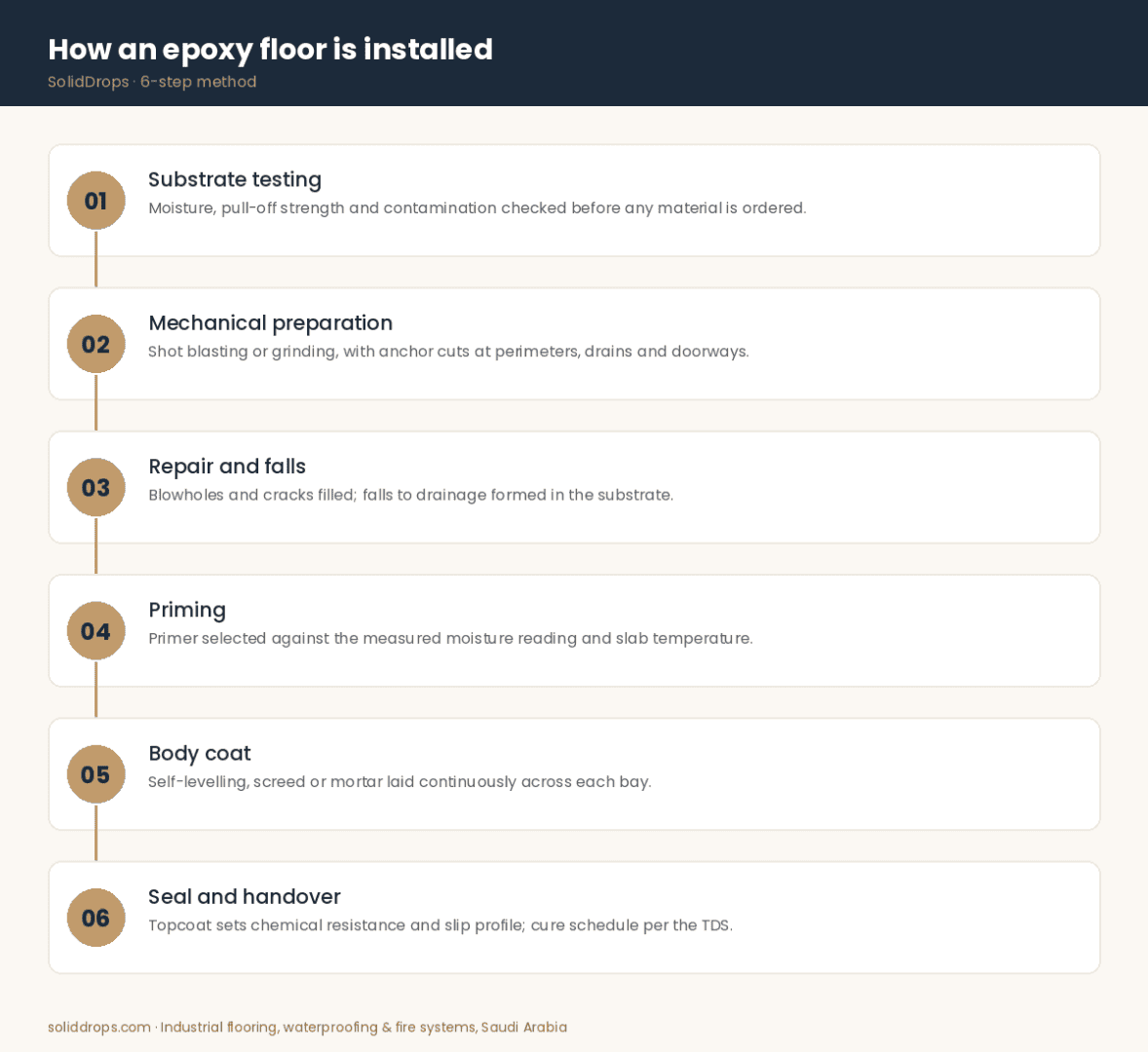
- Substrate assessment. Moisture content, tensile pull-off strength, contamination history and existing coatings. A slab that has been oiled for fifteen years does not receive resin without intervention.
- Mechanical preparation. Shot blasting or diamond grinding to open the surface. Anchor cuts at perimeters, drains and doorways so the system terminates in the slab rather than on it.
- Repair and levelling. Blowholes, cracks and spalled edges filled with resin mortar. Falls to drains formed at this stage – resin follows the substrate, it does not correct it. Our note on concrete repair before epoxy coating goes deeper.
- Primer. Chosen against the moisture reading. Damp-tolerant primers exist and are specified when they are needed, not as insurance.
- Body coat. Self-levelling, screed or mortar, at the thickness the duty demands.
- Seal or topcoat. Chemical resistance, slip profile, UV stability and gloss are set here.
Thickness is a load decision. Pedestrian and light trolley traffic is served at 2-3 mm; pallet trucks and heavy racking push towards screed; impact from dropped tooling or steel wheels calls for mortar. Guessing high wastes budget, guessing low fails at the door threshold first.
Epoxy vs PU concrete vs vinyl: which system suits the room?
Most specification arguments in Saudi Arabia come down to three families. The table below sets them against each other on the criteria that actually decide projects.
| Criterion | Epoxy resin | Polyurethane concrete (Ucrete) | Vinyl sheet / LVT |
|---|---|---|---|
| Typical thickness | 2-3 mm self-levelling, 3-6 mm screed, 4-12 mm mortar | Around 9 mm at rated service temperature | Sheet and tile products; wear layer per data sheet |
| Thermal tolerance | Limited; hot water and steam cleaning need review | Rated to 130 C, with thermal shock cited from -40 C to 130 C | Interior comfort temperatures only |
| Chemical exposure | Strong with the right grade, including concentrated acids and alkalis | Designed for organic acids, fats, oils and aggressive cleaning agents | Domestic and clinical cleaning agents |
| Best fit | Warehouses, workshops, electronics, general production | Wet process areas, kitchens, cold rooms, chemical plant | Hospitals, schools, offices, retail |
| Indicative service life | 5-10 years | 20+ years | Per manufacturer warranty and duty class |
| Install window | 3-5 days self-levelling; 5-7 days mortar systems | 5-7 days | Depends on subfloor readiness |
A fuller side-by-side sits on our epoxy vs PU cement comparison. For occupied clinical and education buildings, the vinyl flooring guide is the better starting point.
How long does epoxy flooring take to install?
For a self-levelling system on a sound slab, plan 3-5 days including preparation. Mortar and heavy-duty build-ups run 5-7 days. Those windows assume the area is cleared, powered, lit and closed to other trades – which is the assumption most programmes get wrong.
The sequence rarely compresses. Preparation and repair occupy the first day or two. Priming follows once moisture readings are accepted. Body coats go down in a continuous pour across a bay, because a self-levelling floor stopped mid-bay leaves a visible cold joint. Sealing happens last, and then the floor is left alone.
Cure is the part clients underestimate. Foot traffic, light trolleys, racking installation and full chemical service each become available at different intervals, and those intervals belong to the product data sheet for the specific system – not to a rule of thumb. Ambient and slab temperature move them in both directions: a hot slab in a Jeddah summer accelerates the reaction and shortens working time, while a chilled interior slows it. We confirm the cure schedule against the approved TDS and the measured slab temperature before committing a handover date.
Programme tip: sequence the floor after overhead services and before racking, partitions and equipment bases. Retro-fitting resin around installed plant costs more and looks worse.
Not sure which epoxy system your slab needs?
Send drawings and the duty the floor must carry. Our technical team will survey the substrate and specify against it.
What drives epoxy flooring cost in Saudi Arabia?
No credible contractor quotes a rate before seeing the slab. Price is set by a handful of variables, and most of them are decided by the building rather than the coating.
- System thickness and family. The step from 2-3 mm self-levelling to 4-12 mm mortar changes material volume several times over.
- Substrate condition. Grinding a clean new slab is routine. Removing an old failed coating, treating oil contamination or rebuilding spalled bays is a separate scope.
- Falls and drainage. Forming falls to gullies in wet areas is screeding work carried out before the resin.
- Performance grade. ESD, high chemical resistance and food-zone finishes carry different material costs than a general-duty floor.
- Detailing. Coving, expansion joints, thresholds, plinths and line marking are counted per metre, not absorbed.
- Access and shift pattern. Night work, live-plant shutdowns and phased handovers all carry programme cost.
- Area and geography. A single 5,000 m2 hall behaves differently from twelve small rooms; mobilisation to Tabuk differs from Jeddah.
Our breakdown of epoxy flooring cost factors expands each line. For a figure against your drawings and a site inspection, request a quotation – we do not publish rates that would be wrong for your building.
What goes wrong, and how do you avoid it?
Resin floors fail for a short and repetitive list of reasons. Almost all of them trace back to preparation or moisture.
Moisture in the slab. Applying over concrete that has not dried, or over a slab with no functioning damp-proof membrane, produces blistering and delamination weeks later. Measure, record, and select the primer against the reading.
Inadequate mechanical preparation. Acid etching and a light sweep are not preparation. Without shot blasting or grinding to open the surface, adhesion depends on a thin laitance layer that was always going to let go.
No anchor cuts. A system that stops flush at a doorway or drain edge gets peeled by wheel traffic. Terminations must be cut into the slab.
Wrong grade for the exposure. A general-duty epoxy in a wash-down bay, or a smooth gloss finish where staff work in wet conditions, are specification errors rather than installation ones. Slip profile is chosen from the duty and confirmed against the manufacturer’s rating.
Ignoring joints. Movement joints in the substrate carry through the floor. Bridging them with resin simply relocates the crack.
Limitations are worth stating plainly. Epoxy is not the answer for continuous steam cleaning or heavy thermal shock – that is polyurethane concrete territory. Standard grades can amber under strong direct sunlight, so UV-stable topcoats are specified for daylit halls. And an epoxy floor does not rescue a structurally poor slab; it copies it.
What this means for projects in Saudi Arabia
Climate changes the method, not the chemistry. Three conditions matter most.
Heat. Slab temperatures inside an uncooled warehouse in Riyadh or Jeddah in summer can sit far above the comfortable application window. Resin viscosity drops, pot life shortens, and a self-levelling mix can skin before it flows out. The practical answers are early-morning or night application, conditioned material storage, smaller batch sizes and more hands on the squeegee. Slab temperature is measured, not estimated.
Humidity and coastal air. On the Red Sea and Gulf coasts – Jeddah, Dammam, Jubail – dew point management matters. Condensation forming on a cool slab during application ruins the bond. Overnight work is often the wrong call in coastal humidity for exactly this reason, so the schedule follows the dew point rather than the shift roster.
Ground conditions. Sabkha and high-salinity ground water in Eastern Province locations put sulfate and chloride pressure on slabs. That is a substrate and waterproofing question before it is a coating question; the resin sits on whatever the concrete has become.
On the compliance side, KSA buyers routinely ask for SASO-aligned quality documentation, and regulated food and pharmaceutical projects layer SFDA, GMP, HACCP and ISO 14644 requirements over the flooring specification. Defence and aviation scopes may reference MIL-SPEC materials. Ask for these to be stated in the tender rather than discovered at handover.
Who supplies and installs epoxy flooring in Saudi Arabia?
SolidDrops supplies and installs industrial epoxy flooring across Saudi Arabia, working from Jeddah and covering Riyadh, Dammam, Jubail, Makkah, Medina and Tabuk. The scope is single-source: substrate survey, moisture and adhesion testing, preparation, repair, system application, detailing and handover documentation. We are also an authorised distributor for Stonhard, whose system range covers heavy-duty resin flooring alongside our other lines.
What a serious enquiry looks like, from our side: drawings or area take-off, the duty the floor must carry, the chemicals and temperatures it will meet, the cleaning regime, and the shutdown window available. With those five, a specification and a quotation can be built that survive the first year of use.
Related reading before you specify: warehouse floors under forklift traffic, food processing plant flooring and the maintenance and cleaning schedule that protects the investment. To start, email [email protected] or call +966 50 213 1112.
Frequently asked questions
Who supplies and installs epoxy flooring in Saudi Arabia?
SolidDrops supplies and installs industrial and commercial epoxy flooring across Saudi Arabia, including Jeddah, Riyadh, Dammam, Jubail, Makkah, Medina and Tabuk. The scope covers substrate testing, mechanical preparation, repair, system application and detailing. SolidDrops is also an authorised distributor for Stonhard resin flooring systems. Enquiries: [email protected] or +966 50 213 1112.
How thick should an epoxy floor be?
Thickness follows duty. A self-levelling epoxy is typically 2-3 mm and suits pedestrian and light trolley traffic. An epoxy screed at 3-6 mm handles heavier loading, and an epoxy mortar at 4-12 mm is specified where impact, steel wheels or thermal cycling are present. Mortar-grade systems reach compressive strengths above 80 MPa.
What is the difference between epoxy and Ucrete flooring?
Epoxy is a resin system usually built at 2-12 mm and chosen for chemical resistance and cleanability in dry to moderately wet areas. Ucrete is a polyurethane concrete rated for service to 130 C with thermal shock cited from -40 C to 130 C, which suits steam cleaning, hot process water and cold rooms. Indicative service life differs: 5-10 years against 20+ years.
Is epoxy flooring suitable for hot climates like Saudi Arabia?
Yes, once cured, but application must be managed. High slab and ambient temperatures shorten pot life and working time, so material is conditioned, batches are kept small, and work is scheduled to the coolest part of the day. Slab temperature and dew point are measured before priming rather than assumed.
Does epoxy flooring resist chemicals?
The right grade does. Chemical-resistant epoxy systems are specified against sulfuric acid up to 98%, hydrochloric up to 37%, nitric up to 40% and sodium hydroxide up to 50%. Aviation systems are specified against Jet A-1 fuel, Skydrol hydraulic fluid, propylene glycol de-icer and MEK solvents. Always match the grade to the actual exposure list.
How long does epoxy flooring take to install?
A self-levelling system on a sound slab typically takes 3-5 days including preparation. Mortar and heavy-duty build-ups run 5-7 days. Cure intervals for foot traffic, racking and full chemical service come from the product data sheet for the approved system and are affected by slab and ambient temperature.
Is epoxy flooring suitable for food factories?
Yes, where the grade and finish are correct. Food-zone systems are specified to a surface profile in the Rz 20-70 micrometre band to meet HACCP zoning while remaining cleanable, with coving and falls to drainage detailed in. Regulated projects also reference SFDA expectations, FDA 21 CFR and EU 1935/2004 material approvals.
How much does epoxy flooring cost in Saudi Arabia?
Cost depends on system thickness, substrate condition, whether falls and drainage need forming, the performance grade, detailing such as coving and line marking, access and shift pattern, and the size and location of the area. SolidDrops does not publish rates because they would be wrong for most buildings. Request a quotation after a site inspection.
Talk to a SolidDrops flooring specifier
Supplier and installer of industrial epoxy flooring across Jeddah, Riyadh, Dammam, Jubail, Makkah, Medina and Tabuk.
 Chat Online