
25 Sep Waterproofing in Tabuk: Cold Nights, Frost and Winter Rain
Waterproofing in Tabuk: Cold Nights, Frost and Winter Rain
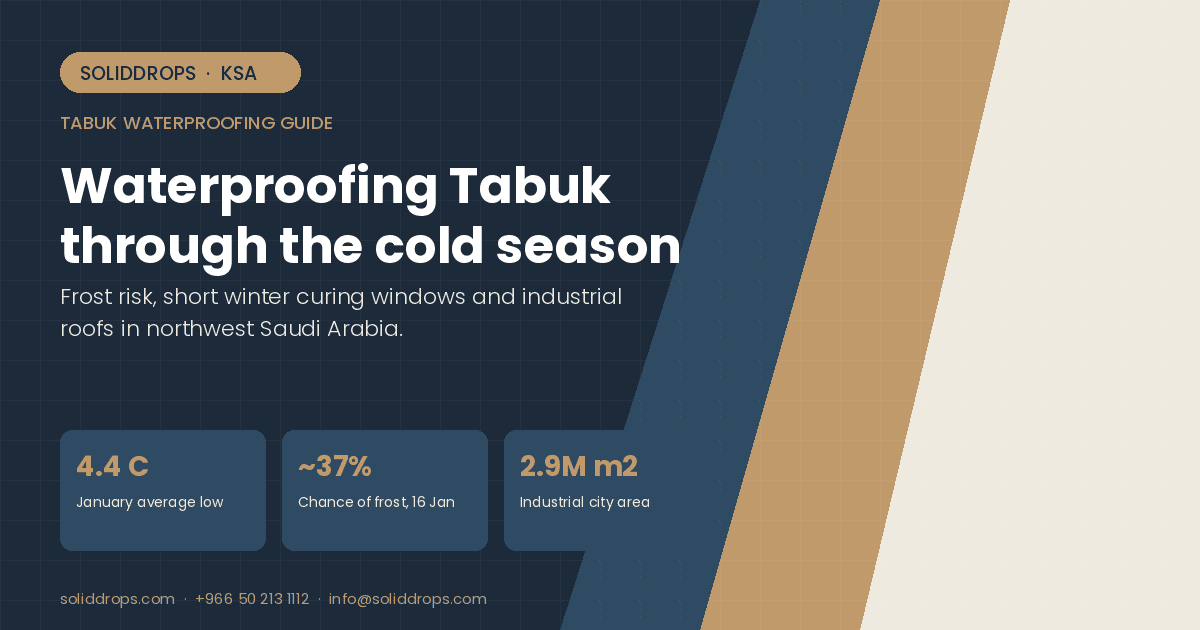
Waterproofing Tabuk is the one place in the Kingdom where cold, not heat, sets the application rules. January nights drop to about 4.4 C on average with a real chance of frost, so liquid membranes have a narrow daily curing window. Winter is also when the little rain that falls arrives.
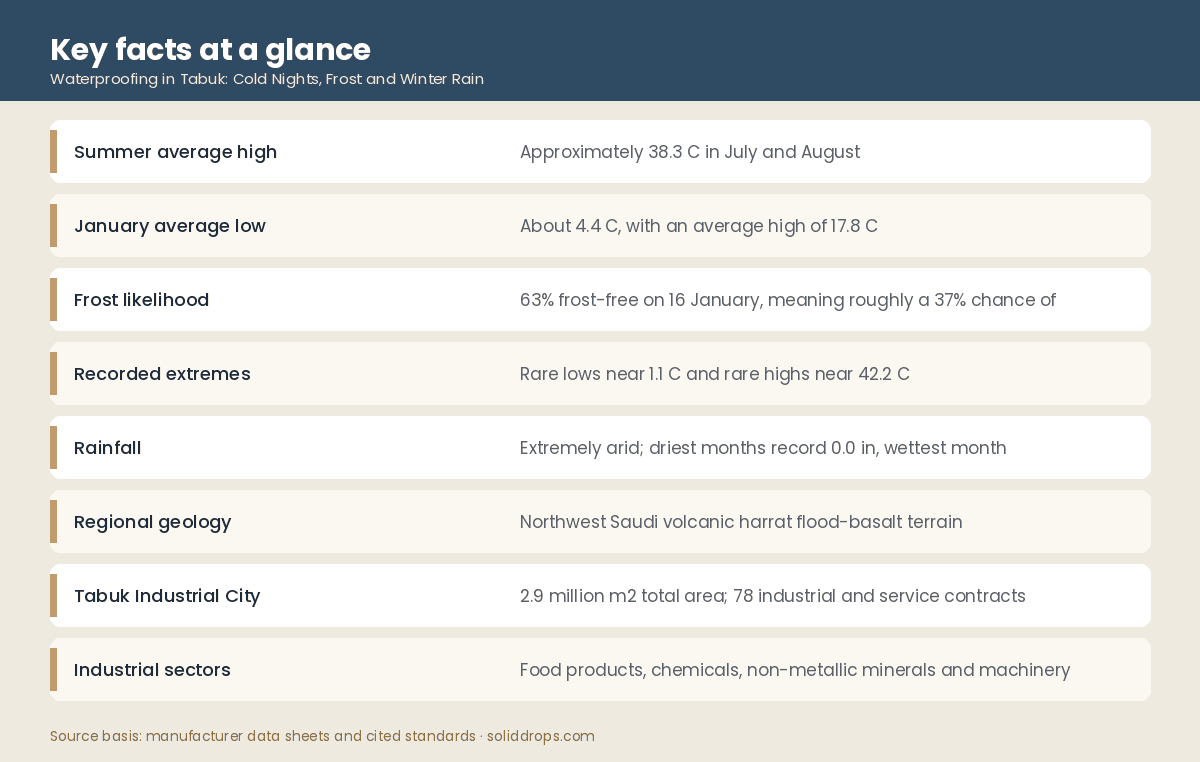
| Property | Value | Basis / standard |
|---|---|---|
| Summer average high | Approximately 38.3 C in July and August | WeatherSpark, Tabuk year-round averages |
| January average low | About 4.4 C, with an average high of 17.8 C | WeatherSpark, Tabuk year-round averages |
| Frost likelihood | 63% frost-free on 16 January, meaning roughly a 37% chance of frost on that date | WeatherSpark, Tabuk year-round averages |
| Recorded extremes | Rare lows near 1.1 C and rare highs near 42.2 C | WeatherSpark, Tabuk year-round averages |
| Rainfall | Extremely arid; driest months record 0.0 in, wettest month January about 2.5 mm | WeatherSpark, Tabuk year-round averages |
| Regional geology | Northwest Saudi volcanic harrat flood-basalt terrain | Peer-reviewed harrat groundwater hydrochemistry study |
| Tabuk Industrial City | 2.9 million m2 total area; 78 industrial and service contracts operating or under implementation | Modon industrial cities register |
| Industrial sectors | Food products, chemicals, non-metallic minerals and machinery | Modon industrial cities register |
| Utilities provision | 2,900 m3 drinking water capacity and 25 MVA electricity supply | Modon industrial cities register |
| Logistics distance | 22 km to Prince Sultan bin AbdulAziz International Airport; 120 km to Halat Ammar Port; 238 km to port; 425 km to rail | Modon industrial cities register |
Why do Tabuk winters change the waterproofing method?
Everywhere else in Saudi Arabia the argument with the data sheet is about the upper temperature limit. In Tabuk, for three or four months of the year, it is about the lower one.
January is the coldest month: an average low around 4.4 C and an average high of 17.8 C. Frost is not a curiosity here. The long-term record gives a 63 per cent chance of being frost-free on 16 January, which means roughly a one-in-three chance of frost on that date. Rare lows reach about 1.1 C. Summer is ordinary by Saudi standards, with July and August averaging about 38.3 C and rare highs near 42.2 C.
For a liquid-applied membrane, cold does three things. Cure slows, sometimes far beyond the published figure. Viscosity rises, so material drags under the squeegee and film thickness becomes uneven. And if the substrate is at or below the dew point, moisture condenses on the surface before the primer goes down, which kills adhesion invisibly.
A crew used to Jeddah conditions will make all three mistakes in their first Tabuk winter.
What does the rainfall record actually say?
Very little, and that is the trap. Tabuk is extremely arid. The driest months record 0.0 inches of rainfall, and the wettest month, January, brings only about 2.5 mm. On that basis a client can reasonably ask why a roof needs waterproofing at all.
The answer is that what does arrive is concentrated in winter, lands on a roof hardened by a summer of sun, and must reach outlets that may not have been cleared in years. A roof in a near-zero-rainfall city is a roof nobody maintains. By the time water appears on a warehouse floor, the membrane has been compromised for a long time.
There is a second water source that has nothing to do with rain. Condensation. A building with a cold night-time roof deck and warm humid interior air, a food-processing hall or a cold store, will condense moisture on the underside of the deck. That is a vapour control and insulation problem, not a membrane problem, and treating it by adding another coat on top achieves nothing.
How does freeze-thaw damage a roof or a slab?
The mechanism is simple. Water enters a crack, a lap or a porous screed during a winter rain event. Overnight temperatures drop toward freezing and the water expands, widening the crack fractionally. Next day it thaws, more water enters, and the cycle repeats.
In a hot city a hairline crack in a parapet coping stays a hairline crack for years. In Tabuk it does not.
What that means in practice:
- Do not leave a partially complete system over winter. An unprotected primed deck or a first coat awaiting a topcoat will take in water at the exposed edge.
- Seal parapets, copings and upstands properly. These take direct wetting and cool fastest because they are exposed on both faces.
- Watch external paving and ramps. Cracked joints in an external slab hold water, and freeze-thaw combined with vehicle loading opens them quickly.
- Avoid ponding as a matter of design. Standing water on a flat roof in a city with frost risk is a far worse condition than standing water in Jeddah.
What do the ground conditions mean here?
Tabuk sits within the volcanic harrat flood-basalt terrain of northwest Saudi Arabia. Basalt and rock ground behaves differently to the sand and sabkha most Kingdom specifications assume.
For basements and below-ground structures, two things follow. Excavation is likely to be in hard material, so the blinding surface presented to a sheet membrane may be coarse and irregular; a regulating screed or a system that tolerates a rough substrate avoids pinholing the sheet during backfill. And backfill against a tanked wall in rocky ground needs a protection board and graded fill, not the site arisings, because a sharp fragment pressed against a membrane under load will eventually breach it.
Groundwater depth and chemistry vary, and neither should be assumed from a regional study. The project’s own site investigation decides whether the structure is tanked against head or drained, and that decision precedes the product choice.
Which buildings in Tabuk need waterproofing?
Industrial city factories
Tabuk Industrial City covers 2.9 million m2 with 78 industrial and service contracts operating or under implementation, supported by 2,900 m3 of drinking water capacity and 25 MVA of electricity. Large roofs, process floors, tanks and bunded areas.
Food and cold-store buildings
Food products is one of the sectors named in the industrial city’s activity mix, alongside chemicals, non-metallic minerals and machinery. These buildings combine washdown floors, vapour control and roof condensation risk.
Province-scale development
NEOM, including the Oxagon industrial port city, sits in Tabuk Province under Vision 2030, and Modon has signed tenders worth $266.4 million to expand Saudi industrial cities.
Commercial and logistics sheds
Warehousing served by the airport 22 km away and a port 120 km away. Long uninterrupted roof runs with heavy thermal movement between winter nights and summer afternoons.
The common feature is scale and low inspection frequency. A very large roof in a city that sees a few millimetres of rain a year is rarely looked at, which is why a planned inspection interval belongs in the handover documents.
Which waterproofing system suits which element in Tabuk?
| Element | Typical system family | The local limit to check |
|---|---|---|
| Large industrial roof, winter programme | Torch-applied or self-adhesive bituminous sheet, or single-ply sheet | Sheet systems avoid the cold-cure problem entirely; check minimum handling temperature for self-adhesive grades |
| Large industrial roof, warm-season programme | Reinforced liquid-applied polyurethane | Needs substrate above the product’s minimum and clear of dew point; not a January choice |
| Parapets, copings and upstands | Liquid detailing system with reinforcement fabric | Direct wetting plus fastest cooling; freeze-thaw opens any unsealed joint |
| Cold store and food-hall roof | Sheet membrane over insulation with a specified vapour control layer | Interstitial condensation, not rain, is the design case |
| Basement in rock ground | Tanking sheet or bonded membrane with protection board | Rough blinding and sharp backfill; site investigation decides tanked versus drained |
| External paving, ramps and yards | Joint sealing and a trafficable coating where required | Freeze-thaw in open joints under vehicle loading |
| Process floors and bunds | Chemical-resistant lining below or integral with the floor finish | Containment duty first; confirm chemical compatibility on the data sheet |
Background on the material families is in our waterproofing systems guide for Saudi Arabia.
Planning a Tabuk roof before the cold season?
We will tell you whether to programme it now with a sheet system or wait for a warmer window.
What are the cold-weather application rules?
These rules keep a Tabuk winter installation sound. They are ordinary practice, simply ignored more often than not.
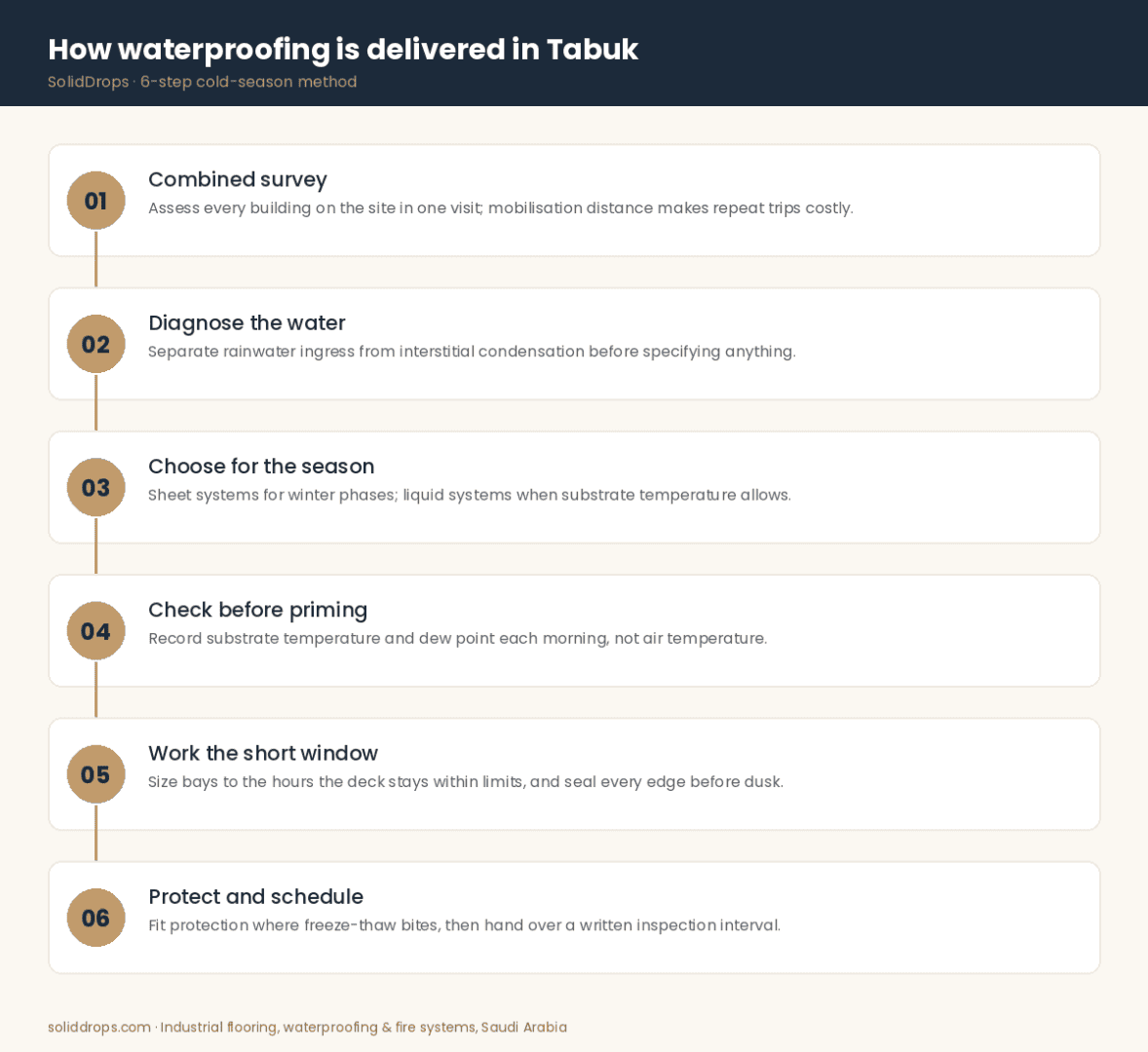
- Measure substrate temperature, not air temperature. A concrete deck at dawn is colder than the air above it and warms slowly.
- Check the dew point before priming. The substrate should sit at least 3 C above it, per common manufacturer guidance; confirm the figure on the product data sheet.
- Start after the deck has warmed, finish before it cools. In January that can mean a working window of a few hours, not a full shift.
- Store material warm. Cold resin will not mix properly and will not level. Conditioned storage overnight is part of the method, not a luxury.
- Extend cure times. Foot traffic and overcoating intervals published for 20 C do not apply at 8 C. Test, do not assume.
- Never leave an open edge overnight in winter. Terminate each day’s work into a sealed detail.
- Consider a sheet system for winter phases. If the programme cannot wait for spring, sheet removes the cure-temperature variable.
What goes wrong on Tabuk projects?
The failures we see in the northwest cluster around three causes.
A hot-climate specification applied without adjustment. A product selected for Riyadh, with a minimum application temperature the Tabuk site cannot meet for a third of the year, is programmed for December anyway. The coating never reaches full cure, and it delaminates within a season.
Maintenance that never happens. Outlets silted, debris dammed at parapets, a split lap nobody looked at. In a city recording 2.5 mm in its wettest month, the roof drops off the facilities schedule entirely.
Condensation misdiagnosed as a leak. Water dripping inside a cold store in January is usually interstitial condensation, and a new roof coating will not stop it. The fix is vapour control and insulation continuity.
An inspection before specifying anything settles all three. Our roof waterproofing inspection checklist is a useful starting point for a facilities team.
What drives waterproofing cost in Tabuk?
SolidDrops prices per project and publishes no rates. Two factors matter more here than in the central and western regions:
- Mobilisation distance. Tabuk is remote from the Kingdom’s main supply hubs. Crew travel, accommodation, plant transport and material haulage are genuine line items, and a single mobilisation covering several buildings is far more efficient than three separate visits.
- Season. A winter programme means short daily windows, possible sheet-system substitution and more shifts for the same area. A spring or autumn programme usually costs less for identical work.
Beyond those: roof area against detail density, whether wet insulation has to be removed, vapour control requirements in cold-store and food buildings, protection board and graded backfill for basements in rocky ground, and access around live process operations.
Send drawings, areas, photographs and target dates and we will quote against defined scope. Tell us if other buildings nearby need attention; combining them changes the mobilisation arithmetic.
Who supplies and installs waterproofing in Tabuk?
SolidDrops supplies and installs waterproofing systems in Tabuk – تبوك – and across northwest Saudi Arabia, covering industrial and warehouse roofs, basements, process areas, tanks and external paving for factories, food and cold-store buildings, logistics sheds and commercial developments.
Our flooring and waterproofing support page for Tabuk sets out the service scope and how enquiries are routed, and epoxy flooring in Tabuk covers the resin floor side, which frequently shares a mobilisation with waterproofing scope on the same building.
Given the distance involved, early contact matters more here than elsewhere. Send the building type, elements in scope, areas and target dates to [email protected] or call +966 50 213 1112, and we will advise whether to programme the work for the cold season with a sheet system or hold it for a warmer window. For projects further west, our Madinah waterproofing guide covers a very different set of constraints.
Frequently asked questions
Can waterproofing be applied in cold weather in Tabuk?
Yes, with the right system. January averages a low of about 4.4 C with roughly a one-in-three chance of frost mid-month, which is below the minimum application temperature of many liquid membranes. Sheet systems avoid the problem. If a liquid system is used, measure substrate temperature and dew point rather than air temperature.
Why does a roof in Tabuk need waterproofing if it barely rains?
Because the roof is unmaintained for long periods and the little rain that falls, about 2.5 mm in the wettest month of January, arrives in winter onto a sun-hardened membrane with blocked outlets. Condensation inside cold stores and food halls is a second water source that has nothing to do with rainfall.
Does frost damage waterproofing membranes in Tabuk?
Frost itself rarely harms a sound membrane. The damage comes from freeze-thaw: water entering a crack, lap or open joint, expanding overnight and widening it, then admitting more water the next day. Parapets, copings, upstands and external paving joints are where this shows first.
What is the best roof waterproofing for Tabuk industrial buildings?
For large factory and warehouse roofs, sheet systems are often the practical choice, particularly for a winter programme, because they do not depend on cure temperature. Reinforced liquid polyurethane suits detail-heavy areas and warmer months. Cold stores need the vapour control layer specified as carefully as the membrane.
When is the best time of year to waterproof in Tabuk?
Spring and autumn give full working days with substrate temperatures comfortably inside most products’ range. Summer is workable with July and August averaging about 38.3 C, using normal hot-weather discipline. Winter is possible but the daily window is short and the system choice narrows toward sheet membranes.
How much does waterproofing cost in Tabuk?
Mobilisation distance is a real cost factor in the northwest, alongside season, roof area against detail count, whether wet insulation must be removed, and vapour control requirements. Combining several buildings into one mobilisation reduces the total. Send drawings and programme dates to [email protected] for a scoped quotation.
Who supplies and installs waterproofing in Tabuk?
SolidDrops is a supplier and installer of waterproofing systems in Tabuk and across northwest Saudi Arabia, covering industrial roofs, basements, process areas, tanks and external paving. Contact [email protected] or +966 50 213 1112 with the building type, areas and your target dates.
Waterproofing support for Tabuk and northwest Saudi Arabia
Supplier and installer for industrial roofs, basements, process areas and tanks. [email protected] · +966 50 213 1112
 Chat Online