
23 Sep Waterproofing in Makkah: Flash Floods, Roofs and Wet Areas
Waterproofing in Makkah: Flash Floods, Roofs and Wet Areas
Waterproofing Makkah buildings is governed by two things most national specifications ignore: short, intense winter rainfall arriving in a steep wadi valley, and wet areas built for extreme occupancy. Roofs, podium decks, basements and ablution areas each need a different barrier, detailed for volume rather than for average rainfall.
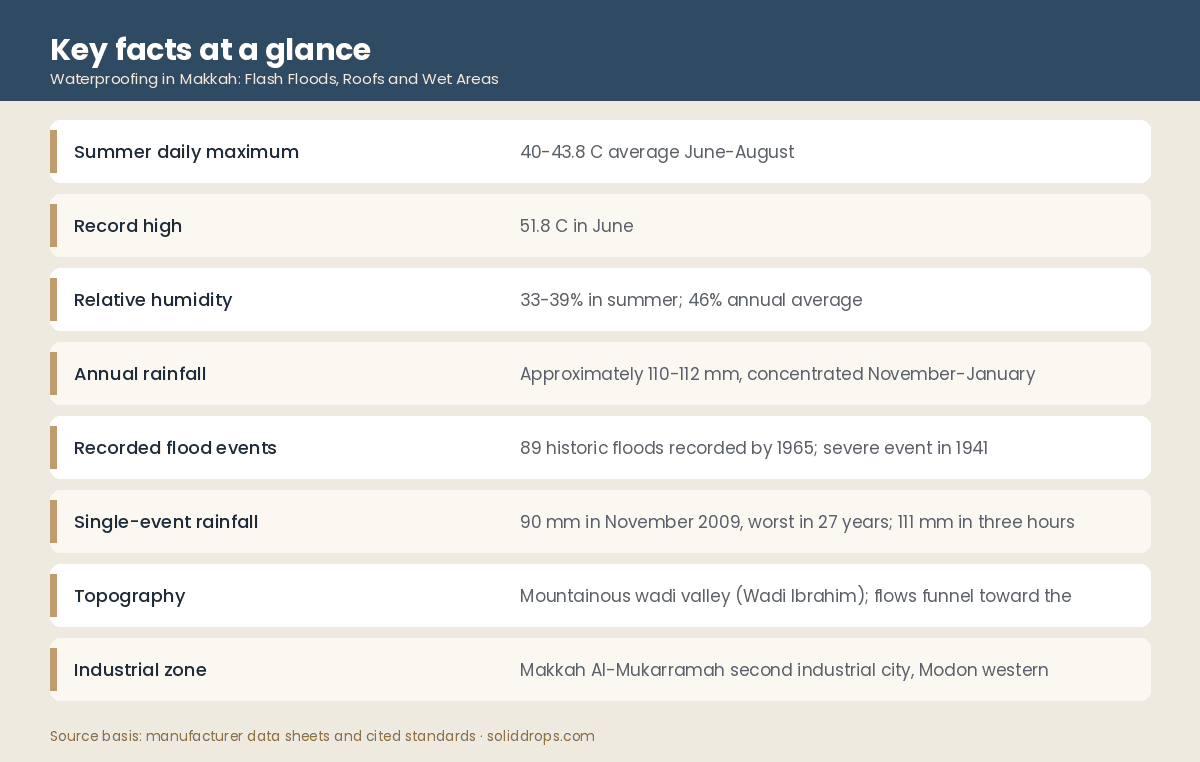
| Property | Value | Basis / standard |
|---|---|---|
| Summer daily maximum | 40-43.8 C average June-August | Climate of Mecca, Wikipedia climate record |
| Record high | 51.8 C in June | Climate of Mecca, Wikipedia climate record |
| Relative humidity | 33-39% in summer; 46% annual average | Climate of Mecca, Wikipedia climate record |
| Annual rainfall | Approximately 110-112 mm, concentrated November-January | Climate of Mecca, Wikipedia climate record |
| Recorded flood events | 89 historic floods recorded by 1965; severe event in 1941 | Published Makkah flood-history review (Springer, 2025) |
| Single-event rainfall | 90 mm in November 2009, worst in 27 years; 111 mm in three hours in January 2011 | Published Makkah flood-history review (Springer, 2025) |
| Topography | Mountainous wadi valley (Wadi Ibrahim); flows funnel toward the Haram area | Published Makkah flood-history review (Springer, 2025) |
| Industrial zone | Makkah Al-Mukarramah second industrial city, Modon western sector | Modon industrial cities register |
| Grand Mosque capacity | Exceeds 1.7 million worshippers across indoor areas, courtyards, Mataf and Sa'i | Saudipedia |
Why does rainfall in Makkah break normal roof details?
Makkah receives roughly 110 to 112 mm of rain a year, almost all of it between November and January. On paper that is a dry city. In practice the total arrives in a handful of events, and the intensity is what destroys detailing. In November 2009 the city took 90 mm in a single episode, the heaviest in 27 years. In January 2011, 111 mm fell in about three hours. A year of rainfall in one working shift.
Design your outlets for an annual average and they will drown. A roof that copes with drizzle ponds deeply once the gullies silt up in the first ten minutes of a storm. On Makkah roofs the two details worth arguing about are outlet capacity with overflow provision, and upstand height at every perimeter and threshold. Both are cheap at design stage and impossible to correct later without cutting the membrane open.
The record is long: a published review of Makkah’s flood history counts 89 recorded events up to 1965, with a severe episode in 1941. This is not new behaviour, and a specification should not treat it as an exception.
What does the wadi valley do to a building's water path?
Makkah sits inside a mountainous wadi valley, Wadi Ibrahim, with surrounding high ground that channels storm flow downhill toward the Haram area. Rain that falls on a slope two kilometres away becomes surface water at your basement ramp within minutes. The relevant exposure for a building near the valley floor is therefore not rain landing on the roof; it is water arriving horizontally at ground level, carrying sediment.
Three consequences follow for the scope.
- Basements are a tanking problem, not a damp-proofing problem. Assume hydrostatic head against the retaining walls and raft, and specify a continuous system with waterstops at construction joints rather than a coating on the internal face.
- Every penetration below flood level is a leak path. Drainage pipes, cable ducts and lift pit entries need proprietary sealed sleeves, not mortar packing.
- Sediment changes maintenance. Wadi water carries silt. Gullies and sump pumps that pass a clean-water commissioning test block on real flow, so access for clearing them belongs in the design.
A membrane is one layer of the answer. Falls, drainage capacity, upstands and pump provision are the rest, and they matter more on a valley floor than on flat ground.
What does the heat do between storms?
For most of the year the problem is the opposite of water. Average daily maximums run 40 to 43.8 C from June through August, with a recorded high of 51.8 C in June. A dark exposed membrane sits well above ambient, and the daily expansion cycle works every lap, termination and movement joint on the roof.
Humidity sits between 33 and 39 per cent in summer, with a 46 per cent annual average. That is dry enough that liquid-applied products skin quickly, which sounds convenient and is not. Fast skinning over a slower-curing body traps solvent, causes pinholes, and shortens the window for a wet-on-tacky second coat. Pot life drops with it: a two-part polyurethane comfortable to work at 25 C is unusable long before the pail empties at 45 C substrate temperature.
Practical response: mix small, store material in shade rather than on the open roof, start early, and stop when substrate temperature passes the manufacturer’s ceiling instead of when the shift ends. Where night work is allowed, check dew point before assuming cool air helps.
Which buildings in Makkah carry the highest waterproofing risk?
Three categories dominate, and they fail differently.
High-rise hotel roofs
Plant-heavy, cluttered with condenser bases, cable trays and access walkways. The membrane is rarely the weak point; the hundreds of penetrations and kerbs are.
Podium decks and landscaped terraces
Buried membranes over occupied space. A leak here is invisible until it appears two floors down, and the repair means removing paving, screed and planting.
Wet areas at extreme occupancy
Ablution spaces, public toilets and back-of-house kitchens that serve visitor numbers no ordinary commercial building sees.
The scale of that last category is what specifiers underestimate. The Grand Mosque’s capacity exceeds 1.7 million worshippers across its indoor areas, courtyards, the Mataf and the Sa’i, and the accommodation and catering buildings around it are sized against that demand. A hotel wet room in Makkah at peak is not a domestic bathroom with a tanking kit; it is a continuously wetted floor with standing water, heavy cleaning chemistry and no realistic drying period.
The city also has an industrial side. The Makkah Al-Mukarramah second industrial city sits within Modon’s western sector, and its factory roofs face the same rainfall intensity with far less maintenance attention than a hotel receives.
Which waterproofing system suits which element in Makkah?
| Element | Typical system family | The local limit to check |
|---|---|---|
| Exposed hotel roof, plant-heavy | Liquid-applied polyurethane or reinforced liquid membrane | Substrate temperature ceiling and shortened pot life through summer; detailing at every condenser base |
| Large exposed roof, few penetrations | Single-ply sheet (PVC or TPO) or bituminous sheet | Thermal movement at laps and terminations under a 40 C-plus daily maximum |
| Podium deck under paving or planting | Hot-applied or sheet membrane with protection and drainage layer | Storm volume: outlet and overflow sizing for a 100 mm-class event, not an annual average |
| Basement raft and retaining walls | Tanking sheet or bonded membrane with waterstops at joints | Hydrostatic head from wadi surface flow; sealed penetrations below flood level |
| Ablution areas and public wet rooms | Cementitious or polymer-modified wet-area membrane under tiling | Continuous wetting and aggressive cleaning; falls to drain and upstand height at door thresholds |
| Kitchen and back-of-house floors | Tanking membrane below a resin or urethane mortar screed | Thermal shock from hot washdown; coved skirtings and sealed gully connections |
For the material comparison behind these families, see our waterproofing systems guide for Saudi Arabia rather than repeating the specification data here.
Planning a Makkah roof or podium before the rain season?
Send drawings and site photographs and we will survey the drainage and detailing, not just the membrane.
How do you programme waterproofing around pilgrim seasons?
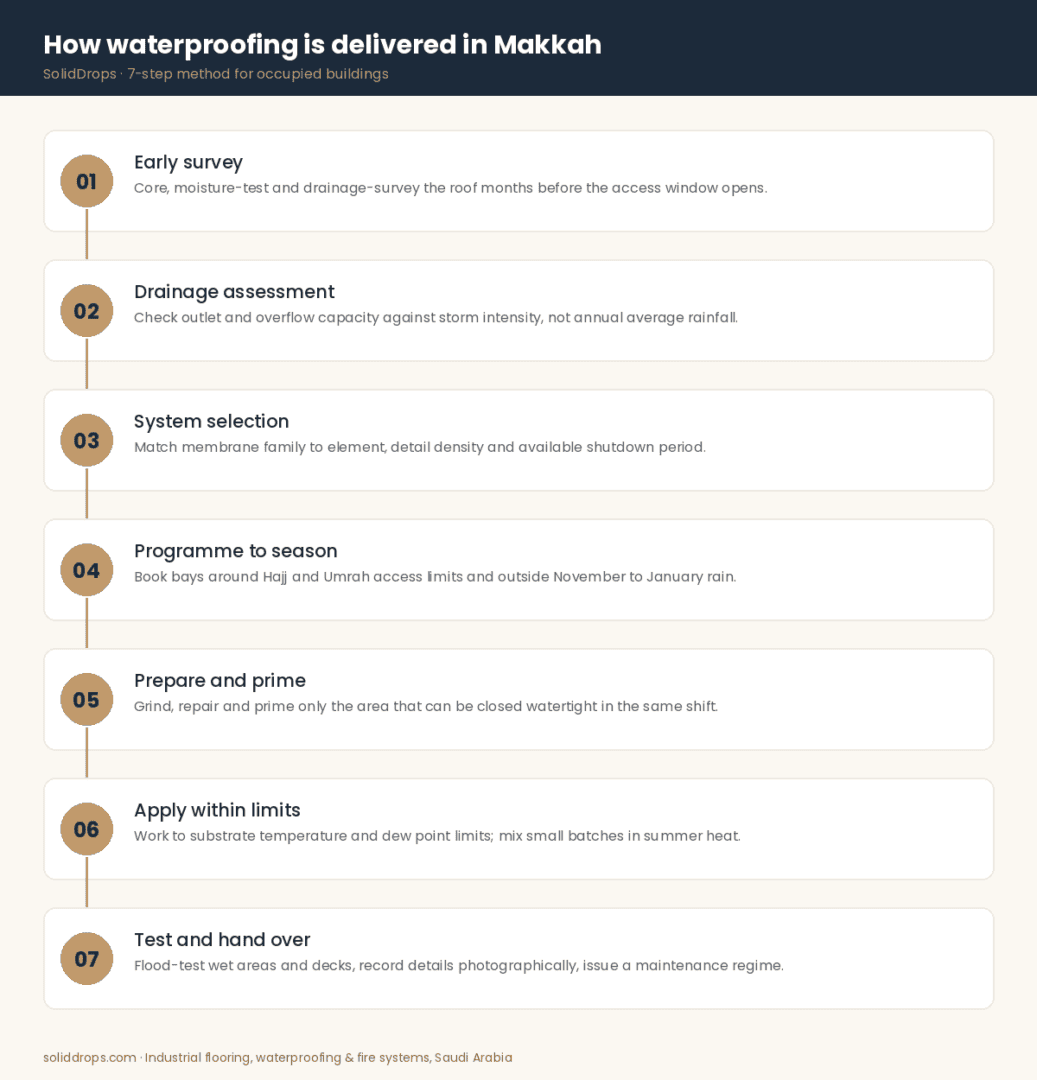
This is the part a contractor from outside the city gets wrong. Hotel and service buildings near the Haram run at capacity during Hajj and through the Umrah season, and access, noise, crane use, deliveries and road closures are all constrained then. The useful shutdown windows are narrow, and they are known well in advance.
What that means in practice:
- Survey and testing happen months ahead. Cores, moisture readings and a drainage survey should be complete before the window opens.
- Material arrives early and is stored on site. A delivery held at a checkpoint in peak season can cost a week of a two-week window.
- Work is broken into self-contained bays that can be closed watertight at the end of each shift. Never leave an open deck overnight in November.
- Roof and podium work is scheduled outside the November-to-January rain concentration where the programme allows it.
- Wet-area refurbishment is phased floor by floor so occupied rooms keep a working facility.
The same discipline applies in Madinah, where the driver is different; our Riyadh waterproofing guide covers thermal cycling rather than flood volume.
What actually goes wrong on Makkah roofs and decks?
Recurring failure patterns, in rough order of how often they appear on survey:
- Outlets sized for average rainfall. The roof holds water because drainage cannot pass a 90 mm event, and ponding finds the weakest lap.
- Upstands too low at door thresholds and plant kerbs. Water does not need to breach the membrane; it walks over the top of it.
- Membrane terminated into a chased groove that was never sealed. Common where a refurbishment reuses the original detail without cleaning it out.
- Penetrations added after handover. A cable tray drilled through a finished podium deck and patched with sealant accounts for a large share of podium leaks.
- Wet-area membrane stopped at the tile line. It must run above splash height and cross the threshold, or the screed wicks water into the corridor.
- Application above the substrate temperature limit. Blistering on a roof coated on a July afternoon.
None of these are exotic. They are detailing and sequencing decisions, which is why an inspection before re-coating is worth more than an upgraded product. Our roof waterproofing inspection checklist sets out what to look at.
What drives waterproofing cost on a Makkah project?
SolidDrops quotes per project and does not publish rates: two roofs of identical area in the same district can differ widely. The factors that move a Makkah number are:
- Detail density. Penetration count, kerbs, upstands, movement joints. A cluttered hotel plant deck costs far more per square metre than an open warehouse roof.
- Access and craneage. High-rise work near the Haram, restricted road access and limited lay-down area all add time.
- Season. A pilgrim-season window carries programme constraints; November to January carries weather risk.
- Substrate condition. Whether the existing screed can be recoated or must come off, and whether moisture content is within the system’s limit.
- Drainage remedial work. Re-sizing outlets, adding overflows and clearing silted channels is often the difference between a repair that holds and one that does not.
- Occupied-building phasing. Night shifts, dust screening and floor-by-floor handover.
Send drawings, an area schedule and photographs of the existing condition, and you get a quotation against a defined scope rather than a rate against an assumption.
Who supplies and installs waterproofing in Makkah?
SolidDrops supplies and installs waterproofing systems in Makkah – مكة المكرمة – covering roofs, podium decks, basements, water-retaining structures and wet areas, for hotels, hospitality back-of-house, healthcare, retail and industrial buildings including the Makkah industrial zone. The same team handles resin flooring, FRP wall panels and construction chemicals, which matters when a wet-area scope crosses from membrane to screed to floor finish.
Our flooring and waterproofing support page for Makkah sets out the service scope and enquiry process, and the epoxy flooring in Makkah page covers the floor finish where the two scopes meet in kitchens, plant rooms and parking decks.
To start: email [email protected] or call +966 50 213 1112 with the building type, elements in scope, area and access window. A site visit and a written recommendation follow. We will tell you where an existing membrane can be recoated and where it cannot, because a recoat over a failed substrate costs the client twice.
Frequently asked questions
Why does Makkah flood if it barely rains?
Because the annual total of roughly 110 to 112 mm arrives in a few short events. Makkah recorded 90 mm in November 2009 and 111 mm in about three hours in January 2011. The city also sits in a mountainous wadi valley, so runoff from surrounding high ground concentrates at the valley floor rather than soaking away.
What is the best roof waterproofing for hotels in Makkah?
For plant-heavy hotel roofs a reinforced liquid-applied polyurethane system usually wins, because it detoures cleanly around hundreds of penetrations without laps. For large open roofs with few penetrations, single-ply sheet is often more economical. The deciding factors are detail density, substrate condition and the access window, so the survey comes first.
Does waterproofing prevent flash flood damage in Makkah?
It prevents water entering through the building envelope, which is a large part of the damage. It does not control the volume arriving at the site. Flood resilience in Makkah needs the membrane plus adequate outlet and overflow capacity, raised thresholds, sealed penetrations below flood level and working sump pumps with access for clearing silt.
How should wet areas be waterproofed in Makkah hotels?
As continuously wetted floors rather than domestic bathrooms. Use a wet-area membrane under the tiling, carried up the walls above splash height and continuously across the door threshold, with correct falls to drain and a sealed gully connection. Occupancy near the Haram means these floors rarely get a drying period.
When is the best time of year to waterproof a roof in Makkah?
Outside the November to January rain concentration and outside the hottest afternoons of summer, when substrate temperature passes the product’s stated ceiling. Spring and autumn mornings give the widest usable window. Pilgrim-season access restrictions often matter more to the programme than weather does.
How much does waterproofing cost in Makkah?
There is no useful square-metre rate. Cost is driven by penetration and detail density, access and craneage near the Haram, substrate condition, whether drainage needs re-sizing, and whether work must fit inside a pilgrim-season window. Send drawings, areas and photographs to [email protected] for a quotation against a defined scope.
Who supplies and installs waterproofing in Makkah?
SolidDrops is a supplier and installer of waterproofing systems in Makkah, covering roofs, podium decks, basements, water tanks and wet areas for hotels, healthcare, retail and industrial buildings. Contact [email protected] or +966 50 213 1112 with the building type, elements in scope and your access window.
Waterproofing support for Makkah projects
Supplier and installer for roofs, podium decks, basements and high-occupancy wet areas. [email protected] · +966 50 213 1112
 Chat Online