
10 Sep Ucrete Flooring in Saudi Arabia: PU Concrete Explained
Ucrete Flooring in Saudi Arabia: PU Concrete Explained
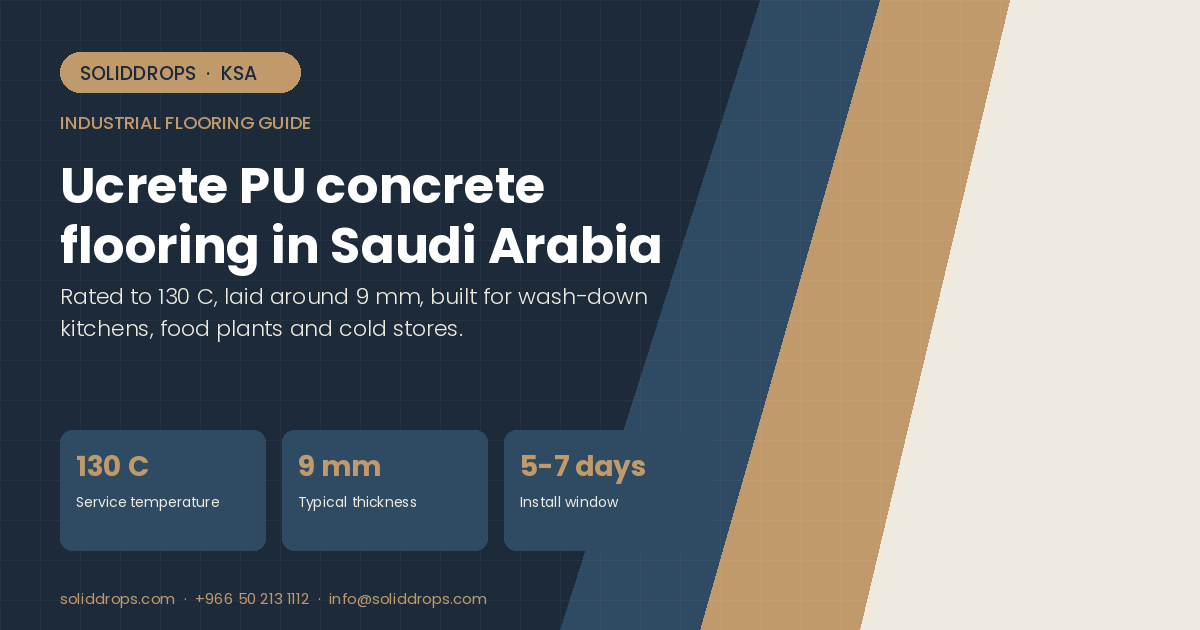
Ucrete flooring in Saudi Arabia is a polyurethane concrete system laid over prepared concrete, typically around 9 mm at its rated service temperature. It is specified for wet, hot and chemically aggressive process areas – kitchens, food plants, cold rooms and chemical facilities – where epoxy would be pushed past its limits.
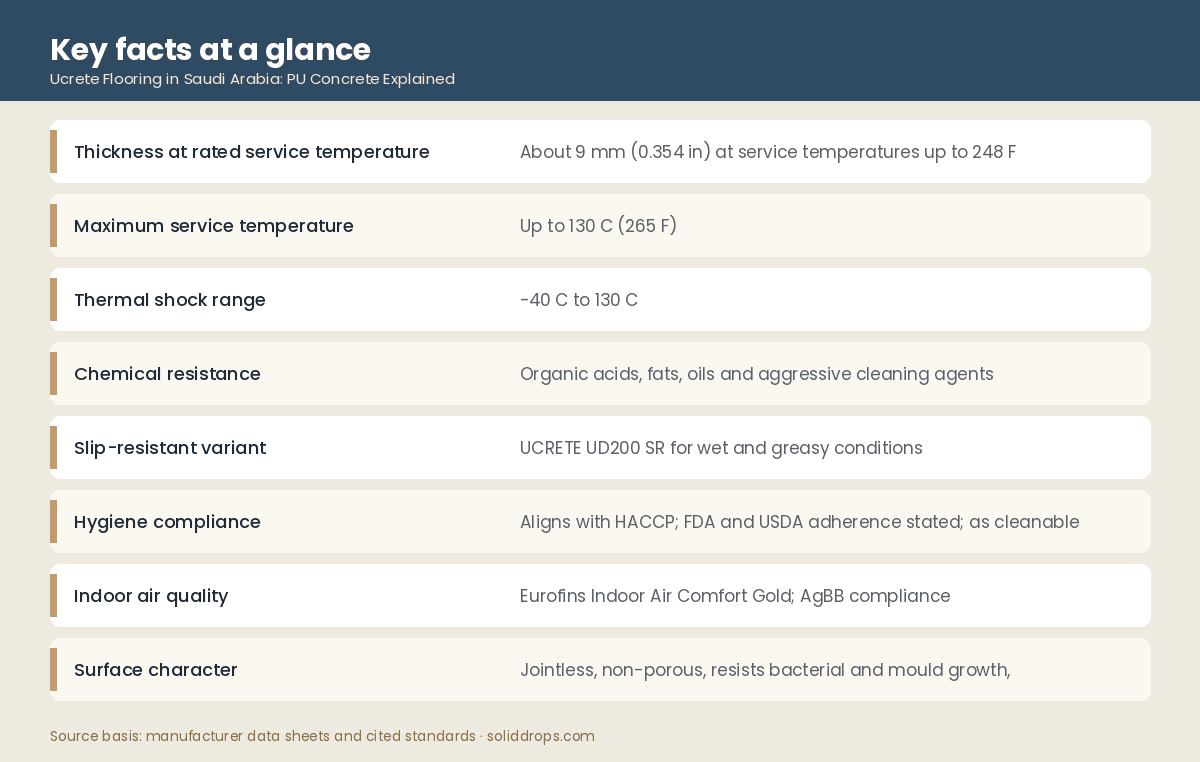
| Property | Value | Basis / standard |
|---|---|---|
| Thickness at rated service temperature | About 9 mm (0.354 in) at service temperatures up to 248 F | Ucrete system data, SolidDrops industrial kitchen page |
| Maximum service temperature | Up to 130 C (265 F) | Ucrete system data |
| Thermal shock range | -40 C to 130 C | Ucrete system data |
| Chemical resistance | Organic acids, fats, oils and aggressive cleaning agents | Ucrete system data |
| Slip-resistant variant | UCRETE UD200 SR for wet and greasy conditions | Ucrete product range |
| Hygiene compliance | Aligns with HACCP; FDA and USDA adherence stated; as cleanable as stainless steel | Ucrete system data |
| Indoor air quality | Eurofins Indoor Air Comfort Gold; AgBB compliance | Ucrete system data |
| Surface character | Jointless, non-porous, resists bacterial and mould growth, withstands high-pressure washing | Ucrete system data |
| Indicative service life | 20+ years | SolidDrops flooring system comparison |
| Installation window | 5-7 days | SolidDrops project method |
What is Ucrete flooring, and how is it different from epoxy?
Ucrete is a polyurethane concrete flooring system – PU concrete, sometimes called urethane mortar or PU cement – manufactured by Master Builders Solutions and installed over prepared concrete by trained applicators. SolidDrops supplies and installs it in Saudi Arabia; we are not the manufacturer, and the performance figures in this guide come from the system data rather than from us.
The chemistry is the point. An epoxy floor is a resin binder with filler. A polyurethane concrete floor combines a polyurethane binder with cement and graded aggregate, producing a material whose coefficient of thermal expansion is close to that of the concrete slab beneath it. That single property explains most of its behaviour: it can be steam cleaned, shocked with boiling water and chilled to freezer temperature without debonding, because it moves with the slab instead of fighting it.
The headline numbers follow from that. Ucrete is rated for service temperatures up to 130 C (265 F), with a thermal shock range cited from -40 C to 130 C. At service temperatures up to 248 F, the system is laid at approximately 9 mm. Thickness and temperature are linked in the manufacturer’s guidance – a hotter duty calls for a heavier section – which is why the process conditions must be established before a thickness is quoted.
Where is Ucrete specified across Saudi facilities?
Ucrete goes where wet meets hot meets chemically aggressive, and where hygiene is audited rather than assumed.
Commercial and industrial kitchens
Hotel, hospital, catering and central production kitchens. Hot spillage, fats and oils, and daily degreasing.
Food and beverage processing
Dairy, bakery, meat, poultry and beverage plants. Organic acids, wash-down and HACCP zoning.
Cold rooms and freezers
Chilled and frozen storage where the floor cycles between temperatures and is cleaned wet.
Chemical and petrochemical plant
Process areas around Jubail, Yanbu and Dammam where spillage and thermal load are continuous.
The hygiene case matters as much as the thermal one. The surface is jointless and non-porous, resists bacterial and mould growth, and withstands high-pressure washing and aggressive cleaning agents – the system data describes it as being as cleanable as stainless steel. It aligns with HACCP requirements and its FDA and USDA adherence is stated in the manufacturer’s documentation. For KSA food and pharmaceutical projects operating under SFDA oversight, that documentation is what an auditor asks to see.
Occupied buildings gain another advantage: Eurofins Indoor Air Comfort Gold certification and AgBB compliance address emissions in enclosed spaces, which matters for a kitchen refurbishment in a running hotel. Related reading: our Ucrete for industrial kitchens page and cold room and freezer flooring.
Ucrete vs epoxy: which one does the room need?
This comparison decides most industrial flooring tenders in Saudi Arabia, and the answer usually falls out of two questions: how hot does the floor get, and how often is it washed?
| Criterion | Ucrete (PU concrete) | Epoxy resin |
|---|---|---|
| Typical thickness | About 9 mm at service temperatures up to 248 F | 2-3 mm self-levelling, 3-6 mm screed, 4-12 mm mortar |
| Service temperature | Up to 130 C, with thermal shock from -40 C to 130 C | Limited; steam cleaning and hot spillage need review |
| Chemical exposure | Organic acids, fats, oils and aggressive cleaning agents | Strong with the right grade, including concentrated acids and alkalis |
| Wet process areas | Designed for it; UD200 SR variant for wet and greasy conditions | Suitable with the correct grade and slip profile, within temperature limits |
| Hygiene documentation | HACCP alignment, FDA and USDA adherence, Eurofins Indoor Air Comfort Gold, AgBB | Food-zone finishes specified to an Rz 20-70 micrometre profile per HACCP zoning |
| Indicative service life | 20+ years | 5-10 years |
| Install window | 5-7 days | 3-5 days self-levelling; 5-7 days mortar |
| Relative cost tier | Highest tier of the systems compared | Lower tier, varying with thickness and grade |
Read the last two rows together. Ucrete carries the highest capital cost of the systems compared, against an indicative service life of 20+ years versus 5-10 for epoxy. In a wash-down area a cheaper floor replaced twice is rarely the cheaper floor. In a dry warehouse, paying for 130 C capability nobody uses is waste. Our epoxy flooring guide and the epoxy vs PU cement comparison take the other side of this in more detail.
How is Ucrete installed?
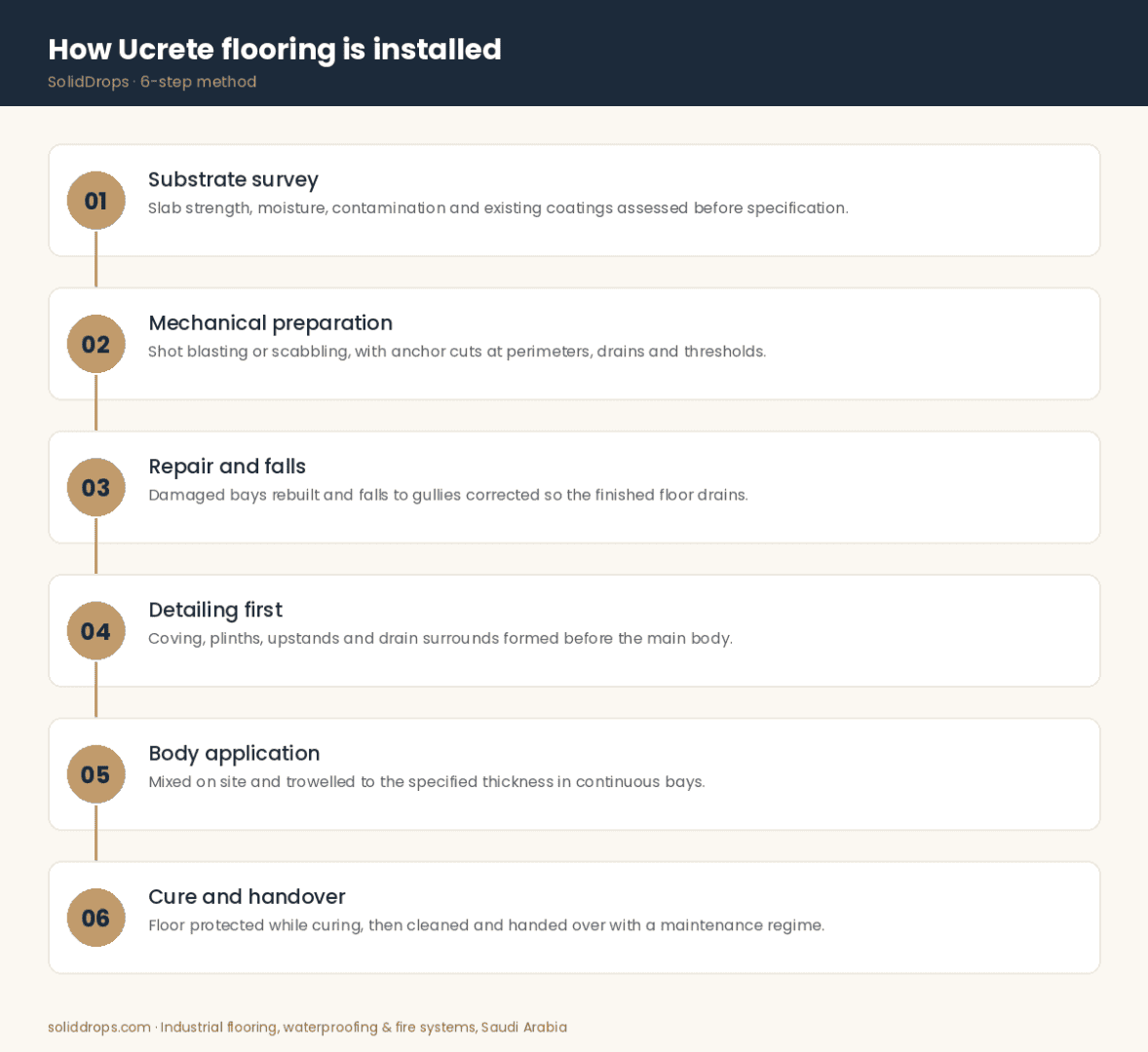
Plan 5-7 days for a Ucrete installation, and treat that window as continuous possession of the area. The sequence is unforgiving of interruption.
- Substrate survey. Slab strength, soundness, moisture, contamination and existing coatings. Ucrete tolerates a green or slightly damp slab better than epoxy does, but the assessment still governs the specification.
- Mechanical preparation. Shot blasting or scabbling to a clean, open profile. Anchor cuts formed at all terminations – perimeters, drains, door thresholds and plinths – so the floor keys into the slab rather than stopping on its surface.
- Repair and falls. Spalled areas rebuilt and falls to gullies corrected. In a wet process room the fall is the system: a level floor holds water, and standing water defeats the point of the specification.
- Detailing first. Coving to walls and plinths, drain surrounds and upstands are formed before the main body so junctions are integral rather than applied afterwards.
- Body application. Mixed on site and trowelled or screeded to the specified thickness in continuous bays, with the finish – smooth or the slip-resistant profile of a variant such as UD200 SR – worked in as it goes.
- Cure and handover. Protected while curing, then cleaned and handed over with the maintenance regime.
Two practical points from site. Ucrete is trowel-applied, so the finish is the applicator’s work as much as the material’s – the crew matters. And the finished texture is chosen deliberately: the grip profile needed at a kitchen fryer line is not what you want in a packing hall where trolleys run all day.
What drives Ucrete flooring cost in Saudi Arabia?
Ucrete sits at the highest cost tier of the flooring systems we compare, and the variables that move a quotation are these.
- Specified thickness. Driven by process temperature and mechanical duty; the manufacturer’s guidance links section to service conditions.
- Substrate condition. Removing failed coatings, treating fat and oil contamination, and rebuilding damaged bays are separate scopes from the flooring itself.
- Falls and drainage. Correcting or forming falls to gullies in a wet room is screed work carried out before the system.
- Detailing quantity. Coving, upstands, plinths, drain surrounds, thresholds and expansion joints are measured per metre and per item, and a kitchen has a great many of them.
- Finish and variant. A slip-resistant grade for wet and greasy conditions is a different selection from a smooth finish.
- Shutdown window. Live plant, night shifts and phased handover in an operating kitchen or cold store carry programme cost.
- Area, geometry and location. Small congested rooms cost more per square metre than open halls; mobilisation to Jubail differs from Jeddah.
We do not publish rates. Cost per square metre is meaningless without the process conditions and the slab, and a figure quoted blind would mislead. Send drawings, the wash-down and temperature regime, and the available shutdown – we will price against those. For the wider picture see our note on flooring cost factors.
Wash-down, hot process or cold store floor to specify?
Send the process temperatures, cleaning regime and drainage layout. We will confirm whether Ucrete is the right system and specify the thickness.
What goes wrong, and where are the limits?
Terminations left on the surface. The most common failure. Without anchor cuts at drains, doorways and perimeters, wheel traffic and thermal movement lift the edge and the floor unzips from there.
Falls not corrected. Installing a jointless, non-porous floor in a room that ponds water solves nothing. The fall belongs in the substrate work.
Substrate strength ignored. Ucrete is stronger than most slabs it is laid on. If the concrete beneath is weak or delaminating, failure occurs in the concrete, and the floor is blamed for it.
Movement joints bridged. Structural joints must be carried through the floor with the correct detail. Covering one relocates the crack, it does not remove it.
Wrong finish for the task. Over-specifying grip creates a floor that traps grease and resists cleaning; under-specifying it creates a slip risk. The variant is chosen from the actual duty.
Limits, stated plainly. Ucrete is a functional industrial floor, not a decorative one: the colour range is restrained and the surface is matt and textured, which is why it is rarely the right choice for showrooms or offices – vinyl serves those better. It carries a higher capital cost than epoxy, so it needs a duty that justifies it. And it does not substitute for waterproofing: a membrane below the slab or screed is a separate scope where groundwater or a floor above an occupied space is involved.
What this means for projects in Saudi Arabia
Kitchen and food plant duty is heavier here than the data sheet assumes. A central production kitchen in Riyadh or a catering facility serving pilgrims in Makkah and Medina runs long, hot shifts with continuous wash-down. That is the exact condition Ucrete is designed for, and it is the honest argument for its cost tier over epoxy in these buildings.
Thermal contrast in cold storage. A chilled store in Jeddah opens its doors into ambient air that can be sixty degrees warmer. The floor at that threshold sees repeated shock and condensation. A system rated for thermal shock from -40 C to 130 C is specified for exactly that transition zone, and the detailing at the door line deserves as much attention as the room itself.
Process plant in the Eastern Province. Facilities around Jubail and Dammam combine chemical exposure with high ambient temperature. Where sabkha ground and saline groundwater have affected the slab, substrate remediation is the first scope, not the last – the floor performs only as well as the concrete carrying it.
Application conditions. Ucrete is mixed and trowelled on site, and high ambient and slab temperatures shorten working time. Batch sizes, crew numbers and shift timing are planned around the measured slab temperature, and material is stored conditioned rather than in a container on the compound.
Documentation. KSA buyers in regulated food and pharmaceutical facilities should request the system’s hygiene and emissions documentation – HACCP alignment, FDA and USDA statements, Eurofins Indoor Air Comfort Gold and AgBB – at submittal stage, alongside the specific product data sheet for the variant being installed.
Who supplies and installs Ucrete flooring in Saudi Arabia?
SolidDrops supplies and installs Ucrete polyurethane concrete flooring across Saudi Arabia, working from Jeddah and covering Riyadh, Dammam, Jubail, Makkah, Medina and Tabuk – أرضيات يوكريت for kitchens, food plants, cold stores and process areas. Ucrete is a Master Builders Solutions system; our role is supply and installation, including substrate survey, preparation, detailing, application and handover documentation.
The information that lets us specify properly is short: the process temperatures the floor will see, the cleaning regime and chemicals used, the mechanical traffic, the drainage layout, and the shutdown window available. Those five inputs determine thickness, variant and finish, and they determine whether Ucrete is the right answer at all – sometimes it is not, and we will say so.
Further reading: food processing plant flooring, industrial epoxy and PU flooring, and our Stonhard system range, for which SolidDrops is an authorised distributor. To arrange a site visit, email [email protected] or call +966 50 213 1112.
Frequently asked questions
Who supplies and installs Ucrete flooring in Saudi Arabia?
SolidDrops supplies and installs Ucrete polyurethane concrete flooring across Saudi Arabia, including Jeddah, Riyadh, Dammam, Jubail, Makkah, Medina and Tabuk. Ucrete is a Master Builders Solutions system; SolidDrops is the supplier and installer, covering substrate survey, preparation, detailing, application and handover. Contact [email protected] or +966 50 213 1112.
What is Ucrete flooring?
Ucrete is a polyurethane concrete flooring system, also described as PU concrete or urethane mortar, laid over prepared concrete. It combines a polyurethane binder with cement and graded aggregate, giving a jointless, non-porous surface that resists bacterial and mould growth and withstands high-pressure washing and aggressive cleaning agents.
How is Ucrete different from epoxy flooring?
Ucrete is rated for service up to 130 C with thermal shock cited from -40 C to 130 C, so it handles steam cleaning, hot spillage and freezer conditions that push epoxy past its limits. Epoxy is thinner, typically 2-12 mm depending on system, and carries a lower cost. Indicative service life is 20+ years for Ucrete against 5-10 years for epoxy.
How thick is Ucrete flooring?
At service temperatures up to 248 F the system is laid at approximately 9 mm (0.354 inches). Thickness is linked to service temperature and mechanical duty in the manufacturer’s guidance, so a hotter or heavier process area may call for a different section. The specification is confirmed against the process conditions before quoting.
Is Ucrete flooring suitable for commercial kitchens?
Yes. It is specified for kitchens because it handles hot spillage, fats, oils and daily degreasing, and its surface is jointless and non-porous, described in the system data as being as cleanable as stainless steel. The UCRETE UD200 SR variant is designed for wet and greasy conditions where slip resistance is required.
Can Ucrete flooring withstand steam cleaning and hot water?
Yes. The system is rated for service temperatures up to 130 C (265 F), with a thermal shock range cited from -40 C to 130 C, and it withstands high-pressure washing and aggressive cleaning agents. That thermal capability is the main technical reason it is chosen over epoxy in wash-down process areas.
Is Ucrete flooring HACCP compliant?
The system data states alignment with HACCP requirements and adherence to FDA and USDA expectations, alongside Eurofins Indoor Air Comfort Gold certification and AgBB compliance for indoor emissions. For regulated food and pharmaceutical facilities in Saudi Arabia, request this documentation with the product data sheet for the exact variant at submittal stage.
How much does Ucrete flooring cost in Saudi Arabia?
Ucrete sits at the highest cost tier of the flooring systems compared. Price is driven by specified thickness, substrate condition, whether falls and drainage need correcting, the quantity of coving and detailing, the finish variant, the available shutdown window, and area and location. SolidDrops quotes after a site inspection rather than publishing rates.
Talk to a SolidDrops flooring specifier
Supplier and installer of Ucrete polyurethane concrete flooring across Jeddah, Riyadh, Dammam, Jubail, Makkah, Medina and Tabuk.
 Chat Online