
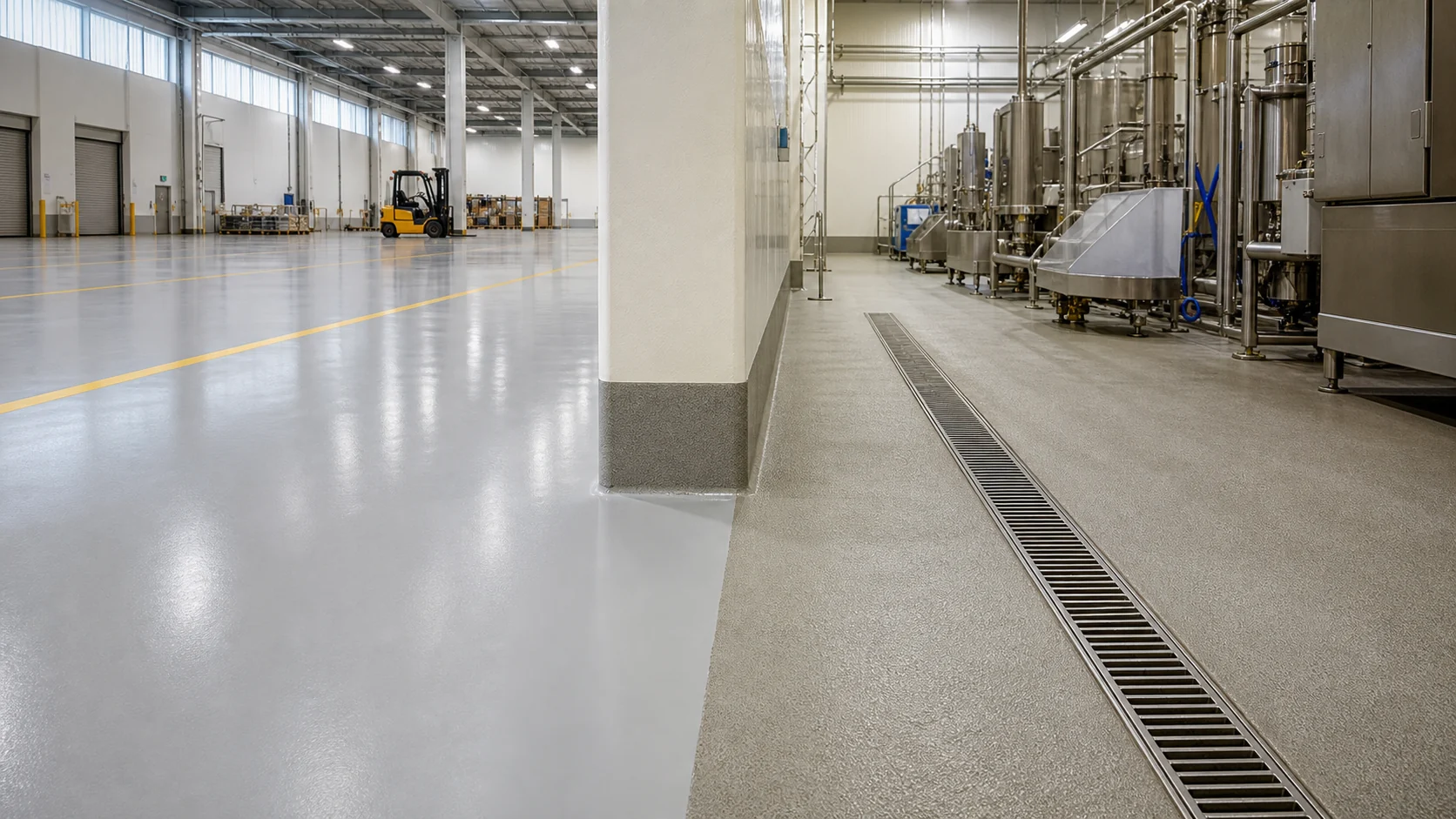
01 Aug Epoxy vs PU Cement Flooring in Saudi Arabia: 2026 Specification Guide
Short answer: choose self-leveling epoxy for dry, clean areas where a smooth, seamless finish matters; use epoxy screed mortar to rebuild worn concrete or create a heavier-duty resin layer; specify polyurethane screed or PU cement flooring for wet processing, hot washdown, thermal cycling and aggressive service; and use a compatible PU coating when UV stability, abrasion resistance or a tough protective topcoat is required.
Updated: 1 August 2026 · Coverage: Saudi Arabia · For: owners, consultants, contractors, facility managers and procurement teams. Final product selection, thickness and cure schedule must follow the approved manufacturer data sheet and actual project conditions.
Need a room-by-room flooring recommendation?
Send SolidDrops the floor area, location, slab photos, traffic, cleaning temperature, chemicals, drainage details and available shutdown time.
Epoxy vs PU cement flooring: quick comparison
Epoxy and polyurethane-cement are not competing versions of one product. They solve different exposure conditions. The table below is a specification starting point, not a substitute for moisture testing, substrate assessment or an approved technical data sheet.
| Flooring system | Typical role | Best-fit areas | Main strength | Watch point |
|---|---|---|---|---|
| Epoxy coating | Thin or high-build protective coating | Light-duty stores, workshops, plant rooms and dust-control areas | Seals concrete and improves cleaning, colour and chemical resistance | A coating cannot hide weak, wet or badly damaged concrete |
| Self-leveling epoxy | Smooth resin body coat, commonly specified in a multi-millimetre build | Dry production, laboratories, showrooms, pharmaceutical support rooms and selected warehouses | Seamless, dense, attractive and easy to clean | Smooth finishes need a separate slip strategy in wet areas |
| Epoxy screed mortar | Trowelled, aggregate-filled repair or wearing layer | Forklift aisles, impact zones, loading areas, equipment bases and worn slabs | Builds thickness and resists impact better than a thin coating | Falls, joints and final texture must be detailed before installation |
| PU screed / PU cement | Polyurethane-cement hybrid screed, smooth or textured | Food plants, industrial kitchens, dairies, cold rooms, wet processing and hot washdown | Handles combined heat, moisture, impact and chemical exposure when correctly specified | Thermal performance depends strongly on the named system and thickness |
| PU coating | Protective polyurethane finish or topcoat | Car parks, ramps, walkways, commercial floors and UV-exposed compatible systems | Abrasion resistance, elasticity and colour/UV stability with aliphatic grades | PU coating is not the same as heavy-duty PU cement screed |
What each industrial flooring system actually does
1. Epoxy floor coating
Epoxy flooring bonds resin and hardener into a dense protective surface over prepared concrete. It is widely used in Saudi warehouses, workshops, factories, parking support rooms and commercial areas because it controls concrete dust, improves cleanability and allows colour zoning or safety marking.
The phrase epoxy flooring covers several builds: primer plus coating, high-build epoxy, broadcast anti-slip epoxy, self-leveling epoxy, decorative systems and conductive ESD floors. A low-cost thin coat and a multi-layer industrial system should never be treated as equivalent. For a broader service overview, see epoxy flooring contractor support in Saudi Arabia.
2. Epoxy self-leveling or self-levelling flooring
Self-leveling epoxy is a flow-applied resin floor that forms a smooth, continuous surface. It is a strong fit when appearance, cleanability and a dense seamless finish matter more than a coarse wet-area texture. Typical projects include dry manufacturing, laboratories, electronics support areas, showrooms, clean corridors and selected logistics spaces.
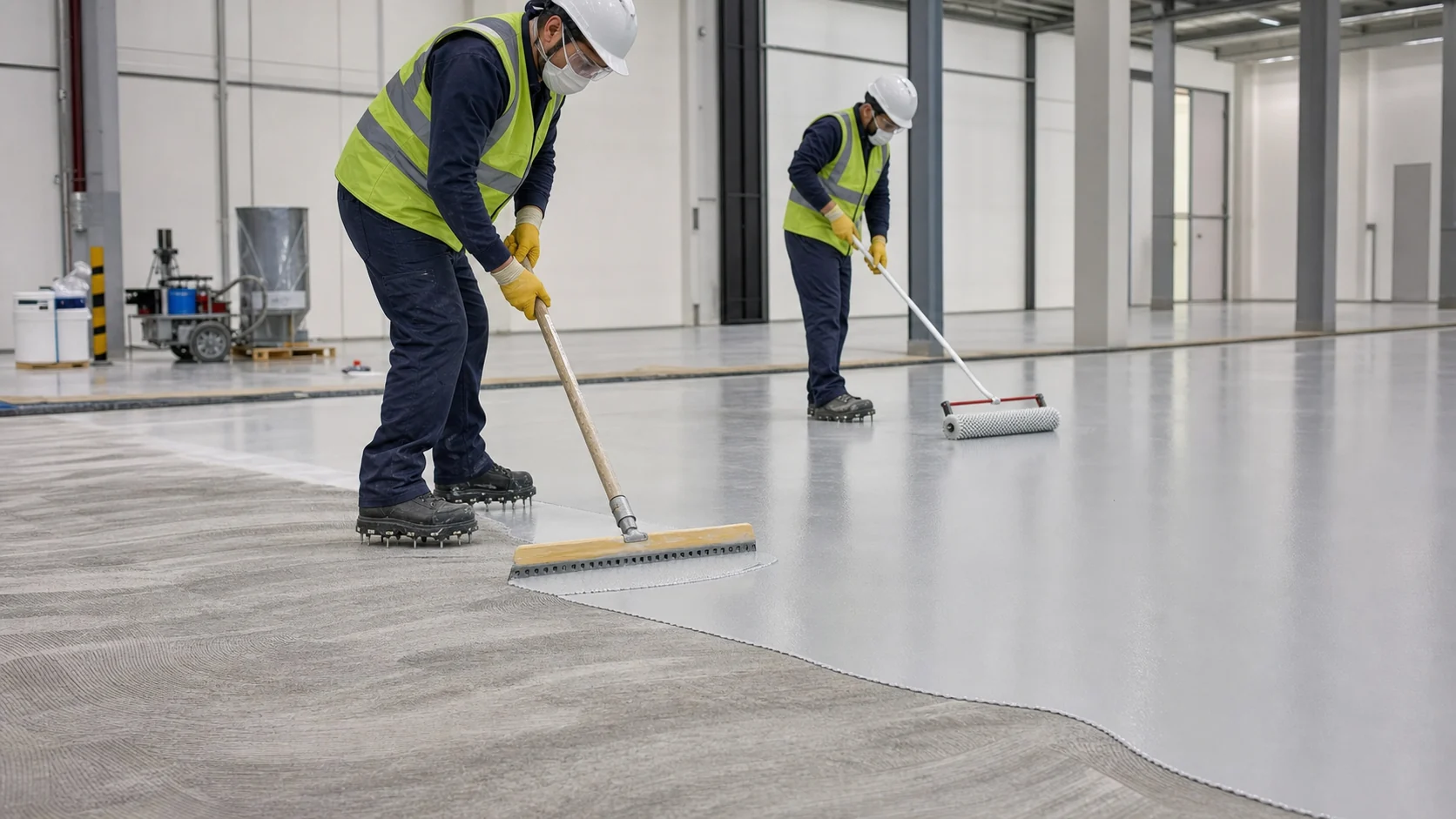
Despite its name, self-leveling epoxy is not a cure for every uneven slab. It can correct small surface variations within the product design, but major undulation, failed concrete, incorrect falls or moving cracks require repair or levelling before the resin body coat. Read more about self-leveling epoxy flooring for industrial areas.
3. Epoxy screed mortar
Epoxy screed mortar combines epoxy resin with selected graded aggregate to create a trowelled layer. It may be used for local rebuilding, heavy-duty surfacing, ramps, forklift turning points, impact zones or damaged slab areas before a compatible finish.
It is not ordinary sand-cement screed. The resin binder gives epoxy mortar high bond and mechanical performance, while the aggregate provides body and wear resistance. As one product-family example, Stonhard describes its Stonclad GS epoxy mortar as a trowelled system applied at 3–6 mm depending on requirements. That is a useful reference range, not a universal thickness for every epoxy screed.
4. Polyurethane screed flooring and PU cement screed flooring
PU cement flooring, polyurethane screed, urethane cement and cementitious polyurethane flooring are often used for the same broad technology family: polyurethane binder, cementitious components and graded aggregates formulated as a heavy-duty resin floor.
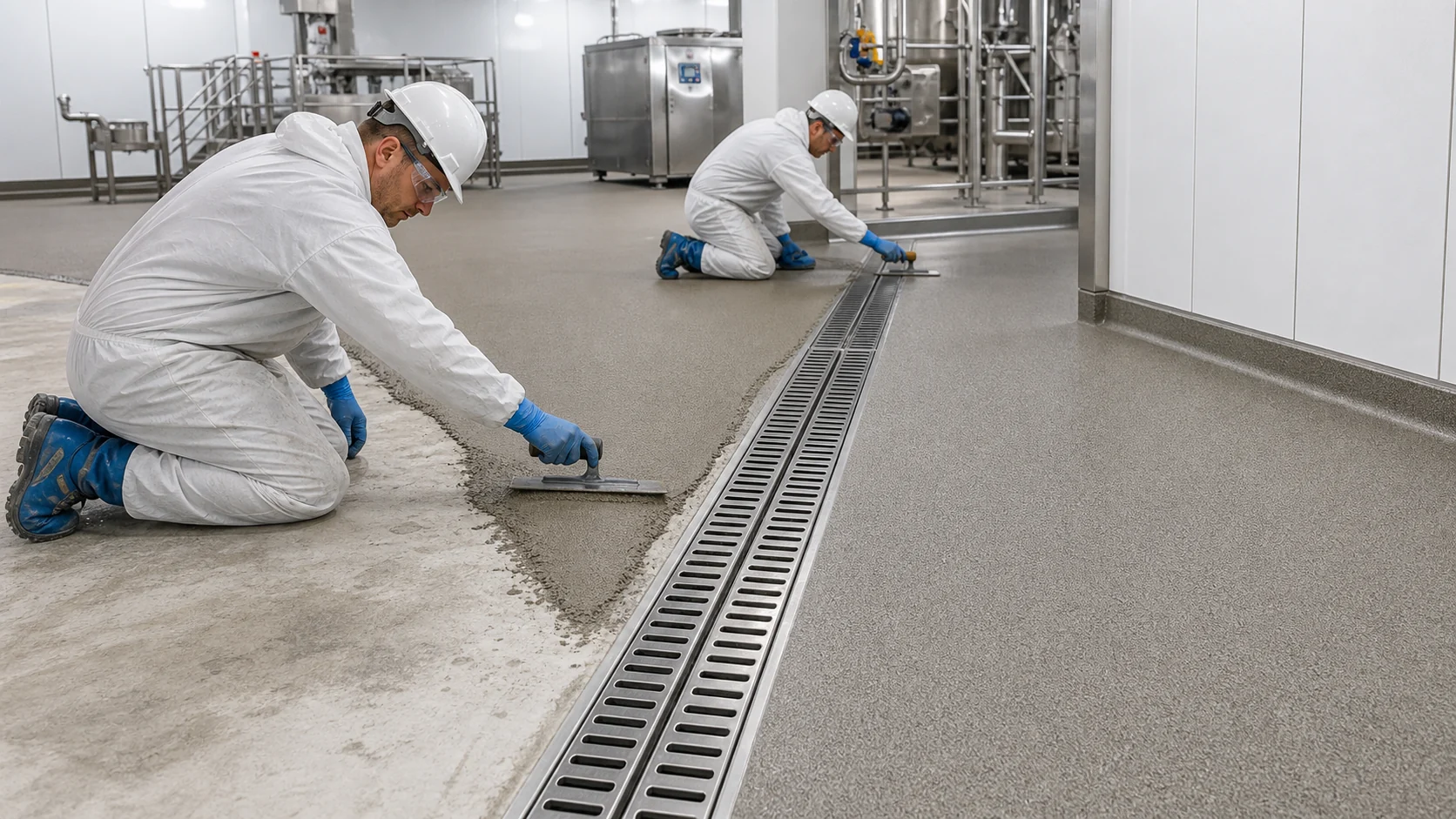
Correctly specified PU cement is normally considered where several stresses occur together: hot-water cleaning, cold-room transitions, oils or food acids, impact, constant moisture, steam or aggressive detergents. This makes it a common route for food factories, beverage plants, industrial kitchens, dairies, bakeries, cold stores and chemical-process rooms.
Thickness matters. Sika’s PurCem guidance shows a family range of roughly 3–12 mm, with higher thermal-shock capability assigned to thicker, named system builds. For example, some heavy-duty products are installed at 6–9 mm, while more demanding temperature exposure may require a thicker specified system. Never copy a maximum temperature from one product into a different thickness or brand.
For hygiene-driven projects, see SolidDrops’ food processing flooring guide for epoxy and PU cement.
5. PU coating and polyurethane floor protection
A PU coating is a resin coating or topcoat, not a synonym for PU cement screed. Depending on the chemistry, it can add abrasion resistance, flexibility, chemical resistance, a matt or gloss finish and improved resistance to colour change under UV exposure. Aliphatic polyurethane grades are commonly chosen when colour and exterior light stability matter.
A compatible PU topcoat can be used over an epoxy body coat to combine epoxy adhesion and build with polyurethane wear or UV properties. Compatibility, recoat window, preparation and slip resistance must be checked as one approved system. A thin PU coat cannot replace a heavy-duty screed where the slab needs thickness, thermal-shock resistance or impact rebuilding.
Which floor should you choose for each area?
| Area or exposure | Starting-point system | Why |
|---|---|---|
| Dry warehouse aisles and pallet traffic | High-build or self-leveling epoxy; epoxy mortar at impact zones | Cleanability, line marking and wear resistance; reinforce turning points and damaged areas |
| Loading bay or forklift turning point | Epoxy screed mortar or heavier broadcast system | Higher point load, impact and abrasion than light storage areas |
| Food production with hot washdown | Textured PU cement / polyurethane screed | Combined heat, water, cleaning chemicals, grease and slip risk |
| Cold room or freezer threshold | Thickness-matched PU cement system | Thermal cycling and wet service can exceed standard epoxy capability |
| Laboratory or clean dry production | Self-leveling epoxy or specialist seamless resin system | Smooth, dense, easy-clean surface; confirm chemical and ESD requirements |
| Electronics, control or sensitive production | Tested conductive or dissipative epoxy system | Static control requires a complete tested build, earthing and acceptance testing |
| Sunlit parking deck, ramp or exterior walkway | Compatible UV-stable polyurethane or traffic coating system | Exterior exposure, abrasion, movement and colour stability need more than generic indoor epoxy |
For logistics projects, also review warehouse epoxy flooring for forklifts and line marking. For static-sensitive rooms, see the anti-static and ESD epoxy flooring guide.
Seven decisions to make before requesting a resin-floor quotation
- Define the room use. State whether the area is dry storage, production, washdown, cold room, kitchen, ramp, laboratory or heavy logistics.
- Describe the traffic. Include pedestrian use, pallet jacks, forklift wheel type, vehicle turning, dropped loads and static equipment loads.
- List liquids and chemicals. Identify oils, acids, alkalis, solvents, detergents, food products and the concentration, temperature and contact time where known.
- State the cleaning temperature. Cold mopping, hot-water washdown and steam cleaning impose very different demands.
- Survey the concrete. Record slab age, moisture, contamination, cracking, laitance, previous coatings, hollow areas and measured pull-off strength where required.
- Detail safety and hygiene. Confirm wet slip resistance, coves, drains, falls, joints, colour zoning, line marking and cleanability.
- Protect the cure window. Give the available shutdown period, access route, ambient conditions and time before pedestrian, forklift, chemical or hot-water exposure.
A good quotation should name the preparation method, primer, repair layer, body coat, aggregate/texture, topcoat, total thickness, joint treatment, cove detail, cure conditions and acceptance tests. A product name without the full build-up is not a complete floor specification.
Why epoxy and PU floors fail prematurely
Most resin-floor failures begin below the visible finish or at poorly resolved details. The common causes are:
- Coating weak laitance, dust, oil or an incompatible old floor.
- Ignoring rising moisture, vapour pressure or a missing damp-proof route.
- Using a thin coating where impact, thermal shock or heavy point loads require a screed.
- Stopping the floor badly at drains, columns, doorways, joints or coves.
- Choosing a glossy smooth finish for a wet, greasy area without a slip assessment.
- Applying outside the permitted temperature, humidity or dew-point conditions.
- Returning the floor to traffic, chemicals or hot washdown before full cure.
Mechanical preparation is normally the foundation of adhesion. The floor must be opened to sound concrete, repaired, cleaned and checked before primer. Existing movement joints should generally be carried through the resin system, and cracks must be classified rather than simply hidden. For diagnosis and repair routes, use the Saudi concrete floor repair guide.
What controls epoxy and PU flooring cost in Saudi Arabia?
The cost per square metre is driven less by the resin name than by the complete scope. The largest variables are substrate preparation, repair quantity, total thickness, aggregate and texture, coves and drainage, joint details, chemical or thermal performance, colour zoning, access, area size, mobilization and shutdown constraints.
A cheaper thin coating may have a lower initial price but a poor life-cycle cost if it is placed in a hot, wet or impact-heavy area. Conversely, heavy PU cement can be unnecessary in a clean dry room that only needs dust control. The economical specification is the lowest complete system that safely matches the exposure—not automatically the thinnest or the thickest floor.
Frequently asked questions
Is epoxy or PU cement flooring better?
Neither is universally better. Epoxy is often the efficient choice for dry, clean, moderate-duty spaces that need a smooth seamless finish. PU cement is usually stronger where hot washdown, thermal cycling, constant moisture, impact and aggressive cleaning occur together.
What is the difference between epoxy self-leveling and epoxy screed mortar?
Self-leveling epoxy flows into a smooth resin surface. Epoxy screed mortar contains more graded aggregate and is trowelled to rebuild, level or protect areas needing greater thickness and impact resistance. They can be different layers within one specification.
Is epoxy screed mortar the same as cement screed?
No. Epoxy screed uses an epoxy resin binder with aggregate. Conventional cement screed uses a cementitious binder. Their moisture behaviour, thickness, cure, bond, strength and preparation requirements are different.
Are PU screed and PU cement the same?
In many project conversations, both names refer to polyurethane-cement hybrid flooring. However, some suppliers also use “PU screed” for other polyurethane builds. Confirm the named product, components, thickness and technical data sheet instead of relying on the label alone.
How thick should industrial epoxy or PU cement flooring be?
Thickness must match traffic, substrate, impact, temperature, chemicals and cleaning. Self-leveling epoxy is commonly a multi-millimetre system; trowelled epoxy mortars may start around 3 mm and build higher; PU cement families may range roughly from 3 to 12 mm, with heavy-duty hot-wash areas often requiring 6–9 mm or a specifically approved thicker build. These are selection ranges, not a project specification.
Can a PU coating be applied over epoxy?
Yes, when the manufacturer approves the combination and the epoxy is within its recoat window or correctly prepared. A compatible aliphatic PU topcoat is often used to improve abrasion, finish or UV stability. Adhesion, dew point, texture and cure must be controlled.
What is the best floor for a food factory?
Use room-by-room selection. Dry packaging may suit a hygienic epoxy system, while wet processing, fryer zones, industrial kitchens, cold-room thresholds and hot-wash areas often need textured PU cement with coves and drain detailing.
What should I send SolidDrops for a flooring recommendation?
Send the KSA city, floor area, drawings or BOQ, slab photos, current floor condition, traffic type, liquids and chemicals, cleaning temperature, wet-slip requirement, drain and cove details, required finish and available shutdown time.
Specify the floor by exposure, not by name
SolidDrops supports epoxy flooring, self-leveling epoxy, epoxy screed mortar, polyurethane screed, PU cement flooring and PU coating inquiries across Jeddah, Riyadh, Dammam, Jubail, Makkah, Madinah, Tabuk and the rest of Saudi Arabia.
Technical reference notes
This guide uses manufacturer information to frame system selection, not to replace a project submittal. Useful primary references include the Sikafloor PurCem flooring and coating guide, Stonhard Stonclad GS epoxy mortar system, Sikafloor-315 polyurethane seal coat data and the Sherwin-Williams epoxy flooring chemistry guide. Always use the current local data sheet for the product offered in Saudi Arabia.
 Chat Online