
10 Sep Cement Self Levelling in Saudi Arabia: A Specifier’s Guide
Cement Self Levelling in Saudi Arabia: A Specifier's Guide
Cement self levelling in Saudi Arabia is a flowable cementitious layer poured over a prepared concrete slab to correct level, close surface texture and give a flat plane for vinyl, LVT, carpet tile, epoxy or PU. It corrects geometry only. Weak concrete, moisture and moving cracks must be fixed first.
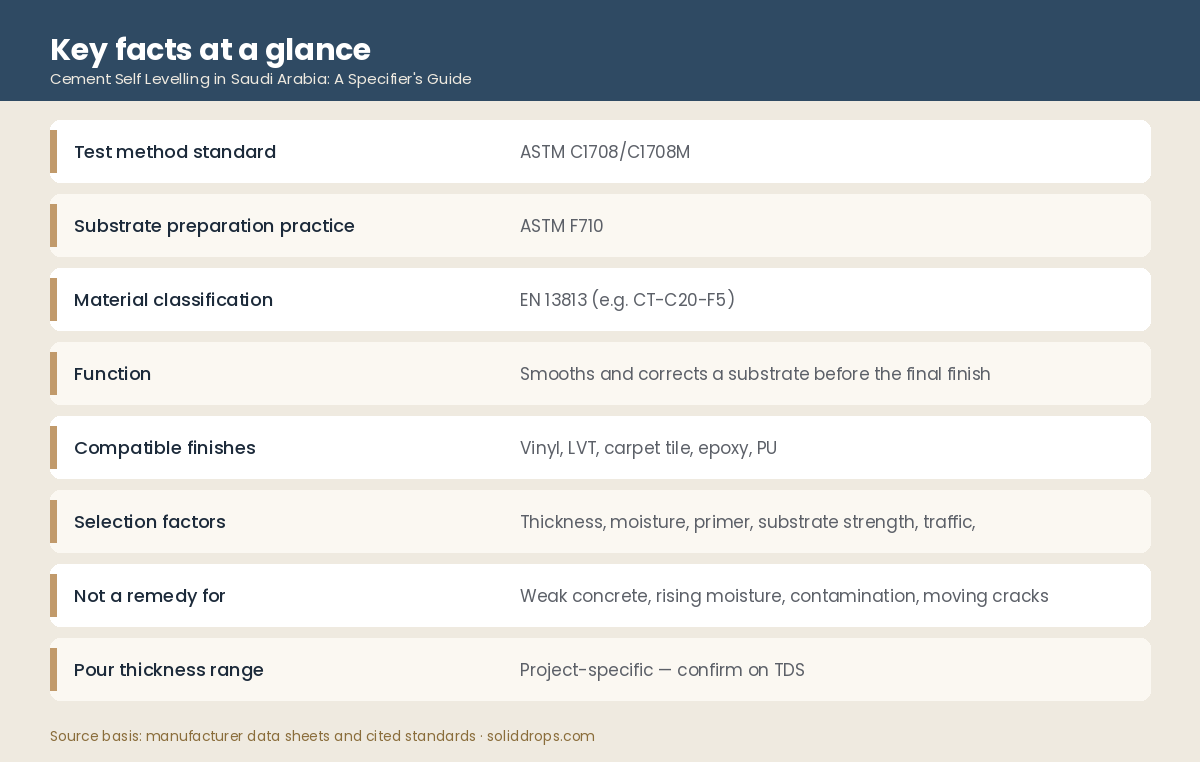
| Property | Value | Basis / standard |
|---|---|---|
| Test method standard | ASTM C1708/C1708M | ASTM standard for self-levelling mortars containing hydraulic cement |
| Substrate preparation practice | ASTM F710 | Practice for preparing concrete floors to receive resilient flooring |
| Material classification | EN 13813 (e.g. CT-C20-F5) | European screed material standard: compressive and flexural strength classes |
| Function | Smooths and corrects a substrate before the final finish | SolidDrops floor preparation practice |
| Compatible finishes | Vinyl, LVT, carpet tile, epoxy, PU | SolidDrops floor preparation practice |
| Selection factors | Thickness, moisture, primer, substrate strength, traffic, temperature and humidity | SolidDrops floor preparation practice |
| Not a remedy for | Weak concrete, rising moisture, contamination, moving cracks | SolidDrops technical guidance |
| Pour thickness range | Project-specific — confirm on TDS | Manufacturer technical data sheet |
| Foot-traffic and full cure time | Project-specific — confirm on TDS | Manufacturer technical data sheet |
| Compressive strength class | Project-specific — confirm on TDS | Declared under EN 13813 by the manufacturer |
What is cement self levelling and what does it actually do?
Cement self levelling in Saudi Arabia describes a family of pumpable or hand-mixed cementitious compounds that are poured onto a prepared slab, spread roughly, then allowed to flow out under their own weight into a flat plane. The material carries fine graded aggregate, hydraulic cement and polymer dispersants; the dispersants are what let a stiff cement mix behave like a liquid without adding enough water to wreck the strength. Test methods for this class of mortar sit under ASTM C1708/C1708M.
The important part of the definition is what the product is not. It is a geometry correction layer. It closes the surface texture of a power-floated slab, removes trowel ridges and gives the flooring contractor a plane flat enough that a 2 mm vinyl sheet will not telegraph every defect underneath.
It does not add structural capacity to a slab that is under-designed. It does not stop moisture rising from below. It does not bridge a crack that is still moving under load or thermal cycling. On projects where those conditions exist, the levelling layer becomes a witness to the problem rather than a cure for it: the crack reflects through within weeks, and the finish above it fails at the same line. Diagnose first, level second.
Where is self levelling used on Saudi projects?
The demand comes from fit-out. Any building where a thin, unforgiving finish is going down over a structural slab needs a levelling layer, because a structural slab is poured to structural tolerances, not to flooring tolerances. Those two numbers are rarely the same, and the gap between them is exactly what the underlayment fills.
- Industrial kitchens and cold rooms, where falls to drains have to be true and the finish is often a resin or a welded vinyl
- Warehouses and factories, ahead of epoxy or PU coatings on slabs that have seen years of traffic
- Hospitals, where welded homogeneous vinyl with coved skirting will show every high spot
- Hotels, malls, showrooms and offices under LVT, carpet tile and stone
- Schools and gyms, where sports vinyl and rubber systems need a controlled base
- Car parks and podium levels, where the levelling layer works alongside the deck coating system
Geographically, floor preparation work runs across Riyadh, Jeddah, Dammam, Jubail, Makkah, Madinah and Tabuk, including projects in the NEOM/Tabuk region. Refurbishment work usually means removing an old tiled floor and finding a substrate nobody planned to expose. Related reading: floor preparation in KSA.
How is the system built up, from slab to finish?
A levelling installation is a stack, and every layer in it has a job. Skip one and the layer above it inherits a defect it cannot absorb.
Substrate. Sound, clean, structurally adequate concrete. Laitance, curing compounds, adhesive residue and oil all have to go — mechanically, by shot-blasting or diamond grinding, not chemically. ASTM F710 is the practice document that sets out what “ready to receive” means for a concrete floor, including moisture assessment and alkalinity. Quote it in the specification: it puts the burden of proof on measurement rather than opinion.
Repairs. Spalls, blow-holes and static cracks are filled with a compatible repair mortar before levelling, not with the levelling compound itself. Moving cracks are treated as movement joints and carried through the new layer. Our note on concrete floor repair before coating covers the same logic.
Primer. The primer controls suction. On a porous slab an unprimed pour loses water into the concrete, pinholes form, and the surface skins before it has flowed. On a dense or non-absorbent substrate a different primer is needed to create a key. Primer type is dictated by the compound manufacturer, and mixing brands across the primer/compound interface is where a lot of debonding starts.
Compound. Selected against thickness, substrate strength, expected traffic and the finish above. Under EN 13813 a cementitious screed material is declared as, for example, CT-C20-F5 — CT for cementitious, C for compressive strength class, F for flexural. Ask for that designation on the datasheet; it is how you compare two products honestly.
Cementitious self levelling vs epoxy self levelling vs traditional screed
Three different things get called “levelling” on site, and they are not interchangeable. The table below sets out how they differ in role, not in marketing.
| Attribute | Cementitious self levelling | Epoxy self levelling | Traditional sand/cement screed |
|---|---|---|---|
| Primary role | Substrate correction under a separate finish | Finished wearing surface in its own right | Level and falls at greater build-up |
| Binder | Hydraulic cement plus polymer dispersants | Two-component reactive resin | Portland cement and graded sand |
| Placement | Poured and self-flowing, pumpable | Poured, spread with notched rake, spike-rolled | Laid semi-dry, screeded and trowelled by hand |
| Classification | EN 13813 CT classes; test methods to ASTM C1708 | EN 13813 SR (synthetic resin) classes | EN 13813 CT classes |
| Chemical resistance | Limited — relies on the finish above | The reason it is chosen | Limited |
| Typical use | Under vinyl, LVT, carpet tile, resin | Industrial halls, labs, food production | Falls to drain, thick build-ups, underfloor heating |
| Substrate moisture | Tolerant during cure but needs assessment per ASTM F710 | Sensitive — usually needs a moisture barrier | Tolerant |
| Thickness and cure | Project-specific — confirm on TDS | Project-specific — confirm on TDS | Project-specific — confirm on TDS |
The common specification error is choosing an epoxy self-levelling floor when the requirement was flatness, or choosing a cementitious underlayment when the requirement was chemical resistance. Decide what the layer is for before deciding what it is made of. Our self levelling materials page and the epoxy flooring guide cover each route in detail.
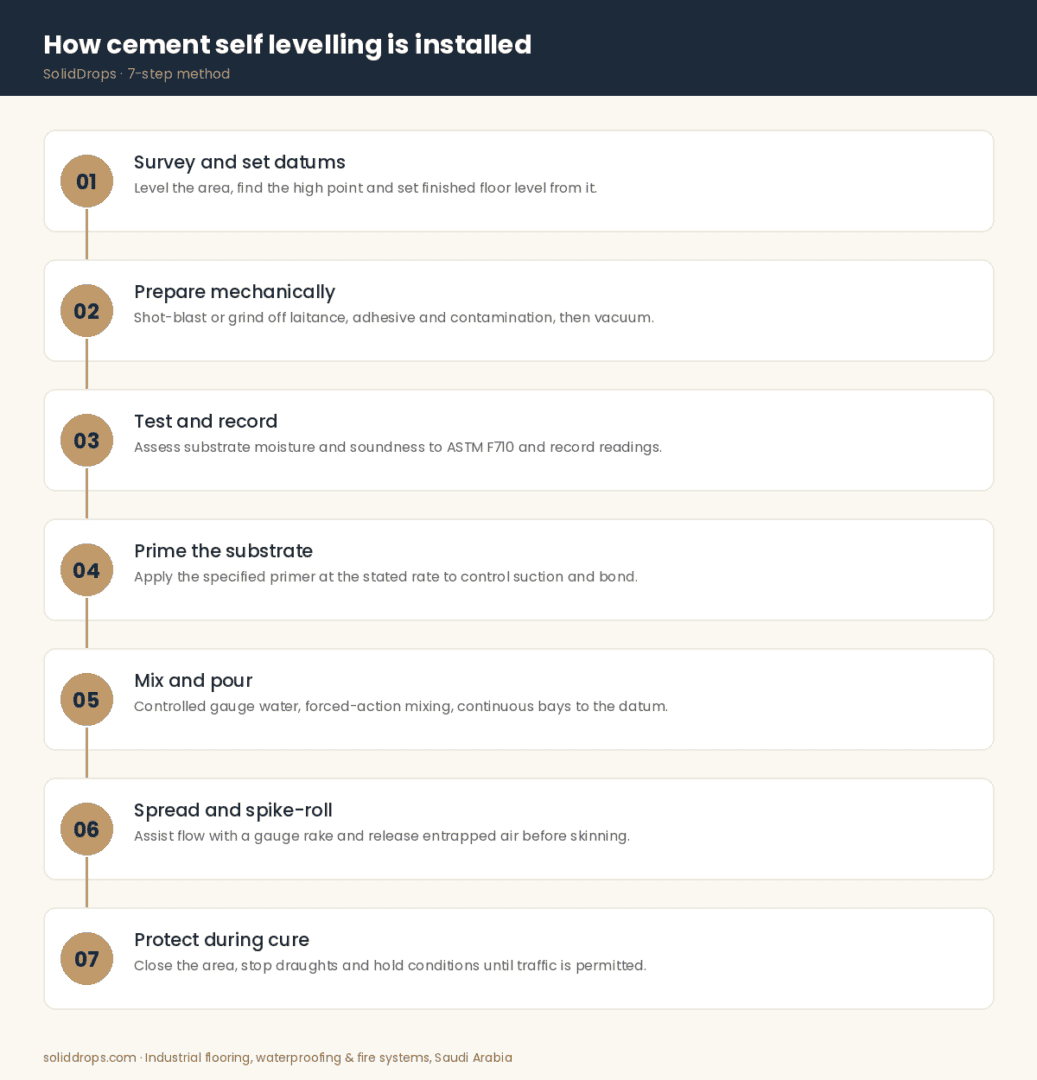
How is cement self levelling installed on site?
Application is fast and unforgiving. Once the mix is on the floor, the working time is measured in minutes, and in Saudi conditions those minutes are shorter than the datasheet’s laboratory figure.
- Survey and set datums. Laser or dumpy level across the area, mark the high point, and set the finished level from it. The high point governs the whole pour — you cannot go below it without grinding.
- Prepare mechanically. Shot-blast or grind to remove laitance and contamination, vacuum thoroughly, and repair defects.
- Test and record. Substrate moisture and surface soundness, assessed to ASTM F710. Record the readings; they are the defence if the finish above later fails.
- Prime. Apply the specified primer at the stated rate and let it develop. Do not pour onto a primer that has not reached the condition the datasheet describes.
- Mix and pour. Controlled water ratio, forced-action mixer or pump. Work in continuous bays, keeping a wet edge, and pour to the datum.
- Spread and de-air. Assist with a gauge rake, then spike-roll to release entrapped air before the surface starts to skin.
- Protect during cure. Close the area, stop draughts, keep direct sun and site heat off the fresh surface, and hold the room conditions until traffic is permitted.
Trafficking and finish-installation times vary by product; take them from the technical data sheet rather than from habit.
Not sure whether the slab needs levelling or repair?
Send us a level survey and photographs of the existing floor and we will tell you what has to be measured before anyone prices the work.
What drives the cost of a self levelling package in KSA?
We do not publish rates, because a rate quoted without seeing the slab is a guess that somebody pays for later. The drivers are consistent, though, and understanding them lets you read a quotation properly.
- Average thickness, not nominal thickness. A floor described as “3 mm levelling” that has a 12 mm dip in one corner consumes material at the average depth across the whole area. Survey data changes the number more than any other single input.
- Substrate condition. A clean, sound, recently poured slab needs a single preparation pass. A slab with tile adhesive residue, oil contamination or old coating needs several passes.
- Repairs before levelling. Crack routing, spall repair and joint treatment are separate line items.
- Primer specification. Non-absorbent or moisture-affected substrates need more expensive primer regimes.
- Access and programme. Pumping into an occupied hotel at night is not the same operation as pouring an empty warehouse by day.
- Area, continuity and location. Large open bays pour efficiently; small cellular rooms with thresholds do not, and mobilisation to Jubail or Tabuk differs from Riyadh.
Send drawings and a level survey and request a quotation against measured conditions.
What goes wrong, and what are the real limitations?
Most levelling failures are traceable to one of a short list of decisions, and none of them are made by the material.
Pouring over an unassessed slab. Moisture is the biggest one. A cementitious underlayment tolerates a damp substrate better than an adhesive does, but the moisture does not disappear; it migrates upward into the vinyl adhesive or the resin above and destroys the bond. Assess to ASTM F710 and specify a moisture control system if the readings demand one.
Treating it as a structural repair. If the concrete underneath is weak, delaminated or unsound, the levelling layer bonds to a layer that is itself detaching. Grind, sound the slab, and remove what fails.
Ignoring joints. Movement joints and construction joints in the substrate must be carried through the levelling layer and the finish. Burying a joint always ends the same way.
Skipping the primer or getting it wrong. Pinholing, poor flow, edge curling and debonding all trace back here.
Water on site. Adding water to extend flow reduces strength and causes dusting and shrinkage. The gauge water figure on the bag is a specification, not a suggestion. Trafficking before the stated time leaves permanent wheel marks and indentation.
What this means for projects in Saudi Arabia
The physics change in this climate, and pretending otherwise costs money. Cementitious materials hydrate faster as temperature rises. A compound with a comfortable open time in a European laboratory will skin noticeably sooner on a slab that has been sitting at high ambient temperature all afternoon. High ambient and substrate temperature and humidity are listed selection factors for a reason: they determine working time, flow distance and the risk of cold joints between bays.
Practical consequences: measure slab temperature, not just air temperature, before mixing. Control gauge water temperature, reduce batch sizes so the pour stays ahead of the skin, shade the area and keep site fans off the fresh surface — moving hot air causes crusting and shrinkage cracking. In summer, pour at night or early morning.
On the coast at Jeddah, Jubail and Dammam, humidity slows the drying of both slab and underlayment, pushing out the time before an adhesive or resin can go down. In Riyadh, low humidity with high temperature is the worst combination for surface crusting. Neither is a reason to change product; both are reasons to change method. أرضيات — the flooring finish above is only ever as flat and as well bonded as the preparation beneath it.
Who supplies and installs self levelling systems in Saudi Arabia?
SolidDrops supplies and installs cementitious self-levelling and floor preparation systems across Saudi Arabia, working from Jeddah and serving Riyadh, Dammam, Jubail, Makkah, Medina and Tabuk. The scope runs from survey through mechanical preparation, repairs, priming and pouring, and — where the same package includes it — the finish above.
Because we install as well as supply, the preparation specification is written against what the finish actually needs. That matters most on refurbishment, where the substrate is an unknown until it is exposed. We also supply materials to contractors managing their own labour, through our construction chemicals supply line.
For anything that also involves water — plant rooms, wet areas, roofs or below-grade slabs — the levelling and waterproofing sequence has to be agreed before either starts. Our waterproofing systems guide sets out how those layers interact.
To start: send drawings, photographs of the existing slab and the intended finish to [email protected], or call +966 50 213 1112. We will tell you what needs measuring before anyone prices the work.
Frequently asked questions
What is self levelling cement used for?
It is used to correct and smooth a concrete substrate before a final floor finish goes down. Typical uses are under vinyl, LVT, carpet tile, epoxy and PU, where the finish is too thin to hide defects in the slab. It corrects level and surface texture only, and does not add structural strength or stop moisture.
How thick can self levelling compound be poured?
Minimum and maximum pour thickness are product-specific and are stated on the manufacturer’s technical data sheet. Some compounds feather to a fine edge, others require a minimum depth to flow correctly, and deep sections may need aggregate extension. Confirm the range on the TDS for the product being specified before setting finished floor levels.
Do I need a primer before self levelling cement?
In almost all cases, yes. The primer controls substrate suction so the compound flows and cures properly, and it promotes bond. Porous and non-absorbent substrates need different primer types. Use the primer named by the compound manufacturer at the stated coverage rate, and do not mix primer and compound from different systems.
Can you put epoxy over self levelling cement?
Yes, provided the underlayment is fully cured, sound, clean and within the moisture limits the epoxy manufacturer states. Assess the substrate to ASTM F710, confirm the compound’s compressive strength is adequate for the coating and the traffic, and prepare the surface mechanically before priming. The underlayment must be strong enough to carry the coating.
What is the difference between screed and self levelling compound?
A traditional sand/cement screed is laid semi-dry and worked by hand, usually at greater thickness, and is used to create falls or build-up. A self levelling compound is poured, flows out under its own weight and is applied thin to correct flatness. Both are classified under EN 13813, but they solve different problems.
Is self levelling cement waterproof?
No. A cementitious self-levelling underlayment is not a waterproofing layer and should never be specified as one. Where water resistance is required, a dedicated waterproofing system is installed and the levelling layer sits in the correct position relative to it. Agree the sequence of waterproofing and levelling before either trade starts.
How long does self levelling cement take to dry in Saudi conditions?
Walk-on and finish-installation times are stated by the manufacturer and vary by product and thickness. High ambient and substrate temperature shorten working time, while coastal humidity in Jeddah, Jubail and Dammam slows drying. Take timings from the technical data sheet and verify substrate readiness by measurement rather than by elapsed days.
How much does self levelling flooring cost in Saudi Arabia?
Cost depends on average pour thickness from a level survey, substrate condition and preparation passes required, repairs, primer specification, access, working hours and project location. We do not publish rates because they are meaningless without site information. Send drawings and photographs and request a quotation against measured conditions.
Planning a floor preparation package in KSA?
SolidDrops supplies and installs self-levelling and floor preparation systems in Riyadh, Jeddah, Dammam, Jubail, Makkah, Medina and Tabuk.
 Chat Online