
10 Sep ESD Flooring in Saudi Arabia: Standards, Resistance and Testing
ESD Flooring in Saudi Arabia: Standards, Resistance and Testing
ESD flooring in Saudi Arabia is resinous or resilient flooring specified to carry static charge to ground within a defined electrical resistance range. Its performance is set by an ESD control programme — usually ANSI/ESD S20.20 or IEC 61340-5-1 — and verified by resistance testing on the finished floor, not by the product name.
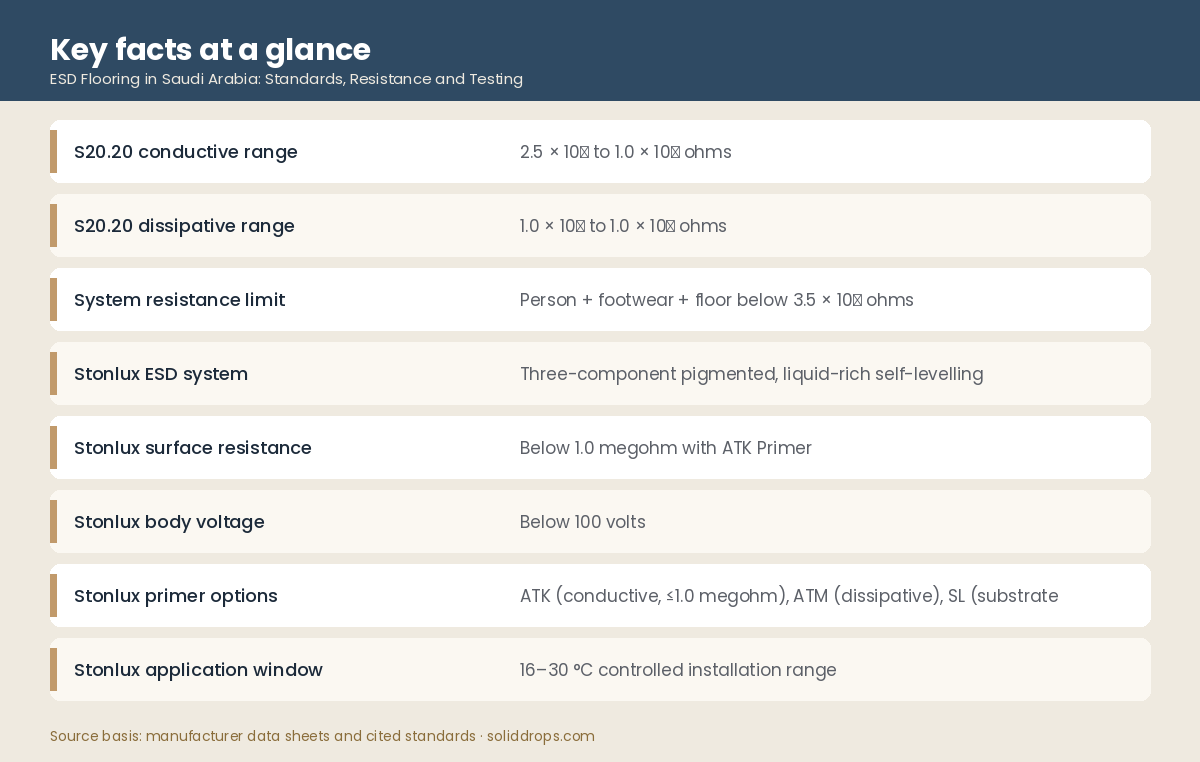
| Property | Value | Basis / standard |
|---|---|---|
| S20.20 conductive range | 2.5 × 10⁴ to 1.0 × 10⁶ ohms | ANSI/ESD S20.20 |
| S20.20 dissipative range | 1.0 × 10⁶ to 1.0 × 10⁹ ohms | ANSI/ESD S20.20 |
| System resistance limit | Person + footwear + floor below 3.5 × 10⁷ ohms | ANSI/ESD S20.20 |
| Stonlux ESD system | Three-component pigmented, liquid-rich self-levelling conductive epoxy, 2–3 mm | Stonhard Stonlux data |
| Stonlux surface resistance | Below 1.0 megohm with ATK Primer | Stonhard Stonlux data, ESD S7.1 |
| Stonlux body voltage | Below 100 volts | ESD STM97.2 |
| Stonlux primer options | ATK (conductive, ≤1.0 megohm), ATM (dissipative), SL (substrate prep) | Stonhard Stonlux data |
| Stonlux application window | 16–30 °C controlled installation range | Stonhard Stonlux data |
| Stonlux return to service | 48 h light traffic, 72 h normal operations at 25 °C | Stonhard Stonlux data |
| Surface resistance test method | ESD S7.1; ASTM F150 as companion method for resilient flooring | Named standards |
What is ESD flooring, and what does it actually control?
ESD flooring in Saudi Arabia is flooring engineered to carry electrostatic charge from a person or an object to earth at a controlled rate. It is not a coating with a static-sounding name. The conductive path runs through the finish, into a conductive primer, into a grounding network, and out to the building earth. Break any link in that chain and the floor is decorative.
Two failure modes matter. The first is the discharge event itself: a charged person touching a sensitive device and destroying or latently damaging it. The second is charge accumulation on a walking operator, which is why body-voltage generation is measured separately from floor resistance.
The critical point for specifiers is that a floor cannot be compliant on its own. ANSI/ESD S20.20 treats the person, the footwear and the floor as one system, and requires the combined resistance of that system to sit below 3.5 × 10⁷ ohms. A floor tested at the right value while operators wear ordinary rubber-soled shoes still fails the system requirement. Footwear policy is part of the flooring specification, and it should appear in the same document.
Which standards govern ESD flooring specification
Two documents dominate. ANSI/ESD S20.20 sets requirements for an ESD control programme, including the flooring/footwear system. IEC 61340-5-1 is its international counterpart and is harmonised with S20.20, though the exact numeric alignment between the two documents should be confirmed against the current editions rather than assumed — we do not restate IEC threshold values here because we have not verified them against the published text.
Test methods sit underneath the programme standards. ESD S7.1 is the method for measuring the resistance of flooring materials, and it is the reference cited for the Stonlux ESD system’s surface resistance. ESD STM97.2 measures body voltage generation on a walking person, which is how the sub-100-volt figure for that system is derived. ASTM F150 is the companion method for electrical resistance of conductive and static-dissipative resilient flooring; it prescribes how to measure, not what value to pass at — the pass/fail threshold comes from your programme.
Within S20.20 the two named ranges are these:
- Conductive: 2.5 × 10⁴ to 1.0 × 10⁶ ohms
- Static dissipative: 1.0 × 10⁶ to 1.0 × 10⁹ ohms
Neither is automatically correct. The target range comes from the owner’s ESD control programme or the consultant’s specification, and that is who should nominate it.
Conductive vs static dissipative: how to choose
Conductive flooring drains charge faster. That is an advantage where devices are highly sensitive and a disadvantage where an operator may contact live equipment, because a lower-resistance path also means less resistance protecting the person. Dissipative flooring bleeds charge more slowly and is the common default in mixed environments.
| Criterion | Conductive | Static dissipative |
|---|---|---|
| Resistance range (S20.20) | 2.5 × 10⁴ to 1.0 × 10⁶ ohms | 1.0 × 10⁶ to 1.0 × 10⁹ ohms |
| Charge decay | Fast | Slower and more controlled |
| Typical use | Electronics assembly, board handling, sensitive device work | Data halls, control rooms, mixed-use technical space |
| Primer route (Stonlux) | ATK Primer, below 1.0 megohm | ATM Primer |
| Live-equipment consideration | Lower path resistance; review against electrical safety policy | Higher path resistance retained |
| Verification | ESD S7.1 resistance testing on the finished floor | ESD S7.1 resistance testing on the finished floor |
In practice the decision is rarely the flooring contractor’s. It belongs to the ESD coordinator or the design consultant, and it should be recorded with the reason. We have walked onto more than one fit-out in Riyadh where the tender said “anti-static epoxy” and nothing else, and the value the client actually needed was two decades away from what was ordered.
System build-up: what a conductive epoxy floor is made of
Take Stonhard Stonlux ESD as a worked example. SolidDrops is an authorised distributor of Stonhard systems in Saudi Arabia, and this is one option among several — the build-up logic is the same across manufacturers.
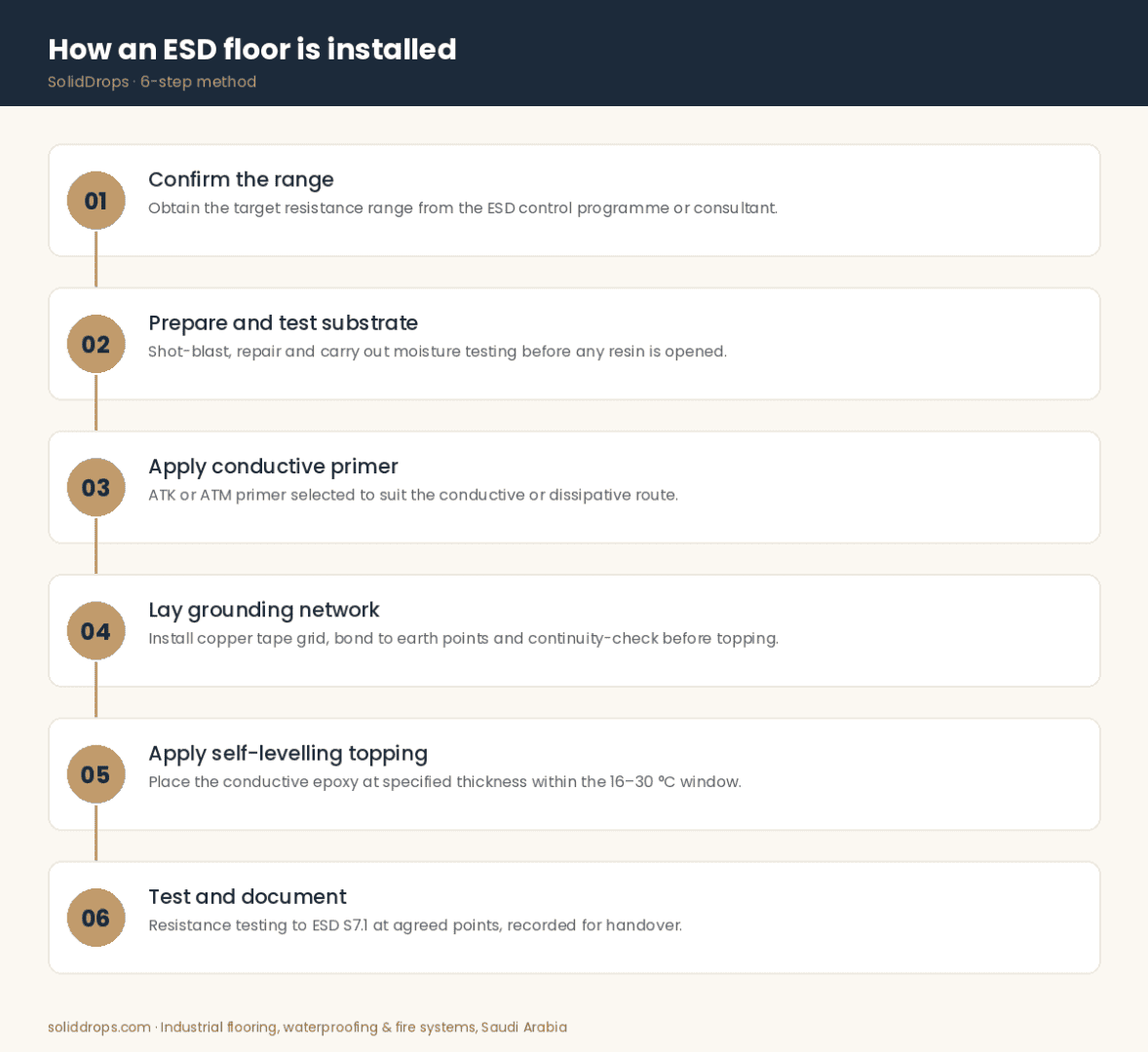
The system is a three-component, pigmented, liquid-rich, self-levelling conductive epoxy applied at 2–3 mm. Beneath it sits the primer, and the primer selection is the electrical design decision. ATK Primer gives the conductive route with surface resistance below 1.0 megohm when tested to ESD S7.1. ATM Primer gives the static-dissipative route. SL Primer handles substrate preparation where the electrical function sits elsewhere in the build-up.
Between primer and topping runs the grounding network: copper tape laid in a grid across the floor area and terminated at grounding points bonded to the building earth. Grid spacing and the number of grounding points are set by the system design and the floor geometry, and they should be shown on a drawing rather than decided by the applicator on the day.
The measured performance of the finished system for Stonlux ESD includes body voltage generation below 100 volts per ESD STM97.2. That figure describes a walking operator on the installed floor and is a different measurement from surface resistance. Both belong in the handover file.
How an ESD floor is installed and tested on site
Substrate first. Concrete must be sound, clean, dry and mechanically prepared — usually shot-blasted — with all laitance removed. Moisture testing is not optional; trapped moisture behind an epoxy film in a Jeddah building with a slab-on-grade is one of the most common causes of failure we are asked to investigate.
Installation runs to a controlled temperature window of 16–30 °C for the Stonlux system. That is a real constraint on a Saudi project. A shell building in Dammam in July with no permanent HVAC is outside the window during the working day, and the answer is temporary conditioning, not optimism.
Copper tape is laid and continuity-checked before the topping goes down. Once the tape is buried, a break is expensive to find. The self-levelling topping is applied at the specified thickness, and the floor cures. For Stonlux ESD at 25 °C, return to service is 48 hours for light traffic and 72 hours for normal operations — figures worth putting into the programme early, because a live data hall handover measured in hours will not accommodate them.
Verification closes the loop: resistance testing to ESD S7.1 at defined grid points, recorded with the test instrument, the electrode arrangement, the ambient conditions and the location of each reading. The test point locations should be agreed before installation, not chosen afterwards to suit the result.
Need a resistance range verified before you tender?
Send the ESD specification and substrate details and our technical team will confirm the system and grounding design.
Where ESD flooring is specified across the Kingdom
The clearest driver is data centre construction. Saudi Arabia’s data centre market was valued at USD 2.91 billion in 2026, up from USD 2.43 billion in 2025, and is projected to reach USD 8.85 billion by 2034 at a CAGR of 14.93% over 2026–2034. Every one of those halls has technical floor area where static control is part of the design brief.
Data halls and MEP rooms
Dissipative floors under raised access systems, in battery rooms and in switch rooms.
Electronics manufacturing
Assembly and test areas where device-level sensitivity sets the resistance target.
Pharmaceutical and cleanrooms
Static control combined with cleanability and chemical resistance requirements.
Laboratories and QC
Instrument rooms where charge accumulation affects measurement as well as equipment.
SolidDrops supplies and installs ESD and conductive flooring across Jeddah, Riyadh, Dammam, Jubail, Makkah, Medina and Tabuk. Requirements differ by sector: an electronics plant in Jubail and a pharmaceutical suite in Riyadh may both ask for أرضيات مضادة للكهرباء الساكنة, and mean different resistance ranges by it.
Cost factors and the mistakes that cause retests
We publish no rates, because an ESD floor is priced against a specification and a substrate, not a square metre. The variables that move the figure:
- Target resistance range — conductive routes carry different primer and grounding cost than dissipative.
- Substrate condition — repair, levelling and moisture mitigation before any resin is opened.
- Grounding network extent — copper tape grid density and number of bonded grounding points.
- Area geometry — many small rooms cost more per square metre than one open hall.
- Programme constraints — the 48/72 hour cure window against the client’s occupancy date.
- Temporary conditioning — maintaining 16–30 °C in an unconditioned shell.
- Testing and documentation — witnessed resistance testing and the handover record.
The recurring mistakes are consistent. Specifying “ESD epoxy” without a resistance range. Omitting footwear from the specification and failing the system test at 3.5 × 10⁷ ohms. Cleaning the finished floor with a polish or a residue-leaving detergent, which insulates the surface and shifts readings by orders of magnitude. And skipping the pre-topping continuity check on the copper tape. For a quotation, send the specification and the substrate details.
What this means for projects in Saudi Arabia
Three climate factors change how these floors behave here. Low relative humidity in inland cities raises charge generation on operators, which makes the flooring/footwear system more critical rather than less — a floor that reads acceptably will not compensate for dry-air charging if footwear is uncontrolled. Coastal humidity in Jeddah and the Eastern Province cuts the other way, and brings substrate moisture risk with it.
Heat is the installation constraint. The 16–30 °C application window and the 25 °C reference for return-to-service timing are not advisory. Slab temperature lags air temperature, so a slab that absorbed heat all week will still be above the window on a cooled morning. Measure the slab, not the room.
Dust is the maintenance constraint. Fine airborne dust settles on any resin floor, and the cleaning regime chosen to deal with it decides whether the floor still meets its resistance range in year three. Specify the cleaning chemicals alongside the floor, and retest periodically to a schedule set by the ESD control programme.
Finally, the resistance range, grounding method and test point locations should be defined by the consultant, the owner’s standard or the ESD control programme — not left to the flooring contractor. Where that decision has not been made, the honest answer at tender stage is to flag it rather than assume a value.
Who supplies and installs ESD flooring in Saudi Arabia
SolidDrops supplies and installs ESD, conductive and static-dissipative flooring across Saudi Arabia. As an authorised distributor of Stonhard systems in Saudi Arabia we can specify Stonhard Stonlux ESD where a self-levelling conductive epoxy suits the brief, and alternative resin or vinyl systems where it does not.
Our scope covers substrate survey and moisture testing, system selection against the stated resistance range, grounding network design and installation, application, and witnessed resistance testing to ESD S7.1 with a documented handover record. For existing facilities we also carry out resistance surveys on installed floors, which is often how a client discovers that a cleaning product change moved the readings.
For related detail see our pages on ESD epoxy flooring for data centres and vinyl versus epoxy ESD flooring. Send the specification to [email protected] or call +966 50 213 1112.
Frequently asked questions
What resistance should ESD flooring have?
It depends on the range your ESD control programme requires. ANSI/ESD S20.20 defines conductive flooring as 2.5 × 10⁴ to 1.0 × 10⁶ ohms and static dissipative as 1.0 × 10⁶ to 1.0 × 10⁹ ohms. The combined resistance of person, footwear and floor must be below 3.5 × 10⁷ ohms.
What is the difference between conductive and static dissipative flooring?
Conductive flooring has lower resistance and drains charge faster, suiting electronics assembly and sensitive device handling. Static dissipative flooring has higher resistance, bleeds charge more slowly, and is common in data halls and mixed technical spaces. The choice should be made by the ESD coordinator or design consultant, and recorded with the reason.
Does IEC 61340-5-1 apply in Saudi Arabia?
IEC 61340-5-1 is the international standard for ESD control programmes and is harmonised with ANSI/ESD S20.20. Which document applies to your facility is set by the owner’s standard, the consultant’s specification or a client audit requirement. Confirm the applicable edition and its threshold values against the published text before writing them into a tender.
How is ESD flooring tested after installation?
Surface resistance is measured to ESD S7.1 at agreed grid points on the finished floor, with the instrument, electrode arrangement, ambient conditions and reading locations recorded. Body voltage generation on a walking operator is measured separately to ESD STM97.2. ASTM F150 is the companion resistance method for resilient flooring. Test locations should be agreed before installation.
How long before an ESD floor can be used?
For the Stonhard Stonlux ESD system at 25 °C, return to service is 48 hours for light traffic and 72 hours for normal operations. Cure timing is temperature-dependent, so build the figures into the programme early. Other systems differ; confirm against the manufacturer’s technical data sheet for the product actually specified.
Can ESD flooring be installed in an unconditioned building?
Not reliably. The Stonlux ESD system has a controlled application range of 16 °C to 30 °C, and a shell building in Dammam or Riyadh in summer sits outside it during the working day. Temporary conditioning is the answer. Measure the slab temperature, not just the air, because slab temperature lags behind.
Who supplies ESD flooring in Saudi Arabia?
SolidDrops supplies and installs ESD, conductive and static-dissipative flooring across Jeddah, Riyadh, Dammam, Jubail, Makkah, Medina and Tabuk. As an authorised distributor of Stonhard systems in Saudi Arabia we can specify Stonlux ESD or alternative resin and vinyl systems, and provide witnessed resistance testing to ESD S7.1 with a documented handover record.
Can cleaning products affect ESD floor performance?
Yes, significantly. Polishes and residue-leaving detergents build an insulating film on the surface and can move resistance readings by orders of magnitude. Specify compatible cleaning chemicals alongside the floor system, brief the facilities team, and retest to a schedule set by the ESD control programme rather than waiting for a failed audit.
Talk to a flooring specifier
SolidDrops supplies and installs ESD and conductive flooring across the Kingdom, with witnessed resistance testing.
 Chat Online