
10 Sep Anti-Static Flooring in Saudi Arabia: A Buyer’s Guide
Anti-Static Flooring in Saudi Arabia: A Buyer's Guide
Anti static flooring in Saudi Arabia is any floor system built to move electrostatic charge safely to earth rather than letting it accumulate. Buying it well means fixing the required resistance range first, then choosing between epoxy, vinyl and rubber on traffic, chemistry, programme and maintenance — in that order.
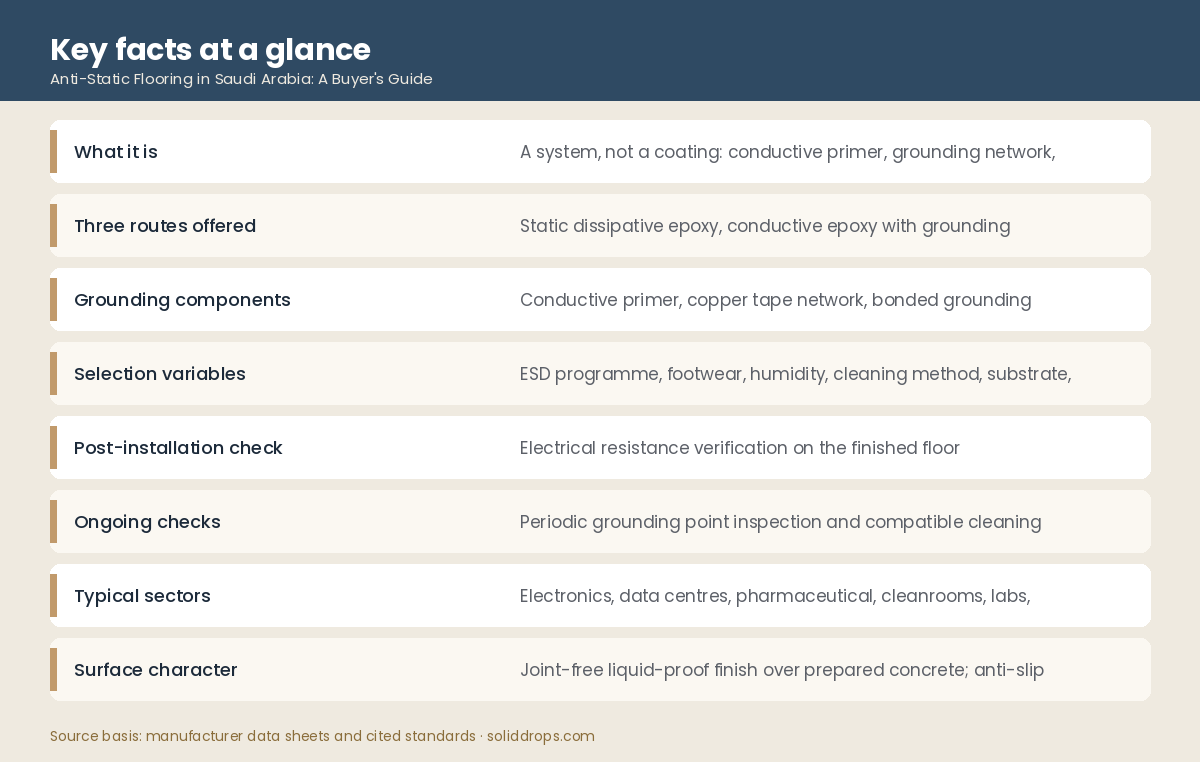
| Property | Value | Basis / standard |
|---|---|---|
| What it is | A system, not a coating: conductive primer, grounding network, conductive finish | SolidDrops anti-static epoxy system |
| Three routes offered | Static dissipative epoxy, conductive epoxy with grounding network, ESD/conductive vinyl | SolidDrops system guidance |
| Grounding components | Conductive primer, copper tape network, bonded grounding points, continuity testing | SolidDrops anti-static epoxy system |
| Selection variables | ESD programme, footwear, humidity, cleaning method, substrate, traffic intensity | SolidDrops selection guidance |
| Post-installation check | Electrical resistance verification on the finished floor | SolidDrops anti-static epoxy system |
| Ongoing checks | Periodic grounding point inspection and compatible cleaning chemicals | SolidDrops anti-static epoxy system |
| Typical sectors | Electronics, data centres, pharmaceutical, cleanrooms, labs, automotive, battery assembly | SolidDrops application areas |
| Surface character | Joint-free liquid-proof finish over prepared concrete; anti-slip options available | SolidDrops anti-static epoxy system |
| Resistance range to specify | Project-specific — set by the ESD control programme, not by the flooring supplier | Confirm with consultant |
| Coverage | Jeddah, Riyadh, Dammam, Jubail, Makkah, Medina, Tabuk and further KSA locations | SolidDrops service area |
What are you actually buying when you buy anti-static flooring?
Anti static flooring in Saudi Arabia is bought as a product and delivered as a system. That gap causes most of the disappointment we see. Anti-static epoxy flooring is not normal epoxy with a different label — it is structurally and electrically different, and the part that does the electrical work is largely invisible once the floor is finished.
A working system has four parts: a prepared concrete substrate, a conductive primer, a grounding network of copper tape bonded to earth points, and a conductive or dissipative wearing surface. Charge travels from the walking operator through the surface, into the primer, along the copper, and out to earth. Miss the copper and you have an expensive floor with no path to ground.
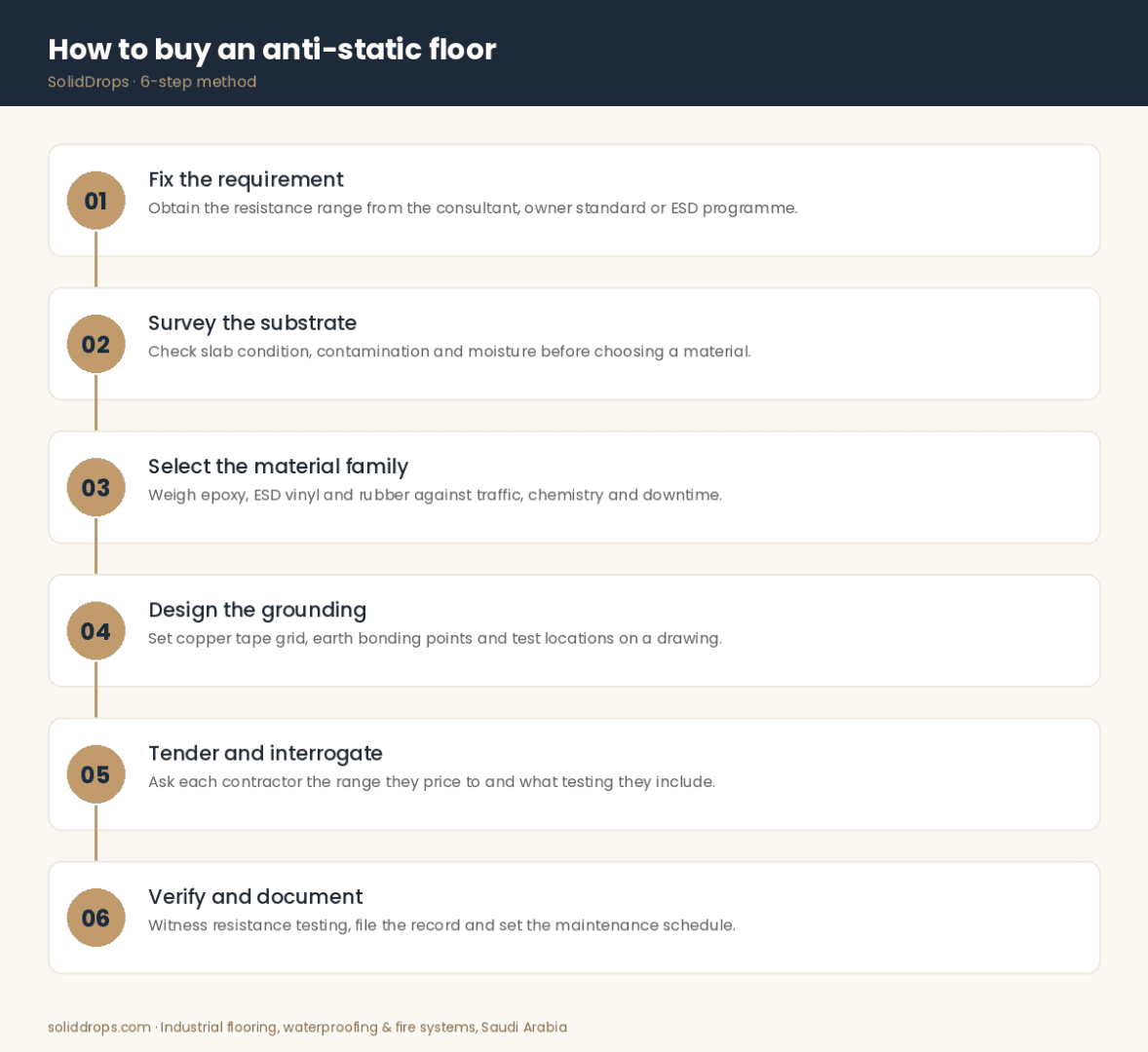
So the purchase decision is not “which epoxy?” It is: what resistance range does my operation require, who is authorised to state it, and does the contractor’s price include the grounding network, the continuity check and the post-installation resistance verification? A quotation that lists a coating and a thickness and nothing else is not a quotation for anti-static flooring.
Step one: get the resistance range from the right person
Before comparing materials, get the number. The resistance range, the grounding method and the test point locations should be defined by the consultant, the owner’s standard or the facility’s ESD control programme. A flooring contractor can advise on how to achieve a target; nominating the target is somebody else’s authority, and a supplier who invents one for you has created a compliance problem rather than solved it.
The formal ranges and test methods sit in the standards. If you need the numbers, the conductive and dissipative bands defined by ANSI/ESD S20.20, the combined person-plus-footwear-plus-floor limit, and the ESD S7.1 test method are set out in our ESD flooring standards guide. This page stays on the buying decision.
Two practical checks before you go to market. First, has anyone confirmed the footwear policy? The floor is only half of the tested system, and a facility that cannot control footwear should say so at design stage. Second, does the range differ by room? Assembly, test, storage and office-adjacent areas frequently carry different requirements, and pricing one blanket specification across all of them usually means overpaying somewhere and failing somewhere else.
Epoxy vs vinyl vs rubber anti-static flooring
Three material families cover almost every anti-static enquiry we receive in the Kingdom. Each is a legitimate answer to a different brief.
| Criterion | Anti-static epoxy | ESD / conductive vinyl | Anti-static rubber |
|---|---|---|---|
| Form | Liquid-applied, joint-free over prepared concrete | Factory-made tiles or sheet, welded joints | Factory-made tiles or sheet |
| Best suited to | Production floors, chemical exposure, heavy traffic | Control rooms and data halls where downtime is critical | Areas prioritising underfoot comfort and acoustics |
| Installation downtime | Longer: preparation plus cure before return to service | Shorter: no wet cure period | Shorter: no wet cure period |
| Substrate demand | High: sound, dry, mechanically prepared concrete | Level and dry substrate; often over screed or access floor | Level and dry substrate |
| Joints and cleanability | Joint-free, liquid-proof surface | Welded seams; cleanable but not monolithic | Seams present; comfort layer can hold soil |
| Repair | Patch and blend; colour match needs care | Individual tiles replaceable | Individual tiles replaceable |
| Grounding | Conductive primer plus copper tape network | Copper strips bonded during installation | Copper strips bonded during installation |
The honest summary: epoxy wins where the floor takes punishment or chemicals, vinyl wins where the room cannot be closed for three days, rubber wins where people stand on it all shift. Nothing in that list is about which product is better.
Where anti-static flooring is needed in Saudi Arabia
Six sectors account for most of the demand across the Kingdom, and each carries its own additional requirement beyond the resistance value.
Data centres
Static control alongside strict downtime limits; dissipative systems in halls and MEP rooms.
Electronics manufacturing
Device-level sensitivity sets the range; assembly, test and rework areas may differ.
Pharmaceutical and cleanrooms
Static control plus cleanability, coving detail and chemical resistance.
Hospitals and labs
Instrument rooms and technical suites where charge affects readings, not just devices.
Fuel and flammable atmospheres
Areas where ignition risk, rather than device damage, drives the requirement.
Automotive and battery assembly
Heavy traffic and impact combined with a static control requirement.
SolidDrops supplies and installs anti-static flooring across Jeddah, Riyadh, Dammam, Jubail, Makkah, Medina, Tabuk and further locations in the Kingdom. Where the requirement is ignition risk rather than component protection, say so explicitly at enquiry stage — the safety case is different and the specification should reflect it.
Questions to ask an anti-static flooring contractor
Use these at tender interview. The answers separate contractors who install anti-static floors from contractors who install epoxy and hope.
- What resistance range are you pricing to, and who gave it to you?
- Is the copper tape grounding network included, and at what grid spacing?
- How many grounding points, and who makes the bond to the building earth?
- Will you continuity-check the copper before the topping is applied?
- What moisture test will you carry out on the substrate, and what is your accept/reject threshold?
- What temperature range does the system need during application, and how will you hold it in an unconditioned building?
- What is the return-to-service time for light traffic and for normal operations?
- Will resistance testing be witnessed, and what will the handover record contain?
- Which cleaning chemicals are compatible, and which will void performance?
- What happens if the floor tests outside range — who bears the rectification?
The last question matters most and gets asked least. A floor that reads outside the target is a genuine possibility on any project, and the commercial position should be agreed before anyone mixes resin, not after.
Not sure which anti-static system your facility needs?
Send the room schedule and the resistance range and our technical team will set out the options and the grounding design.
What drives the cost of an anti-static floor
We do not publish rates. Cost is set by the specification and the substrate, and two buildings of identical area can differ substantially. The variables worth pinning down before requesting a quotation:
- Target resistance range — conductive routes carry more primer and grounding cost than dissipative.
- Substrate condition — repair, levelling and moisture mitigation are frequently the largest single line.
- Grounding network extent — copper tape grid density and the number of bonded earth points.
- Material family — liquid-applied epoxy, welded vinyl and rubber tile price and programme differently.
- Room geometry — many small rooms with coving cost more per square metre than one open hall.
- Programme and access — night or phased works around live operations.
- Testing and documentation — witnessed resistance testing and the handover record.
Where a system needs anti-slip, chemical resistance or a specific cleanroom finish, those requirements should be stated up front rather than added after award. Send the specification, the room schedule and photographs of the existing slab, and request a quotation.
Maintenance: how anti-static floors stop being anti-static
An anti-static floor is a tested installation with a maintenance dependency. It drifts out of compliance quietly, and almost always for one of four reasons.
The first is cleaning chemistry. Polishes and residue-leaving detergents deposit an insulating film that lifts surface resistance well above the target range. The floor looks better and performs worse. Compatible cleaning chemicals must be specified with the floor and given to the facilities team in writing.
The second is the grounding points. They are physical connections in a working building, and they get painted over, unbolted during other trades’ work, or hidden behind equipment installed after handover. Periodic inspection of the grounding points belongs in the planned maintenance schedule.
The third is wear. Traffic thins the wearing surface over time, and heavy point loads or forklift traffic accelerate it. The fourth is change of use: a room re-purposed from storage to assembly inherits the floor it has, not the floor its new function requires.
The remedy for all four is the same — periodic resistance testing to a schedule set by the ESD control programme, with the results filed. A retest that finds a problem is cheap. An audit that finds one is not.
What this means for projects in Saudi Arabia
Humidity swings the specification in both directions. Inland cities such as Riyadh run very dry for much of the year, and dry air increases charge generation on people — which makes footwear control and the flooring/footwear system more important, not less. Coastal sites in Jeddah, Dammam and Jubail carry the opposite risk: raised substrate moisture, which is the leading cause of resin floor failure we are called to investigate.
Heat sets the installation programme. Resin systems have a controlled application temperature window, and a shell building in summer sits outside it during the working day. Temporary conditioning, night working, or both, need to be priced rather than assumed. Slab temperature lags air temperature, so measure the slab.
Dust is a permanent maintenance load. Fine airborne dust settles continuously, and the cleaning regime that deals with it is the same regime that can compromise the floor’s resistance. Get the two decisions made together.
Finally, note the vocabulary. On site, أرضيات مضادة للكهرباء الساكنة is used for everything from a genuine conductive system to a hard-wearing epoxy with no grounding at all. In tender correspondence, state the resistance range and the test standard. That single line removes most of the ambiguity in the Saudi market.
Who supplies and installs anti-static flooring in Saudi Arabia
SolidDrops supplies and installs anti-static flooring across Saudi Arabia, covering static dissipative epoxy for general static concerns, conductive epoxy with a full grounding network where tighter control is required, and ESD or conductive vinyl where downtime, comfort or substrate conditions favour a resilient system.
Our scope runs from substrate survey and moisture testing, through system selection against the stated resistance range, grounding network installation and continuity checking, application, and post-installation electrical resistance verification with a documented handover record. As an authorised distributor of Stonhard systems in Saudi Arabia we can also specify manufacturer-backed conductive resin systems where the project calls for one.
For background reading see our pages on the anti-static epoxy flooring system, our guide to understanding anti-static epoxy flooring, and the standards depth in our ESD flooring guide. To start, email [email protected] or call +966 50 213 1112.
Frequently asked questions
Is anti-static flooring the same as ESD flooring?
In everyday use the terms overlap, and most suppliers treat them as interchangeable. In a specification they should not be. ESD flooring implies a defined resistance range and a formal control programme with verification testing. Anti-static is often used more loosely. Always state the required resistance range and the test standard in tender documents.
How do you ground an anti-static floor?
A conductive primer is applied over the prepared substrate, then a copper tape network is laid across the floor area and terminated at grounding points bonded to the building earth. Continuity is checked before the wearing surface goes down. After installation, electrical resistance is verified on the finished floor and the result recorded.
What industries need anti-static flooring in Saudi Arabia?
Electronics manufacturing, data centres, pharmaceutical facilities, cleanrooms, laboratories, automotive component plants and battery assembly are the common ones. Areas with flammable atmospheres also use conductive flooring, but there the driver is ignition risk rather than component damage, and the safety case behind the specification is different.
Can anti-static flooring be installed over old concrete?
Often yes, provided the slab is structurally sound, can be mechanically prepared, and passes moisture testing. Existing coatings, oil contamination, weak surface layers and rising moisture all need resolving first. A substrate survey before tender avoids the common outcome where preparation cost appears as a variation after the contract is signed.
Should I choose epoxy or ESD vinyl?
Epoxy suits production floors, chemical exposure and heavy traffic, and gives a joint-free liquid-proof surface, but needs substrate preparation and a cure period. ESD vinyl installs faster with no wet cure and allows individual tiles to be replaced, which suits control rooms and data halls where downtime is the binding constraint.
How long does anti-static flooring last?
Service life depends on traffic, point loading, chemical exposure and maintenance, so no single figure applies. The more useful question is how long it stays within its resistance range, which is governed by cleaning chemistry, grounding point integrity and wear. Periodic resistance testing to your ESD programme schedule is the way to know.
How much does anti static flooring cost in Saudi Arabia?
Cost depends on the target resistance range, substrate condition and preparation, extent of the grounding network, material family, room geometry, programme and access constraints, and the testing and documentation required. Send the specification, room schedule and photographs of the existing slab to [email protected] and request a quotation.
Who installs anti-static flooring in Jeddah and Riyadh?
SolidDrops supplies and installs anti-static flooring across Jeddah, Riyadh, Dammam, Jubail, Makkah, Medina, Tabuk and further locations in the Kingdom. Scope covers substrate survey, system selection against the stated resistance range, grounding network installation, application and post-installation resistance verification with a documented handover record.
Request a quotation
SolidDrops supplies and installs anti-static epoxy and ESD vinyl flooring across Saudi Arabia.
 Chat Online