
10 Sep Wet Chemical vs Clean Agent Fire Suppression: A Specifier’s Guide for Saudi Projects
Wet Chemical vs Clean Agent Fire Suppression: A Specifier's Guide for Saudi Projects
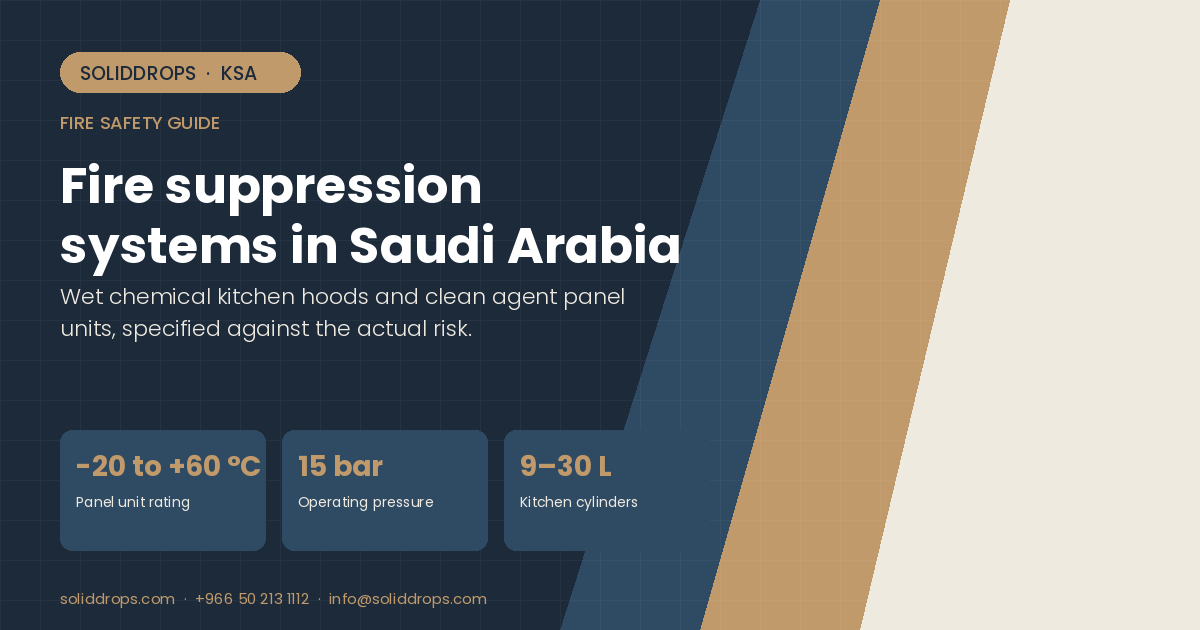
Fire suppression systems in Saudi Arabia are fixed installations that detect and extinguish a fire at its source without waiting for a person to act. The two most commonly specified types are wet chemical systems over commercial cooking equipment and clean agent systems inside electrical panels and enclosed equipment.
Ready to price a system? See our fire suppression systems in Saudi Arabia page for the Synergy kitchen and Firessense panel systems we supply and install.
| Property | Value | Basis / standard |
|---|---|---|
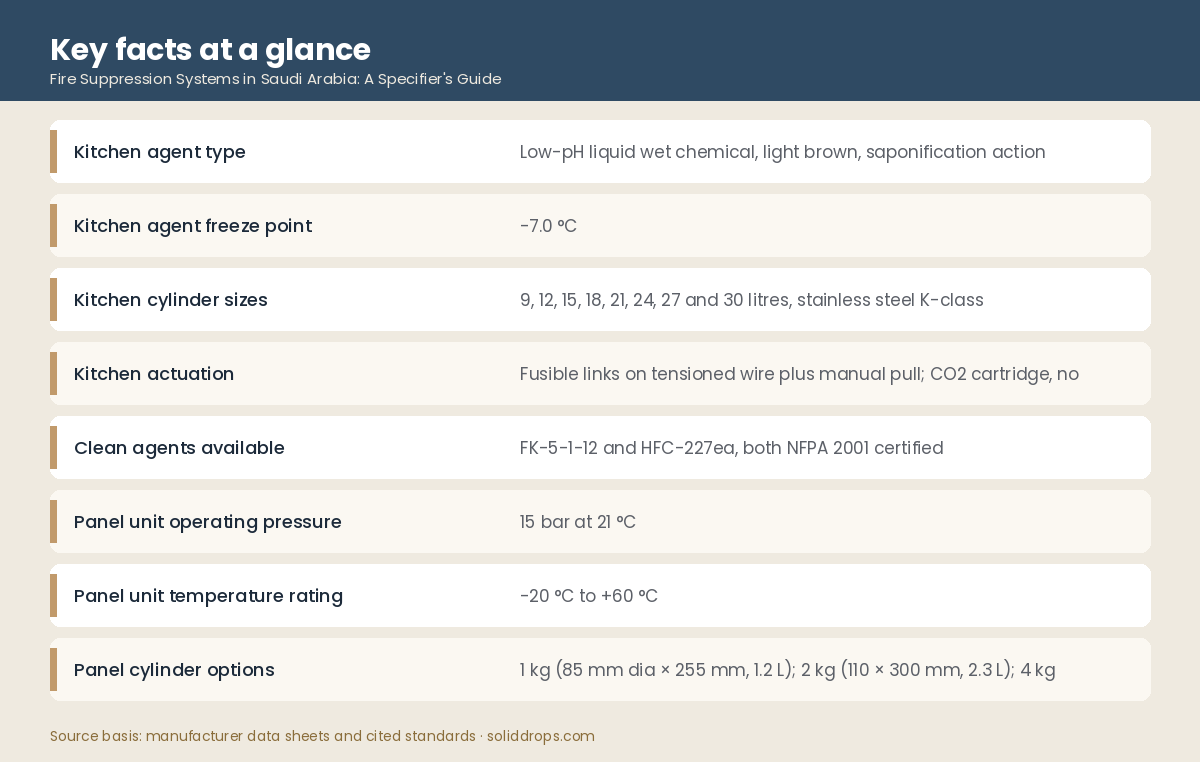
| Kitchen agent type | Low-pH liquid wet chemical, light brown, saponification action | Synergy kitchen system data |
| Kitchen agent freeze point | -7.0 °C | Synergy kitchen system data |
| Kitchen cylinder sizes | 9, 12, 15, 18, 21, 24, 27 and 30 litres, stainless steel K-class | Synergy kitchen system data |
| Kitchen actuation | Fusible links on tensioned wire plus manual pull; CO2 cartridge, no external power | Synergy kitchen system data |
| Clean agents available | FK-5-1-12 and HFC-227ea, both NFPA 2001 certified | Synergy Firessense data |
| Panel unit operating pressure | 15 bar at 21 °C | Synergy Firessense data |
| Panel unit temperature rating | -20 °C to +60 °C | Synergy Firessense data |
| Panel cylinder options | 1 kg (85 mm dia × 255 mm, 1.2 L); 2 kg (110 × 300 mm, 2.3 L); 4 kg (140 × 400 mm, 5.2 L) | Synergy Firessense data |
| Panel unit approval | LPCB approved to LPS 1666 | Synergy Firessense (SSEPL) data |
| Governing codes | NFPA 96 for commercial cooking; NFPA 2001 for clean agents; SBC 801 nationally | NFPA / Saudi Building Code |
What is a fire suppression system, and how does it differ from an extinguisher?
A fire suppression system is a fixed installation that detects a fire and discharges an extinguishing agent onto or into the risk automatically. A portable extinguisher needs a trained person, a clear approach and time; a suppression system needs none of those. That difference is why fire suppression systems in Saudi Arabia are specified for risks that ignite fast, burn hot, or sit inside an enclosure nobody can open safely once it is alight.
Three things define any system: the agent, the detection and actuation method, and the enclosure or surface it protects. Change the risk and all three change. A deep fryer at cooking temperature needs an agent that cools and seals the fuel surface. An energised distribution board needs one that leaves no residue on copper and silicon, delivered without anyone opening the door.
Systems fall into two families. Surface-applied systems discharge onto an exposed hazard — a hood, a duct, a cooking line. Total-flooding systems fill a sealed volume to an extinguishing concentration and hold it. Sprinklers, foam and CO2 flooding sit alongside these as building-scale protection, usually part of the same fire strategy rather than alternatives to it.
Where fire suppression is specified across the Kingdom
Demand follows the building stock. Hotel and mall kitchens in Jeddah and Makkah, staff canteens on industrial estates in Jubail, quick-service chains rolling out across Riyadh — all cook with oil under a hood, and all need suppression over it.
The second concentration is electrical. Data halls, substations, control rooms, generator sets, telecom shelters and roadside kiosks all contain enclosed equipment where an arc or an overheated termination can start a fire inside a metal box. Outdoor shelters and containerised generators in the Eastern Province and the Riyadh region routinely exceed 45 °C in summer, which is why the temperature rating of any device installed inside them matters more here than in a temperate climate.
Commercial kitchens
Hoods, plenums, ducts and appliance-specific nozzles over fryers, ranges and griddles.
Electrical enclosures
LV panels, MCCs, control cabinets, UPS rooms, busbar chambers and generator control boxes.
Enclosed technical spaces
Server rooms, comms rooms and archive stores.
Remote assets
Telecom shelters, kiosks and containerised plant, unsupervised.
How a wet chemical kitchen suppression system works
Kitchen systems use a low-pH liquid wet chemical agent, light brown in appearance, that works by saponification. On contact with hot cooking oil the agent reacts with the fat to form a temporary foam-like layer over the burning surface. That layer smothers the fire and holds while the oil cools below its auto-ignition temperature. Cooling and sealing together are what stop a fryer reigniting.
Detection is mechanical. Fixed-temperature fusible links sit in the airstream along a tensioned cable running the length of the hood. When a link separates, the cable releases and a CO2 cartridge actuates the cylinder; a manual pull station gives staff the same discharge on demand. No external power is required, which is deliberate — kitchen fires and supply failures often arrive together.
Cylinders are stainless steel, K-class, in 9, 12, 15, 18, 21, 24, 27 and 30 litre sizes. Size follows appliance count and hood geometry, not room area. The agent’s freeze point is -7.0 °C — no constraint in a Saudi kitchen, but relevant to storage and shipping. Discharge must also be interlocked to shut down fuel and power to the cooking line; that interlock is the part most often value-engineered out, then found missing at handover.
How clean agent suppression protects electrical panels
Clean agent systems for electrical enclosures work on a different logic: rather than protecting a room, a direct low-pressure unit sits inside the panel itself. The Synergy Firessense range, manufactured by Swastik Synergy Engineering Pvt Ltd, is self-actuating, pneumatic, and needs no external power or control panel. Detection and delivery combine in a heat-sensitive tube routed above the likely ignition points — terminations, contactors, cable entries.
Two agents are offered: FK-5-1-12 and HFC-227ea, both certified to NFPA 2001, the standard for clean agent fire extinguishing systems. Both leave no residue. After a discharge the switchboard is not coated in powder or wet with foam — the entire point when the plant needs it back in service the same shift.
Operating pressure is 15 bar at 21 °C and the units are rated from -20 °C to +60 °C. Check that upper figure against your actual enclosure temperature, not the ambient outside it; an unventilated panel in direct sun in Dammam runs warmer than the weather station says. Cylinder options are 1 kg (85 mm diameter × 255 mm, 1.2 L), 2 kg (110 × 300 mm, 2.3 L) and 4 kg (140 × 400 mm, 5.2 L). The range carries LPCB approval to LPS 1666, which is third-party verification rather than a manufacturer’s own claim — useful evidence at consultant review stage.
Wet chemical vs clean agent vs the building-scale systems
Most projects need more than one of these, working together. The table below sets out where each belongs.
| System type | Typical risk | Agent behaviour | Residue and downtime |
|---|---|---|---|
| Wet chemical | Cooking oils and fats under a hood | Saponifies and cools the fuel surface | Wet residue; deep clean and recharge |
| Clean agent (FK-5-1-12 / HFC-227ea) | Electrical panels and technical rooms | Extinguishes without residue | No residue; inspect then return to service |
| Sprinklers | General building fire load | Water from heads that operate individually | Water damage to contents; heads replaced after operation |
| CO2 total flooding | Unoccupied machinery spaces | Displaces oxygen within a sealed volume | No residue; lock-off controls essential |
| Foam | Flammable liquid storage areas | Blankets the liquid surface to suppress vapour | Foam residue; clean-up required |
A hotel in Medina might carry sprinklers throughout, wet chemical over every kitchen hood, and clean agent units inside the LV panels and comms room. None substitutes for another. The fire strategy defines which risk gets which system, and that strategy is the document to argue about — not the product.
Which standards and codes apply in Saudi Arabia
NFPA 96 governs ventilation control and fire protection of commercial cooking operations, and it is the reference specifiers reach for when setting out hood, duct and appliance protection. NFPA 2001 is the standard for clean agent fire extinguishing systems and is the certification basis for both FK-5-1-12 and HFC-227ea in the Firessense range.
Nationally, the Saudi Building Code SBC 801 is the Kingdom’s fire protection code, most recently the 2024 edition published by the SBC National Committee. Where SBC 801 adopts or modifies an NFPA requirement for an occupancy, the SBC text governs. We do not publish clause-level requirements here: the applicable clause depends on occupancy classification, and Civil Defense review of a specific submission is the only authority that settles it. Treat any blanket claim that “the code requires X” — from us or from anyone selling you equipment — as something to verify. The approval route runs through drawings and the authority having jurisdiction, not through a product brochure.
- NFPA 96 — commercial cooking ventilation and fire protection
- NFPA 2001 — clean agent extinguishing systems
- SBC 801 — Saudi Building Code fire protection requirements
- LPS 1666 — LPCB approval scheme held by the Firessense range
Need a suppression system reviewed before Civil Defense submission?
Send the kitchen layout or panel schedule and our technical team will set out the system type, agent and cylinder sizing.
How these systems are installed and commissioned
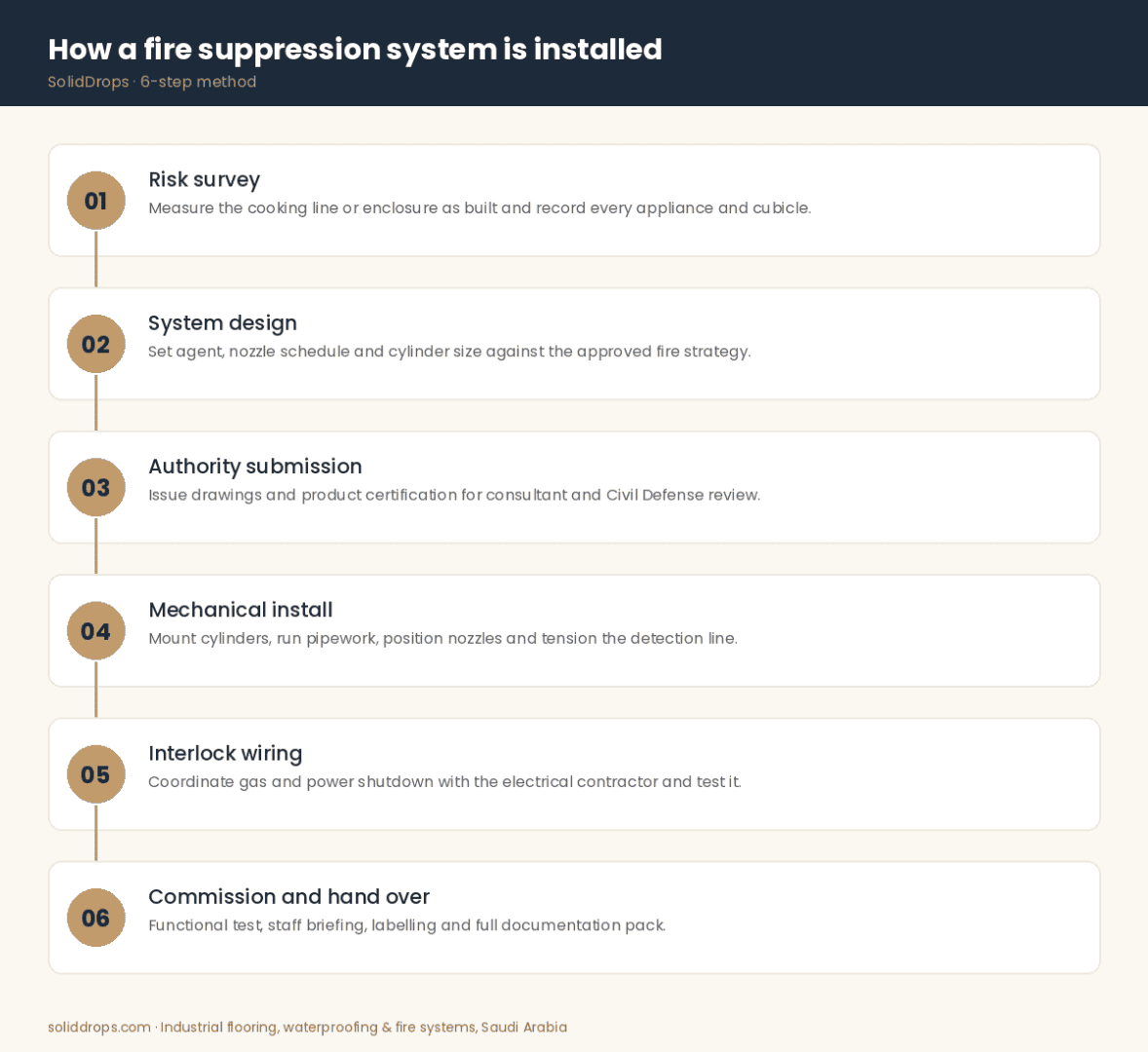
Kitchen installation starts with a survey of the cooking line as built, not as drawn — appliances move during fit-out. Hood dimensions, duct runs and the plenum profile are measured on site, then the nozzle schedule and cylinder size follow the appliance list. Piping is run and supported, the fusible link line tensioned at the correct detection points, and the cylinder mounted where it can be serviced.
The interlock is wired next: discharge must shut off gas and electrical supply to the protected appliances. Commissioning is a functional test of the mechanical release without discharging agent, a check of the pull station, and a witnessed demonstration of the interlock. A staff briefing follows.
Panel units are quicker but less forgiving. The heat-sensitive tube must run directly above the ignition-prone components, secured so it cannot chafe against a busbar and clear of moving door gear. Cylinder mounting must not obstruct maintenance access or breach the enclosure’s clearances. Pressure is checked against the 15 bar at 21 °C figure and recorded, and the door is labelled so whoever opens it next knows a live unit sits inside. Servicing intervals for both families follow the manufacturer’s schedule and the authority’s requirements; recharge after any discharge is neither optional nor deferrable.
What drives cost, and the mistakes that inflate it
We do not publish prices: cost is a function of the risk in front of us. The variables that move the number are worth preparing before asking for a quotation.
- Appliance count and hood length — nozzle count and cylinder size follow the cooking line, not the floor area.
- Number and size of electrical enclosures — a panel room with twelve cubicles is twelve units, not one.
- Agent selection — FK-5-1-12 and HFC-227ea differ in cost and in fill weight for a given volume.
- Interlock scope — gas solenoids, shunt trips and BMS signalling.
- Access and phasing — night works in a trading restaurant cost more than an open shell.
- Servicing — inspection and recharge availability across the Kingdom.
Three mistakes recur: sizing from the room instead of the risk; ordering equipment before the fire strategy is approved, then re-buying after review; and treating the interlock as somebody else’s scope, only to find at handover that nobody priced it. Send the kitchen layout or panel schedule and request a quotation.
What this means for projects in Saudi Arabia
Climate changes the specification in ways easy to miss on a drawing board. The +60 °C upper rating on a panel unit is a real limit, and an unventilated outdoor enclosure in Jubail or Dammam in August can approach it. Where the margin is thin, the answer is usually ventilation or shading, not a different suppression product.
Coastal humidity and airborne salt in Jeddah and the Eastern Province attack cylinder brackets, pipe supports and panel gaskets faster than inland. Dust is the other constant: links coated in kitchen grease and desert dust do not respond at the temperature printed on them, which is why link replacement belongs in scheduled servicing.
Civil Defense approval is a project milestone, not a formality. Build the submission around the fire strategy and approved drawings, and keep manufacturer certificates, the LPCB approval reference and the NFPA 2001 certification in the handover file. Sites in Makkah and Medina with restricted seasonal access windows should plan the programme around them early. Note that the site term أنظمة إطفاء الحريق covers everything from a hood cylinder to a sprinkler main — be specific about which system you mean in correspondence with the authority.
Who supplies and installs fire suppression systems in Saudi Arabia
SolidDrops supplies and installs fire suppression systems across Saudi Arabia, from Jeddah through Riyadh, Dammam, Jubail, Makkah, Medina and Tabuk. SolidDrops is a supplier & installer of Synergy systems in Saudi Arabia, covering the wet chemical kitchen range and the Firessense clean agent units.
Our usual scope is survey, design against the approved fire strategy, supply, installation, interlock coordination, commissioning and handover documentation. For existing buildings we also carry out condition surveys — link condition, cylinder pressure, nozzle alignment, interlock function — which is often how a client learns that a system installed years ago stopped being serviceable.
Suppression sits alongside our detection work; see fire alarm systems supply and alarm systems for commercial and industrial buildings. Send the kitchen layout or panel schedule to [email protected], or call +966 50 213 1112.
Frequently asked questions
Who supplies and installs fire suppression systems in Saudi Arabia?
SolidDrops supplies and installs fire suppression systems across Saudi Arabia, including Jeddah, Riyadh, Dammam, Jubail, Makkah, Medina and Tabuk. SolidDrops is a supplier and installer of Synergy systems in Saudi Arabia, covering wet chemical kitchen hood systems and Firessense clean agent units for electrical panels.
How does a kitchen fire suppression system work?
A low-pH liquid wet chemical agent reacts with hot cooking oil by saponification, forming a temporary foam-like layer over the burning surface while cooling the oil below reignition temperature. Fixed-temperature fusible links on a tensioned cable release a CO2 cartridge that discharges the cylinder; a manual pull station does the same on demand.
What is the difference between FK-5-1-12 and HFC-227ea?
Both are clean agents certified to NFPA 2001 and both extinguish without leaving residue on electrical equipment. They differ in chemistry, in the fill weight needed for a given protected volume, and in cost. Selection depends on enclosure volume, space for the cylinder, and the project’s environmental policy. Confirm at design stage.
Do electrical panels need fire suppression in Saudi Arabia?
It depends on the occupancy, the criticality of the panel and the approved fire strategy. Panels serving data halls, control rooms, hospitals and unattended remote assets are commonly protected, because a fire inside a closed enclosure is not accessible to staff. Whether it is mandatory for your building is settled by SBC 801 and Civil Defense review.
What NFPA standard covers kitchen hood suppression?
NFPA 96, the standard for ventilation control and fire protection of commercial cooking operations, governs hood, duct and appliance protection. NFPA 2001 covers clean agent systems for electrical and enclosed risks. In Saudi Arabia the national reference is SBC 801, and where it modifies an NFPA requirement the SBC text governs.
Will a clean agent system damage the equipment it protects?
No. FK-5-1-12 and HFC-227ea leave no residue, which is why they are used inside switchboards and technical rooms. After a discharge the equipment is inspected and, once the causing fault is rectified, returns to service without the cleaning powder or foam would require. The cylinder must be recharged before the system is live again.
Can suppression equipment handle Saudi outdoor temperatures?
Firessense panel units are rated from -20 °C to +60 °C, which covers most Saudi installations. The figure to check is the temperature inside the enclosure under load and in direct sun, not the ambient weather. Outdoor shelters and containerised generator sets in the Eastern Province routinely exceed 45 °C in summer.
How much does a fire suppression system cost in Saudi Arabia?
Cost depends on appliance count and hood length for kitchens, on the number and size of enclosures for panel systems, on agent selection, on the interlock and shutdown scope, and on site access and phasing. Send the kitchen layout or panel schedule to [email protected] and request a quotation against the actual risk.
Talk to a fire systems engineer
SolidDrops supplies and installs kitchen wet chemical and clean agent panel suppression across the Kingdom.
 Chat Online