
10 Sep Clear Epoxy Resin Flooring: Topcoats, Metallic and 3D Floors
Clear Epoxy Resin Flooring: Topcoats, Metallic and 3D Floors
Clear epoxy resin flooring is a two-component resin and hardener system that cures to a transparent, hard, glossy surface. It is used as a protective topcoat over concrete and decorative floors, and as the binder that carries metallic pigments and 3D imagery. Standard epoxy yellows under UV, so sunlit floors need an aliphatic polyurethane topcoat.
| Property | Value | Basis / standard |
|---|---|---|
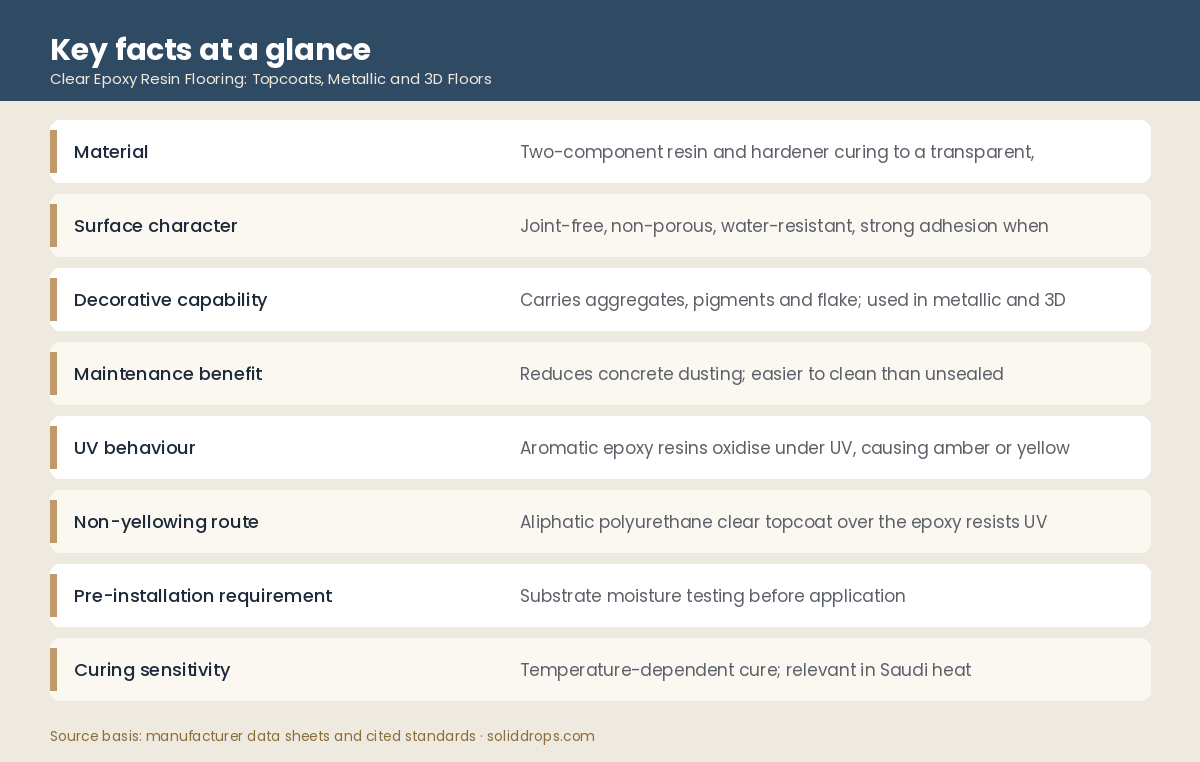
| Material | Two-component resin and hardener curing to a transparent, hard, glossy surface | SolidDrops clear epoxy resin data |
| Surface character | Joint-free, non-porous, water-resistant, strong adhesion when properly prepared | SolidDrops clear epoxy resin data |
| Decorative capability | Carries aggregates, pigments and flake; used in metallic and 3D finish systems | SolidDrops clear epoxy resin data |
| Maintenance benefit | Reduces concrete dusting; easier to clean than unsealed concrete | SolidDrops clear epoxy resin data |
| UV behaviour | Aromatic epoxy resins oxidise under UV, causing amber or yellow discoloration | Epoxy UV stability reference |
| Non-yellowing route | Aliphatic polyurethane clear topcoat over the epoxy resists UV discoloration | Aliphatic PU topcoat reference |
| Pre-installation requirement | Substrate moisture testing before application | SolidDrops clear epoxy resin data |
| Curing sensitivity | Temperature-dependent cure; relevant in Saudi heat | SolidDrops clear epoxy resin data |
| Known defect risk | Bubble formation linked to substrate and application conditions | SolidDrops clear epoxy resin data |
| Suitable applications | Commercial interiors, villas, showrooms, warehouses and moderate-traffic areas | SolidDrops clear epoxy resin data |
What is clear epoxy resin flooring?
Clear epoxy resin flooring is a two-component system — resin and hardener — that cures into a transparent, hard, glossy surface. It has no pigment of its own. Everything you see through it is either the substrate below or the decorative layer it encapsulates, which is why the finished appearance depends far more on preparation than on the resin itself.
The cured film is joint-free, non-porous and water-resistant, and bonds strongly to a correctly prepared substrate. Over bare concrete it reduces dusting and gives a surface that cleans more easily than an unsealed slab. Over timber it lifts the grain. Over a metallic base coat or a printed graphic it becomes the depth of the floor.
Three distinct jobs sit under the same product name, and confusing them is the source of most disappointment: a protective topcoat over an existing floor; a decorative binder for aggregates, pigments and flake; and a build layer in metallic and 3D floor systems. Each has different thickness, different substrate demands and a different failure mode.
Clear epoxy as a topcoat over an existing floor
Used as a topcoat, clear epoxy is the sacrificial and protective layer. It takes the abrasion, the cleaning chemicals and the point loading so the decorative or functional layer beneath does not. On a coloured epoxy floor it delivers the gloss. On a flake system it buries the flake edges and creates a level, cleanable plane. On a polished or sealed concrete slab it stops dusting.
Two things determine whether the topcoat performs. The first is what is underneath it. A clear coat over a contaminated, dusty or moisture-affected floor fails at the interface, and the transparency makes the failure visible in a way a pigmented coat would hide — a delaminated patch under a clear film reads as a bloom or a milky halo long before it lifts.
The second is the exposure. Under interior lighting a clear epoxy topcoat holds its appearance. Under direct sunlight through a showroom glass façade, it will amber. That is not a defect in the material; it is the chemistry, and it is the single most important thing to establish before specifying a clear finish in a Saudi building.
Why clear epoxy yellows, and what to do about it
Standard epoxy resins are aromatic. The aromatic structure absorbs ultraviolet light and oxidises, and that oxidation produces the yellow or amber discoloration familiar from any epoxy floor left in sunlight. It happens gradually, it is not reversible by cleaning, and it is uneven — the sunlit strip along a shopfront ambers while the shaded area behind a display unit stays clear, which makes the change obvious rather than subtle.
The standard remedy is an aliphatic polyurethane clear topcoat over the epoxy. Aliphatic polyurethanes do not carry the same UV-absorbing aromatic structure, so they resist the discoloration and protect the epoxy beneath them. The epoxy still provides build, adhesion and the decorative carrier; the aliphatic PU provides the UV-stable wearing surface.
What this means in practice for a Saudi project is a design decision, not an upgrade. Any clear or light-coloured floor with sun exposure — a showroom in Jeddah with a glazed frontage, a villa entrance hall with a rooflight, a hotel lobby in Riyadh with a south-facing curtain wall — should be specified as an epoxy base with an aliphatic PU topcoat from the outset. Retrofitting a UV-stable coat over an already ambered floor does not restore the colour; it locks it in.
Clear epoxy in metallic and 3D floor systems
Metallic epoxy floors are built, not painted. A pigmented base coat goes down first, then metallic pigments are dispersed into a clear epoxy layer and manipulated while wet — rolled, blown or drawn — to produce the movement in the finish. The clear resin is what suspends the pigment and gives the depth. Change the resin’s clarity and you change the entire visual result.
3D floors work on the same principle with a printed image in place of pigment. The graphic is laid over a base coat and encapsulated in clear resin, and the perceived depth comes from the thickness and optical clarity of that encapsulating layer. Both systems are highly sensitive to substrate flatness, because the clear layer magnifies every undulation beneath it.
Neither is a floor you specify from a photograph. The finish is applicator-dependent, no two pours are identical, and a sample panel produced by the team that will do the work is the only reliable way to agree an appearance. See our pages on metallic epoxy floors and 3D flooring for the finished systems.
UV exposure matters here more than anywhere. A metallic floor is an expensive finish whose value is entirely visual, and ambering across a sunlit area destroys it. Aliphatic PU is the default topcoat on any metallic or 3D installation with daylight exposure.
Clear epoxy vs aliphatic polyurethane topcoat
The two are complementary rather than competing. The table sets out where each belongs.
| Criterion | Clear epoxy topcoat | Aliphatic PU clear topcoat |
|---|---|---|
| Resin chemistry | Aromatic epoxy | Aliphatic polyurethane |
| UV colour stability | Ambers under UV exposure | Resists UV discoloration |
| Typical role | Build layer, decorative binder, interior gloss coat | Final UV-stable wearing surface over the epoxy |
| Suits daylight exposure | Interior areas away from direct sun | Showrooms, lobbies and glazed frontages |
| Decorative carrier | Carries pigments, flake, aggregate and 3D graphics | Applied clear over the decorative layer |
| Where specified together | Epoxy provides build and adhesion | PU provides colour retention and wear |
Note what the table does not say. It does not rank them on hardness, abrasion resistance or chemical resistance, because those values are product-specific and belong on a technical data sheet rather than in a general comparison. Ask for the TDS of the actual products being offered and compare like with like.
Planning a clear or metallic floor with daylight exposure?
Send photographs of the slab and the room use, and our technical team will set out the build-up and UV protection.
Installation: preparation, moisture and bubbles
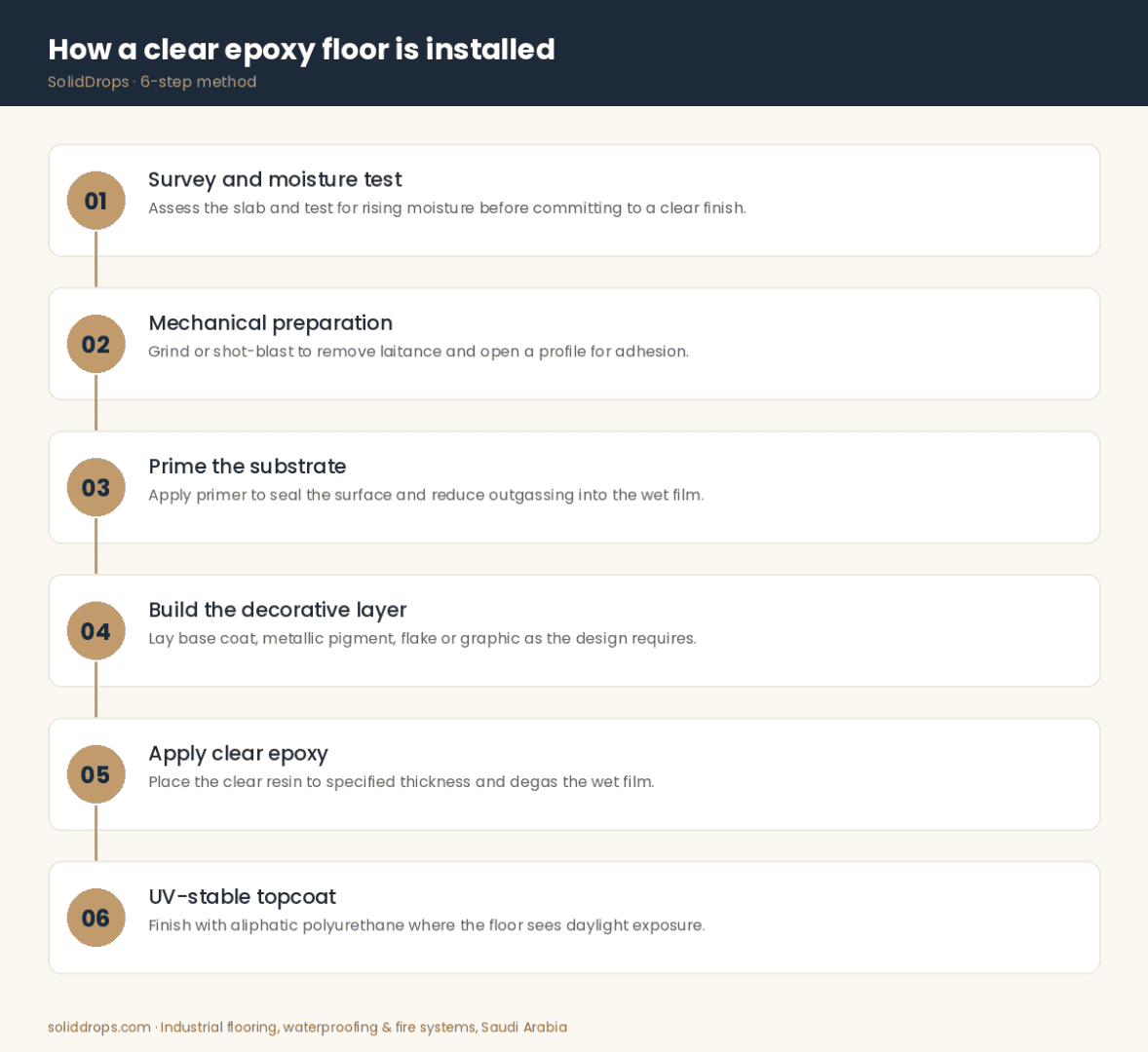
Clear systems are less forgiving than pigmented ones because nothing hides. Preparation is mechanical — grinding or shot-blasting to remove laitance, open the surface and give a profile the resin can key into. Contamination, previous sealers and weak surface layers all come off before anything is mixed.
Substrate moisture testing is a requirement, not a precaution. Moisture rising through a slab behind a non-porous resin film produces blistering and adhesion loss, and on a clear floor the result is visible from the first day. In coastal Jeddah and the Eastern Province, and anywhere with a slab on grade and no functioning damp-proof membrane, this test decides whether the floor should be installed at all.
Bubbles are the other characteristic defect. Air held in the substrate expands as the slab warms and pushes into the wet film; solvent, agitation during mixing and application over a heating surface all contribute. The controls are consistent: prepare and prime properly, mix without whipping air in, avoid applying while the slab temperature is rising, and spike-roll or degas the wet film as the system requires.
Curing is temperature-dependent. Saudi heat accelerates the reaction, which shortens the working time — a pot life that behaves predictably at 20 °C can be materially shorter on a hot afternoon. Plan pours to the temperature, not to the shift pattern.
What drives cost, and where clear epoxy is the wrong answer
We publish no rates. Cost follows the specification and the substrate. The factors that move it:
- Substrate condition — grinding, repair, levelling and moisture mitigation before any resin.
- Flatness requirement — clear layers magnify undulation, so levelling cost rises with the finish quality expected.
- System build-up — a topcoat over an existing floor is not a metallic or 3D system.
- UV protection — an aliphatic PU topcoat is an additional coat and an additional material.
- Area and geometry — small rooms, edges and detailing carry disproportionate labour.
- Access and conditioning — temperature control and downtime around live operations.
Clear epoxy is the wrong specification in three situations. Outdoors or in fully sun-exposed areas without a UV-stable topcoat, where ambering is certain. Over a slab with unresolved rising moisture, where the transparency guarantees the failure will be seen. And in heavy industrial areas with thermal shock, aggressive chemical exposure or steam cleaning, where a urethane mortar or a purpose-designed chemical-resistant system is the correct answer — see our page on chemical and UV-resistant epoxy flooring. For a quotation, send photographs of the slab and the intended finish.
What this means for projects in Saudi Arabia
Sunlight is the governing variable. Solar exposure through glazing in Saudi buildings is intense and prolonged, and a clear epoxy floor behind a shopfront will show colour change where the sun tracks across it. Specify the aliphatic PU topcoat by default in any daylit area, and treat its omission as a deliberate, recorded decision rather than a saving.
Heat governs the installation. Slab temperatures in an unconditioned building through summer shorten pot life and increase outgassing, which is the direct cause of pinholing and bubbles in a clear film. Night pours, temporary cooling and slab temperature measurement — not air temperature — are the practical controls.
Coastal moisture governs the risk. A villa in Jeddah, a showroom in Dammam or a warehouse in Jubail on a slab with a compromised membrane is a moisture problem before it is a flooring problem. Test first.
Finally, appearance expectations need managing in writing. إيبوكسي شفاف is sold on photographs of mirror-flat metallic floors, and the substrate underneath a real project rarely starts that way. Agree the sample panel, agree the flatness tolerance, and agree what daylight exposure the finish will see. Those three agreements prevent most of the disputes we are asked to arbitrate on decorative floors.
Who supplies and installs clear epoxy flooring in Saudi Arabia
SolidDrops supplies and installs clear epoxy resin flooring across Saudi Arabia, from Jeddah through Riyadh, Dammam, Jubail, Makkah, Medina and Tabuk. Our scope covers clear topcoats over existing and new resin floors, decorative flake and aggregate systems, and metallic and 3D installations where clear resin is the binder.
We start with a substrate survey and moisture testing, then set the build-up: preparation, primer, base or decorative layer, clear resin, and a UV-stable aliphatic polyurethane topcoat where daylight exposure requires one. Sample panels are produced before commitment on any decorative finish, because a photograph is not a specification.
For related systems see our pages on clear epoxy resin, metallic epoxy flooring for commercial spaces and self-levelling epoxy for showrooms and offices. Send photographs and the room use to [email protected] or call +966 50 213 1112.
Frequently asked questions
Does clear epoxy flooring yellow in the sun?
Yes. Standard epoxy resins are aromatic, and the aromatic structure oxidises under ultraviolet light, producing amber or yellow discoloration. The change is gradual, permanent and uneven, appearing first where sunlight falls. The remedy is an aliphatic polyurethane clear topcoat over the epoxy, specified from the outset rather than added later.
What is the difference between an epoxy and a polyurethane topcoat?
Epoxy provides build, adhesion and the carrier for decorative pigments, flake and 3D graphics, but ambers under UV. Aliphatic polyurethane does not have the same UV-absorbing structure and resists discoloration, so it is used as the final clear wearing surface. On daylit floors the two are specified together rather than as alternatives.
Can clear epoxy be used outdoors in Saudi Arabia?
Not without UV protection. Direct sun exposure will amber a standard clear epoxy, and Saudi solar intensity accelerates it. Where an exposed or heavily daylit area needs a clear finish, specify an epoxy base with an aliphatic polyurethane topcoat. Also confirm thermal movement and substrate moisture, which behave differently outdoors.
Is clear epoxy flooring waterproof?
The cured film is non-porous and water-resistant, and gives a joint-free surface that resists liquid ingress from above. That is not the same as a waterproofing system for a wet area, a roof or a tank. Where the requirement is containment or below-grade water resistance, a dedicated waterproofing specification applies instead.
What is a metallic epoxy floor?
A metallic epoxy floor is built from a pigmented base coat followed by metallic pigments dispersed in clear epoxy and manipulated while wet to create movement and depth. The clear resin suspends the pigment and carries the visual effect. The finish is applicator-dependent, so agree a sample panel produced by the installing team before committing.
Why do bubbles appear in a clear epoxy floor?
Air held in the substrate expands as the slab warms and pushes into the wet film, and air whipped in during mixing does the same. Applying over a slab whose temperature is rising is the common trigger in Saudi conditions. Proper preparation and priming, careful mixing, correct timing and degassing the wet film are the controls.
How thick should clear epoxy resin flooring be?
Thickness is set by the system and the manufacturer’s technical data sheet, and differs between a thin protective topcoat, a decorative binder coat and a metallic or 3D build layer. We do not quote a general figure because it would mislead. Confirm the specified thickness and coverage rate on the TDS for the product being supplied.
Who installs clear epoxy and metallic floors in Saudi Arabia?
SolidDrops supplies and installs clear epoxy resin, metallic and 3D flooring across Jeddah, Riyadh, Dammam, Jubail, Makkah, Medina and Tabuk. Scope includes substrate survey and moisture testing, preparation, system build-up, decorative work and a UV-stable aliphatic polyurethane topcoat where daylight exposure requires one. Sample panels are produced before commitment.
Request a sample panel
SolidDrops supplies and installs clear epoxy, metallic and 3D resin flooring across Saudi Arabia.
 Chat Online