
10 Sep Gym Flooring in Saudi Arabia: Zone-by-Zone Selection Guide
Gym Flooring in Saudi Arabia: Zone-by-Zone Selection Guide
Gym flooring in Saudi Arabia is specified zone by zone, not room by room. Free weights, cardio, studios, functional training, reception and wet areas each place different demands on impact absorption, noise, grip and cleaning. Rubber rolls and tiles, PU, vinyl, turf strips and acoustic underlay are combined to match those demands.
| Property | Value | Basis / standard |
|---|---|---|
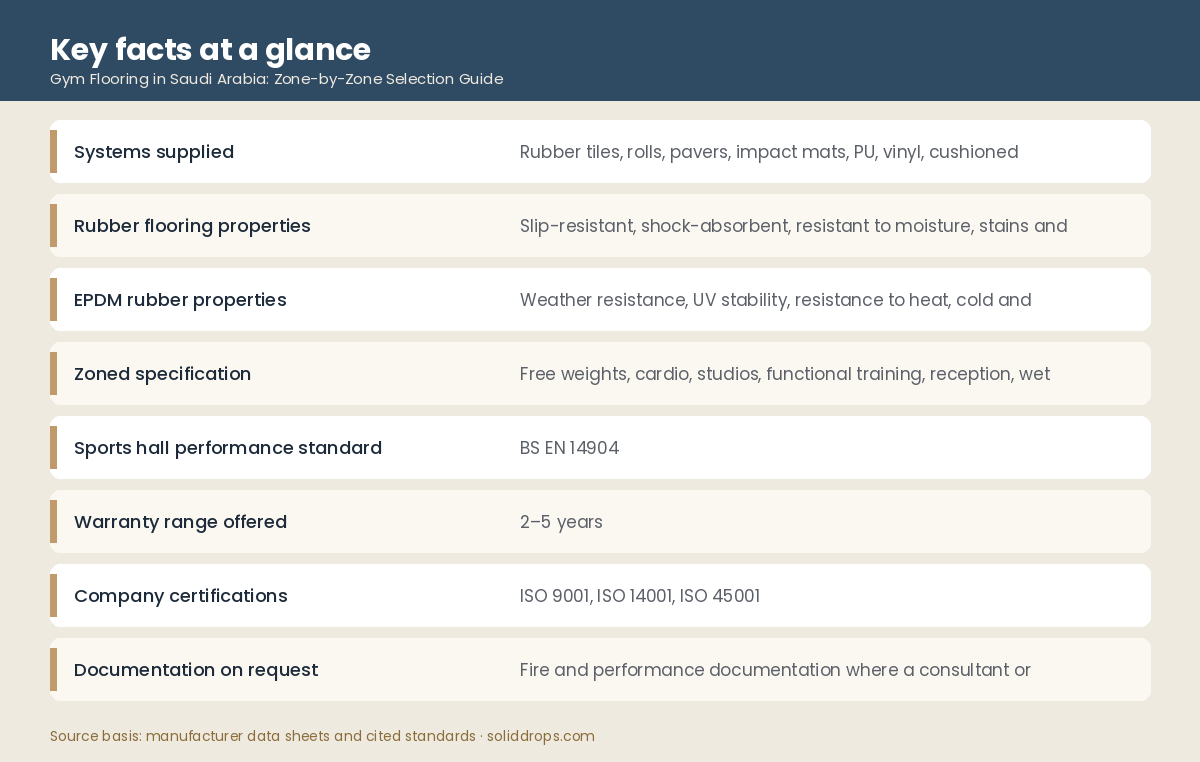
| Systems supplied | Rubber tiles, rolls, pavers, impact mats, PU, vinyl, cushioned resilient floors, acoustic underlay, turf strips, epoxy and microcement | SolidDrops gym flooring scope |
| Rubber flooring properties | Slip-resistant, shock-absorbent, resistant to moisture, stains and chemicals | SolidDrops gym flooring page |
| EPDM rubber properties | Weather resistance, UV stability, resistance to heat, cold and abrasion | SolidDrops gym flooring page |
| Zoned specification | Free weights, cardio, studios, functional training, reception, wet zones | SolidDrops fitness centre guidance |
| Sports hall performance standard | BS EN 14904 | Shock absorption, ball bounce, friction and indentation for indoor sports surfaces |
| Warranty range offered | 2–5 years | SolidDrops gym flooring page |
| Company certifications | ISO 9001, ISO 14001, ISO 45001 | SolidDrops gym flooring page |
| Documentation on request | Fire and performance documentation where a consultant or authority requires it | SolidDrops fitness centre guidance |
| Coverage | Riyadh, Jeddah, Makkah, Dammam, Jubail, Madinah, Tabuk | SolidDrops coverage |
| Thickness and Shore hardness by zone | Project-specific — confirm on TDS | Manufacturer technical data sheet |
What is gym flooring and what is it doing?
Gym flooring in Saudi Arabia covers a set of resilient floor systems chosen for one job: managing energy. A dropped barbell, a rack of dumbbells, a treadmill running twelve hours a day and a class of forty people jumping on a studio floor all put energy into a slab, and the floor either absorbs it, transmits it, or fails under it.
The materials used are rubber tiles, rolls, pavers and impact mats; polyurethane and vinyl systems; cushioned resilient floors; acoustic underlay; artificial turf strips for sled and sprint lanes; and resin or microcement finishes where a hard, cleanable surface is wanted. Rubber dominates because it does several things at once — it is slip-resistant, shock-absorbent, and resistant to moisture, stains and chemicals, which matters as much for sweat and cleaning products as it does for dropped weights.
The performance framework worth knowing is BS EN 14904, the European standard covering indoor sports surfaces. It sets out how shock absorption, ball bounce, friction and indentation are measured. Not every gym area needs a floor tested to it, but it gives consultants a defensible language for what “enough cushioning” means, and it is the right reference when a multi-purpose sports hall sits inside the same facility.
How does the specification change by training zone?
The single most common fit-out mistake is buying one product for the whole floor plate. Zones behave differently and should be specified differently.
- Free weights and platforms — the highest impact energy in the building. Needs the thickest, most impact-tolerant build-up, usually rubber with dedicated platforms or heavy impact mats under drop zones.
- Cardio — static equipment, continuous vibration, point loads under machine feet. Needs indentation resistance and vibration control more than drop protection.
- Studios and group exercise — repeated jumping by many people at once. Comfort underfoot, grip for bare feet and trainers, and acoustic control matter most; this is where a floor tested to EN 14904 criteria makes sense.
- Functional training — sleds, ropes, sprint lanes. Turf strips with rubber either side, and abrasion resistance where sleds run.
- Reception, corridors and retail — appearance, cleanability and slip resistance, often vinyl, resin or microcement.
- Wet zones — changing rooms, showers, pool surrounds. Slip resistance when wet, plus waterproofing beneath; see our waterproofing systems guide.
Setting the zones on a drawing before pricing usually reduces the total cost, because money moves to where impact actually occurs instead of being spread evenly across areas that do not need it.
What does a gym floor build-up look like?
A gym floor is a stack, and each layer earns its place.
Substrate. A sound, level slab. Rubber is flexible and takes the shape of what is under it, so a slab with dips will produce a visibly wavy floor, tiles that rock underfoot and joints that lift. Where the slab is out of tolerance, correct it first — the approach is set out in our cement self levelling guide.
Moisture control and damp-proofing. Required where the slab is ground-bearing or where readings demand it, particularly under adhered systems.
Acoustic underlay. Specified in multi-storey and mixed-use buildings, where a gym above offices or apartments is an acoustics problem before it is a flooring problem. This layer is often deleted during value engineering and almost always regretted.
Wearing layer. Rubber roll, rubber tile, PU, vinyl, turf or resin, selected by zone.
Drop zones and platforms. Localised heavier build-ups under lifting platforms, dumbbell racks and drop areas.
Perimeters, transitions and fixings. Thresholds between zones of different thickness, skirting or cove details, and adhesive or loose-lay decisions. Transitions are where gym floors look cheap or look right.
Rubber roll vs rubber tile vs turf vs PU vs vinyl
The comparison below covers the five options most often shortlisted for a commercial gym. It compares behaviour and fit, not brands.
| Option | Format | Best zones | Strengths | Considerations |
|---|---|---|---|---|
| Rubber roll | Wide rolls, adhered, few joints | Free weights, general training floors | Continuous appearance, fewer joints to lift, good impact absorption | Needs a flat slab and skilled installation; harder to lift for later changes |
| Rubber tile | Interlocking or square tiles, loose-lay or adhered | Free weights, drop zones, phased fit-outs | Individual tiles replaceable; heavier thicknesses available for drop areas | More joints; edges can lift if the substrate or fixing is wrong |
| Artificial turf strip | Roll goods, adhered or loose | Sled lanes, sprint tracks, functional zones | Low friction for sleds, visual lane definition | Not an impact surface; needs rubber either side and periodic grooming |
| Polyurethane (PU) | Liquid-applied resilient system | Studios, multi-use halls, indoor courts | Continuous surface, tunable resilience, good for ball sports | Not intended for heavy barbell drops; skilled application required |
| Vinyl | Sheet or tile, welded or adhered | Studios, reception, corridors, cardio | Cleanable, wide range of appearances, good with underlay | Point-load indentation under equipment feet; not a drop surface |
In practice a commercial gym uses three or four of these in one building. EPDM rubber is worth a separate mention: its weather resistance, UV stability and resistance to heat, cold and abrasion make it the material of choice where the training area extends outdoors, which is increasingly common on Saudi rooftop and courtyard facilities. Our sports flooring guide covers court and track systems in the same facility.
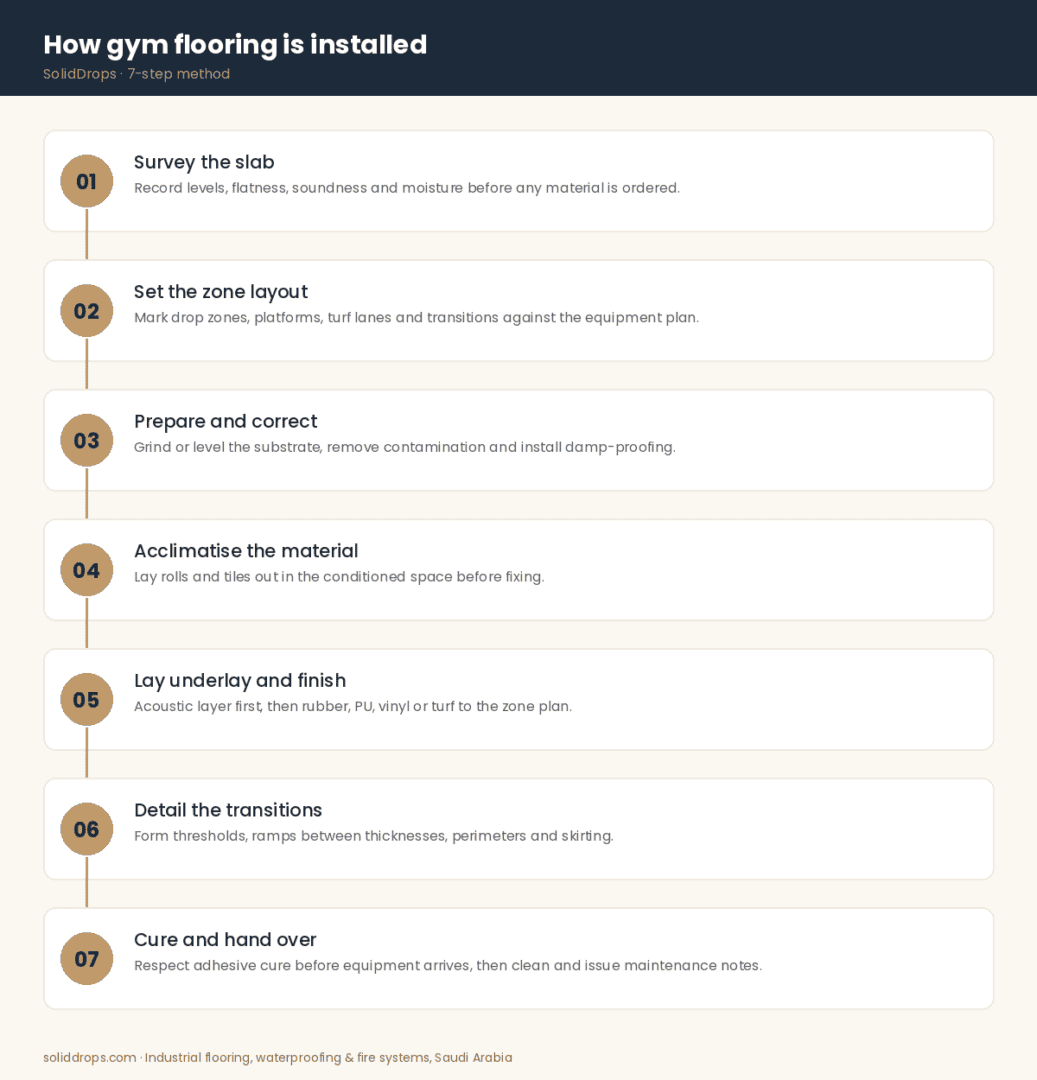
How is gym flooring installed?
Installation is straightforward when the preparation is right and difficult when it is not.
- Survey the slab. Levels, flatness, soundness and moisture. Record the readings before anything is ordered.
- Set the zone layout. Mark drop zones, platforms, turf lanes and transitions on the floor against the equipment plan, not against a generic drawing.
- Prepare and correct. Grind or level as required, remove contamination, and install any damp-proofing.
- Acclimatise the material. Rubber rolls and tiles are laid out in the space to relax and reach room temperature before fixing — skipping this is a common cause of gaps appearing at joints later.
- Lay underlay and wearing layer. Acoustic layer first where specified, then rolls, tiles or liquid system to the zone plan, adhered or loose-laid per the design.
- Detail the transitions. Thresholds, ramps between thicknesses, perimeters and skirting.
- Cure, clean and hand over. Respect adhesive cure times before equipment is moved in, then clean down and issue maintenance instructions.
Equipment delivery is the risk point. Heavy racks dragged across a floor that has not reached full adhesive strength will shift and mark it. Coordinate the equipment installer’s programme with the flooring cure period.
Fitting out a gym and unsure where the money should go?
Send us the equipment layout and we will map the zones and build-ups against it before anything is priced.
What drives gym flooring cost in KSA?
We quote against a drawing and an equipment plan rather than publishing rates, because the same area can differ several times over depending on the following.
- Zone mix. How much of the area is high-impact free-weights build-up versus cardio, studio or circulation.
- Thickness and density. Heavier, thicker rubber costs more per square metre and more to transport and handle.
- Acoustic requirement. Whether the building has occupied space below and what the acoustic consultant has specified.
- Substrate condition. Levelling, repair and moisture control before the floor can be laid.
- Format and fixing. Loose-lay tile against fully adhered roll; adhesive cost and labour differ.
- Detailing. Platforms, inlaid logos, lane markings, transitions and skirting.
- Programme and access. Night work in an operating facility, lift access, and mobilisation to Jubail, Tabuk, Makkah or Medina.
Send a floor plan with the equipment layout marked and request a quotation.
What goes wrong with gym floors?
Most complaints trace to a handful of decisions made before installation.
Under-specifying the drop zone. A general training thickness used under an Olympic platform will indent, split and eventually crack the slab beneath it. Drop energy is concentrated; the floor under it should be too.
Laying over an uneven slab. Resilient flooring reveals the substrate rather than hiding it. Rocking tiles, visible waves and lifting edges are substrate problems, not product faults.
Ignoring acoustics until after opening. Impact noise transmitted to floors below is expensive to fix retrospectively, because it means lifting a finished floor.
No acclimatisation. Material fixed straight off a hot delivery truck contracts as it settles, opening joints.
Wrong cleaning regime. Aggressive solvents and excess water degrade rubber and attack adhesive at joints. Follow the maintenance instructions issued at handover; our note on sports flooring maintenance applies to gym floors too.
Turf used as an impact surface. Turf is for sleds and sprint work, not for dropping weights.
What this means for gyms in Saudi Arabia
Three local conditions change the specification. The first is heat during delivery and storage. Rubber arriving in a container that has stood in the sun will be hot and expanded; laying it immediately guarantees shrinkage gaps. Allow acclimatisation time in the conditioned space, and program deliveries accordingly.
The second is where the training area sits. Rooftop gyms, courtyard functional zones and outdoor rigs are common in Riyadh, Jeddah and Dammam facilities. Outdoors, UV and surface temperature govern, and EPDM’s weather resistance and UV stability are the reason it appears in those areas rather than standard recycled rubber.
The third is the building context. Fitness facilities in KSA are frequently fitted out inside malls, hotels and mixed-use towers with occupied space directly below, which makes impact sound transmission a live issue from day one — نادي رياضي fit-outs above retail are the usual case. Specify the acoustic layer at design stage and keep it through value engineering.
Where a consultant or authority requires fire or performance documentation for the floor finish, that documentation can be supplied against the products used on the project. Ask for it before award, not after installation.
Who supplies and installs gym flooring in Saudi Arabia?
SolidDrops supplies and installs gym and fitness flooring across Saudi Arabia, covering Riyadh, Jeddah, Makkah, Dammam, Jubail, Madinah and Tabuk. The range includes rubber tiles, rolls, pavers and impact mats, PU and vinyl systems, cushioned resilient floors, acoustic underlay, turf strips and resin or microcement finishes, and the company holds ISO 9001, ISO 14001 and ISO 45001 certification.
Installations are offered with a warranty in the 2 to 5 year range depending on the system and the application, and fire or performance documentation can be provided where a consultant or authority requires it on a project.
The work usually starts with the equipment plan rather than the floor plan, because the equipment layout is what determines the zones. From there we survey the slab, set the build-ups, and price the preparation honestly instead of assuming the substrate is ready. See our rubber flooring for fitness centres page for the product detail, and the gym flooring overview for the wider range.
To discuss a facility, send drawings and the equipment layout to [email protected] or call +966 50 213 1112.
Frequently asked questions
What is the best flooring for a gym in Saudi Arabia?
There is no single best floor for a whole facility. Rubber rolls and tiles suit free weights and general training, PU and vinyl suit studios and cardio, turf strips suit sled and sprint lanes, and slip-resistant finishes with waterproofing suit wet zones. Specify by zone against the equipment plan rather than choosing one product throughout.
How thick should rubber gym flooring be?
Thickness depends on the zone and the product, and is stated on the manufacturer’s technical data sheet. Free-weight and drop areas need substantially heavier build-ups than cardio or studio areas, often with dedicated platforms or impact mats. Set the thickness against the equipment layout and the drop energy expected, then confirm it on the TDS.
Is rubber gym flooring good for heavy weights?
Yes, provided the thickness and build-up match the drop energy in that zone. Rubber is shock-absorbent and durable, but a general training thickness used under an Olympic lifting platform will indent and split. Heavier tiles, impact mats or a purpose-built platform are specified where barbells are dropped repeatedly.
What is EPDM gym flooring?
EPDM is a synthetic rubber used in gym and sports flooring for its weather resistance, UV stability and resistance to heat, cold and abrasion. Those properties make it suited to outdoor playgrounds, athletic tracks and rooftop or courtyard training areas, which is why it appears in Saudi facilities where training space extends outside the building.
What flooring reduces noise in a gym?
Impact noise is controlled by the whole build-up, not the top layer alone. An acoustic underlay beneath the rubber or vinyl wearing layer is the usual approach, sized against what the acoustic consultant specifies for the structure. This matters most where a gym sits above occupied offices, apartments or retail in a mixed-use building.
Can gym flooring be installed over existing tiles?
Sometimes, but only after assessment. The existing tiles must be sound, well bonded, level and free of contamination, and hollow or cracked tiles must be removed. Grout lines and level differences may need filling first. In many refurbishments removal and preparation of the slab proves more reliable than laying over the old finish.
How do you clean rubber gym flooring?
Sweep or vacuum daily, then clean with a neutral cleaner and a damp mop or scrubber-drier. Avoid solvents, strong acids or alkalis and excessive water, all of which degrade rubber and attack adhesive at joints. Follow the maintenance instructions issued at handover and address spills quickly, particularly in wet and changing areas.
How much does gym flooring cost in Saudi Arabia?
Cost depends on the zone mix, thickness and density selected, whether acoustic underlay is required, substrate condition and preparation, format and fixing method, detailing such as platforms and inlaid markings, and access and location. We price against a floor plan with the equipment layout marked rather than publishing rates.
Planning a fitness facility in KSA?
SolidDrops supplies and installs gym flooring in Riyadh, Jeddah, Makkah, Dammam, Jubail, Madinah and Tabuk, with fire and performance documentation on request.
 Chat Online