
10 Sep Sports Flooring in Saudi Arabia: Courts, Tracks and Halls
Sports Flooring in Saudi Arabia: Courts, Tracks and Halls
Sports flooring in Saudi Arabia covers acrylic court coatings, EPDM and polyurethane systems, modular sport tiles, vinyl and rubber surfaces. The right choice depends on the sport, whether the surface is indoor or exposed, and the base beneath it. In KSA, UV, heat, sand and ponding decide how long any of them last.
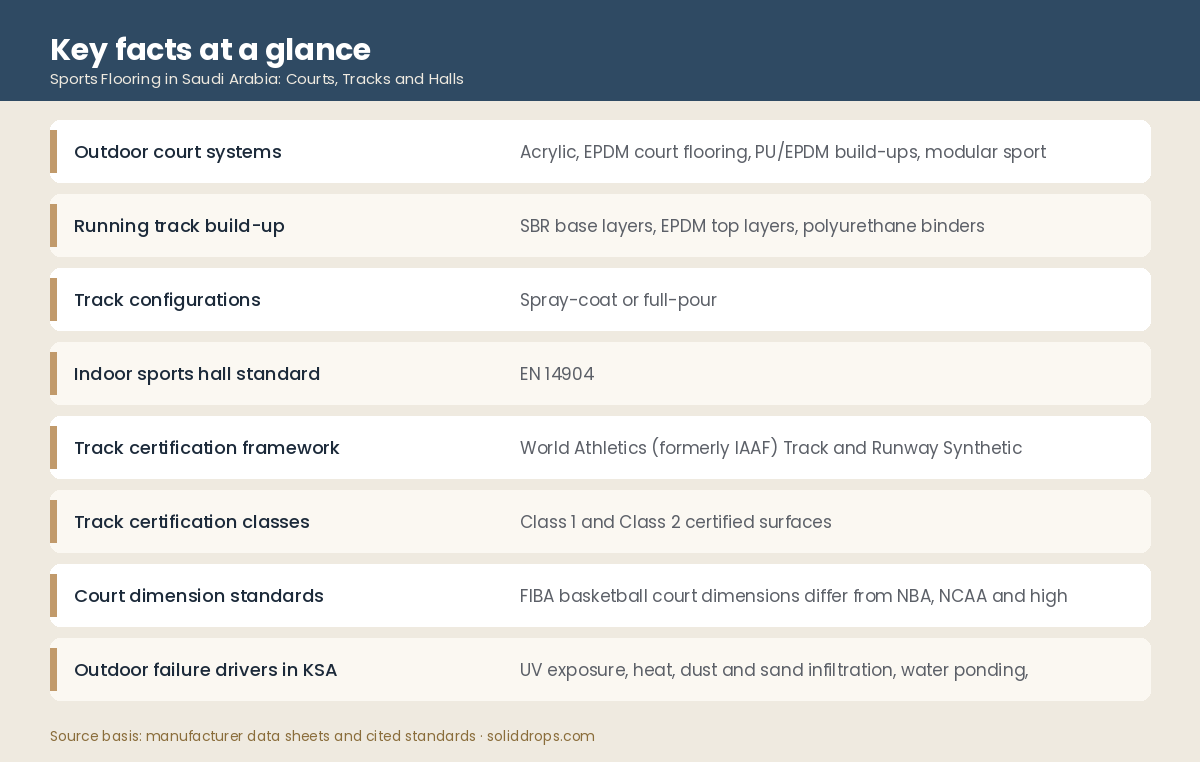
| Property | Value | Basis / standard |
|---|---|---|
| Outdoor court systems | Acrylic, EPDM court flooring, PU/EPDM build-ups, modular sport tiles, rubber | SolidDrops court flooring scope |
| Running track build-up | SBR base layers, EPDM top layers, polyurethane binders | SolidDrops EPDM track systems |
| Track configurations | Spray-coat or full-pour | SolidDrops EPDM track systems |
| Indoor sports hall standard | EN 14904 | Shock absorption, ball bounce, friction and indentation for indoor sports surfaces |
| Track certification framework | World Athletics (formerly IAAF) Track and Runway Synthetic Surface Testing Specifications | World Athletics certification procedures, June 2016 |
| Track certification classes | Class 1 and Class 2 certified surfaces | World Athletics Certification System procedures |
| Court dimension standards | FIBA basketball court dimensions differ from NBA, NCAA and high school | Published court size comparison |
| Outdoor failure drivers in KSA | UV exposure, heat, dust and sand infiltration, water ponding, thermal movement | SolidDrops court flooring guidance |
| Track failure risk factors | Poor base levels, trapped water, weak bonding, edge damage, unsuitable cleaning, sand build-up, delayed repair | SolidDrops EPDM track guidance |
| Sport approval claims | Only where product documents or the specification confirm it | SolidDrops disclosure policy |
What counts as sports flooring, and what does the sport demand?
Sports flooring in Saudi Arabia is a broad category covering everything from an acrylic coating on an outdoor school basketball court to a full-pour polyurethane running track and an indoor multi-use hall floor. What links them is that the surface has a performance job — how a ball bounces, how a shoe grips and releases, how much energy returns to the athlete’s leg — on top of the durability job every floor has.
The systems in regular use here are acrylic sports coatings, EPDM court surfacing, PU and PU/EPDM build-ups, modular sport tiles, rubber systems, and indoor vinyl and PU sports floors. Each is a different answer to the same question: what is being played, by whom, how often, and under what sky.
Two reference frameworks are worth knowing before writing a specification. EN 14904 governs indoor sports hall surface performance — shock absorption, ball bounce, friction and indentation. For athletics, World Athletics (formerly IAAF) publishes the Track and Runway Synthetic Surface Testing Specifications and operates a certification system with Class 1 and Class 2 certified surfaces. Basketball court dimensions differ between FIBA, NBA, NCAA and high school layouts, so confirm which set the client is designing to before setting out any lines.
One principle governs everything below: no sport-body approval, slip rating or shock-absorption class should be claimed for a product unless its own documentation or the project specification confirms it.
Where does each system belong?
Match the system to the sport and the exposure, in that order.
- Tennis, netball, multi-use hard courts (outdoor) — acrylic sports coatings over a sound asphalt or concrete base. Colour, texture and speed of play are adjusted through the coating layers.
- Basketball and volleyball (outdoor) — acrylic systems, or EPDM/PU build-ups where a more forgiving surface is wanted; modular sport tiles where drainage and fast installation matter.
- Running tracks — EPDM systems with SBR base layers, EPDM top layers and polyurethane binders, laid as spray-coat or full-pour. Detail is set out in our EPDM running track guide.
- Indoor halls and multi-use courts — PU or vinyl sports floors, where EN 14904 performance criteria apply and where the same floor may serve basketball, volleyball, badminton and school assembly.
- Playgrounds and play areas — wet-pour rubber and EPDM, chosen for impact attenuation.
- Fitness and training areas within a sports facility — rubber systems specified by zone; see the gym flooring guide.
School projects often combine three of these in one contract: a court, a track or run-up, and an indoor hall.
How is a court or track system built up?
Everything above ground level depends on what is below it. The failure record for sports surfaces in Saudi Arabia is overwhelmingly a record of base problems.
Base. Asphalt or concrete, laid to design falls, compacted and cured. Falls matter more here than most contractors expect: a court that ponds after rain will fail at the ponded area first, every time. Levels should be surveyed and signed off before any surfacing is ordered.
Levelling and patching. Base irregularities corrected with compatible patch binder or levelling materials, so that the surface layer is a uniform thickness. Where a concrete base needs correction before surfacing, our cement self levelling guide covers the preparation logic.
Primer or binder coat. Bonds the system to the base. Weak bonding is a recorded track failure factor, and it usually starts here.
Resilient layer. On a track, SBR base layers bound with polyurethane. On a court, the cushion layers of an acrylic or EPDM build-up.
Wearing and texture layers. EPDM top layer, sprayed or poured, or the acrylic texture coats that set the pace of play.
Line marking. Set out to the governing dimensions for the sport and the body the client is designing to, then applied in a compatible line paint.
Edges and drainage. Perimeter detail, kerbs, drainage channels and the transition to the surrounding surface. Edge damage is where tracks unravel.
Acrylic vs EPDM vs PU vs modular tile vs vinyl
The table compares the five families most often shortlisted. It compares fit and behaviour; performance classes and sport-body approvals are product-specific and must come from the product’s own documentation.
| System | Typical application | Character | Strengths | Considerations |
|---|---|---|---|---|
| Acrylic coating | Outdoor tennis, basketball, netball, multi-use courts | Hard, textured, thin-build coating over asphalt or concrete | Colour control, adjustable texture and pace, straightforward resurfacing | Little cushioning; entirely dependent on base quality and falls |
| EPDM | Running tracks, play areas, cushioned courts | Rubber granule surface bound with polyurethane | Weather and UV resistance, impact absorption, colour stability | Needs skilled installation; sand build-up and trapped water are the main enemies |
| Polyurethane (PU) | Full-pour tracks, indoor halls, multi-use courts | Liquid-applied resilient system, continuous surface | Uniform performance, no joints, tunable resilience | Substrate moisture and application conditions are critical; specialist crews |
| Modular sport tile | Outdoor courts, temporary and phased facilities | Interlocking rigid or semi-rigid tiles laid over a base | Fast installation, drains freely, tiles individually replaceable | Different feel and ball response; base flatness still governs; thermal movement at perimeters |
| Vinyl sports floor | Indoor halls, school gymnasiums | Sheet system with a resilient backing | Consistent indoor performance, cleanable, EN 14904 criteria applicable | Indoor only; needs a level, dry substrate and welded joints |
A wider comparison of rubber, acrylic, PU and vinyl systems is on our sports flooring materials page.
How are sports surfaces installed?
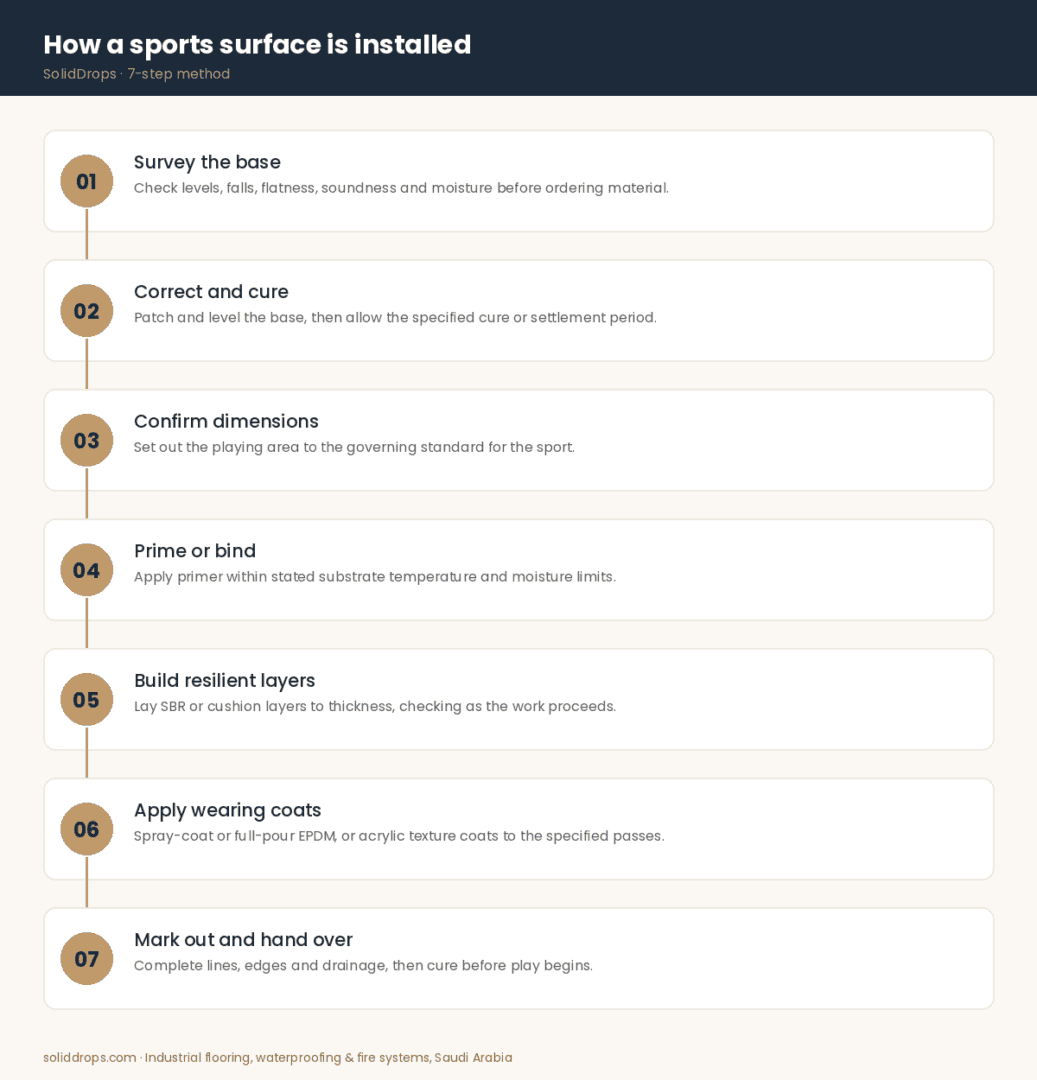
The sequence below is where most of the quality is won or lost, well before the top coat goes on.
- Survey the base. Levels, falls, flatness, soundness and moisture. On refurbishment, also check what is bonded to what.
- Correct and cure. Patch, level and repair the base, then allow the specified cure or settlement period. Rushing this stage is why surfaces delaminate.
- Confirm dimensions. Set out the playing area against the governing standard for the sport and body the client is designing to, before any coating is applied.
- Prime or bind. Apply the primer or binder coat within stated substrate temperature and moisture limits.
- Build the resilient layers. SBR or cushion layers to the specified thickness, checked as the work proceeds rather than afterwards.
- Apply the wearing and texture coats. Spray-coat or full-pour EPDM, or acrylic texture coats to the specified number of passes.
- Mark out and hand over. Line marking, edge and drainage detail completed, then a cure period before play and a written maintenance regime.
Weather windows matter. Application is governed by substrate temperature, humidity and wind, and on Saudi sites the usable window in summer is early morning or night.
Refurbishing a court or track?
Send photographs and level information for the existing base and we will tell you what has to be corrected before any surfacing is priced.
What drives sports flooring cost in KSA?
No responsible rate can be given without seeing the base, because base condition frequently costs more than the surface. These are the drivers.
- Base condition and type. New asphalt, sound existing concrete, or a cracked and ponding old court that needs reconstruction.
- System and total thickness. A three-coat acrylic resurface and a full-pour PU track are different orders of work.
- Area and geometry. Standard rectangular courts price efficiently; tracks with bends, run-ups and field event areas do not.
- Certification requirement. Whether the client requires a certified track surface and the testing that goes with it.
- Line marking complexity. A single-sport court versus a multi-use overlay with several line sets.
- Drainage, kerbs and fencing interfaces. Often specified separately but always affecting the surfacing programme.
- Access, season and location. Occupied schools, night working windows, and mobilisation to Jubail, Tabuk, Makkah or Medina.
Send layout drawings, base details and photographs of any existing surface, and request a quotation.
Why do courts and tracks fail early in Saudi Arabia?
The failure drivers on outdoor surfaces here are consistent: UV exposure, heat, dust and sand infiltration, water ponding and thermal movement. On tracks specifically, the risk factors are poor base levels, trapped water, weak bonding, edge damage, unsuitable cleaning, sand build-up and delayed repair of cuts and bubbles.
Read that list again and notice how much of it is maintenance rather than material. A cut in an EPDM track that is repaired in the same week stays a small repair. Left through a summer, water enters, the bond breaks down around it, and the repair becomes a section replacement. The same is true of a blocked drainage channel: sand accumulates, water stands, and the surface under the pond degrades faster than everything around it.
Thermal movement is the other silent one. Dark surfaces exposed to direct sun reach high surface temperatures and cycle daily. That movement concentrates at edges, kerbs, drainage channels and any restraint, which is exactly where you find lifting and cracking on a five-year-old court that looks fine in the middle.
Cleaning method matters more than cleaning frequency. Pressure washing at the wrong setting, or aggressive chemicals, damages the binder and lifts granules. Guidance is on our sports flooring maintenance page.
What this means for projects in Saudi Arabia
Design for the exposure, then design for the sport. In practice that means three things.
Drainage before surfacing. Rain events are infrequent but intense, and dust between them fills channels. Falls, outlets and a cleaning regime need to be part of the design, not an afterthought — sand and water together do more damage to Saudi courts than play ever does.
UV and heat as a material criterion. Colour stability and binder durability under sustained UV are legitimate selection criteria here, and they are why EPDM appears so often on exposed surfaces. Surface temperature also affects usability: darker courts get hotter, which changes when a school can actually use them.
Programme around the weather window. Substrate temperature limits on primers, binders and coatings are real. Summer installation in Riyadh, Jeddah or Dammam means night and early-morning work, and the tender programme should say so.
Demand for these systems is rising with Vision 2030 sports infrastructure investment, including stadium development linked to the 2034 FIFA World Cup. That means more school, club and municipal facilities in procurement — ملاعب رياضية projects where the specification quality varies widely. Ask for base survey data and product documentation at tender stage; it is the cheapest quality control available.
Who supplies and installs sports flooring in Saudi Arabia?
SolidDrops supplies and installs sports flooring across Saudi Arabia — outdoor courts, EPDM and PU running tracks, indoor halls, playgrounds and school facilities — serving Jeddah, Riyadh, Dammam, Jubail, Makkah, Madinah and Tabuk.
Our approach on court and track work starts with the base rather than the finish. We survey levels and falls, assess the existing surface where there is one, and set out what has to be corrected before any surfacing is priced. Where a client requires a certified track surface or documented performance under a named standard, that requirement is confirmed against the product manufacturer’s own documentation — we do not claim sport-body approval, slip rating or shock-absorption class for any product unless its documents or the project specification confirm it.
For facilities that combine a court, a hall and a training area, the packages are coordinated so the same base preparation serves all of them. See our court flooring page and the gym flooring guide.
Send layout drawings and photographs to [email protected], or call +966 50 213 1112 to arrange a site visit.
Frequently asked questions
What is the best flooring for outdoor basketball courts in Saudi Arabia?
Acrylic coatings over a sound asphalt or concrete base are the common route, with EPDM or PU build-ups where a more forgiving surface is wanted and modular tiles where fast installation and free drainage matter. The base, its falls and its drainage matter more to the outcome than the choice between systems.
How thick should an EPDM running track be?
Track thickness is set by the specification and the product system, and by whether the surface must meet a certification class. World Athletics publishes Track and Runway Synthetic Surface Testing Specifications and operates a certification system with Class 1 and Class 2 surfaces. Confirm the required thickness against the specification and the manufacturer’s system documentation.
Is acrylic or EPDM better for tennis courts?
They serve different priorities. Acrylic coatings give colour control, adjustable surface texture and pace of play, and are straightforward to resurface, but offer little cushioning. EPDM build-ups give more impact absorption and colour stability under UV. The base condition and the standard of play expected should decide between them.
What causes outdoor sports courts to fail in Saudi Arabia?
The main drivers are UV exposure, heat, dust and sand infiltration, water ponding and thermal movement. On tracks, poor base levels, trapped water, weak bonding, edge damage, unsuitable cleaning, sand build-up and delayed repair of cuts and bubbles are the recorded risk factors. Most of these are preventable through design and maintenance.
What flooring is FIBA approved?
Approval is held by specific products, not by material categories, and should only be claimed where the product documentation or the project specification confirms it. FIBA and DIN standards are referenced in sports flooring specification, and FIBA basketball court dimensions differ from NBA, NCAA and high school layouts. Ask the manufacturer for the certificate.
What standards apply to school running tracks?
For athletics surfaces, World Athletics publishes Track and Runway Synthetic Surface Testing Specifications and runs a certification system covering Class 1 and Class 2 surfaces. Indoor sports hall surfaces are covered by EN 14904 for shock absorption, ball bounce, friction and indentation. Which applies depends on the facility and the client’s requirements.
How often should acrylic sports flooring be resurfaced?
Resurfacing intervals depend on usage, base condition, UV exposure and how well the surface has been maintained. Rather than working to a fixed interval, inspect for texture loss, colour fade, cracking and ponding, and act on cuts and bubbles promptly. Delayed repair turns small localised defects into full-area reconstruction.
How much does basketball court flooring cost in Saudi Arabia?
Cost depends on base condition and whether it needs reconstruction, the system and total thickness, area and geometry, whether a certified surface is required, line marking complexity, drainage and kerb interfaces, and access and location. We price against layout drawings, base details and a site inspection rather than publishing rates.
Planning a sports facility in KSA?
SolidDrops supplies and installs courts, tracks and hall flooring in Jeddah, Riyadh, Dammam, Jubail, Makkah, Madinah and Tabuk.
 Chat Online