
10 Sep KDF Sports Flooring: A Specifier’s Guide for Saudi Arabia
KDF Sports Flooring: A Specifier's Guide for Saudi Arabia
KDF sports flooring refers to sports surface systems built from KDF’s raw materials — EPDM rubber granules, polyurethane binders and acrylic coatings — used for running tracks, courts and playgrounds. SolidDrops supplies and installs KDF sports flooring systems in Saudi Arabia for indoor and outdoor facilities.
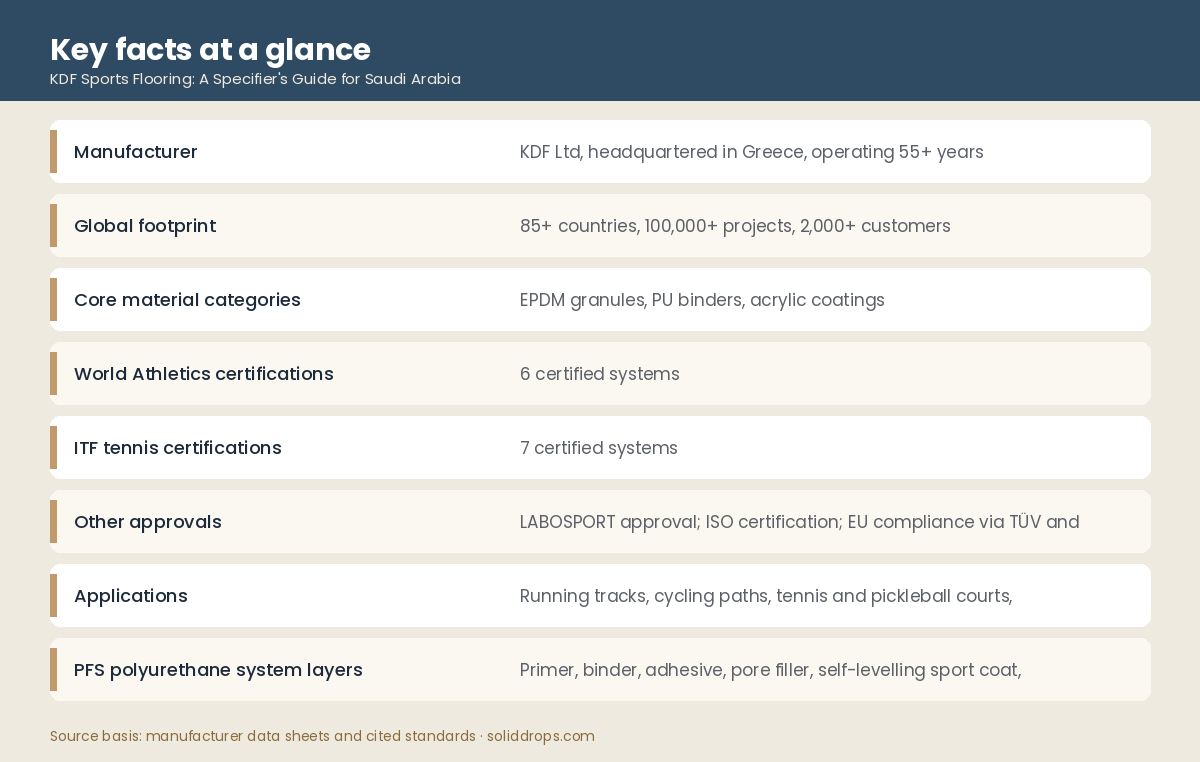
| Property | Value | Basis / standard |
|---|---|---|
| Manufacturer | KDF Ltd, headquartered in Greece, operating 55+ years | KDF company website |
| Global footprint | 85+ countries, 100,000+ projects, 2,000+ customers | KDF company website |
| Core material categories | EPDM granules, PU binders, acrylic coatings | KDF company website |
| World Athletics certifications | 6 certified systems | KDF company website |
| ITF tennis certifications | 7 certified systems | KDF company website |
| Other approvals | LABOSPORT approval; ISO certification; EU compliance via TÜV and Intertek | KDF company website |
| Applications | Running tracks, cycling paths, tennis and pickleball courts, multi-sport arenas, splash zones, playgrounds, equestrian surfaces | KDF company website |
| PFS polyurethane system layers | Primer, binder, adhesive, pore filler, self-levelling sport coat, topcoat | SolidDrops KDF/PFS sports flooring page |
| PFS acrylic system layers | Primer, resurfacer, cushion layer, sand coat, colour coat | SolidDrops KDF/PFS sports flooring page |
| Supplier in KSA | SolidDrops supplies and installs KDF sports flooring systems in Saudi Arabia | SolidDrops KDF/PFS sports flooring page |
What is KDF sports flooring?
KDF sports flooring is the family of sports surfaces built from materials made by KDF Ltd, a Greek manufacturer that has been producing sports flooring raw materials for more than 55 years and supplies into 85 or more countries. The company’s output is grouped into three material categories — EPDM rubber granules, polyurethane binders and acrylic coatings — and those three combine into the systems used on running tracks, courts, cycling paths, splash zones, playgrounds and equestrian surfaces.
That structure explains something buyers often find confusing. KDF is a materials manufacturer, not a court-building contractor. The surface an athlete stands on is an assembly built on site from primers, binders, granules and coatings, and the finished performance depends on the build-up specified, the substrate under it, and the crew that laid it. The same material list can produce an excellent track or a poor one.
SolidDrops supplies and installs KDF sports flooring systems in Saudi Arabia, covering indoor and outdoor courts, tracks and playgrounds. Our existing KDF, PFS, rubber, acrylic, PU and vinyl sports flooring page lists the system families we work with in the Kingdom.
Is KDF the same as PFS sports flooring?
This question comes up in almost every enquiry, so it is worth answering carefully rather than confidently.
KDF Ltd is the Greek manufacturer described above. PFS is the branding that appears on sports flooring systems marketed in the Gulf, including in Saudi Arabia, and buyers frequently search for it as “PSF” as well — the letters get transposed constantly in tender documents and in search boxes. The precise commercial relationship between the KDF and PFS names is not clearly stated on the manufacturer and supplier pages available to us, so we will not characterise it here. It is listed as an open item at the end of this guide.
What we can state plainly is our own position: SolidDrops supplies and installs KDF sports flooring systems in Saudi Arabia, and the PFS-branded polyurethane, acrylic and EPDM system build-ups described on this page are the ones we quote and lay.
For a specifier the practical advice is simple. Write the specification around the system and its performance — layer build-up, granule type and depth, binder, coating, and the certification the facility actually needs — rather than around a brand name. A tender that names only a brand invites substitution; a tender that names a build-up and a certification does not.
What are the main system types?
Four families cover almost every sports surface enquiry in the Kingdom, and each has a natural home.
EPDM rubber
Coloured rubber granules bound in place. Used for running tracks, playgrounds and splash zones where impact attenuation and colour are the priorities.
Polyurethane
A built-up system: primer, binder, adhesive, pore filler, self-levelling sport coat and topcoat. Used for multi-sport courts and tracks where a uniform, resilient playing surface is required.
Acrylic
Primer, resurfacer, cushion layer, sand coat and colour coat. The standard approach for tennis and hard-court surfaces, with pace controlled through the sand coat.
Vinyl
Roll or sheet goods for indoor halls, where a factory-made surface with a defined wear layer is preferred over a site-built one.
Selection follows the sport and the setting, not personal preference. Tennis and pickleball point to acrylic. Athletics tracks and playgrounds point to EPDM. Multi-sport outdoor courts that take basketball, volleyball and five-a-side in the same footprint usually point to polyurethane. Indoor halls with a sprung requirement are a separate conversation again.
Our guides to tennis, basketball and volleyball court flooring and to EPDM running tracks for schools go deeper on each case.
KDF PU vs acrylic vs EPDM vs vinyl
The table below compares the four families on the criteria that decide a tender. The layer build-ups are those published for the PFS polyurethane and acrylic systems; the remaining rows describe generic system behaviour rather than tested figures for any single product.
| Criterion | Polyurethane | Acrylic | EPDM rubber | Vinyl |
|---|---|---|---|---|
| Published layer build-up | Primer, binder, adhesive, pore filler, self-levelling sport coat, topcoat | Primer, resurfacer, cushion layer, sand coat, colour coat | Granule and binder system over a prepared base | Factory sheet over adhesive |
| Typical sports | Multi-sport courts, tracks | Tennis, pickleball, hard courts | Athletics tracks, playgrounds, splash zones | Indoor halls |
| Built on site or factory made | Site built | Site built | Site built | Factory made |
| Cushioning | Set by system thickness | Set by the cushion layer | Set by granule depth | Set by the product’s backing |
| Pace and ball response | Adjustable through the sport coat | Adjustable through sand in the coat | Not a ball-sport surface in most uses | Product-specific |
| Colour options | Custom colours available | Custom colours available | Custom granule colours available | Limited to the product range |
| Outdoor suitability | Yes, with the correct topcoat | Yes, standard for outdoor courts | Yes | Normally indoor |
| Resurfacing route | Recoat the sport coat and topcoat | Recoat colour layers | Patch or overlay granules | Replace sheet |
Note what the table does not contain. Shore hardness, shock absorption percentage and thickness figures for individual products are not published on the sources available to us, and inventing them would be worse than leaving them out. Ask for the specific product data sheet for the SKU being quoted, and require it before award.
Which certifications matter, and when?
Certification is where sports flooring tenders are won and lost, and it is also where a lot of loose language circulates. KDF’s own published position lists 6 systems certified by World Athletics, 7 systems certified by the ITF for tennis, LABOSPORT approval, ISO certification, and EU compliance through TÜV and Intertek.
Two points about how to use that information. First, certification attaches to a system, not to a company. A manufacturer holding six World Athletics certifications does not make every product in its catalogue certified; the certificate names a specific build-up. If a track has to be certified, the certificate for the exact system being installed must be produced, and the installation must match it.
Second, ask whether the facility actually needs it. A school running track used for physical education does not require the same certification as a venue hosting sanctioned competition. Paying for a certified system and then deviating from the certified build-up during value engineering delivers the cost without the benefit, which is the worst of both outcomes.
- Name the required certification in the tender, with the governing body and the class.
- Require the certificate for the specific system, not a company brochure.
- Check that the specified thickness and build-up match the certified one.
- Confirm who is responsible for post-installation testing where competition use is intended.
Planning a court, track or playground?
Send site photographs and the BOQ and the SolidDrops technical team will assess the base before recommending a system.
How is a KDF sports surface installed?
Site-built sports surfaces are unforgiving of a poor base. On the courts we are asked to inspect after a failure, the cause is almost always beneath the colour, not in it.
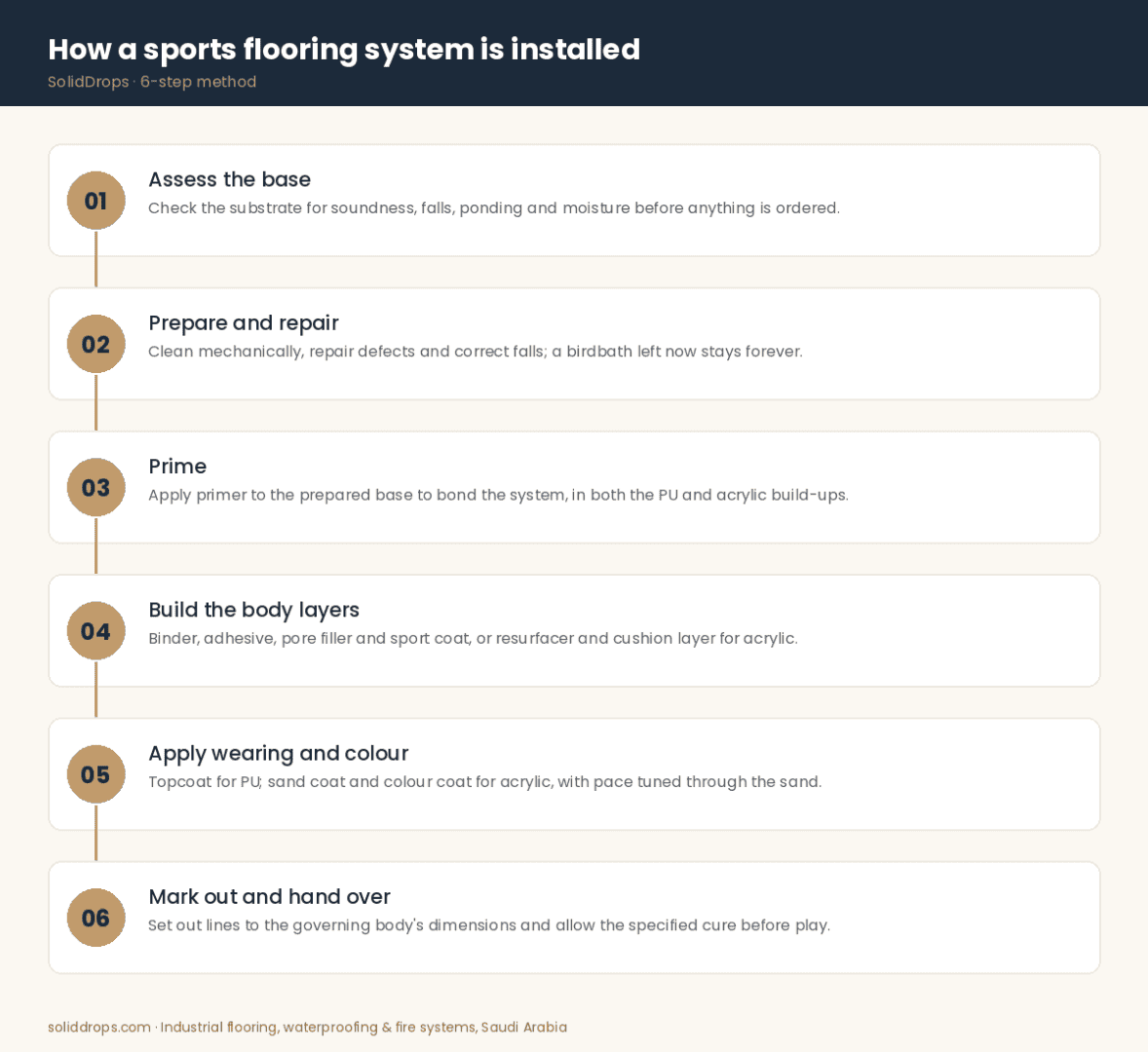
- Base assessment. Check the substrate for soundness, falls, ponding and moisture. Asphalt and concrete bases behave differently and are prepared differently.
- Preparation and repair. Clean mechanically, repair defects, and correct falls before any resin touches the surface. A birdbath left in the base will still be there under the finished court.
- Primer. Applied to the prepared base to bond the system, in both the published polyurethane and acrylic build-ups.
- Body layers. For polyurethane: binder, adhesive, pore filler and the self-levelling sport coat. For acrylic: resurfacer and cushion layer. This is where thickness and resilience are set.
- Wearing and colour layers. Topcoat on the polyurethane system; sand coat and colour coat on the acrylic system, with pace tuned through the sand.
- Line marking and handover. Set out to the governing body’s dimensions for the sports in use, then allow the specified cure before play.
Weather discipline governs the programme outdoors. Rain on an uncured coat, dew forming overnight, or wind driving dust across a wet surface will each cost a layer. In the Kingdom the wind and dust risk is usually more limiting than rain.
What drives the cost of a sports flooring project?
No rates are published here. The variables below are what move the number, and a supplier who quotes before seeing the base is guessing.
- Base condition and type. New concrete, sound asphalt and a tired existing court are three entirely different starting points. Base repair is frequently the largest surprise.
- System family and thickness. An acrylic recoat and a full polyurethane build-up are not comparable scopes.
- Certification requirement. A certified build-up constrains materials and thickness and adds testing.
- Area and geometry. A single large court lays efficiently; four small courts with fences between them do not.
- Line marking complexity. Multi-sport courts with several overlaid sets of lines add labour.
- Site access and programme. School holidays, night work and phased handovers all carry cost.
Proper specification requires site photographs, a substrate assessment and BOQ verification. Send those to [email protected] and request a quotation.
What this means for projects in Saudi Arabia
Outdoor sports surfaces in the Kingdom face conditions that most European reference projects never see, and three of them should shape the specification.
Surface temperature and UV. An outdoor court in Riyadh in July absorbs a full day of direct sun, and dark colours run hotter still. That affects colour choice, the topcoat specified, and the working window for the crew during installation — coatings applied to a slab that is too hot will flash off before they level. Ask for UV and heat performance data for the specific topcoat rather than accepting a general claim of climate adaptability.
Dust and abrasion. Fine airborne sand acts as an abrasive underfoot on every outdoor court in the Kingdom. It shortens the interval between recoats and makes routine sweeping more valuable than any single specification decision.
Base movement and drainage. Thermal cycling across day and night moves a base, and where falls are inadequate, water sits and the surface degrades from beneath. Getting the falls right before the first primer coat is worth more than any upgrade above it. الملاعب الرياضية built on a base that ponds will disappoint regardless of the system laid on top.
Maintenance planning belongs in the specification, not after handover — see our sports flooring maintenance guide for schools and clubs.
Who supplies and installs KDF sports flooring in Saudi Arabia?
SolidDrops supplies and installs KDF sports flooring systems in Saudi Arabia, supporting projects in Riyadh, Jeddah, Dammam, Jubail, Makkah, Medina and Tabuk for schools, clubs, compounds, municipalities and private facilities.
Specification starts with information, not with a price. We ask for site photographs, a substrate assessment and BOQ verification before recommending a system, because the base determines more of the outcome than the surface does. From there the sequence is a written system recommendation with the relevant product data attached, a priced proposal against a defined scope, and installation with hold points at base preparation, body layers and line marking.
Where a consultant has already specified a system, we will review it against the manufacturer’s current data and raise any conflict before mobilisation. Where a certification is required, we will ask for the certificate reference to be named in the tender so that everyone is bidding the same thing.
Contact [email protected] or +966 50 213 1112, or use the contact page. For indoor training and weights areas, our gym flooring guide and the sports flooring guide cover the adjacent scope.
Frequently asked questions
What is KDF sports flooring?
KDF sports flooring means sports surfaces built from KDF’s materials: EPDM rubber granules, polyurethane binders and acrylic coatings. KDF Ltd is a Greek manufacturer operating for more than 55 years across 85 or more countries. The finished surface is assembled on site from primers, binders, granules and coatings rather than supplied as a single product.
Is KDF the same as PFS sports flooring?
KDF is the Greek manufacturer; PFS is the branding seen on sports flooring systems marketed in the Gulf, and it is often searched as PSF. The precise commercial relationship between the two names is not clearly stated on the sources available to us. SolidDrops supplies and installs KDF sports flooring systems in Saudi Arabia.
PU or acrylic: which is better for a court?
Neither is universally better. Acrylic is the standard route for tennis and hard courts, with pace tuned through the sand coat. Polyurethane suits multi-sport courts and tracks where a resilient, uniform surface matters. The base condition, the sports played and any certification requirement decide it, not the chemistry alone.
Are KDF systems certified for athletics tracks?
KDF publishes 6 systems certified by World Athletics and 7 certified by the ITF for tennis, alongside LABOSPORT approval, ISO certification and EU compliance via TÜV and Intertek. Certification attaches to a specific system build-up rather than to the company, so require the certificate for the exact system being installed.
Which surface suits outdoor courts in Saudi heat?
All four families are used outdoors, with vinyl the exception as an indoor product. The decisive factors are the topcoat’s UV and heat performance, colour choice, and correct falls to prevent ponding. Ask for product data on the specific topcoat rather than accepting a general claim about climate adaptability.
What thickness and Shore hardness do these systems have?
Product-level figures such as thickness, Shore hardness and shock absorption are not published on the sources available to us, so we do not quote them. Request the product data sheet for the specific SKU being offered and require it before award, particularly where a certified system is specified.
How long does a court installation take?
Programme depends on the base condition, the number of layers in the specified build-up and the weather. Site-built systems need cure time between layers, and outdoor work is interrupted by wind, dust and dew. A realistic programme is set after the substrate assessment rather than quoted from an area figure alone.
How much does sports flooring cost per square metre in Saudi Arabia?
Rates are not published because base condition, system family, thickness, certification requirements, geometry and line marking all move the figure. Proper specification requires site photographs, a substrate assessment and BOQ verification. Send those to [email protected] or call +966 50 213 1112 for a quotation.
KDF sports flooring across Saudi Arabia
Supply and installation for courts, tracks and playgrounds, with substrate assessment before any system is recommended.
 Chat Online