
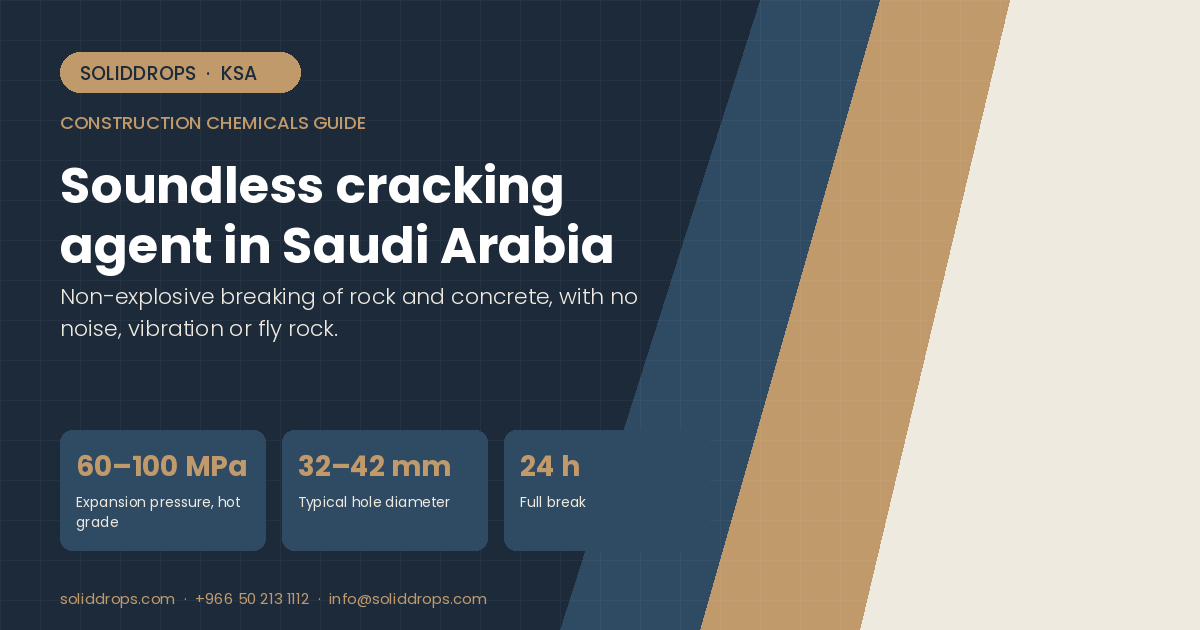
10 Sep Soundless Cracking Agent in Saudi Arabia: A Practical Guide
Soundless Cracking Agent in Saudi Arabia: A Practical Guide
A soundless cracking agent in Saudi Arabia is a reactive expansive powder mixed with water and poured into drilled holes in rock or concrete. The hydration reaction generates expansive pressure that fractures the material without noise, vibration or flying debris. SolidDrops supplies CRACKEN HSCA for enquiries across the Kingdom.
| Property | Value | Basis / standard |
|---|---|---|
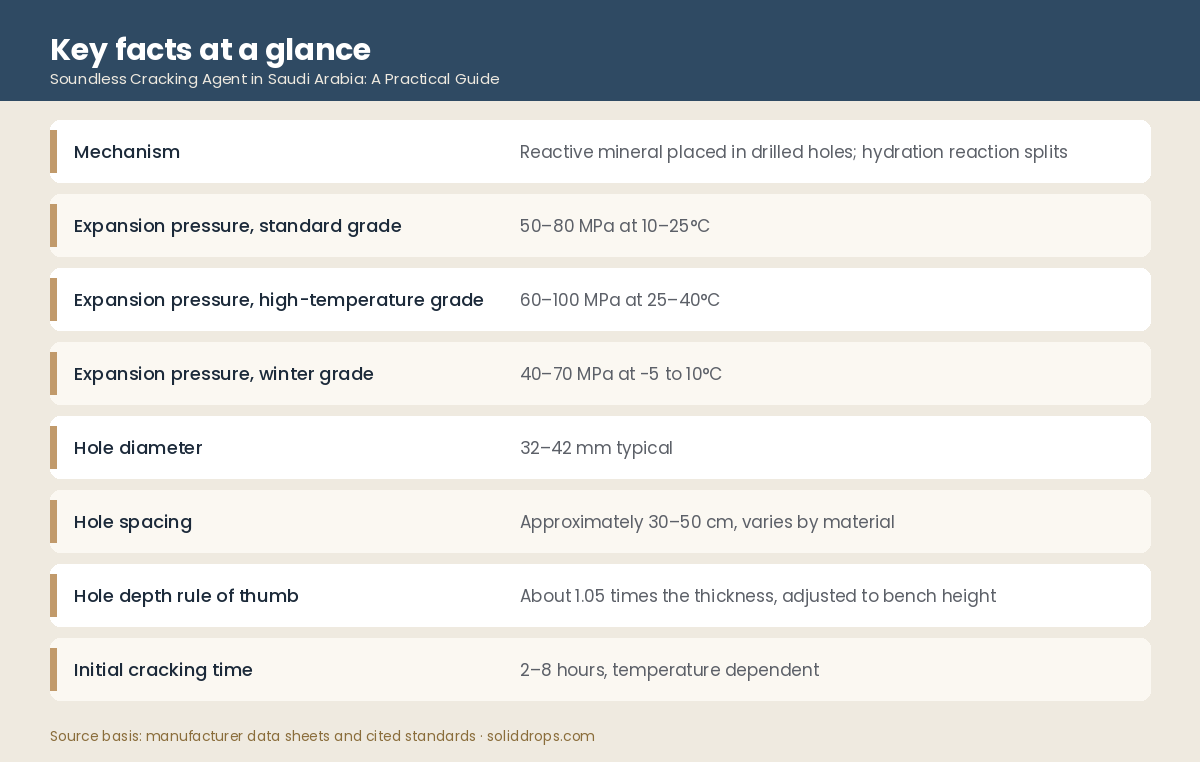
| Mechanism | Reactive mineral placed in drilled holes; hydration reaction splits rock or concrete | SolidDrops HSCA page |
| Expansion pressure, standard grade | 50–80 MPa at 10–25°C | Expand AG technical guide |
| Expansion pressure, high-temperature grade | 60–100 MPa at 25–40°C | Expand AG technical guide |
| Expansion pressure, winter grade | 40–70 MPa at -5 to 10°C | Expand AG technical guide |
| Hole diameter | 32–42 mm typical | Expand AG technical guide |
| Hole spacing | Approximately 30–50 cm, varies by material | Expand AG technical guide |
| Hole depth rule of thumb | About 1.05 times the thickness, adjusted to bench height | Expand AG technical guide |
| Initial cracking time | 2–8 hours, temperature dependent | Expand AG technical guide |
| Full breaking time | Within 24 hours | Expand AG technical guide |
| Grade selection driver | Ambient and material temperature determine the grade | Expand AG technical guide |
What is a soundless cracking agent?
A soundless cracking agent — also written SCA, or HSCA for the high-range grades — is a reactive expansive powder. It is mixed with water to a pourable slurry, poured into holes drilled in rock or concrete, and left. As the mineral hydrates it expands against the walls of the hole, and the tensile stress that builds up splits the material. There is no detonation, no shock wave, no noise and no fly rock.
The physics are worth understanding because they explain both the strengths and the limits. Rock and concrete are strong in compression and weak in tension. An expansive agent exploits that asymmetry directly: it does not blow material apart, it pulls it apart slowly from the inside. The published expansive pressures sit in the range of 50 to 120 MPa depending on grade, which is comfortably beyond the tensile capacity of the materials involved.
The trade-off is time. A blast is over in a second; a soundless cracking agent needs hours. Initial cracking is quoted at 2 to 8 hours and full breaking within 24 hours, both temperature dependent. On a live site next to occupied buildings, that patience is usually the whole point.
SolidDrops offers CRACKEN HSCA enquiries for quarrying, excavation and controlled concrete removal across Saudi Arabia — see our HSCA soundless cracking agent page for the product detail.
Where does it fit on a Saudi site?
The method suits work where vibration, noise or debris would be unacceptable, and where the schedule can absorb an overnight wait. That describes a great deal of what is being built in the Kingdom right now.
Rock excavation near occupied buildings
Basement and foundation digs in built-up Riyadh or Jeddah where a blasting permit and neighbour vibration are the binding constraints.
Controlled concrete removal
Cutting openings, removing mass concrete blocks and dropping foundations inside a plant that keeps running around the work.
Dimension stone and quarrying
Splitting blocks cleanly, where blasting would introduce micro-fractures and reduce the value of the stone.
Confined and sensitive locations
Trenches, tunnels, work near live services and areas where a hydraulic breaker’s noise would be intolerable.
Two situations argue against it. If the volume is large, open and remote, blasting is faster and generally cheaper. If the element is small, isolated and immediately accessible, a hydraulic breaker will be done before the drilling for an expansive agent is finished. The method earns its cost in the middle ground — meaningful volume, real constraints on noise and vibration, and a programme that can wait overnight.
For related products on the chemicals side, see our construction chemicals supplier page for KSA.
How do you set out the hole pattern?
The hole pattern is the design. Everything else is procedure. Get the geometry wrong and the agent will either do nothing visible or crack in a direction nobody wanted.
Published guidance gives a hole diameter of 32 to 42 mm as typical and spacing of roughly 30 to 50 cm, varying with the material. Depth follows a rule of thumb of about 1.05 times the thickness, adjusted to the bench height being worked. Those are starting points, not a specification — hard granite and a lightly reinforced concrete slab do not behave the same way.
Three principles govern the layout in practice. First, direction is set by the row: a line of holes creates a plane of weakness between them, so the crack follows the line you drill. Second, a free face doubles the efficiency of a pattern, because the material has somewhere to move; where there is no free face, spacing tightens. Third, spacing and diameter trade against each other — wider holes tolerate wider spacing, and closer spacing compensates for tougher material.
- Drill the row that defines the intended split line first, and drill it straight.
- Tighten spacing at corners, at reinforcement and where no free face exists.
- Clean the holes of dust and standing water before filling.
- Record the pattern used and the result, so the next area is set out from evidence rather than from a guess.
Which temperature grade for Saudi conditions?
This is where most imported guidance stops being useful in the Kingdom. Expansive agents are supplied in temperature grades, and grade selection is driven by ambient and material temperature. Using a grade outside its window is the single most common cause of both non-performance and dangerous behaviour.
| Grade | Temperature window | Expansion pressure | Practical note for Saudi sites |
|---|---|---|---|
| Winter grade | -5 to 10°C | 40–70 MPa | Rarely relevant except at altitude in winter nights |
| Standard grade | 10 to 25°C | 50–80 MPa | Suits cooler months and shaded or night work |
| High-temperature grade | 25 to 40°C | 60–100 MPa | The usual choice for much of the Saudi working year |
Two field observations matter more than the table. The temperature that governs the reaction is the rock or concrete temperature, not the shaded air reading — a granite face that has taken direct sun all afternoon stays hot long after sunset. Mixing water counts too: water from a bowser standing in the sun accelerates the reaction before the slurry reaches the hole.
In Saudi summer conditions, select the high-temperature grade, use the coolest available mixing water, work in the cooler part of the day, and keep unmixed product out of direct sun. Where site temperatures exceed the published window for any available grade, stop and confirm with the manufacturer.
Soundless cracking agent vs explosives vs hydraulic breaker
The three methods are not interchangeable, and the right answer usually falls out of two questions: what are the vibration and noise constraints, and how much time is available? The comparison below draws on the published SCA-versus-blasting data and on standard characteristics of breaker work.
| Criterion | Soundless cracking agent | Explosive blasting | Hydraulic breaker |
|---|---|---|---|
| Noise | Silent in operation | Loud | Continuous high noise |
| Vibration | Zero | Significant ground vibration | Transmitted through structure and ground |
| Fly rock | None | Present; exclusion zone required | Local fragments only |
| Permits | No special permits reported for the agent itself | Explosives permits and licensed handling required | No special permits |
| Time to break | Initial cracking 2–8 hours; full break within 24 hours | Seconds once loaded | Immediate but slow per cubic metre |
| Stone quality | Clean fractures preserved | Micro-fracturing of surrounding stone | Local damage at the point of impact |
| Preparation | Drilling pattern plus mixing and filling | Drilling, charging, exclusion, shot firing | Machine access and operator |
| Best suited to | Vibration-sensitive sites with an overnight window | Large open volumes away from occupation | Small, accessible, immediate work |
Regulatory classification of expansive agents in Saudi Arabia, including any SASO requirement, is not something we will assert without a published reference — it is listed under the open items at the end of this guide, and it should be confirmed with the relevant authority for your project before procurement.
Breaking rock next to something you cannot shake?
Send the material, volume, geometry and expected site temperature and we will discuss grade selection and pattern.
How is it mixed and placed?
The working method is simple and unforgiving of shortcuts. Follow the manufacturer’s instructions for the specific product; the sequence below is the general shape of the work.
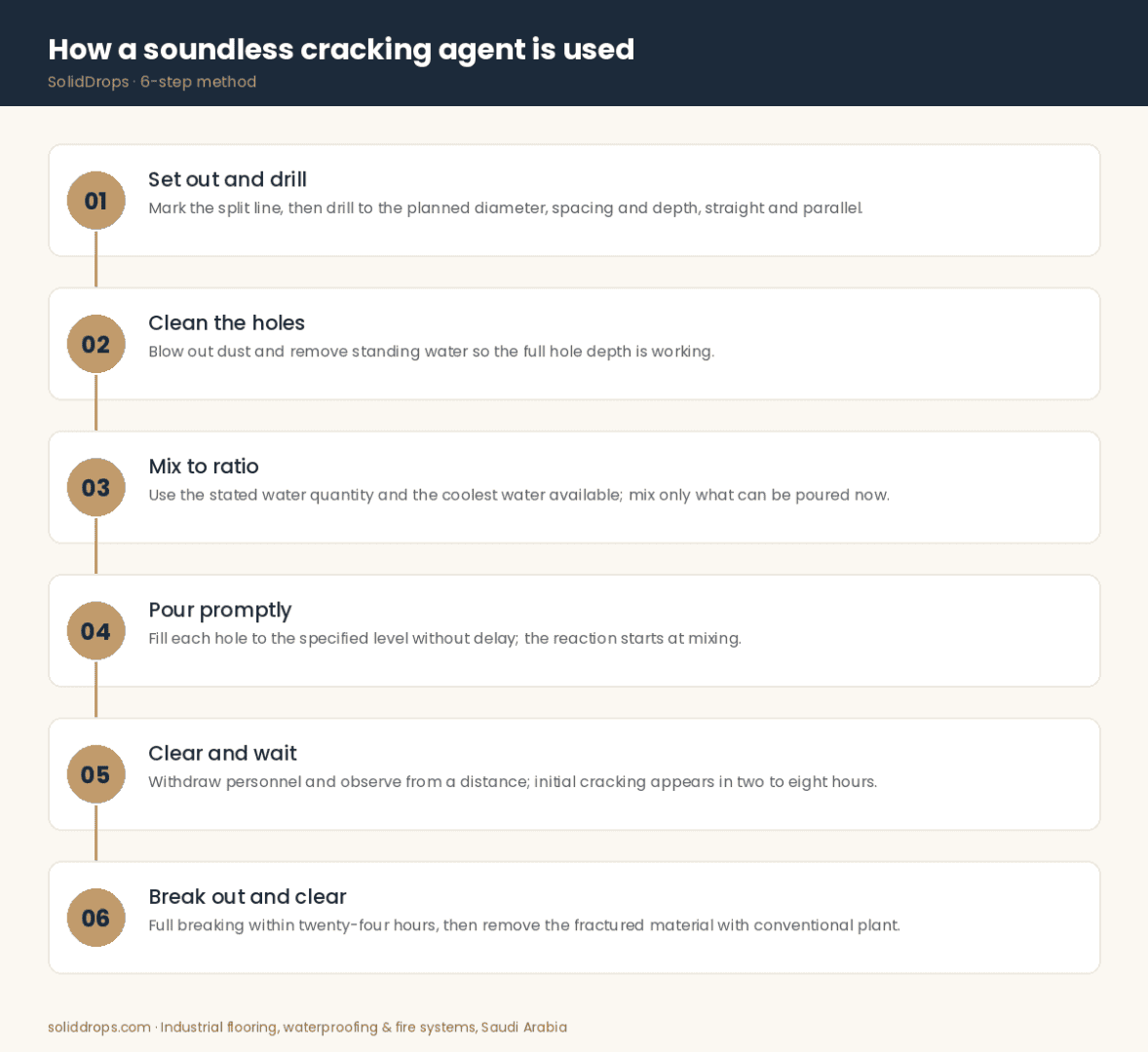
- Set out and drill. Mark the split line, then drill to the planned diameter, spacing and depth, keeping the holes straight and parallel.
- Clean the holes. Blow out dust and remove standing water. Debris at the base of a hole reduces the effective depth and wastes product.
- Mix to the stated ratio. Use the water quantity and mixing time given by the manufacturer, and the coolest water available on a hot day. Mix only what can be poured immediately.
- Pour promptly. Fill each hole to the specified level without delay; the slurry begins reacting from the moment it is mixed.
- Withdraw and wait. Clear personnel from the immediate area, keep the face under observation from a distance and allow the reaction to develop.
- Break out and clear. Initial cracking appears within 2 to 8 hours and full breaking within 24 hours; the fractured material is then removed with conventional plant.
Never look directly into a charged hole, and never stand over one. Keep eye protection on from the moment mixing starts until the material is broken out.
What are the safety and blow-out risks?
Soundless does not mean risk-free. Two hazards define safe practice with these products, and both are well recognised across the industry.
Blow-out. If the reaction accelerates faster than the surrounding material can crack — most often because the temperature grade was wrong for the conditions, the hole diameter was too large, or the mix was too warm — pressure can eject slurry violently from the hole. This is why nobody looks into a charged hole and why the working area is cleared once the holes are filled. Correct grade selection for the actual material temperature is the primary control, not a detail.
Alkalinity. The mixed slurry is caustic. Skin and eye contact must be avoided, which means eye protection, gloves and covered skin throughout mixing, pouring and clean-up. Have clean water available for irrigation before you start, not after an incident.
Beyond those two, ordinary site discipline applies: hold the safety data sheet, brief the crew before the first hole is filled, keep unmixed product dry and shaded, and control the area overnight so nobody wanders past a charged face. Any claim about regulatory classification or approvals should come from the authority or the manufacturer in writing.
What this means for projects in Saudi Arabia
Three local realities shape how this method is planned in the Kingdom.
Heat governs grade, and heat is not what the forecast says. A rock face in Riyadh or a concrete raft in Jubail sits well above shaded air temperature after a day of sun and releases that heat slowly. Grade selection should follow the measured surface temperature of the material. Take the reading; do not infer it.
Constrained urban and industrial sites are the natural market. Excavation next to occupied buildings, work inside operating plants, and anything close to live services is where the absence of vibration and fly rock has real commercial value — a permit avoided and a neighbour not disturbed are both worth money. المواد الكيميائية للبناء of this type are specified for the constraint, not for the cost per cubic metre.
Programme around the wait, not against it. The 2-to-8-hour and 24-hour figures fit an overnight cycle well: drill and charge on the afternoon shift, break out and clear the following morning. Sites that try to compress this into a single shift are the ones that end up disappointed with the method.
Where the work involves damaged or deteriorated concrete rather than bulk removal, our guide to concrete floor problems in Saudi Arabia covers repair options instead.
Who supplies soundless cracking agent in Saudi Arabia?
SolidDrops supplies CRACKEN HSCA soundless cracking agent for enquiries across Saudi Arabia, including Jeddah, Riyadh, Dammam, Jubail, Makkah, Medina and Tabuk. This is enquiry and supply support rather than a branch and crew in every city, and we would rather state that plainly than let a client plan around an assumption.
A useful enquiry contains the material to be broken and its approximate strength, the volume and geometry, the expected material temperature at the time of work, the constraints that ruled out blasting or breaking, and the available working window. With that, grade selection and an indicative pattern can be discussed sensibly. Pricing per hole or per unit is confirmed against the specific enquiry rather than published.
Contact [email protected] or +966 50 213 1112, or use the contact page. If the same project also involves flooring or waterproofing reinstatement after breaking out, our cement self-levelling guide and waterproofing systems guide cover the follow-on trades.
Frequently asked questions
How does a soundless cracking agent work?
A reactive mineral powder is mixed with water and poured into drilled holes. As it hydrates it expands against the hole walls, generating expansive pressure that exceeds the tensile strength of rock or concrete and splits the material. Published pressures range from 40 to 100 MPa depending on the temperature grade used.
How long does it take to crack rock?
Initial cracking is typically seen between 2 and 8 hours after filling, with full breaking within 24 hours. Both figures are temperature dependent, which is why grade selection matters. In practice the method fits an overnight cycle: drill and charge on one shift, break out and clear on the next.
What hole diameter and spacing are needed?
Typical published guidance is a hole diameter of 32 to 42 mm with spacing of roughly 30 to 50 cm, varying with the material, and depth of about 1.05 times the thickness adjusted to bench height. Treat these as starting points and tighten spacing where the material is tough or no free face exists.
Is a soundless cracking agent safe?
It is silent and vibration-free, but it is not hazard-free. The mixed slurry is caustic, so eye protection, gloves and covered skin are required. Blow-out can eject slurry from a hole if the grade is wrong for the temperature or the hole is oversized, so nobody looks into or stands over a charged hole.
Which grade should be used in Saudi summer heat?
Grade follows the temperature of the material, and in most of the Saudi working year that points to the high-temperature grade rated for 25 to 40°C, with a published expansion pressure of 60 to 100 MPa. Measure the surface temperature of the rock or concrete rather than relying on the shaded air reading.
Can it be used on reinforced concrete?
Expansive agents crack concrete but do not cut steel, so reinforcement still has to be dealt with mechanically after the concrete has fractured. The reinforcement layout also affects hole pattern and spacing. Assess the element and its reinforcement before setting out, and expect a follow-on cutting operation.
Is it classified as an explosive in Saudi Arabia?
Available technical guidance describes soundless cracking agents as requiring no special permits for the agent itself, in contrast to explosives. The regulatory and import classification specific to Saudi Arabia, including any SASO requirement, is not published in the sources used for this guide and should be confirmed with the relevant authority before procurement.
Where can I buy a soundless cracking agent in Saudi Arabia?
SolidDrops supplies CRACKEN HSCA for enquiries across Jeddah, Riyadh, Dammam, Jubail, Makkah, Medina and Tabuk. Send the material type and volume, the geometry, the expected material temperature and the working window to [email protected] or call +966 50 213 1112 for grade selection and a quotation.
CRACKEN HSCA enquiries across Saudi Arabia
Supply support for quarrying, excavation and controlled concrete removal, with grade selection matched to site temperature.
 Chat Online