
10 Sep Stonkleen Floor Cleaner: The Guide to Cleaning Resin Floors
Stonkleen Floor Cleaner: The Guide to Cleaning Resin Floors
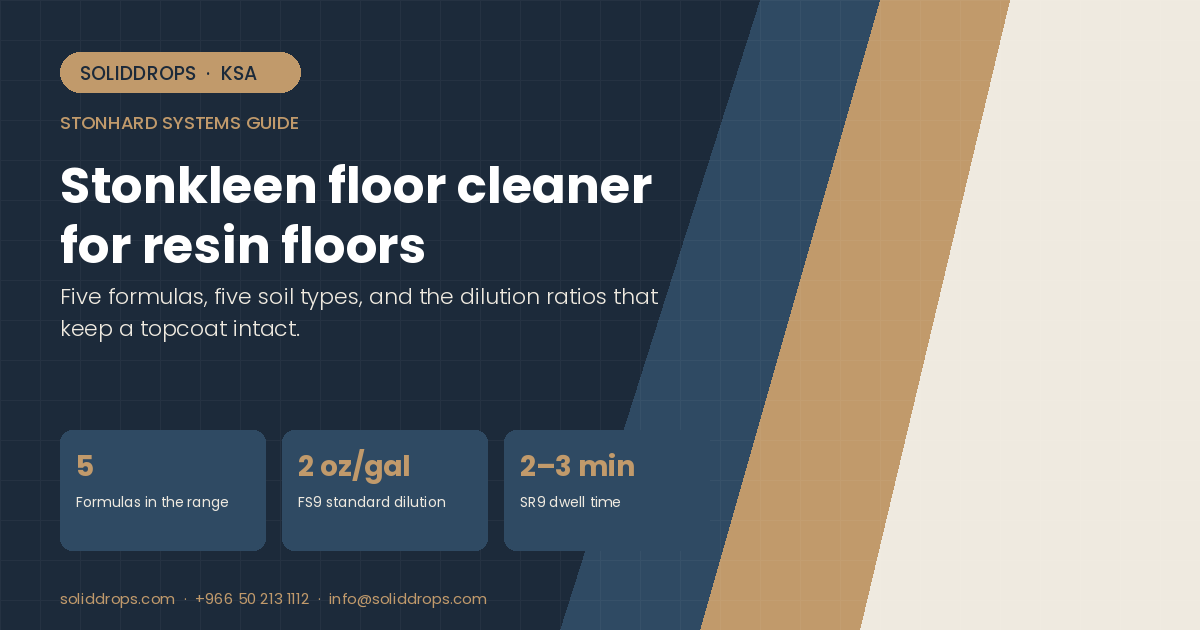
Stonkleen floor cleaner is Stonhard’s range of five formulas — TD9, FS9, AS9, SR9 and MD9 — made to clean epoxy, urethane and MMA resin floors without attacking the finish. Each targets a different soil: buildup, food grease, old finish, spot stains and hard-water scale. SolidDrops supplies the range across Saudi Arabia.
| Property | Value | Basis / standard |
|---|---|---|
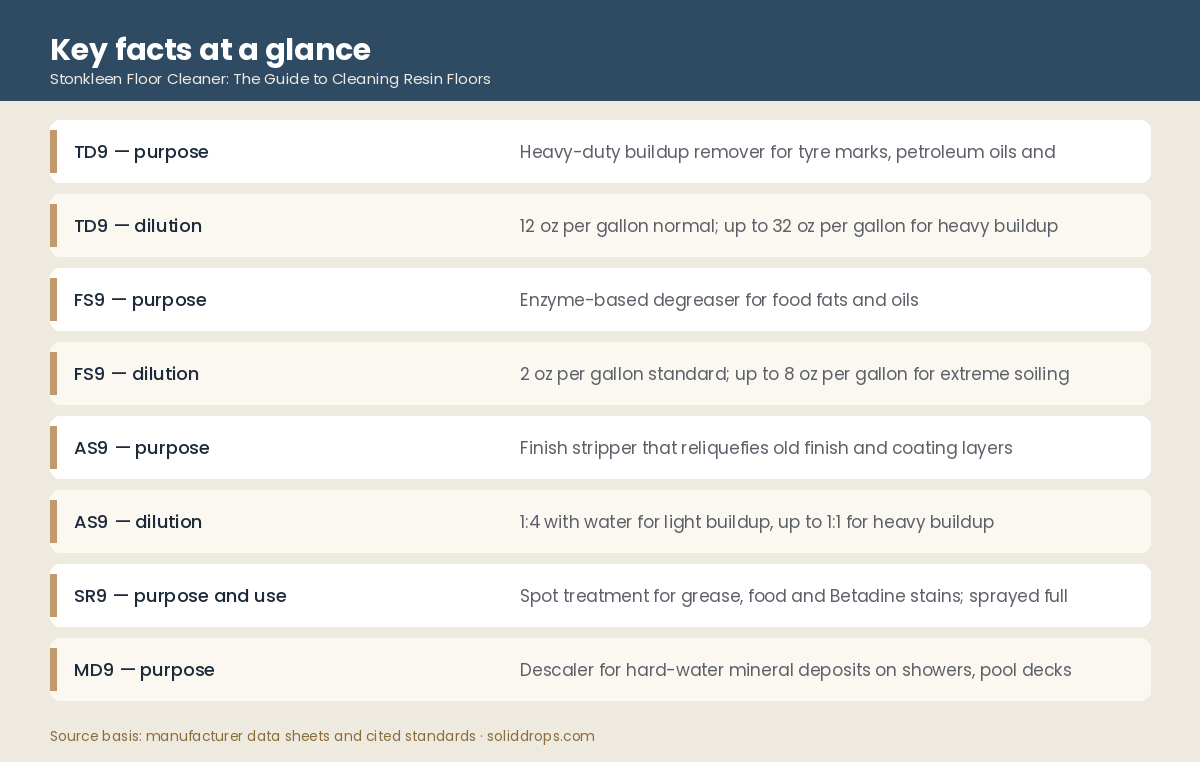
| TD9 — purpose | Heavy-duty buildup remover for tyre marks, petroleum oils and metal oxides | SolidDrops Stonkleen product page |
| TD9 — dilution | 12 oz per gallon normal; up to 32 oz per gallon for heavy buildup | SolidDrops Stonkleen product page |
| FS9 — purpose | Enzyme-based degreaser for food fats and oils | SolidDrops Stonkleen product page |
| FS9 — dilution | 2 oz per gallon standard; up to 8 oz per gallon for extreme soiling | SolidDrops Stonkleen product page |
| AS9 — purpose | Finish stripper that reliquefies old finish and coating layers | SolidDrops Stonkleen product page |
| AS9 — dilution | 1:4 with water for light buildup, up to 1:1 for heavy buildup | SolidDrops Stonkleen product page |
| SR9 — purpose and use | Spot treatment for grease, food and Betadine stains; sprayed full strength, 2–3 minute dwell | SolidDrops Stonkleen product page |
| MD9 — purpose | Descaler for hard-water mineral deposits on showers, pool decks and water-processing floors | SolidDrops Stonkleen product page |
| MD9 — dilution | 2 oz per gallon standard; 4 oz per gallon for heavy deposits | SolidDrops Stonkleen product page |
| Application method (TD9, FS9, MD9) | Mop or autoscrubber, then rinse | SolidDrops Stonkleen product page |
What is Stonkleen floor cleaner?
Stonkleen floor cleaner is Stonhard’s range of five cleaning formulas developed to maintain resinous floors — epoxy, urethane and MMA — without degrading the topcoat that gives those floors their chemical and abrasion resistance. Stonhard has been in flooring and floor maintenance since 1922, and the range reflects a manufacturer’s view of what its own floors need rather than a general-purpose janitorial line.
The five formulas are not variations of one product. Each is aimed at a different soil type, and using the wrong one is the most common reason a maintenance programme underperforms:
- TD9 — heavy-duty buildup remover for tyre marks, petroleum oils and metal oxides.
- FS9 — enzyme-based degreaser for food fats and oils.
- AS9 — finish stripper that reliquefies old finish and coating layers.
- SR9 — spot treatment for grease, food and Betadine stains, used at full strength.
- MD9 — descaler for hard-water mineral deposits.
SolidDrops is an authorised Stonhard distributor in Saudi Arabia and supplies the Stonkleen range for industrial, food-processing and healthcare floors across the Kingdom. Full details of the range sit on our Stonkleen floor cleaning liquids page.
Why does resin flooring need a matched cleaner?
A resin floor is not an inert surface. It is an organic polymer with a finish layer a fraction of a millimetre thick, and everything poured onto it is a chemical decision. Facilities frequently buy on price per drum, then wonder why a floor rated for years of service looks tired inside eighteen months.
Three mechanisms account for most of the damage we see on inspection. Acid attack from strong descalers used off-label will etch and dull a topcoat, and the loss is permanent — you cannot polish gloss back into a chemically damaged resin. Residue films from cleaners that are never rinsed leave a slick, dirt-attracting layer that also compromises slip resistance; a floor that has become slippery when wet has often been over-cleaned, not under-cleaned. Mechanical abrasion from the wrong pad grade on an autoscrubber removes finish faster than traffic does.
There is a commercial dimension as well. Manufacturers’ maintenance guidance exists partly to define what a floor was cared for correctly, and a documented cleaning regime with named products is a far stronger position in any service discussion than a store cupboard of unlabelled containers. Keep the dosing records; they cost nothing and they settle arguments.
For frequency and method by area type, read this alongside our epoxy floor maintenance and cleaning schedule for Saudi Arabia.
Which Stonkleen formula do you need?
Start with the soil, not the room. The same production hall can need two different formulas in two different aisles, and matching them properly is what turns a cleaning budget into a maintained floor.
Black rubber streaks in a warehouse aisle
TD9. Tyre marks, petroleum oils and metal oxides are its stated target, at 12 oz per gallon for normal work.
Greasy film in a cook room or canteen
FS9. The enzyme-based formula addresses food fats and oils at 2 oz per gallon, rising to 8 oz per gallon for extreme soiling.
Layers of old finish nobody can identify
AS9. It reliquefies the existing finish so it can be removed rather than scrubbed off, diluted from 1:4 up to 1:1.
An isolated stain in a clinical area
SR9. Sprayed at full strength for grease, food and Betadine stains, with a 2–3 minute dwell before removal.
White scale around drains and showers
MD9. A descaler for hard-water mineral deposits at 2 oz per gallon, or 4 oz per gallon where deposits are heavy.
Two habits separate good housekeeping teams from poor ones. They test in a small area before committing to a whole hall, and they keep the diluted product in a labelled bottle with the ratio written on it. Nothing wastes chemical faster than a supervisor guessing at the mix.
Stonkleen vs generic degreaser vs acid cleaner
Most sites are choosing between three options: a manufacturer-matched range, a general industrial degreaser bought on price, and an acid-based cleaner used for scale and stubborn marks. The comparison below is about behaviour on a resin floor, not about cost per litre.
| Criterion | Stonkleen range | Generic industrial degreaser | Acid-based cleaner |
|---|---|---|---|
| Designed for | Epoxy, urethane and MMA resin floors | General hard surfaces | Scale, cement haze, mineral deposits |
| Soil targeting | Five formulas, one per soil type | One formula for mixed soils | Mineral deposits only |
| Dosing guidance | Published per formula, e.g. FS9 at 2 oz per gallon | Often broad or absent | Frequently used undiluted on site |
| Risk to topcoat | Formulated for resin finishes | Variable; alkalinity often unstated | Etching and permanent gloss loss |
| Scale removal | MD9 is the dedicated descaler | Generally ineffective | Effective but aggressive |
| Stripping old finish | AS9 reliquefies rather than abrades | Not intended for stripping | Not intended for stripping |
| Documentation value | Named products and ratios, easy to record | Weak evidence of correct care | Frequently a cause of disputes |
The honest conclusion is that acid cleaners have a legitimate role on masonry and tile and almost none on a resin topcoat. If a site is reaching for acid to clear scale from a resin floor, MD9 exists precisely to remove that need.
How are Stonkleen products applied?
Method matters as much as chemistry. The sequence below reflects the published application guidance for the dilutable formulas and standard resin-floor housekeeping practice.
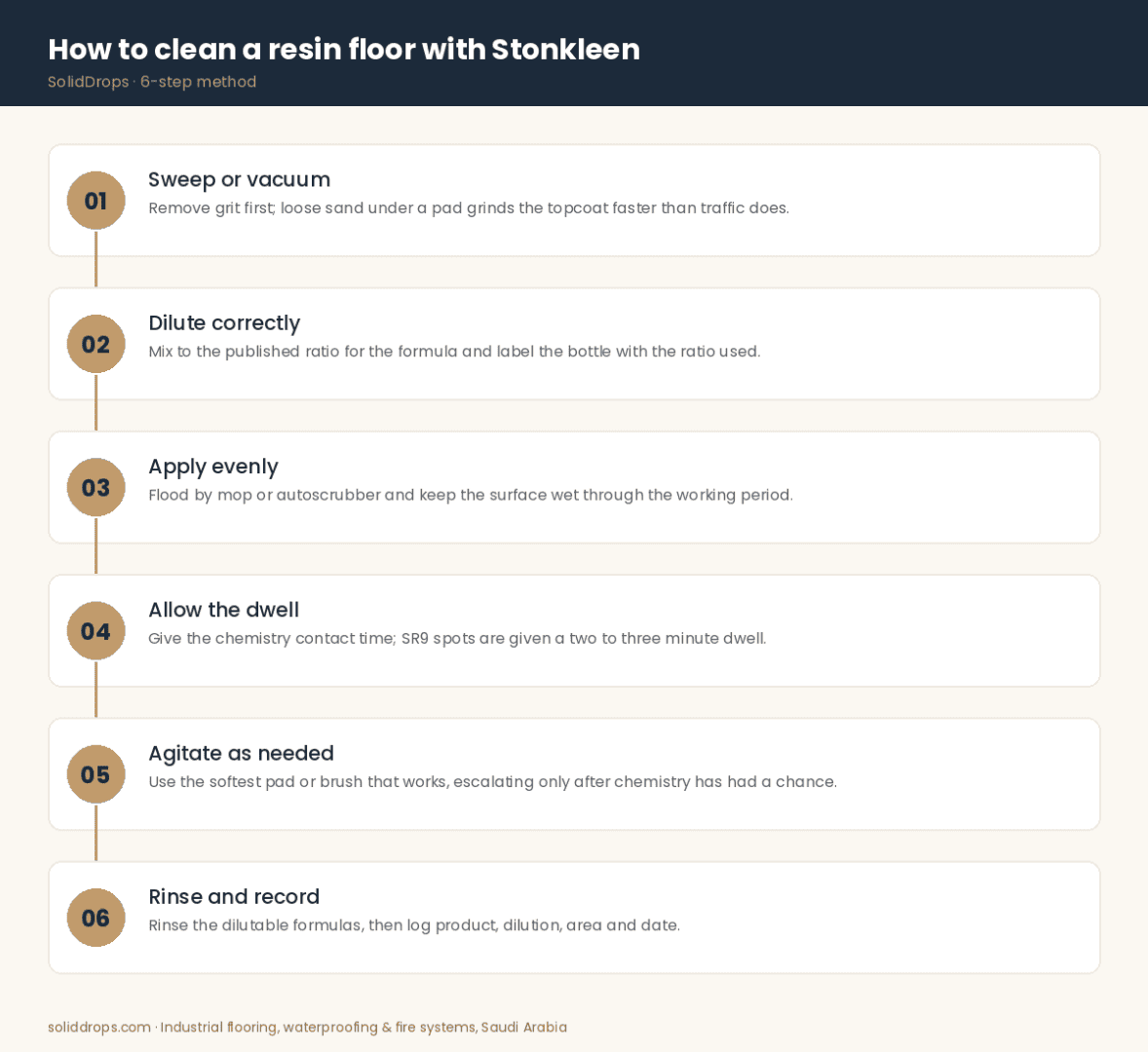
- Sweep or vacuum first. Grit left on the floor turns an autoscrubber into a grinding machine. This step is skipped more often than any other.
- Dilute to the stated ratio. TD9 at 12 oz per gallon for normal buildup, FS9 at 2 oz per gallon, MD9 at 2 oz per gallon — increase only where soiling justifies it, and never guess.
- Apply by mop or autoscrubber. Flood evenly and keep the surface wet through the working period rather than letting it dry back into a film.
- Allow the dwell. Chemistry needs contact time. SR9, used at full strength on spots, is given a 2–3 minute dwell before removal.
- Agitate where needed. Use the softest pad or brush that does the job; escalate only after the chemistry has been given a fair chance.
- Rinse and remove. TD9, FS9 and MD9 are followed by a rinse. Residue left behind is a slip and soiling problem, not a saving.
Two site notes for the Kingdom. First, in summer a floor surface can be warm enough to dry a cleaning solution before it has worked — clean smaller sections at a time. Second, hard water in much of Saudi Arabia leaves its own deposits on rinsing, which is exactly why a descaler belongs in the store cupboard rather than only in the shower rooms.
Not sure which formula your floor needs?
Send photographs of the soiling and the floor type and the SolidDrops technical team will match the formula and the dilution.
How often should a resin floor be cleaned?
Frequency follows soil load and hygiene risk, not the calendar. A defensible programme normally has three tiers, and the products above map onto them cleanly.
- Daily. Sweep or vacuum, then wet clean traffic lanes and process areas with the dilutable formula matched to the dominant soil — FS9 in food areas, TD9 where wheeled traffic dominates.
- As they occur. Spot treatment of localised stains, which is where SR9 is used at full strength rather than diluting a whole tank for one mark.
- Periodic. Descaling with MD9 where hard water leaves deposits, and stripping with AS9 where an applied finish has reached the end of its life.
Set the frequency by area rather than by building. A chilled despatch bay and an adjacent dry store rarely justify the same routine, and writing one schedule for both usually means the dirty area is under-served while the clean one is over-cleaned. Record what was used, at what dilution, on which date — the log takes a housekeeping supervisor a minute and it is the only evidence that exists later.
Sports and gym surfaces follow a different logic again; our guide to sports flooring maintenance for schools and clubs covers that case.
What drives the cost of a floor cleaning programme?
Pack sizes and prices for Stonkleen in Saudi Arabia require individual confirmation, so no rate is published here. What can be said is which variables move the annual figure.
- Dilution discipline. The gap between 2 oz and 8 oz per gallon is a fourfold difference in consumption. Trained dosing is the largest controllable cost on this line.
- Soil load and shift pattern. A three-shift food plant consumes on a different scale from a single-shift warehouse.
- Floor area and equipment. Autoscrubber coverage per hour changes labour cost far more than chemical cost.
- Formula mix. A site with hard-water scale and heavy grease needs two or three formulas in stock, not one.
- Delivery and stock-holding. Consolidated orders across multiple sites reduce handling.
For availability, pack sizes and a quotation for your site, contact [email protected] or +966 50 213 1112 with your floor area, floor type and a description of the soiling.
What this means for projects in Saudi Arabia
Three local conditions shape a maintenance programme here and rarely appear in guidance written for cooler markets.
Hard water. Mineral content in much of the Kingdom means that scale returns on wash-down floors, shower blocks and pool surrounds even where cleaning is diligent. This is an ordinary maintenance item, not a defect, and it is the reason a dedicated descaler such as MD9 belongs on the standing order rather than being bought in a panic.
Heat and evaporation. On a warm slab in Riyadh or Jubail, a cleaning solution can dry before its dwell time is complete, leaving residue and doing little cleaning. Work in smaller sections, keep the surface wet, and schedule heavy cleaning outside the hottest part of the day where operations allow.
Dust and sand. Fine airborne sand is the most underestimated abrasive on any Saudi floor. It arrives at every door, and once it is under a pad it grinds the topcoat. Entrance matting, disciplined sweeping and frequent pad changes protect a resin floor more than any chemical does. تنظيف الأرضيات is a housekeeping task on paper and an asset-protection task in practice.
Where a floor has already lost its finish, cleaning will not restore it; see our guide to concrete floor problems in Saudi Arabia and their repairs.
Who supplies Stonkleen in Saudi Arabia?
SolidDrops is an authorised Stonhard distributor in Saudi Arabia and supplies the Stonkleen range for enquiries across Jeddah, Riyadh, Dammam, Jubail, Makkah, Medina and Tabuk. Availability and pricing are confirmed individually rather than published, because pack sizes and lead times vary by formula.
Practical support usually matters more than the drum itself. We will review the floor type and the soiling before recommending formulas, set the dilution ratios your team will actually work to, and put them on a written schedule tied to the areas rather than to the building. Where the floor is a Stonhard system we have installed, that schedule sits alongside the installation record.
If you are also specifying a new floor, the maintenance regime should be agreed before handover rather than after the first complaint. Our Stonclad UT urethane mortar flooring guide and the food-grade epoxy flooring materials page cover the systems most often paired with this range. Contact [email protected] or +966 50 213 1112.
Frequently asked questions
What is Stonkleen used for?
Stonkleen is used to clean and maintain resinous floors — epoxy, urethane and MMA — without damaging the finish. The range covers five soil types: heavy buildup and tyre marks with TD9, food grease with FS9, old finish removal with AS9, spot stains with SR9, and hard-water scale with MD9.
What removes tyre marks from an epoxy floor?
TD9 is the formula intended for that soil. It is described as a heavy-duty buildup remover for tyre marks, petroleum oils and metal oxides, used at 12 oz per gallon for normal work and up to 32 oz per gallon where buildup is heavy, applied by mop or autoscrubber and then rinsed.
Can you use acid or bleach on a resin floor?
Acid cleaners risk etching and permanent gloss loss on a resin topcoat, and general-purpose products with unstated chemistry are a gamble. Use products formulated for resinous floors and follow the published dilution. For hard-water scale, MD9 is the dedicated descaler and removes the reason sites reach for acid.
What is the best degreaser for a food factory floor?
FS9 is the range’s enzyme-based degreaser for food fats and oils, intended for food-processing, food-service and restroom floors. The standard dilution is 2 oz per gallon, increasing to as much as 8 oz per gallon under extreme soiling, applied by mop or autoscrubber and then rinsed.
How do you strip an old floor finish?
AS9 is the finish stripper in the range. It reliquefies old finish and coating layers so they can be removed rather than scrubbed away, diluted at 1:4 with water for light buildup and up to 1:1 where buildup is heavy. Test a small area first and confirm the substrate is a suitable candidate.
How often should an epoxy floor be cleaned in Saudi Arabia?
Set frequency by area and soil load rather than by building. Most sites run daily sweeping plus wet cleaning of traffic and process areas, spot treatment as stains occur, and periodic descaling or stripping. Airborne sand and hard water usually push Saudi sites toward more frequent sweeping than equivalent plants elsewhere.
Does Stonkleen work on floors from other manufacturers?
The range is formulated for resinous floors generally — epoxy, urethane and MMA. Compatibility with a specific third-party system is still worth confirming before a full application, and the standard precaution applies either way: test a small, inconspicuous area at the intended dilution before treating a whole hall.
Who supplies Stonkleen in Saudi Arabia and what does it cost?
SolidDrops is an authorised Stonhard distributor in Saudi Arabia and supplies the range across Jeddah, Riyadh, Dammam, Jubail, Makkah, Medina and Tabuk. Pack sizes and pricing are confirmed individually rather than published. Send your floor area, floor type and a description of the soiling to [email protected] for a quotation.
Stonkleen enquiries across Saudi Arabia
Authorised Stonhard distributor. Formula selection, dilution guidance and a written cleaning schedule for your areas.
 Chat Online