
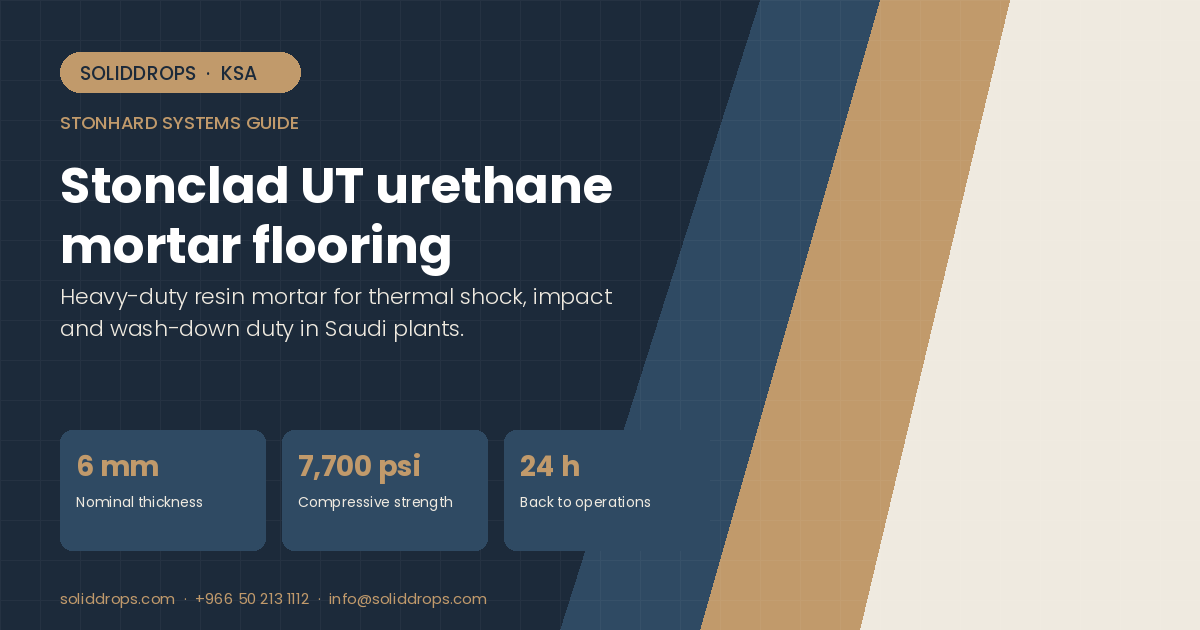
10 Sep Stonclad UT Flooring: Urethane Mortar Guide for Saudi Arabia
Stonclad UT Flooring: Urethane Mortar Guide for Saudi Arabia
Stonclad UT flooring is Stonhard’s troweled urethane-urea mortar system, installed at a nominal 6 mm (1/4 in.) and built for thermal shock, thermal cycling, impact and heavy wheeled traffic. SolidDrops is an authorised Stonhard distributor in Saudi Arabia and supplies and installs the system nationwide.
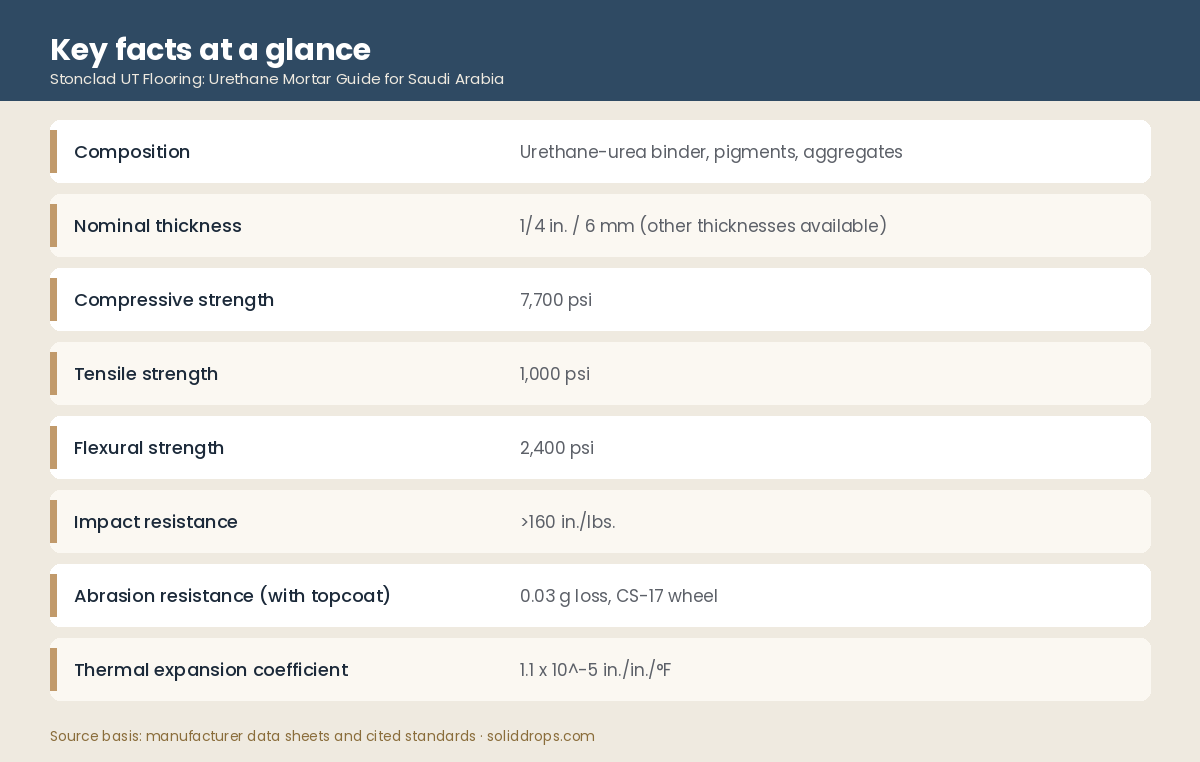
| Property | Value | Basis / standard |
|---|---|---|
| Composition | Urethane-urea binder, pigments, aggregates | Stonhard product page |
| Nominal thickness | 1/4 in. / 6 mm (other thicknesses available) | Stonhard product page |
| Compressive strength | 7,700 psi | ASTM C-579, 7-day (Stonhard PDS) |
| Tensile strength | 1,000 psi | ASTM C-307 (Stonhard PDS) |
| Flexural strength | 2,400 psi | ASTM C-580 (Stonhard PDS) |
| Impact resistance | >160 in./lbs. | ASTM D-2794 (Stonhard PDS) |
| Abrasion resistance (with topcoat) | 0.03 g loss, CS-17 wheel | ASTM D-4060 (Stonhard PDS) |
| Thermal expansion coefficient | 1.1 x 10^-5 in./in./°F | ASTM C-531 (Stonhard PDS) |
| Water absorption | Less than 1% | ASTM C-413 (Stonhard PDS) |
| Return to service | Foot traffic 6 hours at 77°F/25°C; normal operations 24 hours | Stonhard PDS |
What is Stonclad UT flooring?
Stonclad UT flooring is a troweled urethane mortar — more precisely a urethane-urea system — from Stonhard, placed at a nominal 1/4 in. (6 mm) and finished with a broadcast texture and topcoat. It sits in the heavy-duty end of the resin flooring family: not a coating measured in microns, but a screed thick enough to be a wearing surface in its own right. The Stonhard product data sheet describes the composition simply as a urethane-urea binder with pigments and aggregates.
The distinction matters on site. A 300-micron epoxy coating takes its strength from the concrete underneath and fails when that concrete spalls. A 6 mm urethane mortar carries impact, absorbs thermal movement and keeps working when the slab beneath it is imperfect. That is why specifiers reach for it in wash-down bays, cook rooms, loading docks and production aisles rather than in offices or showrooms.
Two properties define the system’s behaviour. First, the coefficient of thermal expansion is 1.1 x 10^-5 in./in./°F (ASTM C-531), close enough to concrete that steam cleaning and cold spillage do not shear the bond. Second, water absorption is under 1% (ASTM C-413), so the floor does not hold moisture, sugars or fats in its body.
SolidDrops is an authorised Stonhard distributor in Saudi Arabia and supplies and installs the Stonclad range as part of the wider Stonhard product range in the Kingdom.
Where is Stonclad UT used in Saudi plants?
The system earns its place wherever the floor is attacked by temperature, not only by wear. Stonhard positions Stonclad as a heavy-duty resin mortar for warehouses, logistics centres, factories and production lines, and SolidDrops supports that range across Jeddah, Riyadh, Dammam, Jubail, Makkah, Madinah and Tabuk.
Food and beverage production
Cook rooms, filling halls and wash-down aisles where hot water, caustic cleaning and dropped equipment all land on the same square metre.
Cold and chilled areas
Docks and anterooms that swing between an air-conditioned chill and a 45°C loading yard several times a shift.
Logistics and warehousing
Turning circles, dock levellers and pallet-drop zones where point impact, not abrasion, is what destroys the floor.
Process and utility rooms
Boiler rooms, CIP skids and plant rooms with steam, condensate and periodic chemical release.
A useful screening question on any walk-through: does anything hot or cold touch this floor directly? If a hose runs at 80°C, if a chiller drips, if a mould is dropped straight from an oven, the thin-film options come off the list quickly. Where the exposure is purely mechanical and ambient, an epoxy mortar may still be the correct and more economical answer — that comparison is set out below.
For a broader view of how systems are chosen by process area, see our guide to food processing plant flooring in Saudi Arabia.
What does the Stonclad UT system build-up look like?
The finished floor is a layered assembly, and each layer answers a specific failure mode. Read from the concrete upwards.
- Prepared substrate. Sound, dry concrete opened by mechanical means to a defined profile — never acid etching, never a quick sweep.
- Termination detail. A keyed anchor cut at every perimeter, drain, doorway and construction joint, so the mortar is locked in rather than feathered out.
- Urethane mortar body. Mechanically mixed and notch-trowel applied at a nominal 6 mm; the Stonhard PDS gives coverage of roughly 190 sq ft (17.6 sq m) per unit at that thickness.
- Broadcast texture. Aggregate cast into the wet mortar and set to the slip profile the area actually needs, from a light tread to an aggressive wash-down finish.
- Topcoat. Seals the texture and delivers the abrasion figure of 0.03 g loss under ASTM D-4060 with a CS-17 wheel.
- Coved skirting where required. Coving turns a floor into a cleanable box and removes the dirt trap at the wall junction.
Thickness is a specification decision, not a default. The 6 mm figure is nominal, and Stonhard notes that other thicknesses are available; heavier thermal shock and steam cleaning normally argue for more, not less. Confirm the intended thickness against the current product data sheet for the specific project before it reaches BOQ stage.
Stonclad UT vs epoxy mortar vs Ucrete: which system fits?
These three sit in the same price bracket conversation and behave very differently in service. The table below compares them on the criteria that decide most tenders. Figures for Stonclad UT are from the Stonhard product data sheet; the other two columns describe generic system behaviour rather than any single manufacturer’s numbers.
| Criterion | Stonclad UT (urethane mortar) | Epoxy mortar | Polyurethane concrete (Ucrete-type) |
|---|---|---|---|
| Binder chemistry | Urethane-urea with pigments and aggregates | Epoxy resin with graded aggregate | Polyurethane with cementitious filler |
| Typical placed thickness | Nominal 6 mm (1/4 in.) | Commonly 4–9 mm | Commonly 6–9 mm |
| Thermal shock and steam | Designed for thermal shock and cycling | Limited; bond stress at hot wash-down | Designed for steam cleaning and shock |
| Impact resistance | Greater than 160 in./lbs. (ASTM D-2794) | Good, but more brittle failure mode | Good; heavy-duty grades available |
| Compressive strength | 7,700 psi (ASTM C-579, 7-day) | Manufacturer-specific | Manufacturer-specific |
| Return to operations | Foot traffic 6 h at 25°C; full service 24 h | Typically longer at ambient | Manufacturer-specific |
| Appearance | Pigmented, uniform, texture set by broadcast | Wide decorative range | Utilitarian, limited palette |
| Where it wins | Hot and cold cycling with heavy traffic | Dry, ambient, abrasion-led areas | Aggressive wet process and thermal duty |
Read that table alongside our Ucrete polyurethane concrete flooring guide, which covers the cementitious-urethane family in detail, and our overview of industrial epoxy and PU flooring in Saudi Arabia.
How is Stonclad UT installed and how long does it take?
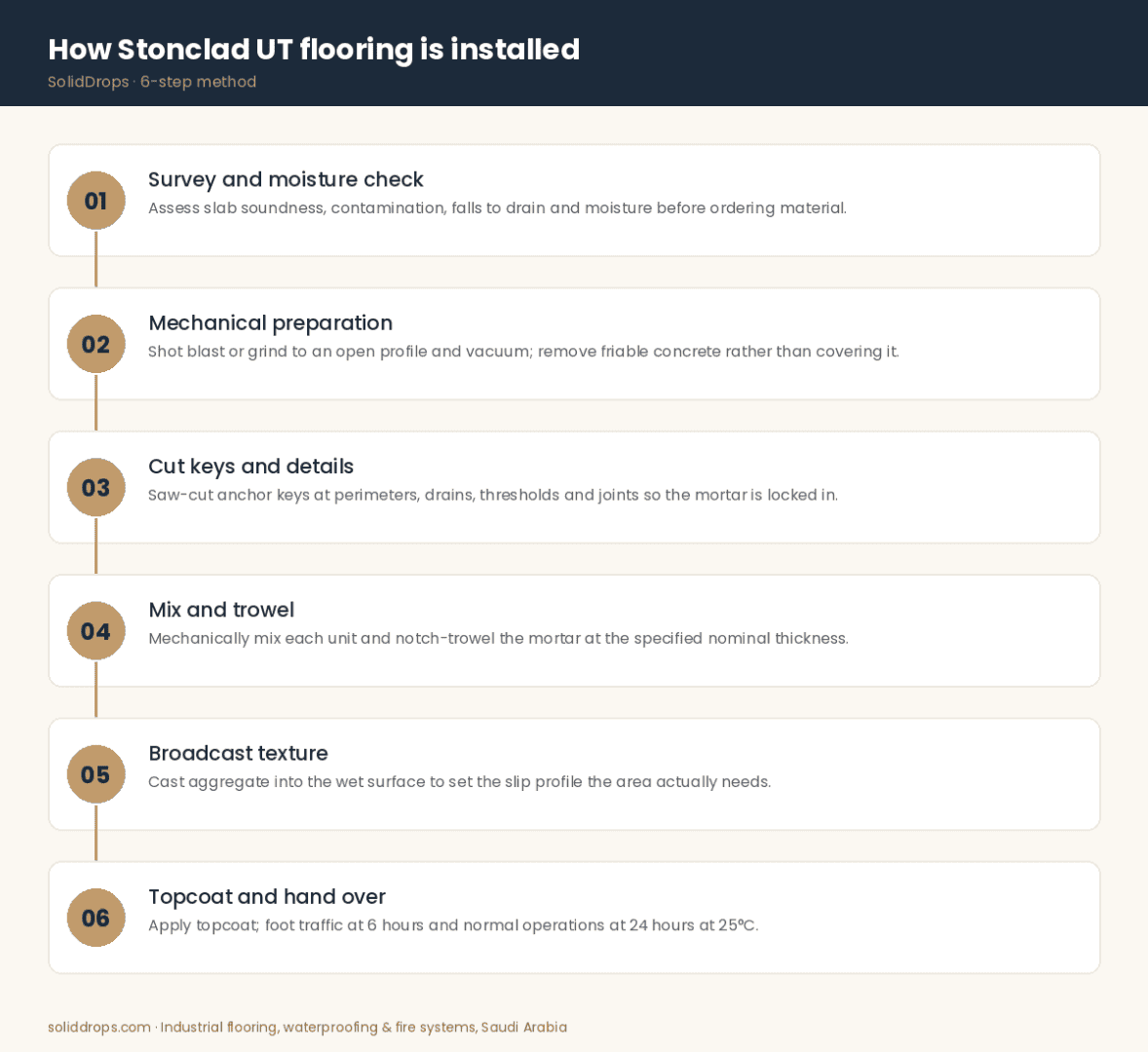
Installation is a trowel trade, and the outcome depends far more on the preparation and the crew than on the product. The sequence below is the working method; the durations come from the Stonhard product data sheet.
- Survey and moisture check. Assess the slab for soundness, contamination, falls to drain and moisture condition before any material is ordered.
- Mechanical preparation. Shot blast or grind to a sound, open profile and vacuum continuously. Contaminated or friable concrete is removed, not covered.
- Cut keys and details. Saw-cut anchor keys at perimeters, drains, thresholds and joints; treat moving joints through the mortar rather than across it.
- Mix and place. Mechanically mix each unit fully and notch-trowel the mortar at the specified thickness, working to a wet edge in disciplined bays.
- Broadcast and finish. Cast aggregate into the wet surface to set the slip profile, then remove loose material once cured.
- Topcoat and return to service. Apply the topcoat, then release the area to foot traffic after 6 hours at 25°C and to normal operations after 24 hours.
The 6-hour and 24-hour figures are quoted at 77°F/25°C. Site temperature moves them in both directions, and in Saudi conditions the slab is often warmer than the air — the practical consequence is a shorter working window for the trowel crew, not a shorter shutdown for the client. Plan the programme around the 24-hour figure and treat anything faster as a bonus.
Specifying a floor for thermal shock duty?
Send drawings and process temperatures and the SolidDrops technical team will review the duty before you commit to a system.
What drives the cost of a Stonclad UT floor?
SolidDrops does not publish rates for Stonclad UT, and any figure quoted without a site inspection should be treated with suspicion. The variables below are what actually move a number on this system.
- Substrate condition. Repairs, re-falls to drain and removal of an existing failed coating are frequently the largest single line, and they are invisible until the first pass of the shot blaster.
- Specified thickness. The 6 mm nominal is a starting point; heavier thermal or impact duty raises material quantity directly.
- Detailing density. Coving, drain surrounds, thresholds and joint treatment cost more per linear metre than open field area costs per square metre.
- Area geometry. Long open bays trowel efficiently; a plant room full of plinths and pipe penetrations does not.
- Access and shutdown windows. Night work, phased handover and live-plant hygiene controls all carry labour cost.
- Site conditions. Temperature control, power, lighting and extraction for the preparation phase.
For a project-specific figure, send drawings, area schedules, process temperatures and photographs of the existing floor to [email protected] and request a quotation.
What goes wrong with urethane mortar floors?
Most of the failures we are called to inspect are not product failures. They are decisions taken weeks before the mortar arrived.
Preparation short-cuts. A floor that was swept and primed rather than mechanically opened will debond, and it will do so first at the traffic lanes where the shear is highest. There is no coating that repairs this from above.
Missing termination keys. Feather edges at doorways and drains chip under wheel loads within months. The anchor cut is cheap at installation and expensive to retrofit.
Moisture ignored. A slab on grade without an effective damp-proof membrane will push moisture into any resin system. Test, record the result, and specify accordingly rather than hoping.
Wrong system for the duty. Urethane mortar is a heavy industrial surface. It is not a decorative floor, and specifying it where a coating would do is as much an error as the reverse.
Cleaning regime mismatch. Aggressive acid descalers and unsuitable degreasers can dull a topcoat that would otherwise last for years. Match the chemistry to the floor — our Stonkleen floor cleaner guide sets out how the formulas differ, and the epoxy floor maintenance and cleaning schedule covers frequency.
What this means for projects in Saudi Arabia
Three site realities change how this system should be specified in the Kingdom, and none of them appear on a data sheet written for a temperate market.
Slab temperature, not air temperature. In Riyadh or Jubail during summer, a slab in an unconditioned shed can sit well above the ambient reading. Resin systems react to what they touch. That compresses pot life and working time, so bay sizes shrink, crews get larger, and material is stored conditioned rather than in a container in the yard.
Thermal cycling is a daily event. A chilled production hall opening onto a loading yard produces a temperature swing across a threshold every time a door lifts. This is precisely the duty Stonclad UT is built for, and it is also the reason coving and door-line detailing deserve more attention here than in a mild climate.
Coastal exposure and wash-down chemistry. On the Jeddah and Dammam coasts, salt-laden air and humid nights slow surface cure and raise the risk of blush on topcoats applied late in the evening. Sequencing matters. أرضيات إيبوكسي are often the default request in a tender document, but where hot wash-down and thermal shock are present, a urethane mortar is the more defensible specification.
Where a project also involves freezer or chill rooms, read this alongside our guide to cold room and freezer flooring in Saudi Arabia.
Who supplies and installs Stonclad UT in Saudi Arabia?
SolidDrops is an authorised Stonhard distributor in Saudi Arabia and supplies and installs Stonhard resin flooring systems, including the Stonclad range, for clients in Jeddah, Riyadh, Dammam, Jubail, Makkah, Medina and Tabuk.
A typical engagement runs in four stages: a site visit and substrate assessment; a written system recommendation with the relevant Stonhard product data sheets attached; a priced proposal against a defined scope and programme; then installation by a trained crew with hold points recorded at preparation, mortar placement and topcoat. Where a client’s consultant has already written a specification, we will review it against the manufacturer’s current data and flag any conflict before mobilisation rather than after.
Contact [email protected] or +966 50 213 1112, or use the contact page to arrange a site visit. Bring drawings, process temperatures, cleaning chemistry and photographs of the existing floor to the first conversation and the specification stage moves quickly.
Frequently asked questions
Is Stonclad UT epoxy or polyurethane?
Neither, strictly. Stonhard describes the composition as a urethane-urea binder with pigments and aggregates, which places it in the polyurethane family rather than the epoxy family. That chemistry is what gives it its thermal shock and thermal cycling performance, and it behaves quite differently from an epoxy mortar of the same thickness.
How thick is Stonclad UT?
The nominal thickness is 1/4 in. or 6 mm, and Stonhard notes that other thicknesses are available. Coverage at the nominal thickness is approximately 190 sq ft, or 17.6 sq m, per unit. Heavier thermal or impact duty usually justifies a greater thickness, which should be confirmed against the current product data sheet for the project.
How long before we can use the floor again?
The Stonhard product data sheet gives return to foot traffic at 6 hours and return to normal operations at 24 hours, both at 77°F/25°C. Site temperature shifts those figures, so programme the shutdown around the 24-hour value. Chemical exposure after a fresh installation should follow the manufacturer’s guidance rather than the traffic times.
Can Stonclad UT handle forklift traffic?
It is designed for heavy industrial traffic and impact, with impact resistance greater than 160 in./lbs. under ASTM D-2794 and compressive strength of 7,700 psi under ASTM C-579 at 7 days. Wheel type, point loads and turning circles still need to be stated at design stage, because they influence thickness and detailing more than the headline figures do.
Is Stonclad UT suitable for Saudi heat?
Yes, with the right site controls. The system is built for thermal cycling, but summer slab temperatures shorten working time during installation, so bay sizes, crew size and material conditioning have to be planned. The finished floor is far less sensitive to heat than the installation window is.
How is it cleaned without damaging the topcoat?
Use cleaning chemistry matched to the resin and to the soil type, applied by mop or autoscrubber and rinsed. Aggressive acids and unsuitable strippers dull the topcoat over time. Stonhard’s Stonkleen range covers degreasing, stripping, spot removal and descaling for resinous floors, and SolidDrops supplies it in Saudi Arabia.
Who supplies Stonclad UT in Saudi Arabia?
SolidDrops is an authorised Stonhard distributor in Saudi Arabia and supplies and installs the Stonclad range across Jeddah, Riyadh, Dammam, Jubail, Makkah, Medina and Tabuk. Enquiries go to [email protected] or +966 50 213 1112, and a site visit precedes any system recommendation.
What does Stonclad UT cost per square metre in Saudi Arabia?
Rates are not published because substrate condition, specified thickness, detailing density, access and shutdown windows change the figure substantially. Send drawings, area schedules, process temperatures and photographs of the existing floor and request a quotation against a defined scope.
Talk to an authorised Stonhard distributor in Saudi Arabia
Site visits, substrate assessment and a written system recommendation with the manufacturer's data attached.
 Chat Online