
10 Sep Rubber Flooring in Saudi Arabia: Gyms, Playgrounds and Plant
Rubber Flooring in Saudi Arabia: Gyms, Playgrounds and Plant
Rubber flooring in Saudi Arabia is a resilient surface made from vulcanised or bonded rubber granules, supplied as tiles, rolls or poured in place. It absorbs impact and noise, holds grip when wet, and serves gyms, playgrounds, kitchens, plant rooms and data centres.
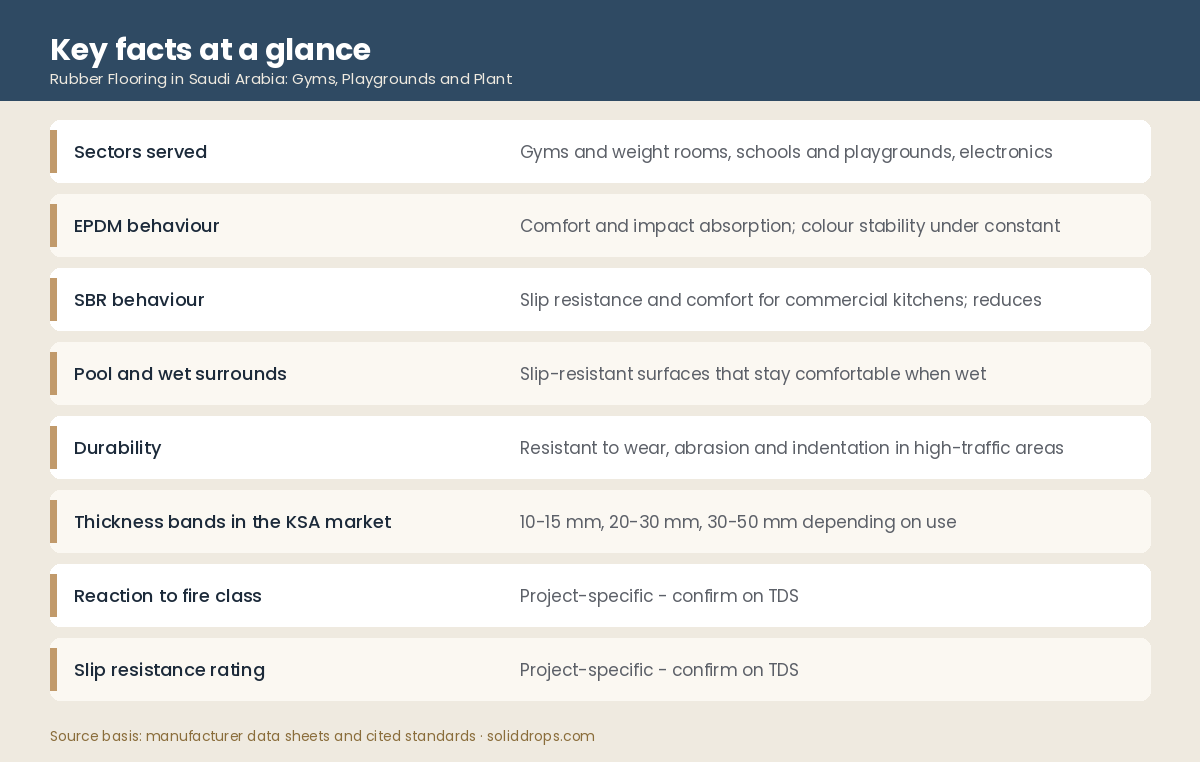
| Property | Value | Basis / standard |
|---|---|---|
| Sectors served | Gyms and weight rooms, schools and playgrounds, electronics and data centres, healthcare and labs, industrial workstations, commercial kitchens, equipment rooms | SolidDrops rubber flooring range |
| EPDM behaviour | Comfort and impact absorption; colour stability under constant sun exposure | SolidDrops rubber flooring data |
| SBR behaviour | Slip resistance and comfort for commercial kitchens; reduces noise transmission | SolidDrops rubber flooring data |
| Pool and wet surrounds | Slip-resistant surfaces that stay comfortable when wet | SolidDrops rubber flooring data |
| Durability | Resistant to wear, abrasion and indentation in high-traffic areas | SolidDrops rubber flooring data |
| Thickness bands in the KSA market | 10-15 mm, 20-30 mm, 30-50 mm depending on use | Published industry range, KSA supplier data |
| Reaction to fire class | Project-specific – confirm on TDS | EN 13501-1 classification |
| Slip resistance rating | Project-specific – confirm on TDS | DIN 51097 / ASTM F2772 |
| Playground critical fall height | Project-specific – confirm on TDS | EN 1177 impact attenuation |
What is rubber flooring, and what is it made of?
Rubber flooring is a resilient surface built from rubber granules or vulcanised sheet, laid as interlocking tiles, rolled sheet, or mixed with binder and trowelled in place. Its defining property is elastic recovery: it deforms under a dropped dumbbell or a falling child and returns to shape, dispersing energy that a concrete or resin floor would send straight back.
Three raw materials cover most of what is specified in Saudi Arabia. EPDM is a synthetic rubber supplied in coloured granules; it gives comfort and impact absorption and holds colour stability under constant sun exposure, which is why it dominates outdoor and playground work. SBR is a tougher, usually black recycled or virgin styrene-butadiene rubber; it delivers slip resistance and comfort in commercial kitchens and cuts noise transmission through the structure. Recycled SBR crumb with an EPDM wear layer is the common compromise: an economical base carrying a coloured, UV-stable top.
Formats matter as much as compound. A 15 mm interlocking tile behaves nothing like a 4 mm bonded roll in a gym, and a poured EPDM playground surface is a different trade entirely from laying tiles. The rest of this guide separates them, because most disappointing rubber floors in KSA are correct materials in the wrong format.
Where is rubber flooring used in Saudi facilities?
The list is broader than most buyers expect, because rubber solves three unrelated problems: impact, noise and grip.
Gyms and weight rooms
Free-weight platforms, functional zones and cardio floors. Thickness follows the drop height, not the room size.
Schools and playgrounds
Play areas, running tracks and multi-use courts. EPDM for colour stability under Saudi sun exposure.
Electronics and data centres
Equipment rooms and technical spaces, where footfall noise and static control both matter.
Kitchens and wet zones
SBR grades for grip and standing comfort in commercial kitchens; pool surrounds that stay comfortable when wet.
Healthcare and research laboratories use rubber for the same reasons hospitals use vinyl: quiet underfoot, forgiving to stand on, and tolerant of rolling equipment without indenting. Industrial workstations use it as an anti-fatigue floor where operators stand a full shift on concrete. Demand across KSA follows building type rather than city. Our page on gym rubber flooring for fitness centres goes deeper on the training side, and the gym flooring guide covers the full zone-by-zone build-up.
Rubber tile vs roll vs poured in place: which format?
Format determines cost, appearance, programme and how the floor behaves in five years.
| Criterion | Interlocking / loose-lay tile | Rolled sheet | Poured in place |
|---|---|---|---|
| Typical use | Free-weight zones, plant rooms, phased or temporary layouts | Gym floors, corridors, technical rooms, functional training areas | Playgrounds, running tracks, curved and multi-coloured outdoor areas |
| Joints | Visible joints at every tile edge | Few joints; seams at roll widths only | Effectively jointless once cured |
| Subfloor demand | Most tolerant of a slightly uneven slab | Flatness telegraphs through thinner rolls | Requires a sound, correctly falling base |
| Design freedom | Limited to tile module and stock colours | Colour flecks and roll widths | Curves, logos and colour zoning formed on site |
| Repair | Individual tiles lifted and swapped | Section cut out and re-bonded | Patch repair; colour match needs care |
| Install effort | Fastest, least disruptive | Moderate; adhesive and rolling | Longest; mixed and trowelled on site, weather-dependent |
A working rule from site: use tiles where loads are heavy and layouts change, rolls where the floor should read as one surface, and poured systems where geometry or fall-height performance drives the design.
How thick should rubber flooring be?
Thickness is a function of the energy the floor must absorb, and the KSA market works in three broad bands – roughly 10-15 mm, 20-30 mm and 30-50 mm – selected by use.
- Thinner sections serve walking traffic, cardio equipment, technical and equipment rooms, and anti-fatigue standing areas, where comfort and noise reduction matter more than impact.
- Mid sections handle general free-weight areas, functional training and busy multi-use spaces where dropped equipment is routine but not extreme.
- Heavier sections are for Olympic lifting platforms, heavy drop zones and playground areas where impact attenuation governs.
Playgrounds are the case where thickness is not a preference. The required depth is derived from the critical fall height of the equipment served, tested to EN 1177. That figure comes from the equipment schedule and the tested build-up of the specific system, so it belongs on the drawings before procurement, not after. We state it from the manufacturer’s tested data for the product being installed.
Two practical notes. Thickness and density trade against each other: a dense 15 mm tile can outperform a soft 20 mm one under racking, and a soft thick tile is unstable underfoot for lifting. And thickness changes thresholds, so a 30 mm gym floor meeting a 10 mm corridor floor needs a designed transition.
EPDM vs SBR: how do you choose the compound?
The two compounds fail in different places, which is the honest basis for choosing.
EPDM is the outdoor and coloured-surface material. Its value in Saudi Arabia is colour stability under constant sun exposure – a play area laid in bright EPDM in Riyadh does not bleach into pastel within two seasons the way lesser pigmented compounds do. It also gives comfort and impact absorption, which is why poured playground and track surfaces use an EPDM wear layer. It costs more, and that cost is concentrated in the coloured granule.
SBR is the workhorse. It delivers slip resistance and standing comfort in commercial kitchens, cuts noise transmission through the slab, and resists wear, abrasion and indentation in high-traffic areas. It is usually black or heavily flecked, so it is specified where performance outranks appearance: plant rooms, back-of-house, weight zones, industrial workstations.
The usual answer on a real project is both. An SBR base under an EPDM wear layer buys UV-stable colour where it is seen and economical mass where it is not. What does not work is a black recycled SBR surface outdoors in full Saudi sun, expected to look the same in three years.
Planning a gym, play area or technical floor?
Tell us the drop heights, the exposure and the slab condition. We will specify compound, format and thickness against them.
How is a rubber floor installed?
Rubber forgives a great deal, but not a bad base, and not being laid straight out of a hot container.
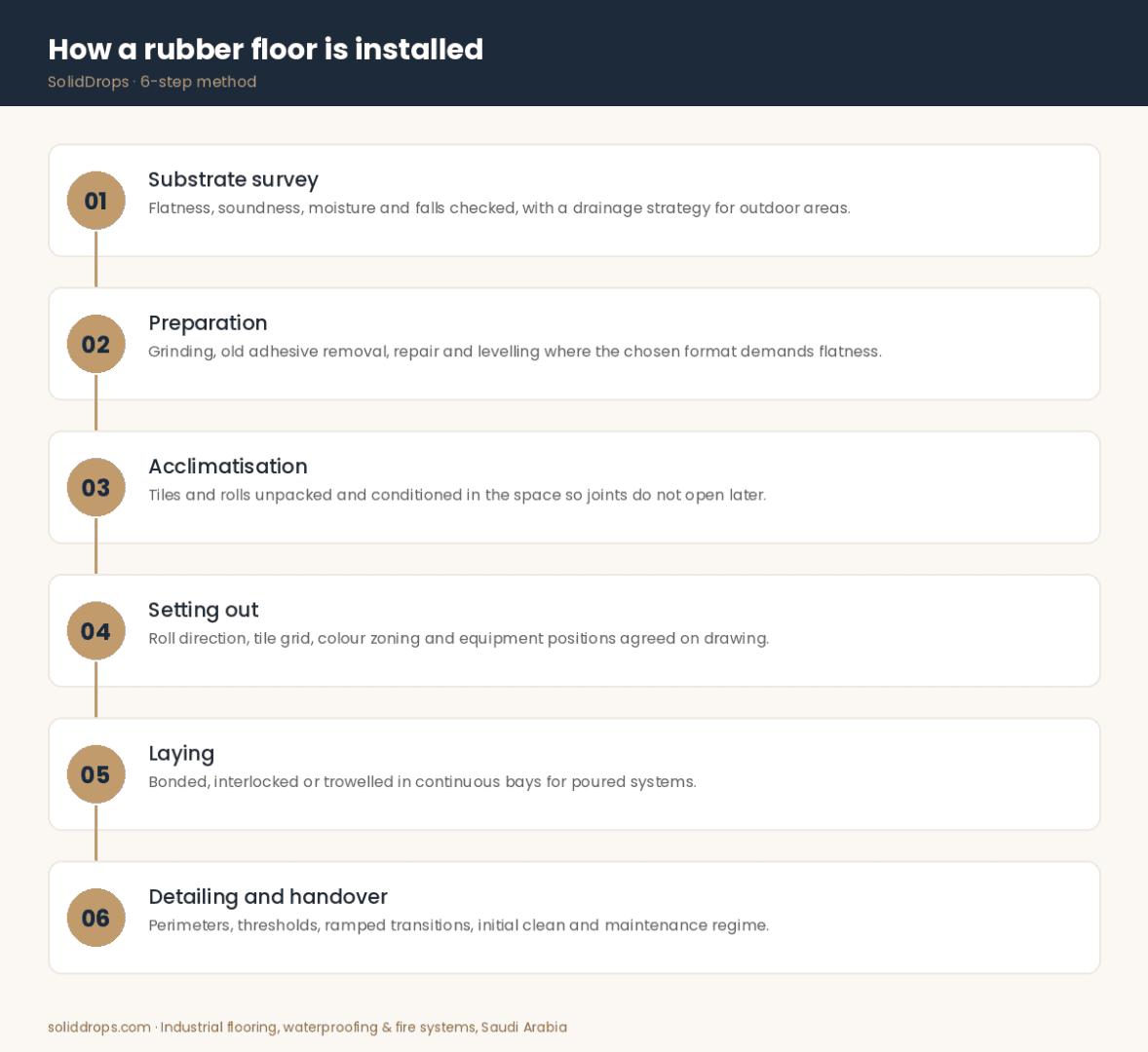
- Substrate survey. Flatness, soundness, moisture and falls. Outdoor areas need a drainage strategy; indoor areas need a slab that will not push moisture into the adhesive.
- Preparation. Grinding, removal of old adhesive or coatings, repair of spalled areas, and a smoothing compound where the format demands flatness. Thinner rolls telegraph everything beneath them.
- Acclimatisation. Rolls and tiles are unpacked and conditioned in the space so they relax before laying. Material that goes down warm and tight will shrink at the joints.
- Setting out. Roll direction, tile grid, colour zoning and equipment positions agreed against the layout drawing before the first adhesive is spread.
- Laying. Bonded with the specified adhesive, or loose-laid and interlocked where the design allows. Poured systems are mixed and trowelled to a screeded depth in continuous bays.
- Detailing and handover. Perimeters, thresholds, drain surrounds, ramped transitions and edge restraint. Then an initial clean and a maintenance regime.
Where an anti-static specification applies – equipment rooms, electronics production – the conductive path must be designed in: conductive adhesive, earthing tapes and a tested continuity to ground. That is covered in our ESD flooring guide.
What drives rubber flooring cost, and what goes wrong?
Cost first. The variables that move a rubber flooring price are compound and colour content (EPDM costs more than SBR), thickness band, format, the amount of preparation the existing slab needs, the geometry of the area, edge and transition detailing, any ESD or fall-height performance requirement, and the access and shift pattern. Outdoor work adds drainage and base construction, which frequently exceeds the surfacing itself. SolidDrops quotes against drawings and a site inspection rather than publishing rates.
Now the failures, all of which we have been called to inspect.
- Moisture under bonded rolls. Adhesive fails, sheets lift at the seams. Measure the slab and treat it before laying, not after.
- Loose-laid tiles that migrate. Without edge restraint or perimeter bonding, tile floors creep under dragged equipment and open gaps.
- Undersized thickness in drop zones. The tile survives; the slab beneath it cracks, and the equipment above it wears out early.
- No transition detail. Height changes at doors and corridors become trip hazards and edge damage points.
- Aggressive cleaning. Solvents and strong degreasers attack the binder and dull the surface. Rubber wants a neutral cleaner and a routine.
- Outdoor systems without falls. Standing water on a poured surface after a rare heavy rain shortens its life and leaves staining.
Limits, stated plainly: rubber is not chemically resistant in the way a resin floor is, so process areas with acid or solvent exposure belong to epoxy systems. New rubber has a characteristic odour that fades with ventilation. And a rubber floor cannot correct a slab that is out of level.
What this means for projects in Saudi Arabia
Sun and surface temperature. Outdoor rubber in Riyadh, Jeddah or Tabuk sees intense, sustained UV and very high surface temperatures. Two consequences follow. Pigment choice matters, which is the argument for an EPDM wear layer with its colour stability under constant sun exposure. And dark surfaces get hot: play areas and track surfaces benefit from lighter colours and shade structures, a specification decision taken with the landscape design rather than after complaints.
Programme is affected too. Poured systems are mixed and cured on site, so laying in the middle of a summer afternoon shortens working time and risks a poor finish. Early-morning work is standard practice.
Wind-blown sand and dust. A textured or granular rubber surface holds fine sand. It is not a defect, but it does set the cleaning regime – regular sweeping or vacuuming rather than occasional wet cleaning – and that should be written into the O and M rather than discovered by a facilities team.
Coastal humidity. In Jeddah, Dammam and Jubail, adhesive open times and cure behaviour shift with humidity, and dew forming on a cool slab before dawn will ruin a bond. Site conditions are recorded during installation.
Compliance. Public and school projects in KSA typically require documented reaction-to-fire classification, usually to EN 13501-1, and playground surfaces require EN 1177 impact attenuation data for the tested build-up. Both are product-specific, so ask for the test certificate for the exact system offered – not for the manufacturer’s range.
Who supplies and installs rubber flooring in Saudi Arabia?
SolidDrops supplies and installs rubber flooring across Saudi Arabia, from Jeddah and covering Riyadh, Dammam, Jubail, Makkah, Medina and Tabuk – أرضيات مطاطية for gyms, schools, playgrounds, kitchens, technical rooms and industrial workstations. The scope runs from substrate survey and preparation through to setting out, laying, edge and transition detailing, and the maintenance regime issued at handover.
To specify well, we ask for four things: what happens on the floor (drop heights, equipment, traffic), whether it is indoor or exposed, the existing slab condition, and any performance requirement that must be certified – fall height, fire class, ESD. With those, the compound, format and thickness follow logically, and the quotation reflects the actual scope rather than an assumed one.
Further reading: the rubber flooring solutions overview, our gym flooring page, and the full flooring range. Email [email protected] or call +966 50 213 1112 to arrange a site visit.
Frequently asked questions
Who supplies and installs rubber flooring in Saudi Arabia?
SolidDrops supplies and installs rubber flooring across Saudi Arabia, including Jeddah, Riyadh, Dammam, Jubail, Makkah, Medina and Tabuk. Work covers gyms and weight rooms, schools and playgrounds, commercial kitchens, healthcare and laboratory spaces, industrial workstations, equipment rooms and data centres. Contact [email protected] or +966 50 213 1112.
What is the difference between EPDM and SBR rubber flooring?
EPDM is a coloured synthetic rubber that gives comfort and impact absorption and holds colour stability under constant sun exposure, which suits outdoor and playground surfaces. SBR is a tougher, usually black compound offering slip resistance and standing comfort in commercial kitchens and reducing noise transmission. Many systems combine an SBR base with an EPDM wear layer.
How thick should rubber flooring be for a gym or playground?
The KSA market works in bands of roughly 10-15 mm, 20-30 mm and 30-50 mm. Thinner sections suit cardio, technical rooms and standing areas; mid sections suit general free-weight and functional zones; heavier sections suit lifting platforms and playgrounds. Playground depth is set by the equipment’s critical fall height tested to EN 1177, not chosen by preference.
Is rubber flooring slip resistant when wet?
SBR grades are specified for slip resistance and comfort in commercial kitchens, and rubber pool surrounds are supplied as slip-resistant surfaces that stay comfortable when wet. The actual rating is product-specific and stated on the data sheet, usually against DIN 51097 or ASTM F2772. Ask for the test value for the exact product rather than a general claim.
Can rubber flooring be used outdoors in Saudi heat?
Yes, with the right compound. EPDM wear layers are used outdoors because they maintain colour stability under constant sun exposure. Two design points follow: dark surfaces reach high temperatures, so lighter colours and shade help; and outdoor areas need falls and drainage designed into the base, since standing water shortens the life of the surface.
Is rubber flooring fire resistant?
Reaction-to-fire performance is product-specific and must be read from the classification for the exact system, normally reported to EN 13501-1. It is not a property of rubber in general. For schools, public buildings and technical rooms in Saudi Arabia, request the test certificate for the offered build-up and have it named in the specification.
How is rubber flooring installed and how long does it take?
The sequence is substrate survey, preparation and levelling, acclimatisation of the material, setting out, laying, then edge and transition detailing before handover. Tiles are the fastest and least disruptive format, bonded rolls sit in the middle, and poured-in-place systems take longest because they are mixed and cured on site. Programme is confirmed after the site survey.
How much does rubber flooring cost per square metre in Saudi Arabia?
Price is driven by compound and colour content, thickness band, format, the amount of substrate preparation required, area geometry, edge and transition detailing, certified performance such as fall height or ESD, and access. Outdoor work adds base and drainage construction. SolidDrops quotes against drawings and a site inspection rather than publishing rates.
Talk to a SolidDrops flooring specifier
Supplier and installer of rubber flooring across Jeddah, Riyadh, Dammam, Jubail, Makkah, Medina and Tabuk.
 Chat Online