
Request an Anti-Static ESD Flooring Review
Complete the project details below. Required fields are kept short; drawings, BOQ and photos can be shared during follow-up.
Anti-static ESD epoxy flooring is a seamless resin floor that carries static charge safely to earth through a conductive primer and grounding points. SolidDrops supplies and installs conductive (104–106 Ω) and static-dissipative (106–109 Ω) systems across Saudi Arabia, testing resistance at every stage of installation.
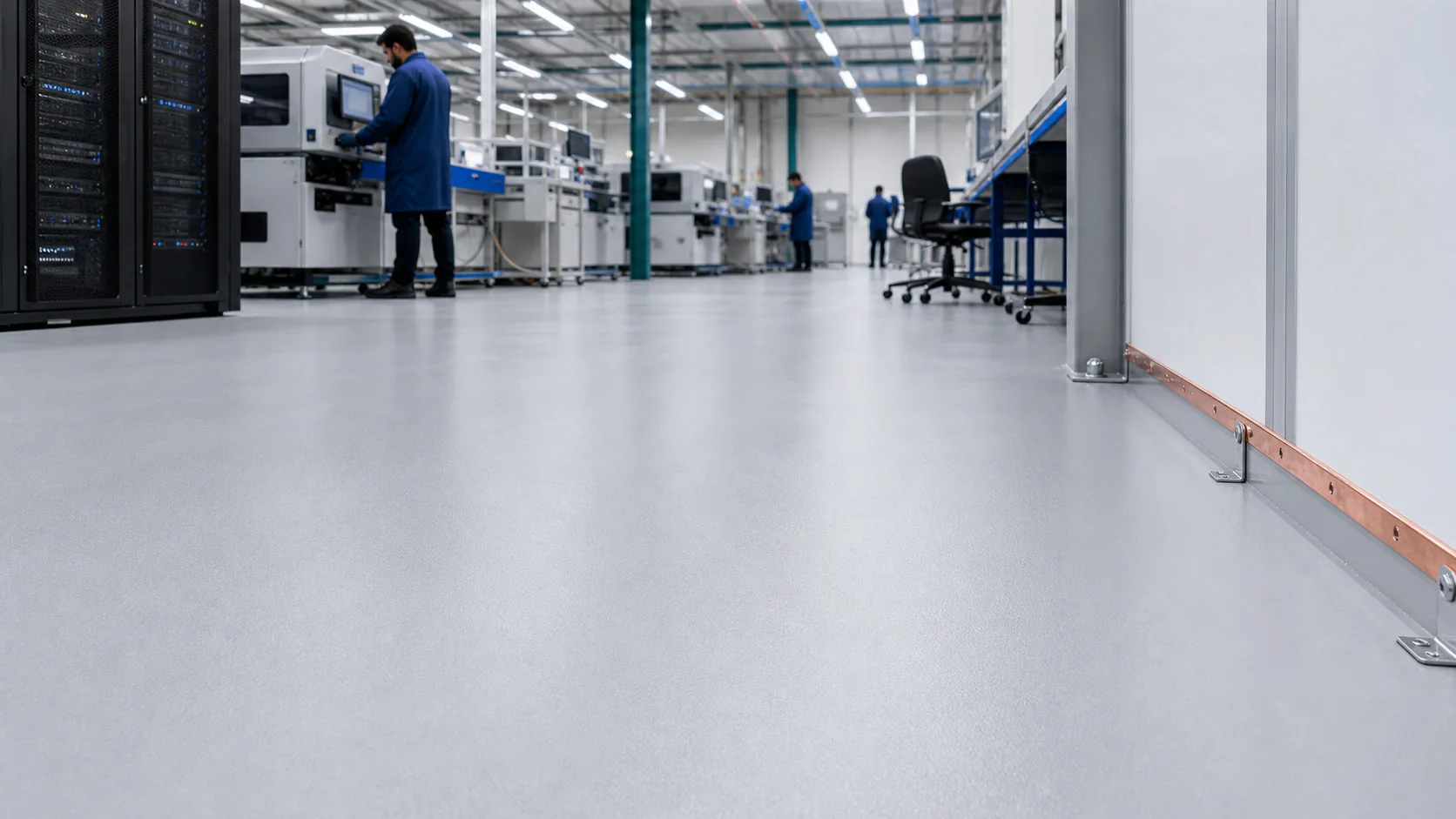
An ESD epoxy floor is a multi-layer system, not a single coating. A typical SolidDrops build is 2–3 mm of self-levelling ESD epoxy over a conductive primer, with a grounding connection to the building's earth. The table below is what most consultants ask for before they approve a submittal.
| Parameter | SolidDrops supply & installation (KSA) |
|---|---|
| Conductive resistance to ground | 1 × 10⁴ to 1 × 10⁶ Ω: fast discharge for sensitive electronics handling |
| Static-dissipative resistance to ground | 1 × 10⁶ to 1 × 10⁹ Ω: controlled discharge for data centres, labs and control rooms |
| System thickness | Typically 2–3 mm self-levelling ESD epoxy (final build per manufacturer data and consultant specification) |
| Grounding | Depends on the system: copper tape grid with earth points, tapeless conductive primer, or earth-point-only systems. Selected per brand, specification and budget |
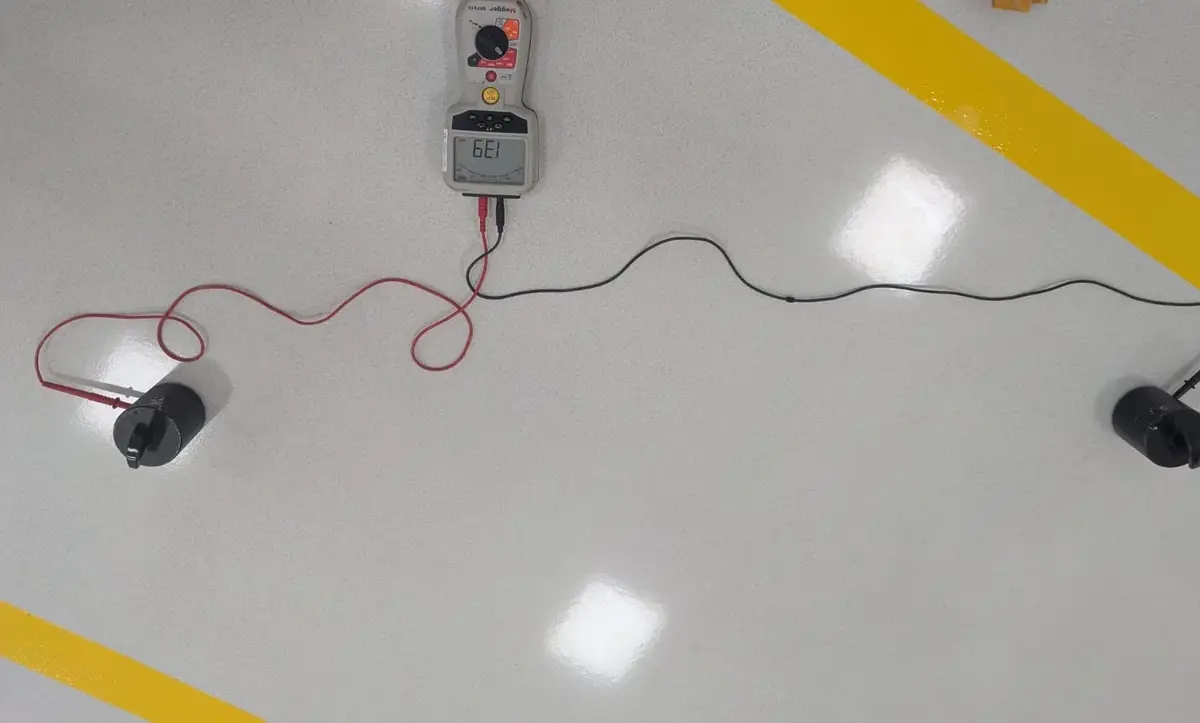
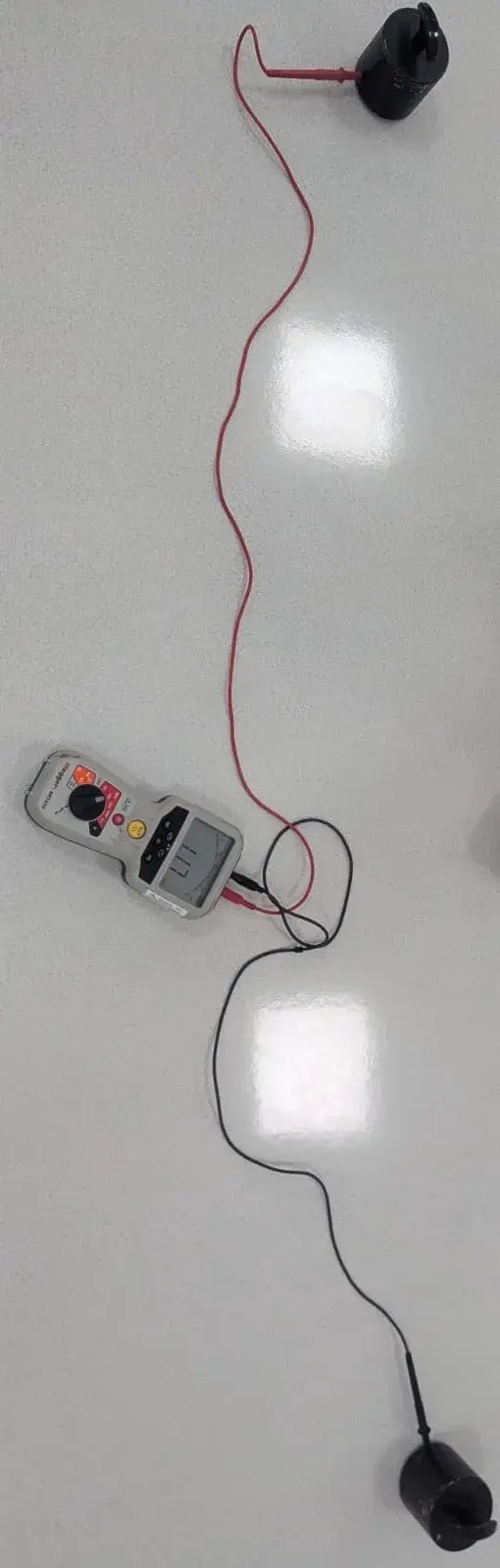
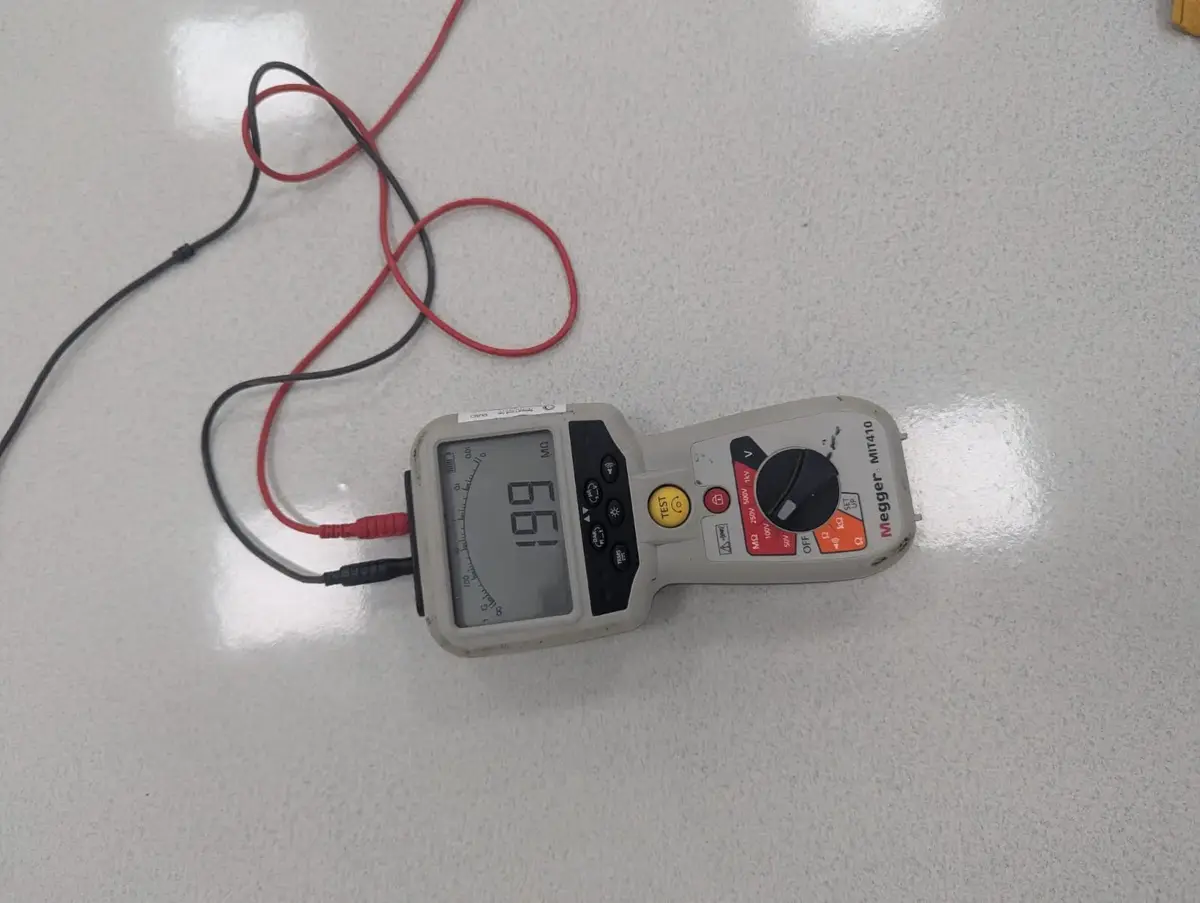
| Test methods | ANSI/ESD STM7.1 (floor resistance), ANSI/ESD STM97.1 (person–footwear–floor), IEC 61340-4-1; acceptance limits as set in the project specification |
| Programme reference | Floor criteria within ANSI/ESD S20.20 and IEC 61340-5-1 ESD control programmes |
| Materials | Branded ESD systems only, with options to suit different budgets. Stonhard Stonlux ESD (conductive and dissipative) held in stock in Saudi Arabia |
| Quality assurance | Branded materials, installed to the manufacturer's method and tested at every stage |
| Quality control | Resistance checked at every stage: primer, grounding continuity and finished floor |
| Handover records | Method statement, material TDS/SDS, test readings by area and grounding point layout |
Resistance bands are the ranges commonly used for conductive and static-dissipative resin floors. The acceptance values on your project are the ones in your consultant's specification and the selected manufacturer's data sheet.
The two grades are not interchangeable. If the wrong resistance class goes down, the floor can fail the consultant's acceptance test even though it was installed perfectly. Match your room to the column that describes it, then confirm against the BOQ.
| Criteria | Conductive ESD epoxy | Static-dissipative ESD epoxy |
|---|---|---|
| Resistance to ground | 104 – 106 Ω (low) | 106 – 109 Ω (moderate) |
| How charge leaves | Rapid drain to earth | Controlled, gradual drain to earth |
| Typical KSA rooms | Electronics and PCB assembly, component handling, test benches, automotive electronics lines | Data centre white space, server and UPS rooms, NOC/telecom rooms, labs, cleanrooms, hospital equipment rooms |
| Grounding | Copper tape, tapeless or earth-point system (depends on brand); verified earth connection always | Copper tape, tapeless or earth-point system (depends on brand); verified earth connection always |
| Thickness | Typically 2–3 mm self-levelling | Typically 2–3 mm self-levelling |
| Footwear | ESD footwear required to get the full benefit | ESD footwear recommended; system test includes the person |
| Pick this when… | Your specification asks for a maximum resistance of 106 Ω or a "conductive" floor | Your specification asks for "static dissipative" or a range up to 109 Ω |
Not sure whether your BOQ calls for conductive or dissipative? Send the spec sheet or room list to info@soliddrops.com or WhatsApp +966 50 213 1112. Our technical team will read the clause and tell you which grade it needs before you price it.
ESD epoxy controls static for electronics and people. It is not specified by SolidDrops as a spark-proof floor for explosive or flammable atmospheres. Those areas need a separately engineered hazardous-area solution.
"Anti-static" is how most buyers describe the floor they want, but it is not a resistance class. Consultants, ESD coordinators and test reports work in ohms: a conductive or static-dissipative range, a named test method and a pass limit. A capable antistatic floor coating service provider turns the word in your enquiry into those three items before quoting, then proves them on site once the floor has cured. If an offer only says "anti-static epoxy" with no range and no test, there is nothing in it you can check at handover, and two quotations that look identical may be pricing very different floors.
| Term in your enquiry | What it should mean in the specification | Question to ask the contractor |
|---|---|---|
| "Anti-static" | A buyer's description, not a measurable range | Which range will you deliver and report: conductive or static-dissipative? |
| "Static-dissipative" | Resistance to ground in the 106 – 109 Ω band | Which test method, and what is the pass limit? |
| "Conductive" | Resistance to ground in the 104 – 106 Ω band | Will both the lower and the upper limit be checked? |
| "ESD floor to S20.20" | The floor is qualified together with ESD footwear and the person walking on it | Will the test include footwear and walking body voltage, not only floor resistance? |
Electronics plants, data centres and labs that run an ESD control programme to ANSI/ESD S20.20 do not accept the floor on a resistance reading alone. The floor, the footwear and the person are tested as one system. The limits most often referenced for flooring qualification are:
These figures are for orientation. The edition of the standard and the acceptance values written in your project specification always decide the test.
Comparing two ESD offers? Send both to info@soliddrops.com or WhatsApp +966 50 213 1112. We will point out where the grade, the test or the grounding differs, so you are comparing like with like.
There is no honest single rate per m² for an ESD floor. The grade (conductive or dissipative) matters, but the site usually moves the price more than the resin does. These are the factors we price on every SolidDrops offer:
A site survey or a clear BOQ is the quickest way to a firm, project-specific quotation. We send pricing by email: info@soliddrops.com.

Every layer has a job, and the floor only works if all five are continuous. Seen from the slab up:
Sequence and products follow the selected manufacturer's system sheet. Some systems are tapeless, and some combine layers 2 and 4.
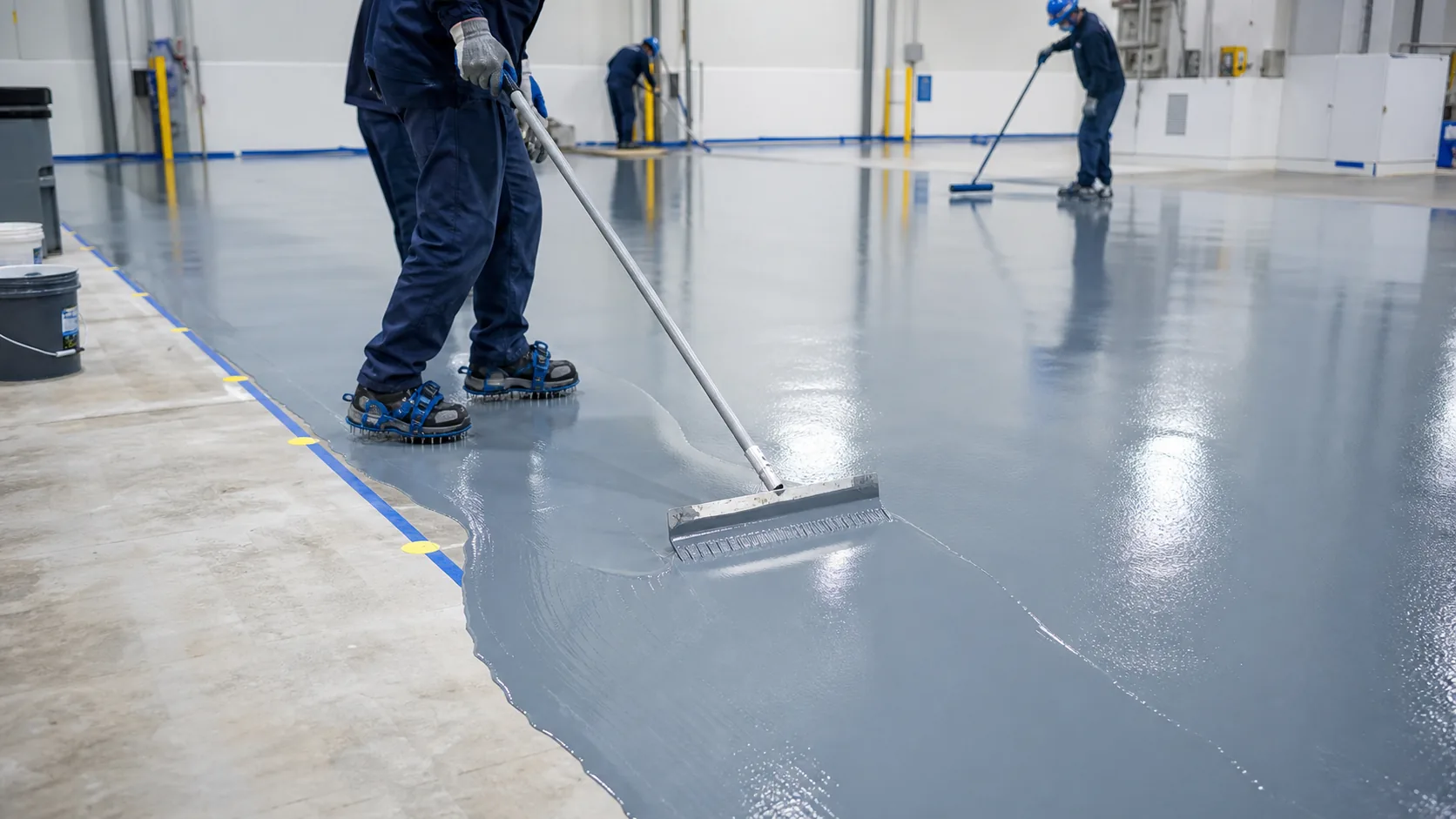
There is no single ESD build that suits every room or budget. Different brands ground the floor in different ways, so SolidDrops offers several branded systems and recommends one after reading your specification. Whatever the route, the floor is always connected to earth and tested.
Self-adhesive copper tape runs under the conductive primer and is connected to earth points. This is a common choice where the consultant's specification calls for a tape grid.
Some brands spread the charge through the conductive primer itself, with no copper tape. This means fewer steps and a cleaner substrate, where the system and specification allow it.
Some systems connect to building earth through dedicated earth points placed to the manufacturer's layout. The number of points depends on the room size and the system.
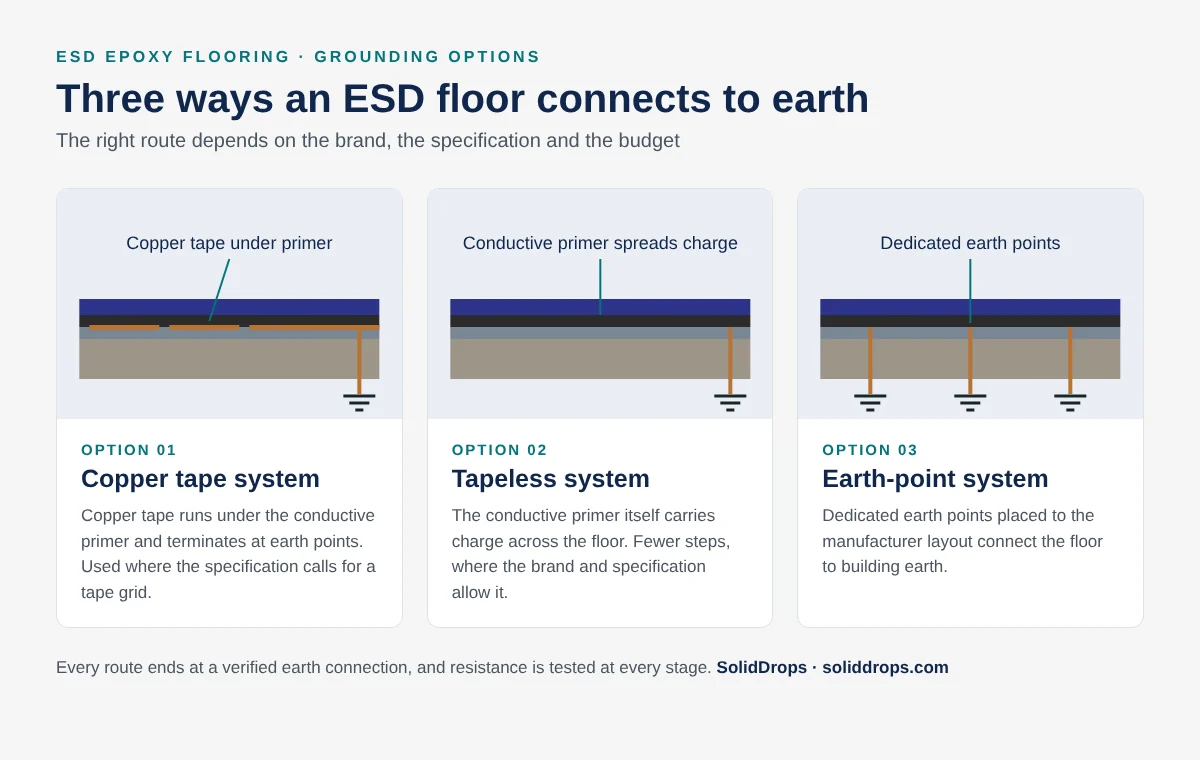
Because we work with more than one branded system, we can offer a route that meets the specification at a cost that fits the project. Send the BOQ or room details and we will email the suitable options with pricing.
"Anti-static" on a drawing is not a full specification. ESD flooring is justified when static can damage what you make, store or run, and when the floor is part of a wider static-control programme with footwear, grounding and testing.
Demand is growing with data-centre build-outs and electronics manufacturing in Riyadh, the Eastern Province and the industrial cities. The rooms we are most often asked to review:
White space, server halls, UPS and battery rooms, and the slab below raised access floors. Usually dissipative. Read our ESD flooring guide for data centres.
PCB lines, SMT areas, repair benches and component stores where a single discharge can scrap a board. Usually conductive.
Network operations centres, SCADA and control rooms, and telecom switch rooms with 24/7 equipment.
Testing labs, instrument rooms and clean zones that need a seamless, low-dust surface that is easy to clean.
SFDA-regulated support areas, hospital equipment and imaging rooms, and medical device assembly.
Sensor, harness and control-unit assembly; maintenance bays for electronic equipment in hangars and plants.
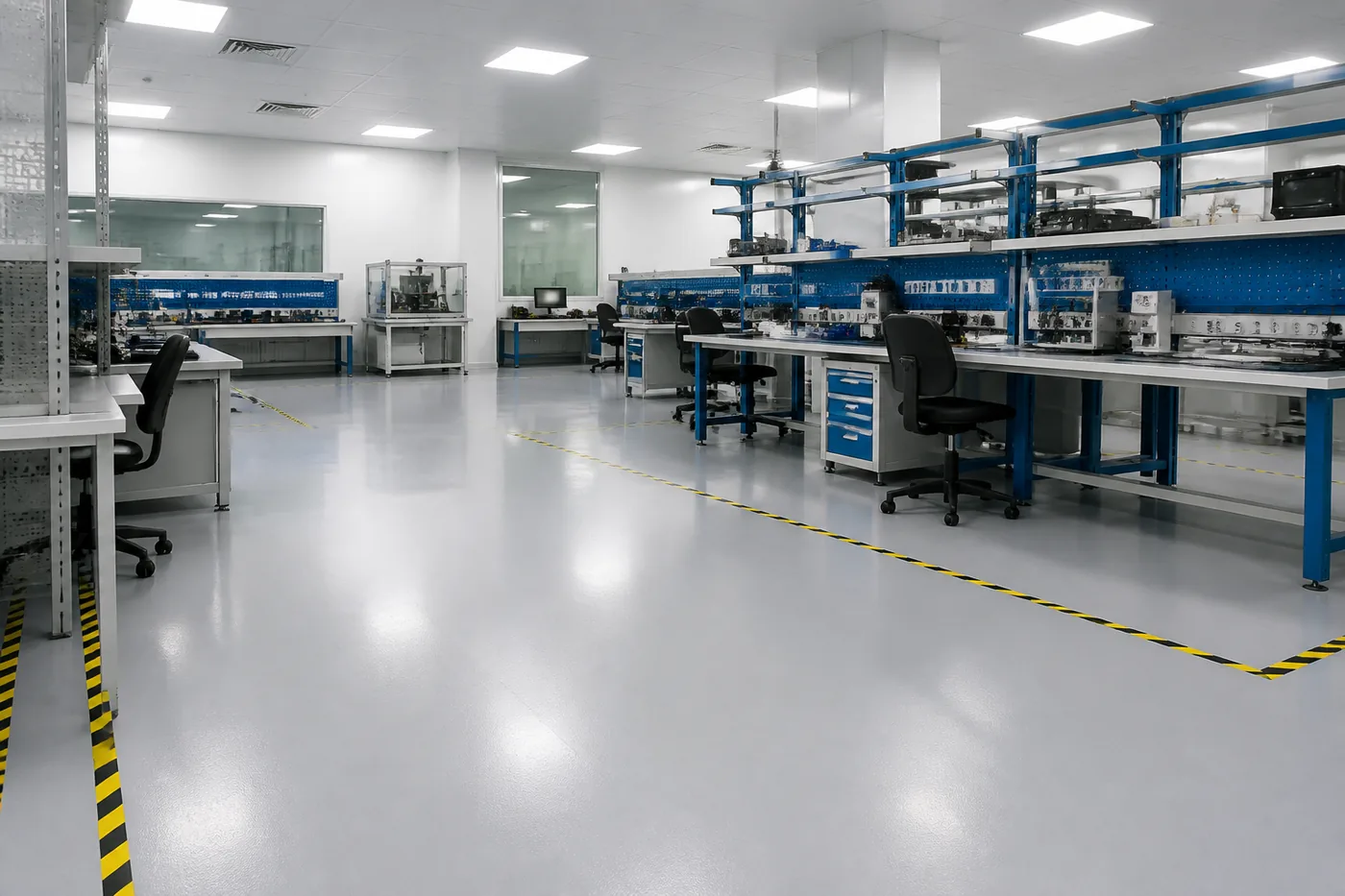
Most ESD failures we are called to inspect start below the coating. In the Kingdom, three conditions come up again and again:
In Jeddah, Dammam and Jubail, high water tables and coastal humidity push moisture up through the slab, which can blister or debond a resin floor. We test slab moisture before priming, and if readings are above the manufacturer's limit we specify a moisture-tolerant primer or barrier.
Summer temperatures shorten working time and can affect the finish. On non-air-conditioned sites we schedule pours for cooler hours and follow the product's temperature limits.
Data centres and factories rarely shut down. We phase areas, plan night shifts and protect neighbouring equipment from dust and odour.
Resistance is checked at each stage, not only at handover. That way a grounding fault is found while it can still be fixed, not after the top layer has covered it.
We read the BOQ, consultant clause and room list, confirm the grade (conductive or dissipative) and agree the test method and acceptance values.
Slab strength, moisture, cracks, joints and old coatings are checked, and earth point locations are agreed with the electrical contractor.
Diamond grinding, repairs and joint treatment, then the sealer or moisture-barrier primer where needed.
Copper tape or earth points are installed as the chosen system requires and connected to building earth. After the conductive primer, continuity and resistance are measured.
The self-levelling conductive or dissipative layer is applied within the manufacturer's temperature and thickness limits, followed by coves and details.
The finished floor is tested to the agreed method, and readings are recorded by area alongside the method statement, TDS and grounding layout.
Typical cure guidance for resin floors is light foot traffic after about 24 hours and full service after about 7 days at normal room temperature. Your project's figures follow the selected system's data sheet.
| Item | What to state | Why it changes the offer |
|---|---|---|
| Room and process | Room use, devices handled, footwear policy | Decides conductive vs dissipative |
| Electrical requirement | Resistance range, test method, voltage, sampling plan | Defines how acceptance is proved |
| Substrate | Slab age, strength, moisture readings, existing coatings | Preparation and primer selection |
| Mechanical exposure | Trolleys, pallet jacks, racking and raised-floor pedestals | Thickness and wear allowance |
| Chemicals and cleaning | Cleaning agents, spills and floor polish policy | Some polishes insulate the surface and break ESD performance |
| Finish and safety | Colour, gloss and slip-resistance needs | Texture and colour choices per grade |
| Grounding | Number and position of earth points and who provides them | Scope split between flooring and electrical contractor |
| Handover | Test report format, as-built grounding layout, maintenance guide | Documentation effort and witness testing |

For consultant approval we prepare the method statement, TDS/SDS and test plan. Pricing is sent with the submittal once we have the BOQ or room details.
Email info@soliddrops.comA dissipative floor priced for a conductive requirement fails acceptance. We confirm the clause before quoting.
Leads to blistering and debonding. We prevent it with moisture testing, repairs and the right primer.
Broken grounding or unconnected earth points create isolated zones. We test continuity before the top layer goes down.
Waxes and polishes can insulate the surface. Every handover includes cleaning guidance.
Joints, coves and pedestal bases left untreated become weak points. We detail them in the method statement.
Testing to a different method than the specification invites disputes. We agree the method before work starts.
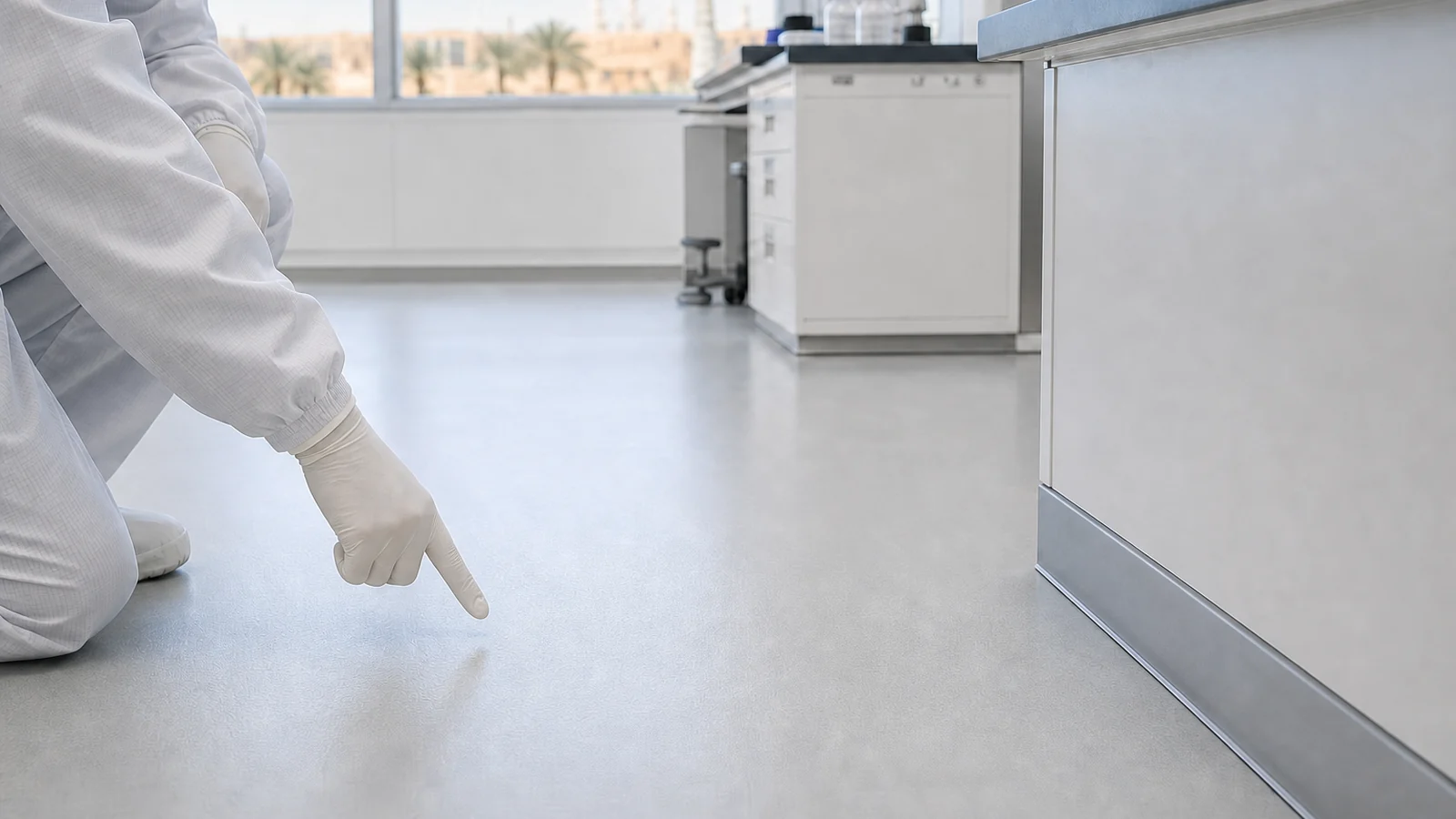
Often, yes, but only after we know why it stopped working. Our retrofit assessment covers:
Anti-static ESD epoxy flooring is a seamless resin floor made electrically conductive or dissipative so that static charge drains safely to earth. It combines a conductive layer, a grounding connection to earth and an ESD top layer, and it protects sensitive electronics, data-centre equipment and lab instruments from electrostatic discharge.
The cost depends on the grade (conductive or dissipative), floor area, slab condition and repairs, grounding density, coving and detailing, the testing and records required, and whether work runs at night in a live facility. SolidDrops prices each project after reviewing the BOQ or surveying the site.
Conductive ESD floors have a lower resistance to ground, typically 10⁴–10⁶ ohms, and drain charge quickly. They suit electronics assembly. Static-dissipative floors sit at typically 10⁶–10⁹ ohms and drain charge in a controlled way. They suit data centres, labs and control rooms. Always follow the range in your project specification.
Not always. It depends on the brand and system. Some ESD systems use copper tape under the conductive primer, some are tapeless and spread charge through the conductive primer itself, and some connect to earth through dedicated earth points only. Every system needs a verified earth connection. SolidDrops recommends the route after reviewing your specification and budget.
Yes. SolidDrops works with several branded ESD systems: copper-tape systems, tapeless systems and earth-point systems, in conductive and dissipative grades. We match the system to your specification, room use and budget. All materials are branded, so quality is assured.
The floor alone is only part of the path. Charge leaves the body through the footwear and then the floor, so ESD footwear or heel grounders are needed for full protection. That is why ANSI/ESD STM97.1 tests the person, footwear and floor together.
ESD control programmes are usually built on ANSI/ESD S20.20 or IEC 61340-5-1. Floor resistance is measured with methods such as ANSI/ESD STM7.1 and IEC 61340-4-1, and the person–footwear–floor system with ANSI/ESD STM97.1. The project specification defines which of these apply and the acceptance limits.
The programme depends on area, slab repairs and access. A typical room covers preparation, grounding, primer and the top layer, with resistance testing between stages. Resin floors generally take light foot traffic after about 24 hours and full service after about 7 days, per the system's data sheet.
Yes. ESD or dust-proof resin floors are often applied to the slab under raised access floors in data centres. The pedestals, grounding of the raised-floor grid and the finish on top must all be coordinated so the static path is continuous.
No. ESD flooring is required where the owner, consultant, OEM or ESD control programme specifies it, mainly in rooms with static-sensitive equipment or processes. General warehouses and corridors usually need a standard industrial epoxy.
Send your name and company, phone or WhatsApp number, city and approximate area in m², and the room use. If you have them, add the BOQ, the consultant's ESD clause, drawings or a site photo. We will confirm the grade, the test method and a priced offer.
Ask for three things before comparing prices: the resistance range the provider will deliver (conductive 104–106 Ω or static-dissipative 106–109 Ω), the test method and pass limit used at handover, and a grounding plan for your room. An offer that cannot put these in writing is pricing a coating, not an ESD floor. SolidDrops confirms the grade and the test method in its offer.
In an S20.20 programme the floor is qualified together with the footwear and the person. Commonly referenced limits are floor resistance to ground below 1.0 × 10⁹ Ω (ANSI/ESD STM7.1), person–footwear–floor system resistance below 1.0 × 10⁹ Ω (STM97.1) and walking body voltage below 100 V (STM97.2). Your project specification sets the final acceptance values.
SolidDrops is based in Jeddah and supplies and installs ESD epoxy flooring all over Saudi Arabia, including Riyadh, Jeddah, Dammam, Jubail, Makkah, Madinah and Tabuk, as well as the industrial cities around them.
Our crews mobilise from Jeddah to project sites all over KSA. Select your city for local project support:
توريد وتركيب أرضيات إيبوكسي موصلة ومبددة للكهرباء الساكنة مع التأريض والاختبار في كل مرحلة، في جدة والرياض والدمام وجميع مدن المملكة. للاستفسار: واتساب +966 50 213 1112.
Reviewed by Ali Haider, Technical Consultant, SolidDrops (12 years in industrial flooring and waterproofing in Saudi Arabia) · Last updated 22 November 2026
Conductive and dissipative ESD floors, supplied, grounded and tested by one team. أهلاً وسهلاً, we reply on WhatsApp and email.
Complete the project details below. Required fields are kept short; drawings, BOQ and photos can be shared during follow-up.
Further reading — SolidDrops technical guides

SolidDrops is a Saudi-based supplier and installer of industrial flooring and waterproofing systems, with teams in Jeddah, Riyadh and Dammam, serving factories, warehouses, food plants, hospitals and commercial projects across Saudi Arabia since 2016. We specify, supply and apply epoxy, Ucrete & Stonhard UT, Silikal MMA, ESD and vinyl floors, roof and basement waterproofing, FRP hygienic panels and construction chemicals, then keep them in service through SolidDrops Care.
Our services
Recent articles
هندسة الأسطح المقاومة: الدليل الشامل للأرضيات الصناعية، العزل المائي، والأرضيات الرياضية في السعودية21 Nov 2026Engineering Resilient Surfaces: The Complete Guide to Industrial Flooring, Waterproofing and Sports Surfaces in Saudi Arabia21 Nov 2026Waterproofing in Tabuk: Cold Nights, Frost and Winter Rain25 Sep 2026Contact
☎Call +966 50 213 1112✉Email info@soliddrops.com✓WhatsApp usHead office: Jeddah, Saudi Arabia
Projects: Jeddah · Riyadh · Dammam · all KSA
Office hours: Sat–Thu, 8 AM–6 PM
Phone & WhatsApp: 24/7 · English · العربية
ISO 9001 · ISO 14001 · ISO 45001 certified
Certificates available on request for tenders
Privacy Notice · Contact page
 Chat Online
Use this feature to chat with our agent.
Cookies on SolidDrops
We use cookies to keep the site secure, understand visits and measure enquiries. Privacy Notice