
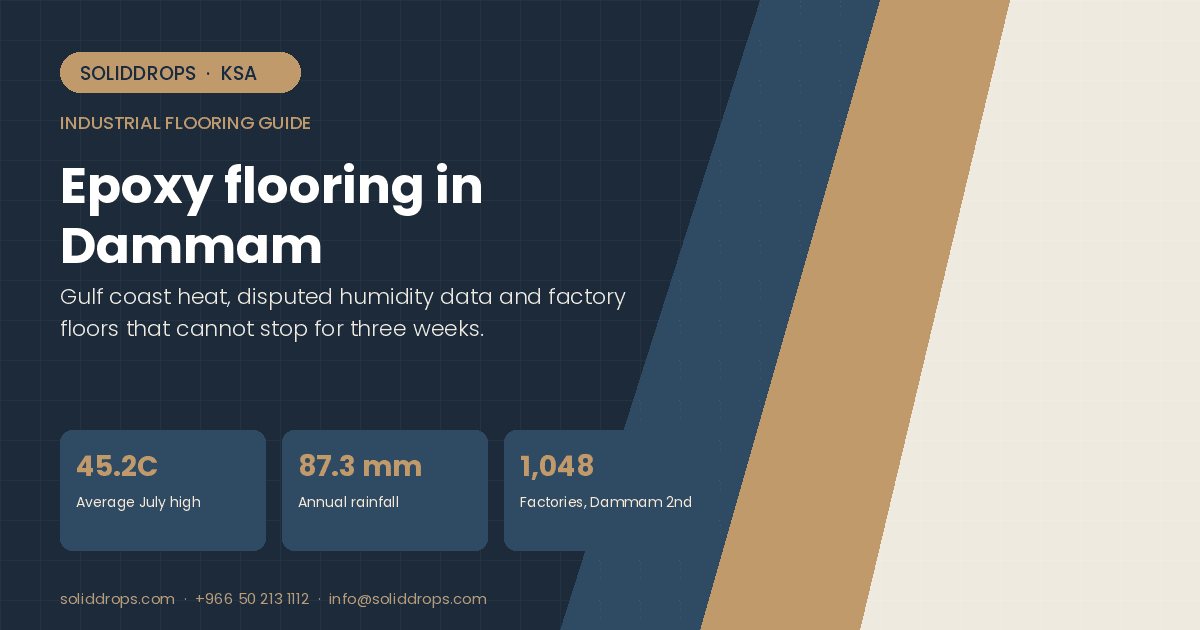
14 Sep Epoxy Flooring in Dammam: Heat, Ground and Factory Floors
Epoxy Flooring in Dammam: Heat, Ground and Factory Floors
Epoxy flooring in Dammam is specified for hotter summers than either Riyadh or Jeddah records, with July highs averaging 45.2C. The floors are mostly factory and logistics floors inside the Modon industrial cities, so heat management, shift planning and honest slab testing decide the result.
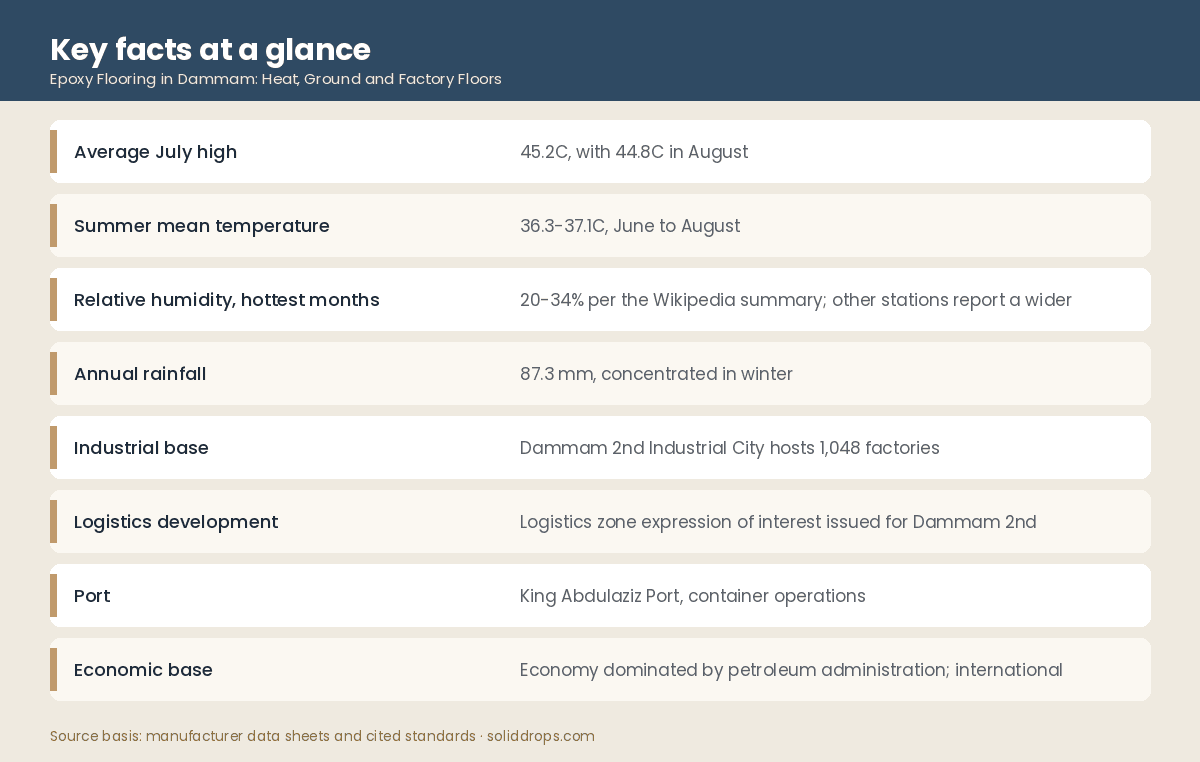
| Property | Value | Basis / standard |
|---|---|---|
| Average July high | 45.2C, with 44.8C in August | Wikipedia, Dammam climate table |
| Summer mean temperature | 36.3-37.1C, June to August | Wikipedia, Dammam climate table |
| Relative humidity, hottest months | 20-34% per the Wikipedia summary; other stations report a wider seasonal range | Wikipedia, Dammam; weather-and-climate.com |
| Annual rainfall | 87.3 mm, concentrated in winter | Wikipedia, Dammam climate table |
| Industrial base | Dammam 2nd Industrial City hosts 1,048 factories | Modon news release |
| Logistics development | Logistics zone expression of interest issued for Dammam 2nd Industrial City | National Center for Privatization / Modon |
| Port | King Abdulaziz Port, container operations | King Abdulaziz Port record |
| Economic base | Economy dominated by petroleum administration; international manufacturers present in the industrial cities | Wikipedia, Dammam |
What sets epoxy flooring in Dammam apart?
Epoxy flooring in Dammam is mostly factory flooring. The city’s economy is dominated by petroleum administration, and its two industrial cities hold a dense manufacturing base, with Dammam 2nd Industrial City alone recorded at 1,048 factories. That skews the work heavily towards production halls, workshops, technical rooms and distribution floors rather than retail or residential finishes.
Two conditions shape those floors. The first is heat: July highs here average 45.2C, above both Riyadh and Jeddah in the same comparison, with August close behind at 44.8C. The second is that Dammam is a Gulf coast city, so nothing about the ground should be assumed from a climate table.
The third factor is operational rather than environmental. A working factory floor cannot be handed over for three weeks. Almost every Dammam resin job is sequenced around production, which changes system selection as much as any technical property does.
How does 45C heat change the work on site?
Ambient air at an average July high of 45.2C produces slab surface temperatures well above that where sun reaches the concrete, and a steel-clad industrial shed without running air conditioning holds heat late into the evening. Mean summer temperatures of 36.3 to 37.1C across June to August mean this is a season, not a heatwave.
Three effects follow, and all of them are about time rather than durability.
- Pot life collapses. A mixed batch that behaves predictably at 25C can become unworkable long before the crew reaches the far wall.
- Substrate outgassing. Air in the concrete expands as the slab warms through the day and pushes up through a wet film, leaving pinholes. Applying on a falling slab temperature, typically late evening, reduces it.
- Recoat windows tighten. The interval between coats shortens at high temperature, so the next coat has to be ready before the first one is too far advanced.
The countermeasures are unglamorous: shaded and conditioned material storage, smaller batches, more mixers, and a written decision on which hours the floor gets applied. Get those into the method statement and the heat stops being an argument.
Can you trust a humidity figure for Dammam?
This is a real problem and it is worth stating plainly. Published humidity data for Dammam does not agree. The Wikipedia climate summary gives 20-34% relative humidity in the hottest months, while other weather sources report a wider seasonal range reaching well above that. A specification written against the lower figure and applied on a day at the higher one will meet conditions it did not plan for.
The engineering answer is to stop designing off a table. Relative humidity, air temperature and substrate temperature should be measured on the actual slab, on the actual shift, and logged. A calculated dew point margin from site instruments outranks any published city average.
That discipline also protects the contract. Where a floor is rejected later, the dew point and substrate logs are the record that shows conditions were within the manufacturer’s stated window at the time of application.
What should you assume about the ground in Dammam?
Nothing. No Dammam-specific ground or groundwater source sits behind this guide, and regional generalisations about Eastern Province coastal geology are not a substitute for the report on your plot. This page therefore quotes no soil or water table figure for the city.
What a flooring specifier can do without that data is test the slab in front of them. That is the controlling information anyway, because a resin system responds to the concrete it bonds to, not to the strata beneath it.
- Take slab relative humidity readings and compare them to the system’s stated limit.
- Ask for the project geotechnical report and read what it says about groundwater and salts before writing any moisture clause.
- Check for a damp-proof membrane in the construction records, and treat its absence as a design condition rather than a surprise.
- Pull-off test the existing surface where a previous coating is being overlaid.
Rainfall of 87.3 mm a year, concentrated in winter, is low but not zero. External aprons, ramps and yard-facing thresholds still need falls and a movement detail.
Which Dammam buildings need a resin floor?
The demand sits inside the industrial estates and the port corridor. Dammam 2nd Industrial City is a Modon estate recorded at 1,048 factories, a logistics zone expression of interest has been issued for that same estate, and King Abdulaziz Port runs the container operations that feed it.
Production halls
Machine bases, point loading, oil and coolant drips, and a floor that must survive being cleaned with whatever the maintenance team already owns.
Maintenance workshops
Impact from dropped tooling, hydraulic fluid, welding spatter and vehicle traffic in the same bay.
Technical and control rooms
Cable-managed floors where dust generation and static control matter more than abrasion resistance.
Distribution and logistics floors
Long racking runs, aisle marking, and the flatness the material handling equipment was bought against.
Buildings inside a Modon estate come with estate rules: gate permits, hot-work approvals and restricted delivery hours. Those belong in the programme from day one, not in a claim later.
Which epoxy system suits which Dammam floor?
| System | Best for in Dammam | Key local limit |
|---|---|---|
| Roller-applied epoxy coating | Dust-proofing and marking sound warehouse and workshop slabs during a short possession | Thin films are the least forgiving of high slab temperature and outgassing pinholes |
| Self-levelling epoxy screed | Production halls, assembly areas and technical rooms needing flatness and easy cleaning | The shortest working window of the group in summer; effectively a night-shift system |
| Epoxy or urethane mortar screed | Machine bays, loading aprons and workshop floors taking impact, heat or spillage | Requires the longest possession, which is the scarcest thing in a live factory |
| Anti-static or conductive build-up | Control rooms, electronics areas and process rooms with a defined static requirement | Performance is verified by measured resistance on the finished floor, not by product choice |
Thickness and performance data belongs in the technical guides, not repeated here: see the epoxy flooring guide for Saudi Arabia and the anti-static flooring buyer’s guide.
Working around a production shutdown?
Tell us the possession window and the process on the floor, and our technical team will match the system to the time available.
How should a Dammam factory floor be programmed?
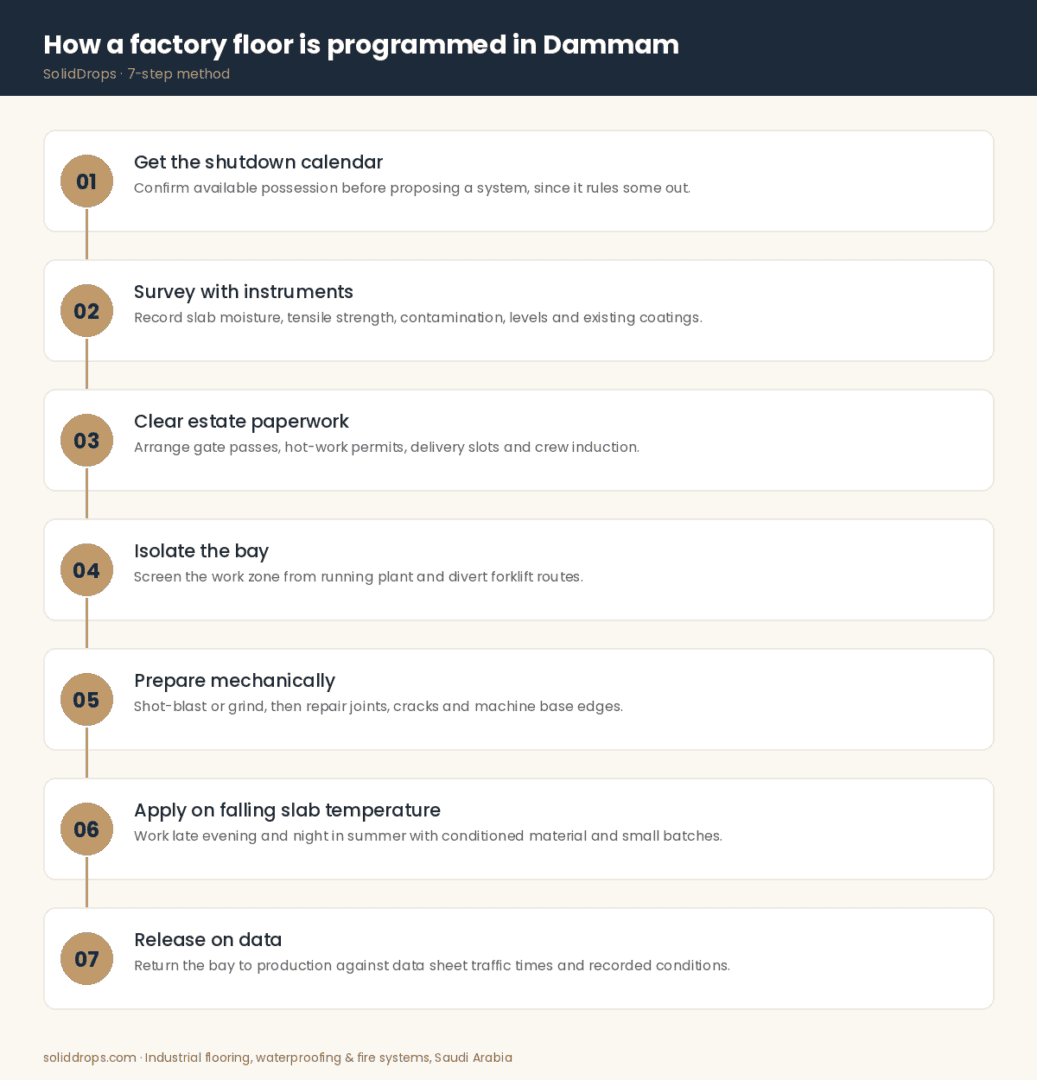
Programme design starts with the production plan, not the flooring drawing.
- Get the shutdown calendar first. Ask which weekends, maintenance days or annual stops are available before proposing a system, because possession length rules out some build-ups entirely.
- Survey with instruments. Slab moisture, tensile strength, levels, contamination and existing coating identification, recorded and issued.
- Clear the estate paperwork. Gate passes, hot-work permits, delivery slots and induction for the crew, arranged ahead of mobilisation.
- Isolate the bay. Screen the work area from the running plant, control access, and agree how forklift routes divert.
- Prepare mechanically. Shot-blast or grind, then repair joints, cracks and machine base edges before priming.
- Apply on falling slab temperature. Late evening and night shifts through summer, with conditioned material and small batches.
- Return to production on data. Release the bay against the data sheet’s traffic times and the recorded conditions, not against pressure from the shift supervisor.
What goes wrong on Dammam floors?
- Pinholing from a warming slab. Applied in the morning as the concrete heats, the film gets perforated by rising air. Apply on a cooling slab instead.
- Batches that gel in the bucket. Material stored in a yard container at summer temperature has already lost half its working time before mixing starts.
- A coating asked to do a screed’s job. Under a machine base or a steel-wheeled trolley, a thin film will not last a year regardless of quality.
- Handover into live production. The most common damage to a new factory floor happens in the first 48 hours, from traffic returned before the system reached traffic cure.
- Chemical exposure declared after the fact. Coolants, acids and solvents used on the line must be listed at survey stage so resistance can be checked against manufacturer data.
What drives the cost of epoxy flooring in Dammam?
- Possession length. The single biggest variable. A floor done over four consecutive nights costs differently from one done in twelve two-hour windows.
- Substrate condition. Oil-soaked workshop concrete needs degreasing and cutting out before any resin is opened.
- System build-up. Coating, self-levelling screed and mortar screed differ by several times in material volume and labour.
- Detailing. Machine base perimeters, drainage channels, joints and plinths are measured separately from the field area.
- Estate access. Permits, escorted deliveries and restricted hours inside an industrial city add time that has to be priced.
- Mobilisation. Plant and crews travelling into the Eastern Province, and the distance from Dammam out to satellite plots, are legitimate cost lines.
Send the shutdown window, the floor area and photographs of the existing slab, then request a quotation.
Who supplies and installs epoxy flooring in Dammam?
SolidDrops supplies and installs epoxy flooring in Dammam and across the Eastern Province for factories, warehouses, workshops, technical rooms and commercial service areas. The scope covers system selection against the process on the floor, concrete preparation, application and handover records.
The day-to-day service is set out on our epoxy flooring in Dammam page, and projects needing roof, tank or wet-area protection alongside the floor are covered by flooring and waterproofing support in Dammam. For plant-side work further up the coast, see our Jeddah site conditions guide.
Enquiries in Arabic for أرضيات إيبوكسي are welcome. Contact [email protected] or +966 50 213 1112 with the building type, the process carried out on the floor and the shutdown window available.
Frequently asked questions
Does epoxy flooring withstand the heat in Dammam?
A cured epoxy floor inside a building handles Dammam’s climate without difficulty. The heat is an installation constraint: July highs averaging 45.2C shorten pot life and tighten recoat windows. Where a floor is also exposed to hot process liquids or steam cleaning, a urethane mortar screed is the better choice than an epoxy coating.
Is epoxy flooring suitable for factories in Dammam?
Yes, and factory floors are most of the resin flooring work in the city, with 1,048 factories recorded in Dammam 2nd Industrial City alone. The system must be matched to the process: point loading, impact, oils and cleaning chemicals decide between a coating, a self-levelling screed and a mortar screed.
Does Dammam have high groundwater that affects flooring?
No Dammam-specific groundwater source is quoted in this guide, and regional assumptions are not a substitute for the project geotechnical report. For flooring purposes the controlling test is slab relative humidity measured on site, compared against the system’s stated moisture limit before anything is specified.
How long does an epoxy floor last in Eastern Province heat?
Service life depends on the system, the thickness and the traffic, so no figure is quoted here. The practical drivers are correct build-up selection for point loading, proper preparation, and a cleaning regime that suits the finish. Manufacturer data sheets give the performance limits for each system.
Can a factory floor be coated without stopping production?
Usually in phases rather than fully. Bays are isolated and released one at a time around the production plan, which is why the shutdown calendar should be agreed before the system is chosen. Short windows favour fast-return coatings; mortar screeds need longer possessions.
When should epoxy flooring be applied in Dammam?
Through summer, on a falling slab temperature, usually late evening or night. Applying as the concrete warms during the morning pushes air up through the wet film and leaves pinholes. Winter and the shoulder seasons allow daytime work with fewer constraints.
How much does epoxy flooring cost in Dammam?
Cost is set by possession length, substrate condition, system build-up, detailing around machine bases and drains, industrial estate access requirements and mobilisation. No rate is meaningful without those. Send the shutdown window, area and slab photographs to [email protected] and request a quotation.
Who supplies epoxy flooring in Dammam?
SolidDrops supplies and installs epoxy flooring in Dammam and the wider Eastern Province for factories, warehouses, workshops and technical rooms, including survey, preparation, application and handover records. Enquiries go to [email protected], or +966 50 213 1112 by phone or WhatsApp.
Talk to a flooring specifier in Dammam
SolidDrops supplies and installs industrial resin flooring across Dammam and the Eastern Province, with instrument survey and recorded site conditions.
 Chat Online