
13 Sep Epoxy Flooring in Jeddah: Humidity, Dew Point and Salt
Epoxy Flooring in Jeddah: Humidity, Dew Point and Salt
Epoxy flooring in Jeddah is controlled by moisture in three forms: air, ground and rainfall. Summer humidity runs 53-59% with September dew points above 27C, coastal ground carries salt and a high water table, and rain arrives in short violent bursts. Each one attacks a different stage of the work.
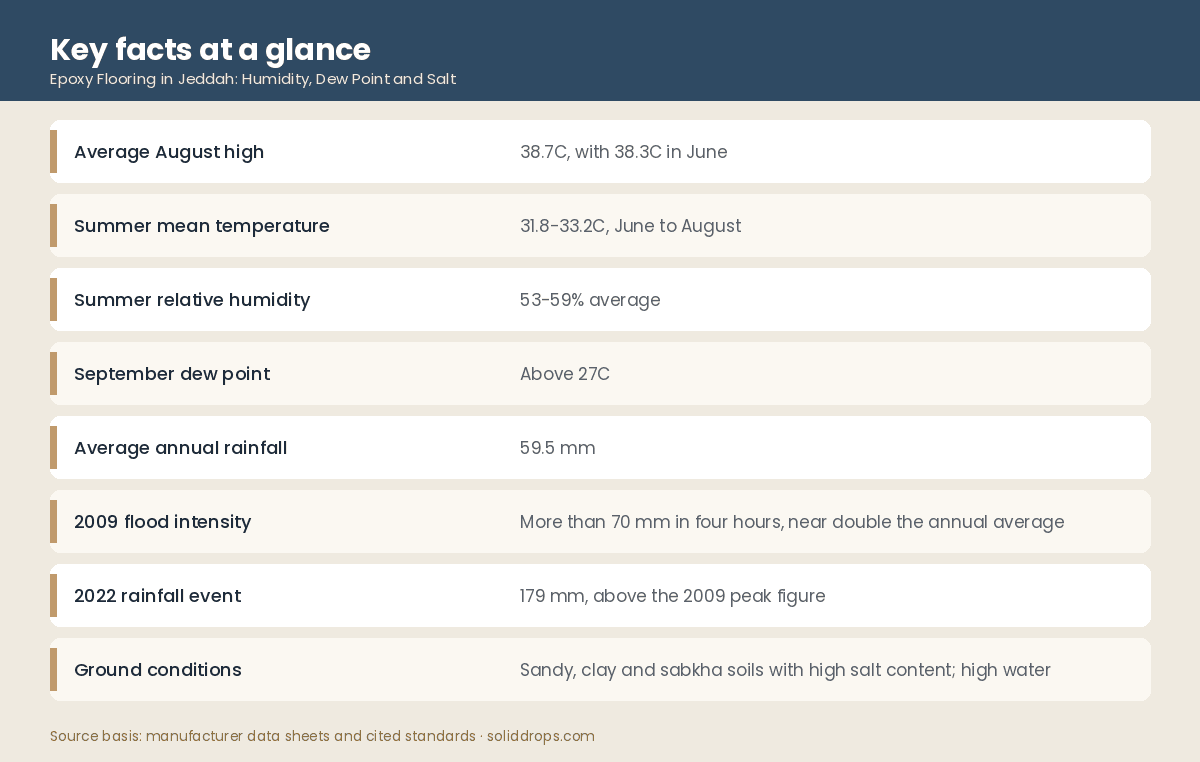
| Property | Value | Basis / standard |
|---|---|---|
| Average August high | 38.7C, with 38.3C in June | Wikipedia, Jeddah climate table |
| Summer mean temperature | 31.8-33.2C, June to August | Wikipedia, Jeddah climate table |
| Summer relative humidity | 53-59% average | Wikipedia, Jeddah |
| September dew point | Above 27C | Wikipedia, Jeddah |
| Average annual rainfall | 59.5 mm | Wikipedia, Jeddah climate table |
| 2009 flood intensity | More than 70 mm in four hours, near double the annual average | 2009 Jeddah floods record |
| 2022 rainfall event | 179 mm, above the 2009 peak figure | Arab News, 25 November 2022 |
| Ground conditions | Sandy, clay and sabkha soils with high salt content; high water table in coastal districts | Asas Lab, soil nature of Jeddah |
| Port and industry | Jeddah Islamic Port, 36th largest seaport worldwide; Jeddah's industrial district is the 4th largest in Saudi Arabia | Wikipedia, Jeddah |
What makes epoxy flooring in Jeddah a moisture problem?
Epoxy flooring in Jeddah is a moisture-management exercise from survey to handover. Three separate water sources act on the same floor, and each needs its own answer.
The first is the air. Summer relative humidity averages 53-59%, and September dew points climb above 27C. On any surface cooler than that dew point, a film of water forms whether anyone can see it or not.
The second is the ground. Jeddah soils include sandy, clay and sabkha material with high salt content, and the water table is high in coastal districts such as the Corniche and South Jeddah. That combination drives chloride and sulfate attack on concrete and reinforcement.
The third is rainfall, which is tiny in annual total and enormous in intensity. The city averages 59.5 mm a year, yet in November 2009 more than 70 mm fell in four hours, close to double the annual figure, and the 2022 event was reported at 179 mm.
A specification that answers only one of the three is not a Jeddah specification.
How does dew point decide when you can apply?
The rule every applicator knows is that substrate temperature should sit clear of the dew point before a primer or coating goes down. In Jeddah that rule stops being a formality and starts governing the shift pattern.
Air holding 53-59% relative humidity at August highs of 38.7C carries a great deal of water. As a slab cools overnight, particularly near a cold store or under an exposed roof, it can drop below dew point while the air stays warm. Condensation forms on concrete that looks dry, and the primer bonds to water.
Two practical consequences follow. First, night work is not automatically the safe option here that it is inland, because the dew point risk peaks in the early hours. Second, the measurement is not optional: substrate temperature, air temperature and relative humidity should be logged at the start of every bay and repeated during the pour.
- Log substrate temperature against dew point, not air temperature alone.
- Dehumidify and warm the slab in enclosed areas rather than waiting for the weather.
- Stop applying when the margin closes, and record why.
What does Jeddah's flood history mean for a ground-floor slab?
The flood record is a design input, not a headline. A city that averages 59.5 mm a year but has received more than 70 mm in four hours, and 179 mm in a single 2022 event, will put water across ground-floor slabs, loading bays and basement ramps that were drawn for a dry climate.
For a resin floor, the damage is rarely the water itself. Cured epoxy handles wetting. The damage is what water does around the floor: hydrostatic pressure under a slab with no working damp-proof membrane, silt and hydrocarbon contamination driven into open joints, and salt carried in and left behind as the water evaporates.
So the flooring scope in Jeddah should ask where water goes. Falls to drainage, a raised threshold at shutter lines, coved upstands in wash-prone rooms, and sealed movement joints all cost little at construction and a great deal to retrofit.
Where a building has flooded before, test the slab for residual moisture and contamination before pricing any system. Assume nothing from the original drawings.
What do salt and the water table do to the slab?
Documented Jeddah ground conditions include sabkha soil with high salt content, which lowers bearing capacity and drives corrosion, alongside a high groundwater table in the coastal belt that makes excavation difficult and exposes concrete and reinforcement to chloride and sulfate attack.
For flooring, the consequence is straightforward. A slab sitting on salty, wet ground without an effective barrier is a moisture pump. Water vapour rises through the concrete, reaches the underside of a low-permeability resin film, and either blisters it or fails the bond. Where salts travel with the water, they crystallise at the interface and lift the coating mechanically.
Two decisions follow. Measure slab relative humidity properly before choosing the system, and where readings exceed the manufacturer’s limit, specify a vapour-suppressant layer or moisture-tolerant primer rather than hoping the topcoat copes. On a basement or a below-grade plant room, the correct conversation is tanking, not flooring; our waterproofing systems guide sets out the options.
Reinforcement protection and structural repair sit with the structural engineer. A contractor promising to cure chloride-induced corrosion with a floor coating is selling the wrong product.
Which buildings in Jeddah need this?
Jeddah’s industrial district is the fourth largest in Saudi Arabia, after Riyadh, Jubail and Yanbu, and Jeddah Islamic Port is the 36th largest seaport in the world and the second busiest in the Middle East. That port economy sets the flooring brief for much of the city.
Port-side logistics and cold chain
Container handling aprons, transit sheds and chilled stores, where thermal shock at door lines and constant humidity dominate.
Food processing and central kitchens
Wash-down, steam cleaning, organic acids and drainage falls, with hygienic coving and slip performance graded before appearance.
Manufacturing in Jeddah 3rd Industrial City
Modon estate units with mixed process loads, machine bases and localised chemical spillage.
Commercial and mixed-use fit-out
Back-of-house, parking and plant areas in developments such as the Jeddah Central waterfront programme.
Food and cold chain is where Jeddah diverges most from an inland city. Wash-down plus permanently humid air means a coating that relies on a dry substrate between cleans will not get one.
Which epoxy system suits which Jeddah floor?
| System | Best for in Jeddah | Key local limit |
|---|---|---|
| Roller-applied epoxy coating | Dry-goods warehousing, showroom and parking areas on a sound, dry slab | Least tolerant of dew point error and rising damp; the thin film shows every substrate moisture defect |
| Self-levelling epoxy screed | Production halls and logistics floors where flatness and cleanability are graded | Needs verified slab moisture; a vapour-suppressant layer is often the deciding cost |
| Urethane or polyurethane mortar screed | Food processing, central kitchens, cold store approaches and wash-down bays | Detailing at coving, drains and door thresholds is the whole job; budget the falls, not the area |
| Vapour-suppressant primer build-up | Ground-floor slabs on high water table sites, and previously flooded buildings | Adds a layer and a cure period to the programme; specify against measured readings |
System data sits in our epoxy flooring guide for Saudi Arabia and, for the wash-down systems, the polyurethane concrete flooring guide. Use those for thickness and temperature limits; use this page for the Jeddah constraints on the choice.
Unsure whether your Jeddah slab needs a vapour barrier?
Send the slab history and drawings and our technical team will set out the testing needed before anything is specified.
How should a Jeddah floor be programmed?
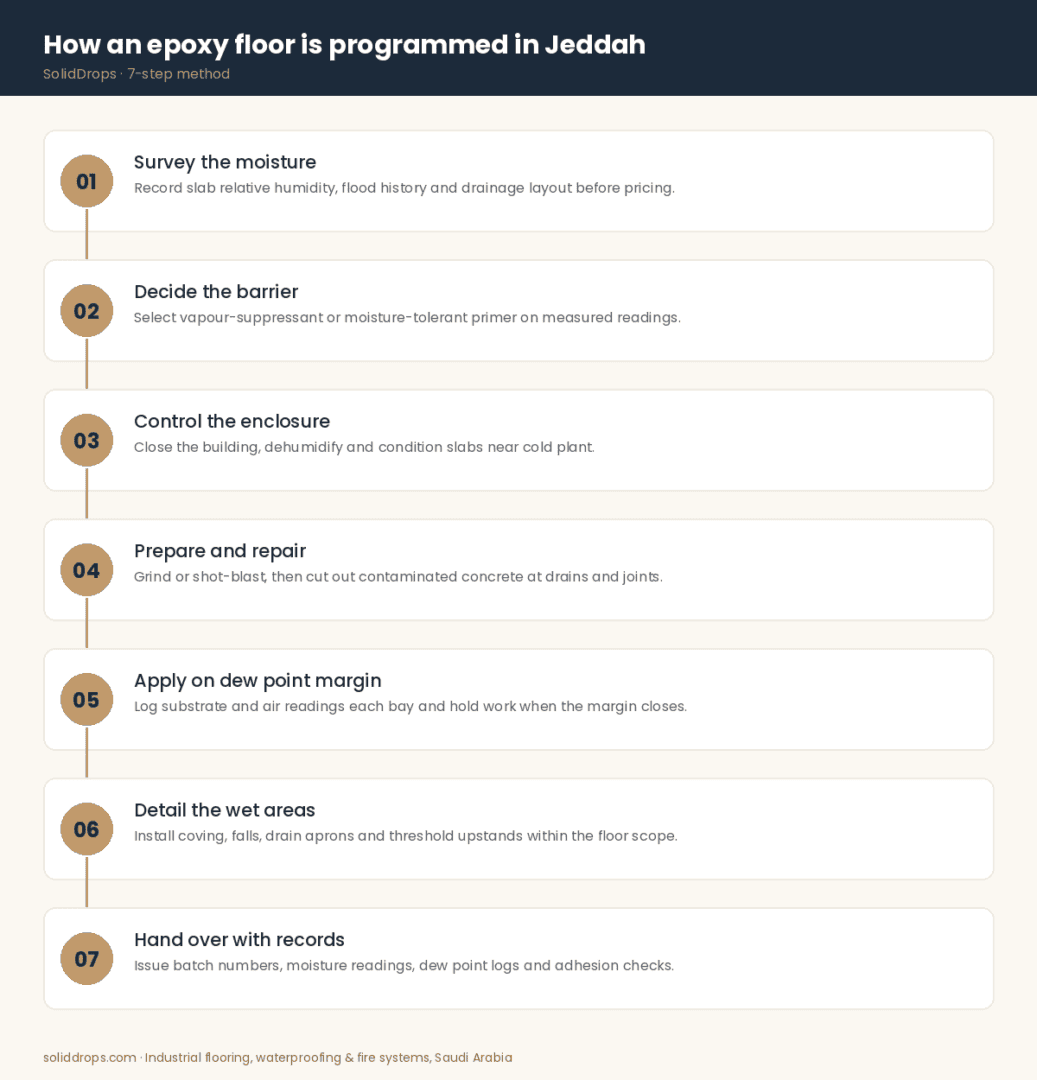
- Survey the moisture first. Slab relative humidity, surface condition, flood history and drainage layout, recorded before anything is priced.
- Decide the barrier. Choose vapour-suppressant or moisture-tolerant primer on measured readings, and get it into the tender rather than the variation.
- Control the enclosure. Close the building, run dehumidification and, where a floor sits near cold plant, condition the slab before priming.
- Prepare and repair. Shot-blast or grind, then cut out contaminated concrete around old drains and joints instead of coating over it.
- Apply on dew point margin. Log substrate and air temperature and relative humidity at each bay, and hold the work when the margin closes.
- Detail the wet areas. Coving, falls, drain aprons and threshold upstands installed as part of the floor, not as a follow-on trade.
- Hand over with records. Batch numbers, moisture readings, dew point logs and adhesion checks issued together.
Food and port operations rarely release a whole building. Expect small phased possessions, weekend shutdowns and a night-shift crew working around chilled areas that cannot be switched off.
What goes wrong on Jeddah floors?
- Osmotic blistering from an untested slab. The single most common coastal failure. Blisters appear weeks after handover, filled with liquid, and the only real repair is removal.
- Priming through condensation. A slab below dew point at 6am takes a primer that never bonds. The floor looks perfect until traffic peels it.
- Coating run flat into a wash-down area. No falls, no coving, standing water at the wall line, and biological growth in the corner within a season.
- Salt left in the substrate. Flood or leak residue not removed before priming crystallises at the bond line and lifts the film.
- Cold-store thresholds treated as ordinary floor. Thermal movement across a door line splits a rigid coating; that detail needs a flexible joint and a tolerant system.
Every one is preventable at survey stage and expensive afterwards. The moisture test is the cheapest line in the quotation.
What drives the cost of epoxy flooring in Jeddah?
SolidDrops prices against a surveyed site. These variables move a Jeddah figure further than the resin choice does.
- Measured slab moisture. Whether a vapour-suppressant layer is needed is the largest single swing on a coastal ground-floor slab.
- Wet-area detailing. Coving, drain aprons, falls and thresholds are measured in linear metres and can outweigh the floor area.
- Substrate repair. Contaminated or salt-damaged concrete around old drainage has to be cut out and rebuilt.
- Climate control. Dehumidification plant and slab conditioning for a humid enclosed area is a real line item.
- Phasing. Port-side and food operations release floors in small bays at night; the same area costs more that way.
- Mobilisation. SolidDrops is based in Jeddah, so mobilisation within the city is short; sites in the wider Makkah region add travel and permit time.
Send drawings, slab history and the shutdown window, then request a quotation.
Who supplies and installs epoxy flooring in Jeddah?
SolidDrops supplies and installs epoxy flooring in Jeddah for warehouses, food facilities, kitchens, workshops, retail service areas and parking structures. Scope runs from survey and moisture testing through preparation, application and handover records. Enquiries often arrive in Arabic asking for أرضيات إيبوكسي for a coastal warehouse or a central kitchen.
Our city page covers the day-to-day service: epoxy flooring in Jeddah. Where the same building needs roof, basement or wet-area protection, that combined scope sits on flooring and waterproofing support in Jeddah.
For a comparison with Gulf coast conditions on the other side of the Kingdom, see our Riyadh site conditions guide. Contact [email protected] or +966 50 213 1112 with the building type, slab history and available shutdown window.
Frequently asked questions
Does epoxy flooring work in Jeddah's humidity?
Yes, provided the application is controlled. Cured epoxy is unaffected by humid air. The risk is during installation: at 53-59% summer humidity and September dew points above 27C, condensation can form on a slab that looks dry. Substrate temperature must be logged against dew point before priming.
How long does epoxy flooring take to cure in Jeddah humidity?
Cure times come from the product data sheet and vary by system and temperature, so no figure is quoted here. What matters locally is that high humidity affects surface finish and amine blush risk on some epoxies more than it affects the cure schedule. Confirm timings on the data sheet.
Is epoxy flooring suitable for food facilities in Jeddah?
Epoxy coatings suit dry food storage. For wash-down areas, steam cleaning and cold store approaches, a polyurethane or urethane mortar screed with coving, falls to drainage and detailed thresholds is the usual specification. The detailing around drains and door lines matters more than the floor area.
Does sabkha soil affect flooring in Jeddah?
Indirectly but seriously. Jeddah soils include sabkha material with high salt content and a high water table in coastal districts, which drives moisture and salts up through a ground-floor slab. The flooring answer is measured slab moisture testing and, where readings demand it, a vapour-suppressant layer.
Can epoxy flooring be laid in a building that flooded?
Yes, after testing. Jeddah has recorded more than 70 mm of rain in four hours and a 179 mm event in 2022, so previously flooded slabs are common. Test for residual moisture and contamination, cut out affected concrete around drains and joints, then select the system on the readings.
What is the best time to install an epoxy floor in Jeddah?
Any month works inside a controlled enclosure, which is why the enclosure matters more than the calendar here. September, with dew points above 27C, is the hardest period for uncontrolled areas. Plan dehumidification and slab conditioning rather than chasing a season.
How much does epoxy flooring cost in Jeddah?
There is no fixed rate. The main drivers are measured slab moisture and whether a vapour barrier is required, wet-area detailing in linear metres, substrate repair, climate control plant and night or phased working. Send drawings and slab history to [email protected] and request a quotation.
Who installs epoxy flooring in Jeddah?
SolidDrops supplies and installs epoxy flooring in Jeddah for industrial, food, logistics, commercial and parking projects, and is based in the city. Work includes survey, moisture testing, preparation, application and handover records. Contact [email protected] or +966 50 213 1112.
Talk to a flooring specifier in Jeddah
SolidDrops supplies and installs epoxy and polyurethane flooring across Jeddah, with slab moisture testing and dew point control built into the method.
 Chat Online