
15 Sep Epoxy Flooring in Jubail: Chemical Exposure and Turnarounds
Epoxy Flooring in Jubail: Chemical Exposure and Turnarounds
Epoxy flooring in Jubail is specified for a petrochemical city, so the floor is selected against a declared chemical exposure list and installed inside a fixed plant turnaround window. Get the chemistry and the shutdown dates right and the rest of the specification follows from them.
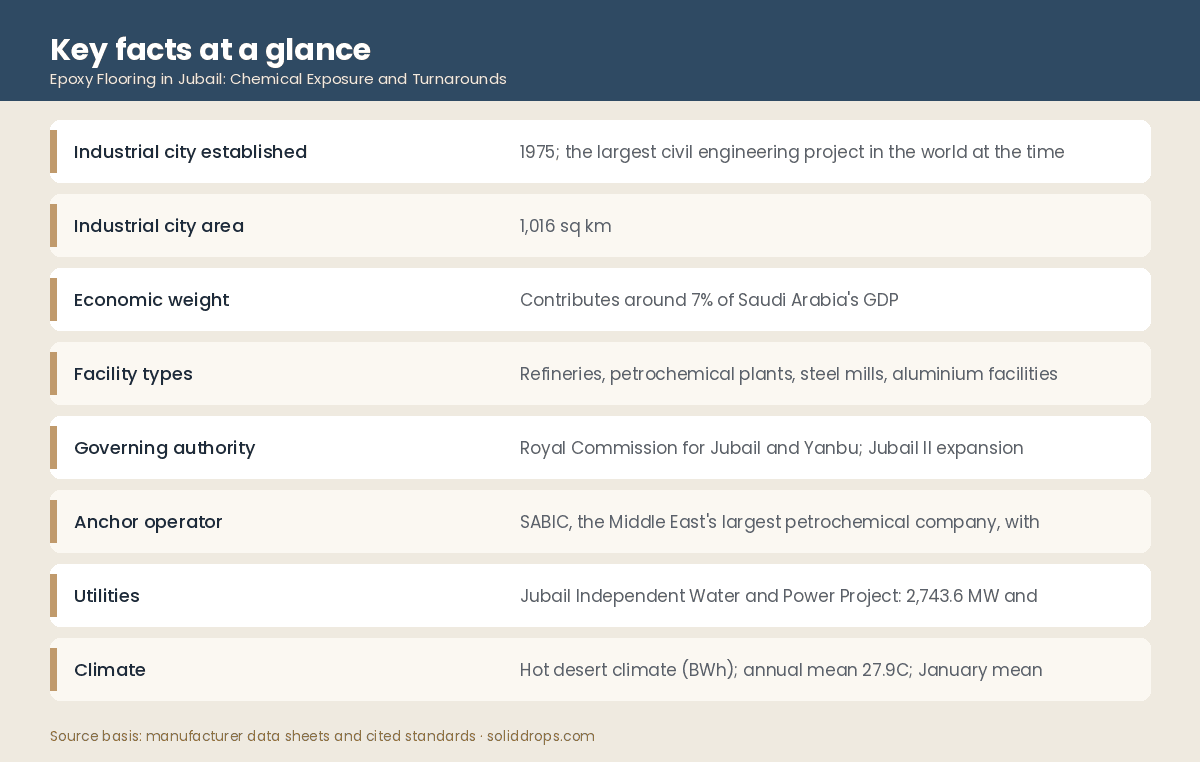
| Property | Value | Basis / standard |
|---|---|---|
| Industrial city established | 1975; the largest civil engineering project in the world at the time | Wikipedia, Jubail |
| Industrial city area | 1,016 sq km | Wikipedia, Jubail |
| Economic weight | Contributes around 7% of Saudi Arabia's GDP | Wikipedia, Jubail |
| Facility types | Refineries, petrochemical plants, steel mills, aluminium facilities and desalination plants | Wikipedia, Jubail |
| Governing authority | Royal Commission for Jubail and Yanbu; Jubail II expansion contracted to Bechtel in 2004 at 3.8 billion US dollars | Wikipedia, Jubail |
| Anchor operator | SABIC, the Middle East's largest petrochemical company, with major operations in Jubail | Wikipedia, Jubail |
| Utilities | Jubail Independent Water and Power Project: 2,743.6 MW and 800,000 cubic metres of water daily | Wikipedia, Jubail |
| Climate | Hot desert climate (BWh); annual mean 27.9C; January mean daily minimum around 8C | Wikipedia, Jubail |
Why is epoxy flooring in Jubail specified differently?
Epoxy flooring in Jubail is specified inside a purpose-built industrial city. Jubail Industrial City was established in 1975, covers 1,016 square kilometres, and contributes around 7% of Saudi Arabia’s GDP through refineries, petrochemical plants, steel mills, aluminium facilities and desalination plants. The Royal Commission for Jubail and Yanbu manages it, and the Jubail II expansion was contracted to Bechtel in 2004 at 3.8 billion US dollars.
That setting changes the brief in two ways that no other Saudi city imposes so consistently.
First, the floor has a chemical duty. A plant floor is not asked to look good; it is asked to survive a defined list of process fluids at defined temperatures. Second, the floor has a date. Work happens inside a turnaround or a scheduled shutdown, and that window does not move because a contractor needs another night.
Utility scale reinforces the point. The Jubail Independent Water and Power Project generates 2,743.6 MW and 800,000 cubic metres of water a day, and facilities on that scale run to a maintenance calendar set years ahead.
How should chemical exposure be declared?
The most useful document a client can hand a flooring contractor in Jubail is not a drawing. It is a list. Resistance is a property of a specific resin against a specific chemical, at a specific concentration, temperature and contact time, and a system that shrugs off one acid may soften in a solvent.
A usable exposure schedule states, for each area:
- The chemical name and concentration, not a family label such as “acids”.
- The temperature at which it contacts the floor, including steam and hot wash-down.
- Whether the exposure is splash and clean-up, or standing contact in a bund.
- The cleaning agents used, which are often more aggressive than the process fluid.
- Mechanical duty in the same area: drums dragged, forklifts, dropped tooling.
That schedule is then checked line by line against manufacturer chemical resistance data. This guide quotes no resistance ratings, because a rating without the matching product and concentration is worthless. Where the list includes a chemical the epoxy family does not cover, the answer is usually a vinyl ester or a polyurethane-based screed rather than a thicker epoxy.
What does a plant turnaround window do to the method?
A turnaround is a fixed-duration shutdown with hundreds of trades competing for the same access. Flooring sits near the end of the sequence and absorbs every delay upstream of it, which is why the honest question at tender is not how fast the resin cures but how much time the floor will actually get.
Three consequences shape the method.
Cure time becomes a selection criterion. Where the window is short, a fast-return system may be the only technically viable answer even if a slower system would perform better in service. That trade-off should be made openly with the client, in writing.
Preparation must be planned for a live plant. Shot-blasting near running equipment, hot-work permits, confined space entries and gas testing all consume window time before any resin is opened.
Contingency belongs in the programme. If the floor is handed over two days late, the plant does not start. Building a spare shift into the sequence is cheaper than explaining a delayed start-up.
What do the temperatures do, inside and outside?
Jubail has a hot desert climate, with an annual mean temperature of 27.9C and a January mean daily minimum of around 8C. Published peak summer figures for the city vary between sources, so this guide quotes none; site-measured air and substrate readings are what a method statement should be built on.
For plant flooring, the process temperature usually matters more than the weather anyway. Steam cleaning, hot spillage and thermal cycling at a vessel base put a floor through swings that no ambient record captures. A rigid epoxy bonded to concrete that is repeatedly shocked with hot water will eventually debond at the edges, regardless of how well it was installed.
Two rules cover most cases. Where hot liquids or steam reach the floor, specify a thermal-shock-tolerant screed rather than a coating, and detail the drainage so the liquid leaves quickly. Where the area is externally exposed, treat solar gain on the slab as a real load and plan application for the cooler hours.
Which Jubail areas need which approach?
Process and pump areas
Declared chemical exposure, bunding, drainage falls and coving, with mechanical duty from maintenance access.
Chemical storage and bunds
Standing contact rather than splash, which raises the resistance requirement and makes the upstand detail part of the containment.
Maintenance workshops
Impact, hydraulic oils, welding and vehicle traffic, where abrasion resistance leads and chemical duty is intermittent.
Control rooms and substations
Dust-free, cleanable and, where equipment demands it, a defined static control requirement verified by measurement.
Utility and desalination buildings
Constant wet service, treatment chemicals and pump plinth detailing around running equipment.
Warehousing and laydown
Racking loads, forklift traffic and marking, with the least demanding chemical brief on the site.
Describing the area by duty rather than by building name is what lets a specification be checked. Two rooms in the same plant can need entirely different systems.
Which system suits which Jubail duty?
| System | Best for in Jubail | Key local limit |
|---|---|---|
| Epoxy coating | Warehousing, laydown areas, substations and low-exposure service floors | Thin film gives the least protection where chemicals stand; not a bund solution |
| Self-levelling epoxy screed | Control rooms, laboratories and clean process areas with splash-level exposure | Chemical list must be checked against product data; cure time may exceed a short turnaround |
| Urethane or polyurethane mortar screed | Steam cleaning, hot spillage, thermal cycling and wet utility areas | Needs proper falls and drainage to earn its thermal-shock performance |
| Vinyl ester or specialist chemical-resistant build-up | Bunds and areas with aggressive standing chemicals outside the epoxy range | Specialist handling and longer lead time; confirm availability against the shutdown date |
Product data belongs with the products: see the epoxy flooring guide for Saudi Arabia and the urethane mortar flooring guide for thickness, temperature and resistance data.
Have a turnaround date and an exposure list?
Send both and our technical team will confirm which systems fit the chemical duty and the window you actually have.
How is the work sequenced inside a shutdown?
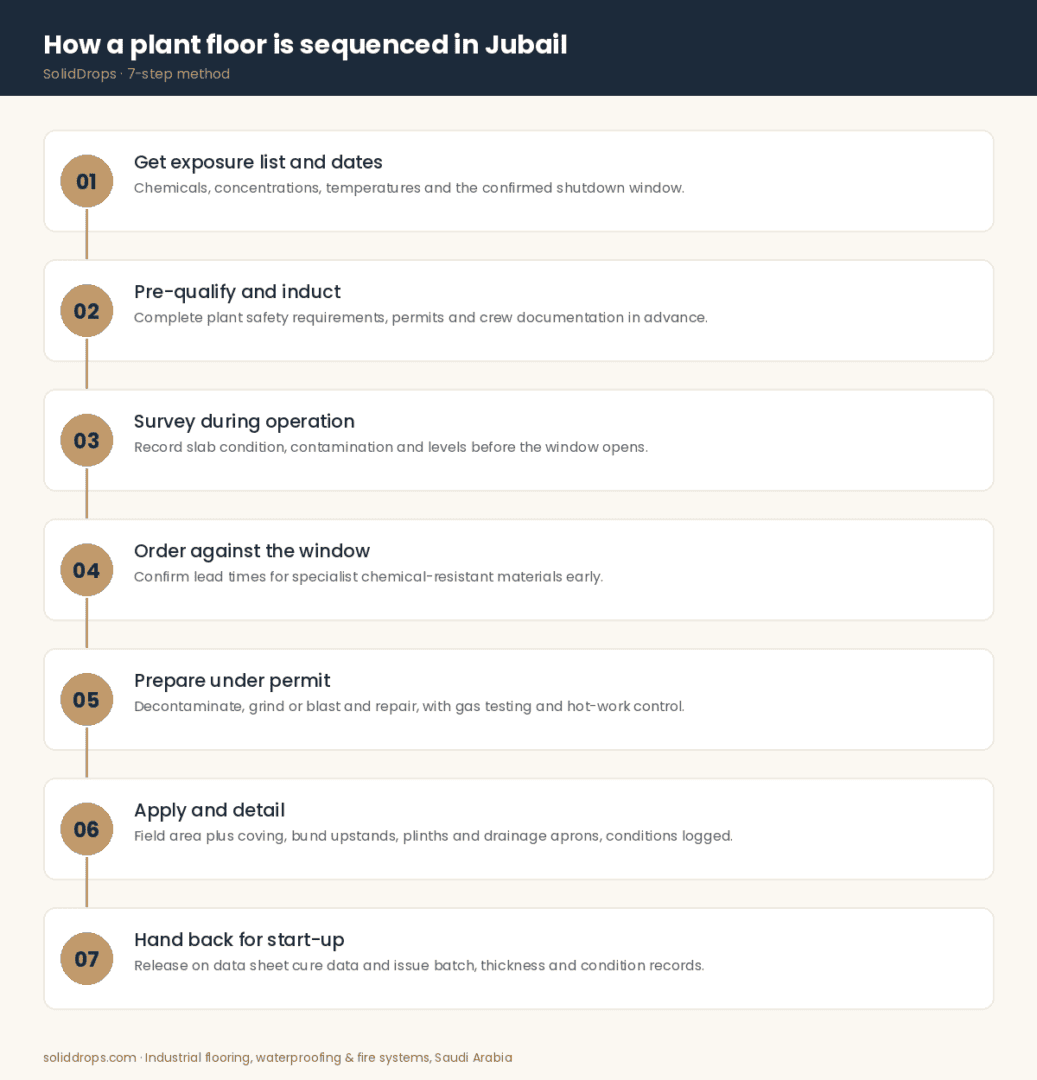
- Obtain the exposure schedule and the dates. Chemicals, temperatures and the confirmed window, before a system is proposed.
- Pre-qualify and induct. Royal Commission and plant safety requirements, permits, inductions and crew documentation completed ahead of the shutdown.
- Survey during operation. Slab condition, existing coating identification, contamination and levels recorded while the plant still runs, so no window time is spent on discovery.
- Order against the window. Confirm material lead times, particularly for specialist chemical-resistant systems, before the shutdown starts.
- Prepare under permit. Mechanical preparation, decontamination of chemically soaked concrete and repairs, with gas testing and hot-work control as required.
- Apply and detail. Field area, coving, bund upstands, plinths and drainage aprons, with conditions logged at each bay.
- Hand back for start-up. Release against data sheet cure data, and issue batch records, thickness checks and condition logs with the floor.
What goes wrong on plant floors in Jubail?
- Exposure declared as a category. “Chemical resistant” on a drawing is not a specification. Without names, concentrations and temperatures, the selection is guesswork.
- Contamination left in the concrete. Concrete soaked with oils or process fluid over years must be decontaminated or cut out, or the new floor debonds from beneath.
- Cure time discovered too late. A system chosen on performance alone, then found to need more days than the shutdown allows, forces a rushed substitution.
- Bunds treated as floors. Containment areas hold standing liquid and need an upstand and detail continuity that a field coating does not provide.
- Thermal shock ignored around steam. A rigid coating near a steam lance lifts at the edges within months.
- Permit time not priced. Gas testing, escorts and hot-work approvals consume real hours inside the window.
What drives the cost of epoxy flooring in Jubail?
- The chemical duty. A specialist chemical-resistant build-up is a different order of cost from a general-purpose epoxy coating.
- Window length. Compressed shutdown work carries more crew, more shifts and more contingency.
- Decontamination. Removing chemically soaked concrete is measured after investigation, not estimated from a drawing.
- Detailing. Bund upstands, plinths, drainage aprons and coving are priced in linear metres and often dominate a small area.
- Permits and safety. Inductions, gas testing, standby personnel and escorted access are chargeable time inside a live plant.
- Mobilisation. Distance into the industrial city, accommodation for a shutdown crew and material lead time all sit in the figure.
Send the exposure schedule, the shutdown dates and the area breakdown, then request a quotation.
Who supplies and installs epoxy flooring in Jubail?
SolidDrops supplies and installs epoxy and polyurethane flooring in Jubail for industrial plants, chemical exposure zones, workshops, warehouses and utility buildings. The work covers survey, system selection against a declared exposure list, preparation, application and handover records, and it is scheduled around the plant’s own shutdown calendar.
Our city page covers the standing service: epoxy flooring in Jubail. Where tanks, roofs, bunds or below-grade structures need protection alongside the floor, see flooring and waterproofing support in Jubail. For conditions further down the coast, our Dammam site conditions guide covers the factory-floor side of the Eastern Province.
Arabic enquiries for أرضيات إيبوكسي are handled directly. Contact [email protected] or +966 50 213 1112 with the exposure schedule and the shutdown dates, and a survey can be arranged while the plant is still running.
Frequently asked questions
What epoxy flooring resists chemicals in a Jubail plant?
It depends entirely on which chemicals, at what concentration and temperature, and whether contact is splash or standing. Epoxy covers a wide range but not everything; aggressive standing exposure often needs a vinyl ester or polyurethane-based system. Selection is made by checking your exposure schedule against manufacturer resistance data.
Can epoxy flooring be installed during a plant turnaround?
Yes, and most Jubail plant flooring is. The controlling factor is how many days the floor actually gets after upstream trades finish. Cure schedule then becomes a selection criterion alongside performance, and survey work should be completed while the plant is still running to protect window time.
Is epoxy flooring suitable for chemical storage bunds?
A bund is a containment structure, not a floor area, so it needs continuous detailing up the upstands and a system rated for standing contact with the stored chemical. A general-purpose epoxy coating applied only to the base is not sufficient. Specify against the stored product and its temperature.
Does steam cleaning damage epoxy flooring?
It can. Repeated thermal shock at a steam lance or hot spillage point makes rigid coatings debond at edges and joints over time. Where hot water or steam reaches the floor regularly, a urethane or polyurethane mortar screed with proper falls to drainage is the appropriate specification.
What is needed to work inside Jubail Industrial City?
Plant and Royal Commission safety requirements apply: crew induction, permits, hot-work approval where preparation generates sparks or heat, gas testing in some areas, and escorted or restricted access. These consume real hours and should be programmed and priced before the shutdown starts, not discovered during it.
How long does an industrial epoxy floor last in a plant?
Service life depends on the system, thickness, chemical duty and traffic, so no figure is quoted here. In practice the areas that fail early are those where the declared exposure did not match reality, or where a coating was used where a screed was needed. Manufacturer data gives the performance limits.
How much does epoxy flooring cost in Jubail?
Cost is driven by the chemical duty, the length of the shutdown window, decontamination of contaminated concrete, linear-metre detailing at bunds and plinths, permit and safety time, and mobilisation. Send the exposure schedule and shutdown dates to [email protected] and request a quotation.
Who supplies epoxy flooring in Jubail Industrial City?
SolidDrops supplies and installs epoxy and polyurethane flooring in Jubail for plants, chemical exposure zones, workshops and utility buildings, including survey, preparation, application and handover records. Reach the team at [email protected] or on +966 50 213 1112.
Talk to a flooring specifier for Jubail
SolidDrops supplies and installs industrial resin flooring in Jubail, surveyed while the plant runs and installed inside the shutdown window.
 Chat Online