
16 Sep Epoxy Flooring in Makkah: Heat, Wadi Floods and Season Planning
Epoxy Flooring in Makkah: Heat, Wadi Floods and Season Planning
Epoxy flooring in Makkah has to be specified around three local facts: daily summer maxima of 40 to 43.8C, roughly 110mm of rain falling almost entirely between November and January into a wadi valley, and buildings that cannot close during pilgrim seasons. Each one changes the system, not just the schedule.
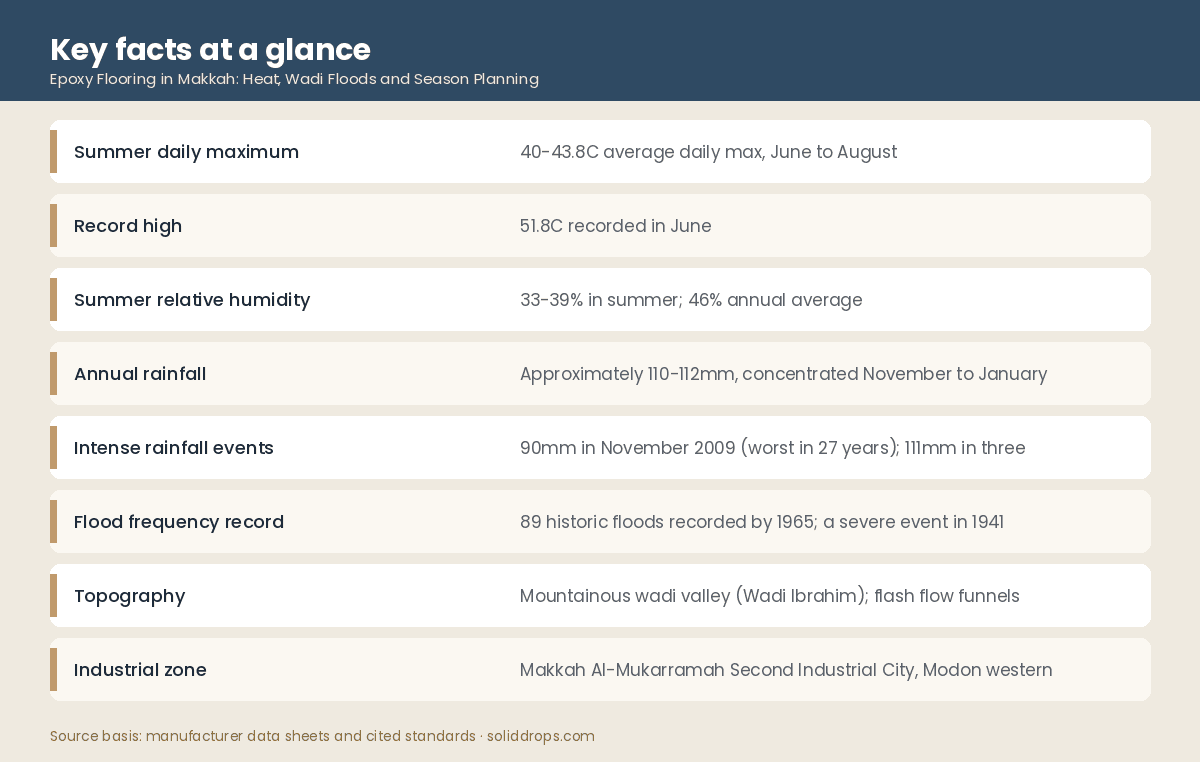
| Property | Value | Basis / standard |
|---|---|---|
| Summer daily maximum | 40-43.8C average daily max, June to August | Climate of Mecca (Wikipedia climate record) |
| Record high | 51.8C recorded in June | Climate of Mecca (Wikipedia climate record) |
| Summer relative humidity | 33-39% in summer; 46% annual average | Climate of Mecca (Wikipedia climate record) |
| Annual rainfall | Approximately 110-112mm, concentrated November to January | Climate of Mecca (Wikipedia climate record) |
| Intense rainfall events | 90mm in November 2009 (worst in 27 years); 111mm in three hours, January 2011 | Published Makkah flood records; Springer, Discover Sustainability (2025) |
| Flood frequency record | 89 historic floods recorded by 1965; a severe event in 1941 | Published Makkah flood records |
| Topography | Mountainous wadi valley (Wadi Ibrahim); flash flow funnels toward the Haram area | Springer, Discover Sustainability (2025) |
| Industrial zone | Makkah Al-Mukarramah Second Industrial City, Modon western sector | Modon industrial cities directory |
| Peak occupancy driver | Grand Mosque capacity exceeds 1.7 million worshippers | Saudipedia, capacity of the Grand Mosque |
What makes epoxy flooring in Makkah different from the rest of Saudi Arabia?
Epoxy flooring in Makkah is not hot-climate flooring with a different postcode. Three conditions stack here, and a specification that handles one while ignoring the other two will still fail. The first is sustained heat: average daily maxima of 40 to 43.8C from June through August, with a record high of 51.8C in June. The second is water arriving all at once — around 110 to 112mm of annual rainfall, almost all of it between November and January, into a mountainous wadi valley. The third is occupancy. Buildings serving a Grand Mosque whose capacity exceeds 1.7 million worshippers do not shut down for the convenience of a flooring contractor.
Compare that with a coastal site. Makkah’s summer relative humidity sits at 33 to 39 per cent against a 46 per cent annual average — drier air than the Red Sea coast, so dew point strike-through on a curing film is a smaller risk than it would be in Jeddah. The trade is that the slab runs hot, and heat drives resin chemistry harder than humidity does.
So the practical question in مكة المكرمة is rarely which resin in the abstract. It is: what temperature will the concrete be at seven in the morning, where does the water go in January, and when is the building actually empty?
How does Makkah's heat change the application window?
Resin systems cure by exotherm. Raise the substrate temperature and the reaction accelerates, shortening pot life, working time and the window in which a wet edge survives across a bay. At 40C-plus ambient, a slab under a metal roof all afternoon sits well above air temperature, and mixed material starts gelling before the squeegee has crossed the floor. What that means for a Makkah programme:
- Mix smaller. Reduce batch size so no unit sits in the pail longer than the working time the TDS allows at the measured slab temperature — not at 25C laboratory conditions.
- Measure the substrate, not the air. A surface thermometer on the slab and a reading of relative humidity and dew point, taken at the hour you intend to pour, is the only defensible basis for going ahead.
- Shift to night or early morning. Most Makkah summer work runs overnight or in the hours before sunrise, when the slab has shed its stored heat.
- Store material conditioned. Drums left on a compound in June are not at the temperature the data sheet assumes. Shaded, temperature-controlled storage is part of the scope, not a courtesy.
Lap marks, roller ridges, patchy gloss and pinholing in Makkah are usually not workmanship failures in the ordinary sense. They are the visible record of material that gelled faster than the crew could move.
What do the wadi valley and the flood record mean for slabs?
Makkah sits in a wadi valley, and flash flow funnels down the surrounding high ground rather than soaking away. The record is long: 89 historic floods were recorded by 1965, with a severe event in 1941. More recently, November 2009 brought 90mm — the heaviest in 27 years — and January 2011 delivered 111mm in three hours, close to a full year of rain inside a single morning.
Basement car parks, hotel service yards, laundry and kitchen levels and ground-floor stores in the lower valley have all taken water from outside the building envelope rather than from a failed pipe. Two things follow. Treat slab moisture as a live variable: a slab flooded three winters ago may still be releasing moisture, and in-slab relative humidity testing before coating is a condition of proceeding. Then coordinate the floor with the tanking. A resin coating is a wearing surface, not a waterproofing system against hydrostatic pressure from beneath. Where flood ingress or groundwater is credible, the membrane is decided first and the floor sits on top of it — our guide to waterproofing systems in Saudi Arabia sets out those options.
Which buildings in Makkah actually need resin flooring?
Demand here leans toward hospitality and capacity infrastructure rather than heavy manufacturing. Makkah Al-Mukarramah Second Industrial City, in Modon’s western sector, provides the light and medium industrial estate; the larger volume of resin flooring sits behind hotel and service buildings around the central area.
Hotel back-of-house
Production kitchens, wash-up, cold rooms, service corridors and staff canteens. Hot water, oils and steam cleaning rule out standard epoxy in the wet zones.
Central laundries
High-throughput laundries supporting pilgrim-capacity hotels. Constant humidity at floor level, chemical dosing and trolley traffic.
Multi-storey and basement car parks
Deck coatings with crack-bridging and slip resistance, plus ramp detailing that tolerates steering-tyre scrub in heat.
Warehousing and distribution
Catering, retail and pilgrim-supply stores feeding the central area, with racking legs and forklift traffic on the same slab.
Healthcare and clinical support
Coved, cleanable, joint-free finishes in treatment and support areas serving seasonal peak loads.
Light industry at Modon
Workshops, plants and service units on the industrial estate, where chemical and abrasion resistance drives the choice.
We describe the building type, not the client. What a specifier needs is the duty, and the duty in a 24-hour production kitchen at peak occupancy is a different animal from a showroom floor.
Which resin system suits which Makkah building?
The table maps common Makkah duties to system families and to the local constraint that usually decides between them.
| System | Best for in Makkah | Key local limit |
|---|---|---|
| Epoxy coating (roller-applied) | Warehouses, stores, workshops and plant rooms at the Modon estate | Working time collapses on a hot slab; needs night work in summer |
| Epoxy self-levelling | Showrooms, back-of-house corridors, clean storage | Shows every defect in a flood-affected or damp slab; test first |
| Polyurethane concrete (urethane mortar) | Hotel production kitchens, wash-up, laundries, cold rooms | Specified where steam and hot water discharge would debond epoxy |
| Anti-slip broadcast systems | Ramps, service yards, wash-down areas, kitchen wet zones | Aggregate grade must be cleanable, not merely rough |
| Car park deck coating | Basement and multi-storey decks serving central-area hotels | Must tolerate thermal movement and, at basement level, flood ingress history |
| UV-stable polyurethane topcoat | Any floor under daylight — atria, top decks, glazed lobbies | Aromatic epoxy ambers under direct sun; the topcoat is the protection |
Where the duty is hot wet processing, the decision is usually made before the site visit ends. Our polyurethane concrete flooring guide covers the thermal shock and thickness detail; the wider system comparison sits in the epoxy flooring guide for Saudi Arabia.
Planning a floor in Makkah around a pilgrim season?
Send the area drawings and the access window you actually have, and our technical team will set the build-up and programme against it.
How do you programme flooring work around Hajj and Umrah seasons?
This constraint defeats more sound specifications than any material question. Hotels, kitchens, laundries and car parks serving the central area carry their heaviest load during pilgrim seasons, continuously. A floor needing seven days of possession will not get seven days in peak weeks. Decide the shutdown window before selecting the system, then work backwards:
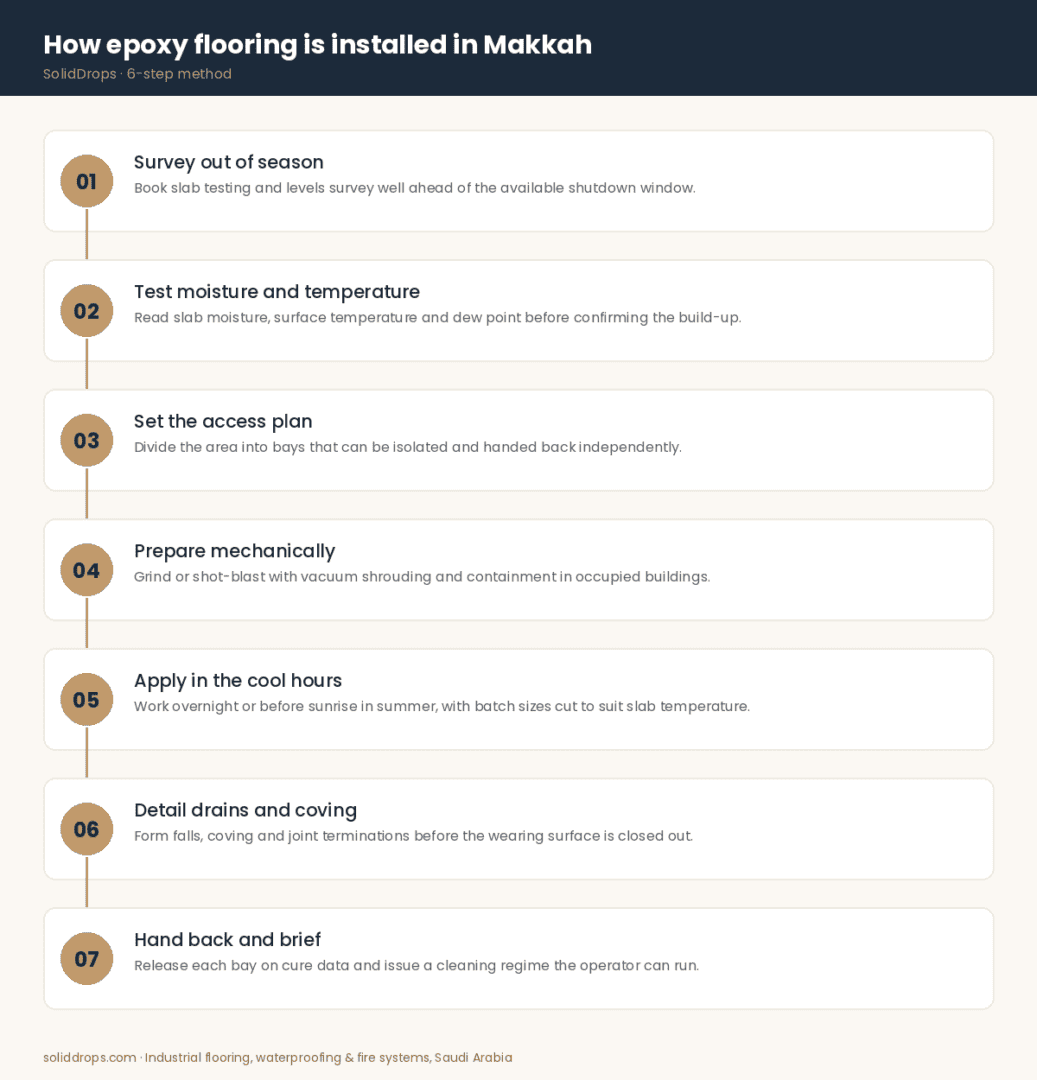
- Survey early, out of season. Moisture testing, adhesion pull-offs and a levels survey need access, and access is cheap months ahead.
- Sectionalise. Break a kitchen into bays that can be isolated, drained and handed back independently.
- Match cure time to the window. Fast-cure systems exist, but the trade-off in working time on a hot slab has to be accepted openly, not discovered on the night.
- Protect adjacencies. Dust from mechanical preparation in an operating hotel is a programme risk; vacuum-shrouded grinding and containment are normal here.
- Book the low season. Major re-flooring is planned against the operator’s own occupancy forecast.
What goes wrong on Makkah floors, and how is it avoided?
Failures here cluster into a short list.
- Coating a damp slab. After a flood event, residual moisture pushes the coating off in blisters. Test before ordering material, not after.
- Standard epoxy in a hot wet kitchen. Steam cleaning and boiling discharge cause thermal shock that a thin epoxy film does not survive. Polyurethane concrete is specified for a reason.
- Ignoring substrate temperature. Roller marks and pinholes trace back to gelling in the pail. Measure the slab, not the shade temperature.
- Aromatic epoxy in daylight. Ambering in an atrium or on an exposed top deck is a cosmetic failure that a UV-stable topcoat prevents from day one.
- Anti-slip that cannot be cleaned. An over-coarse broadcast in a food area traps soil and fails hygiene audits within months.
- No falls to drain. Standing water in a wash-down area finds the weakest detail; falls and drain terminations are designed with the floor.
- Unsealed movement joints. Joints carried through the coating instead of detailed will telegraph and crack.
What drives the cost of epoxy flooring in Makkah?
We quote per project, because the variables below move the figure far more than the resin does. No honest number can be given without seeing the slab.
- Slab condition. Repairs, levelling, crack treatment and removal of old coatings — often the largest line in buildings that have taken water.
- Preparation method. Shot-blasting an open warehouse differs from vacuum-shrouded grinding in a live hotel corridor.
- System and build-up. A roller-applied coating and a polyurethane concrete screed at kitchen thickness are different orders of material cost.
- Access and working hours. Night shifts, seasonal access restrictions and work in occupied buildings all carry a premium.
- Sectionalised handover. Five isolated bays cost more than one pour.
- Ancillary scope. Coving, drain detailing, movement joints, line marking and anti-slip zoning are priced separately.
Send drawings, photographs of the existing slab and the intended use of each area, and we will return a quotation against a defined build-up.
Who supplies and installs epoxy flooring in Makkah?
SolidDrops supplies and installs epoxy and resin flooring in Makkah, alongside waterproofing, FRP hygienic wall panels, construction chemicals and fire alarm materials. Work covers hotel back-of-house, kitchens and laundries, car park decks, warehousing, healthcare support areas and light industrial units on the Modon estate. Our epoxy flooring in Makkah page sets out the service scope, and flooring and waterproofing support in Makkah covers combined packages.
The sequence is consistent: site survey with slab moisture and temperature readings, a written build-up against the measured duty, mechanical preparation, application inside a verified window, and handover with a maintenance regime the operator can run. The same technical team covers Jeddah, Riyadh, Dammam, Jubail, Madinah and Tabuk — Madinah conditions differ enough to be worth reading separately in our Riyadh site conditions guide. For a specification review or quotation, contact [email protected] or +966 50 213 1112.
Frequently asked questions
Who supplies and installs epoxy flooring in Makkah?
SolidDrops supplies and installs epoxy and resin flooring in Makkah for hotel back-of-house areas, kitchens, laundries, car parks, warehouses and light industrial units. The service covers survey, slab testing, written build-up, preparation, application and handover. Contact [email protected] or +966 50 213 1112.
Is epoxy flooring suitable for Makkah's heat?
Yes, once cured. The difficulty is the application window, not the service life. With average daily maxima of 40 to 43.8C in summer and a recorded high of 51.8C, substrate temperature shortens pot life and working time, so most summer installations in Makkah run overnight or before sunrise with reduced batch sizes.
Does Makkah flooding affect ground-floor and basement flooring?
It can. Makkah sits in a wadi valley with 110 to 112mm of annual rain concentrated between November and January, and recorded intense events include 90mm in November 2009 and 111mm in three hours in January 2011. Slab moisture testing and a decision on tanking should precede any coating.
What flooring is best for a hotel kitchen in Makkah?
Polyurethane concrete, commonly called urethane mortar, is normally specified for production kitchens, wash-up and laundries. It tolerates hot water and steam cleaning that would cause a thin epoxy film to debond through thermal shock, and it can be laid with integral coving and falls to drain.
Can epoxy flooring be installed while a Makkah hotel stays open?
Usually, by sectionalising the area into bays that can be isolated, prepared and handed back independently. Vacuum-shrouded grinding and containment control dust in live buildings. The programme is set against the operator’s occupancy forecast, with major work planned outside peak pilgrim seasons.
How long does epoxy flooring take to cure in Makkah?
Cure time depends on the product and the substrate temperature, both read from the technical data sheet against measured site conditions rather than assumed. High slab temperatures speed the reaction and shorten working time. Confirm foot-traffic, light-traffic and full chemical cure times for the specific system before fixing a handback date.
How much does epoxy flooring cost in Makkah?
Cost is driven by slab condition and repair scope, preparation method, the system build-up, access restrictions and night working, sectionalised handover, and any ancillary coving, drainage or waterproofing. Prices are not published because those variables dominate. Send drawings, slab photographs and area uses for a quotation against a defined build-up.
Request a Makkah site survey
SolidDrops supplies and installs epoxy flooring, resin systems and waterproofing across Makkah. Email [email protected] or call +966 50 213 1112.
 Chat Online