
18 Sep Epoxy Flooring in Tabuk: Cold Nights, Cure Risk and Logistics
Epoxy Flooring in Tabuk: Cold Nights, Cure Risk and Logistics
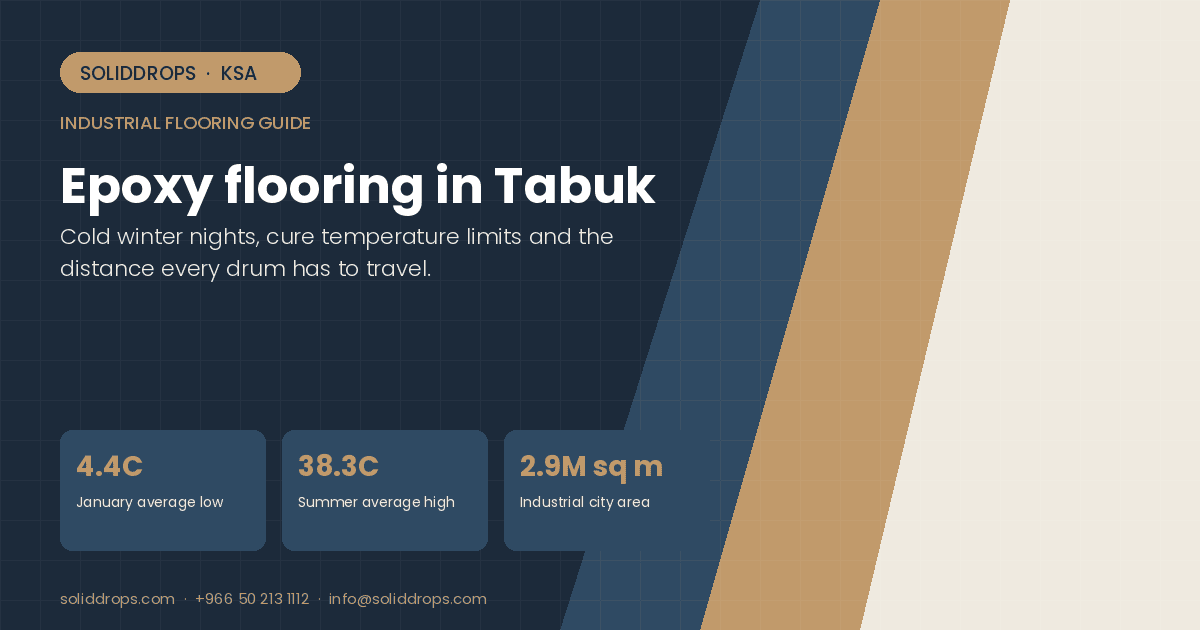
Epoxy flooring in Tabuk is unusual for Saudi Arabia because winter, not summer, sets the hard limit. January averages a low of 4.4C with roughly a 37 per cent chance of frost in mid-month, and epoxy cure slows sharply as the slab cools toward a product’s stated minimum temperature.
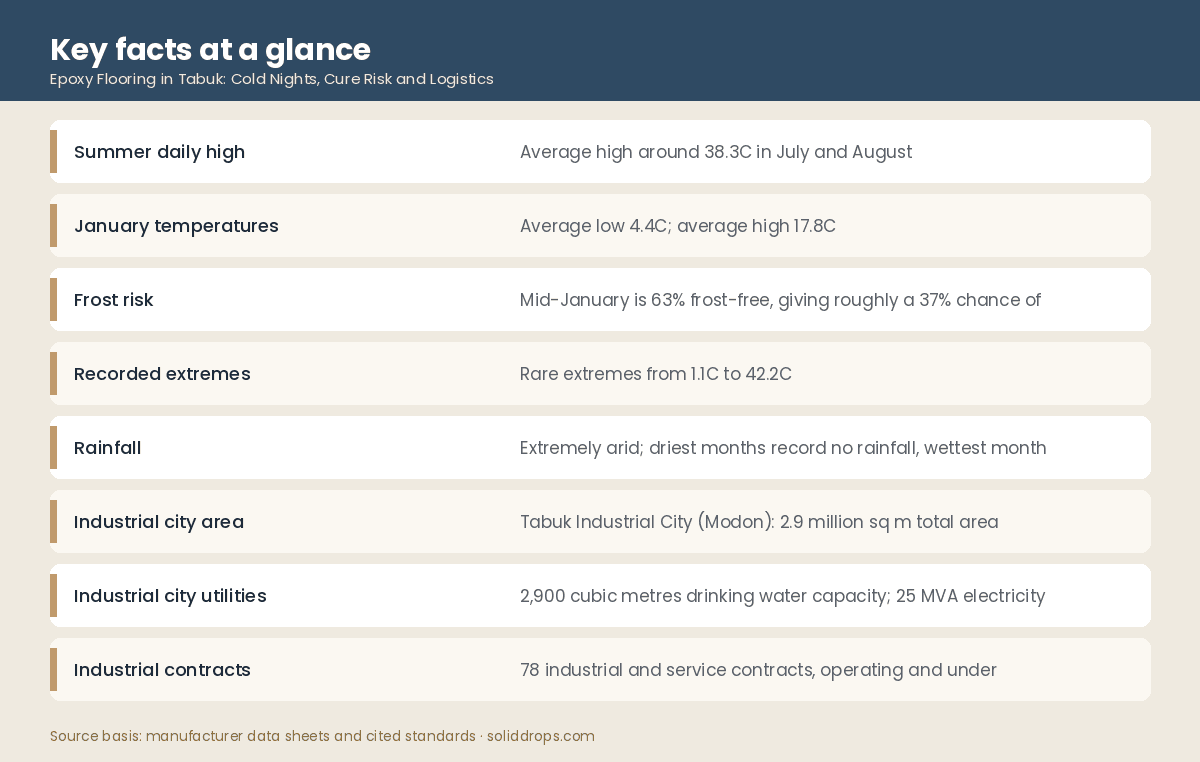
| Property | Value | Basis / standard |
|---|---|---|
| Summer daily high | Average high around 38.3C in July and August | Weather Spark, Tabuk year-round averages |
| January temperatures | Average low 4.4C; average high 17.8C | Weather Spark, Tabuk year-round averages |
| Frost risk | Mid-January is 63% frost-free, giving roughly a 37% chance of frost on that date | Weather Spark, Tabuk year-round averages |
| Recorded extremes | Rare extremes from 1.1C to 42.2C | Weather Spark, Tabuk year-round averages |
| Rainfall | Extremely arid; driest months record no rainfall, wettest month January around 2.5mm | Weather Spark, Tabuk year-round averages |
| Industrial city area | Tabuk Industrial City (Modon): 2.9 million sq m total area | Modon industrial cities directory |
| Industrial city utilities | 2,900 cubic metres drinking water capacity; 25 MVA electricity supply | Modon industrial cities directory |
| Industrial contracts | 78 industrial and service contracts, operating and under implementation: food products, chemicals, non-metallic minerals, machinery | Modon industrial cities directory |
| Logistics distances | 22km to Prince Sultan bin AbdulAziz International Airport; 120km to Halat Ammar Port; 238km to port; 425km to rail | Modon industrial cities directory |
Why is epoxy flooring in Tabuk a winter problem, not a summer one?
Most resin flooring guidance for Saudi Arabia assumes the risk is heat. In Tabuk that is half wrong. Summer is hot — average highs near 38.3C in July and August, rare extremes reaching 42.2C — and the usual hot-weather discipline applies. But the condition that ruins floors here arrives in January.
The January average low is 4.4C against an average high of 17.8C. Mid-January is only 63 per cent frost-free — roughly a one-in-three chance of frost on a given mid-month night — and rare extremes have reached 1.1C. That is a slab temperature range no epoxy data sheet treats as normal.
Epoxy cures by reaction between resin and hardener, and that reaction slows as temperature falls. Below the minimum substrate temperature stated on the technical data sheet, cure can stall altogether, leaving a film that stays soft, blushes, or never reaches its design hardness and chemical resistance. There is no recovering that. The floor comes off and goes back down.
A day in تبوك can swing more than ten degrees between the working afternoon and the small hours. A crew that applies at three in the afternoon at 17C is asking a floor to cure through a night that may approach freezing.
How do you install a resin floor through a Tabuk winter?
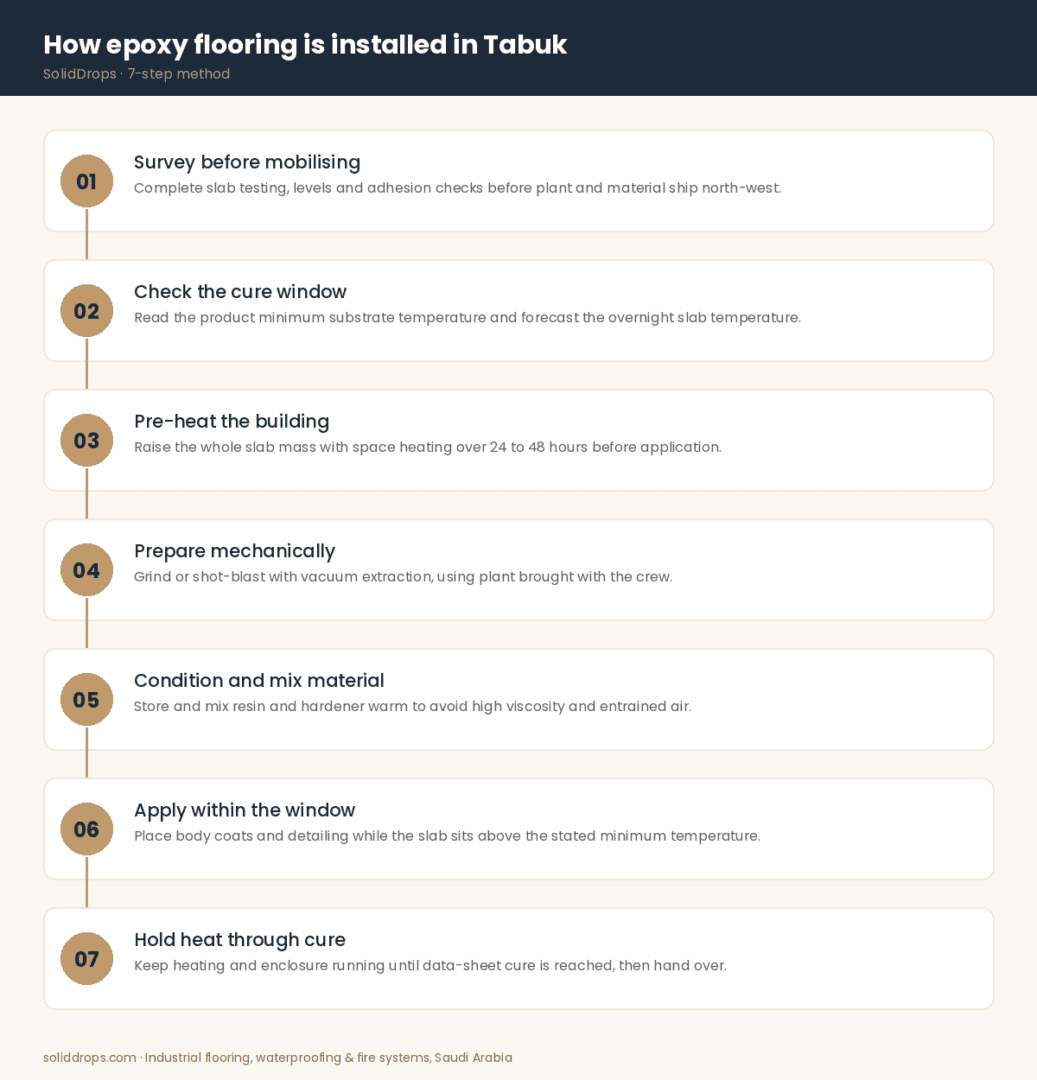
Cold-weather work is possible here. It is a matter of controlling the slab, not the calendar.
- Read the minimum substrate temperature. Every resin has one and it varies by product. Confirm it on the data sheet for the exact system, then measure the slab against it, not the air.
- Measure at the coldest point of cure. Where the slab will be at four in the morning matters more than where it is when the squeegee moves.
- Heat the building, not the surface. Space heating that raises the whole slab mass over 24 to 48 hours before application is effective. Direct flame or radiant heat pointed at a wet film is not; it skins the surface and traps solvent and moisture below.
- Keep the heat on through cure. Withdrawing heating the night after application is a common, expensive mistake.
- Condition the material. Cold resin and hardener are viscous, mix poorly and entrain air. Store drums warm, not in an unheated container.
- Watch dew point and carbamation. Epoxy amine hardeners curing in cold, damp conditions can produce amine blush or carbamation — a greasy or hazy surface bloom that must be removed before overcoating.
- Allow longer between coats. Overcoating intervals stretch in the cold. Applying the next coat on a summer schedule over an uncured layer causes interlayer failure.
Where a winter programme is unavoidable, some manufacturers offer low-temperature hardeners. Their limits are product-specific and must be read from the data sheet; the broader system comparison is in our epoxy flooring guide for Saudi Arabia.
What do the ground and the arid climate mean for slabs in Tabuk?
Tabuk sits within the volcanic harrat terrain of north-west Saudi Arabia, ground that behaves differently from the sabkha of the Eastern Province or the coastal deposits of the Red Sea shore. Rainfall is close to negligible: the driest months record none at all, and even January, the wettest, brings only around 2.5mm.
It would be easy to conclude slab moisture is not a Tabuk concern. That conclusion causes failures. Rainfall does not control moisture inside a slab; construction water, service leaks, wash-down and a missing damp-proof membrane all do, and a new industrial slab carries construction moisture for months regardless of the climate outside. On a fast-track build, the pressure to coat a young slab is the real risk.
Test in-slab relative humidity before committing to a system. Where the reading is high and the programme cannot absorb a drying period, a moisture-suppressing primer is a legitimate answer; hoping is not. Cold and damp compound each other, too: a cool slab dries slowly, so a winter programme already fighting cure temperature is often fighting residual moisture as well.
Which buildings in Tabuk and the north-west need resin flooring?
Demand here is industrial and development-led rather than driven by dense existing urban stock. Tabuk Industrial City, part of the Modon network, covers 2.9 million square metres, served by 2,900 cubic metres of drinking water capacity and a 25 MVA electricity supply. It holds 78 industrial and service contracts, operating and under implementation, across food products, chemicals, non-metallic minerals and machinery.
Those four sectors map onto four different floors.
Food production units
Wash-down bays, process halls and cold stores where hot water, cleaning chemicals and thermal shock rule out a thin coating.
Chemical plants
Bunded areas and process floors selected against a specific chemical exposure list, not a general resistance claim.
Non-metallic minerals and machinery
Heavy abrasion, impact and point loading, calling for screed thicknesses rather than roller coatings.
Warehousing and logistics
Units serving the airport at 22km and the port road; forklift traffic, racking legs and durable line marking.
New development fit-out
Commercial, accommodation and support buildings from the region’s new construction programme.
Workshops and maintenance bays
Oil and fuel resistance, wheel scrub at turning points, and cleanability under grit and dust.
The province also contains NEOM, including the Oxagon industrial port city, under Saudi Vision 2030. Modon has signed tenders reported at 266.4 million dollars to strengthen Saudi industrial cities. We make no claim about involvement in either; the relevance to a specifier is that the pipeline is new-build, which means young slabs, compressed programmes and early first-fix decisions.
Which resin system suits which Tabuk building?
Read the right-hand column first. In Tabuk the limit is usually cure temperature or mobilisation, not the duty itself.
| System | Best for in Tabuk | Key local limit |
|---|---|---|
| Epoxy coating (roller-applied) | Warehouses, machinery units and logistics sheds at the Modon industrial city | Cure stalls below the TDS minimum substrate temperature on winter nights |
| Epoxy self-levelling | Assembly areas, clean storage, showrooms and offices | Cold slab increases viscosity and the risk of poor flow and entrained air |
| Epoxy screed / broadcast quartz | Non-metallic mineral processing, machinery halls, impact zones | Thicker sections take longer to cure through in cold conditions |
| Polyurethane concrete (urethane mortar) | Food production, wash-down bays, cold stores | Chosen for thermal shock duty; still requires temperature-controlled placing |
| Chemical-resistant epoxy or vinyl ester | Bunds and process floors in chemical units | Selected against a stated exposure list; substitution is not a like-for-like swap |
| Moisture-suppressing primer system | Young slabs on fast-track new-build packages | Cold slabs dry slowly, so residual construction moisture persists longer |
For hot wet processing, our polyurethane concrete flooring guide sets out the thickness and thermal shock detail.
Planning a Tabuk floor through the winter months?
Send the handover date and the building's heating arrangement, and our technical team will set the build-up and the cure window against them.
How does mobilisation distance change a Tabuk programme?
Tabuk sits well away from the Kingdom’s main supply corridors, and the Modon figures make the position concrete: 22km to Prince Sultan bin AbdulAziz International Airport, 120km to Halat Ammar Port, 238km to port and 425km to rail. A resin flooring package is materials, plant and a trained crew, and all three have to arrive. What that means in practice:
- Confirm quantities before mobilising. A shortfall found mid-pour is not a same-day resupply here; survey-verified areas and a deliberate material contingency matter more than in Riyadh or Jeddah.
- Send the plant with the crew. Shot-blasters, grinders and vacuum extraction travel as part of the package rather than being hired locally.
- Plan continuous working. Once a crew is on site, the job favours a continuous programme over repeated short visits.
- Protect material in transit and storage. Both winter cold and summer heat affect drums; conditioned storage on site is part of the scope.
- Front-load the survey. Slab testing, levels and adhesion checks are reported before the main mobilisation, so the build-up is fixed before anything ships.
What goes wrong on Tabuk floors?
- Applying into a cold night. Applied in a mild afternoon, cured through hours near freezing: soft film, tacky surface, or a coating that never reaches design hardness.
- Heating the surface instead of the slab. Flame or radiant heat aimed at a wet film skins it and traps what is underneath. Heat the building mass in advance instead.
- Pulling the heaters too early. Cure continues after the crew leaves; so must the heating.
- Amine blush from cold, damp cure. A hazy or greasy bloom forms on the surface and, if not removed, prevents the next coat bonding.
- Summer overcoating intervals used in winter. Coating over an uncured layer delaminates, and it only shows under traffic.
- Coating a young slab. On a fast-track build, construction moisture blisters the floor whatever the rainfall figures say.
- Under-ordering material. Resupply distance turns a small quantity error into a delay.
What drives the cost of epoxy flooring in Tabuk?
Quotations are issued per project after survey. In Tabuk two cost drivers barely register elsewhere.
- Mobilisation and logistics. Distance, plant transport and material delivery are a visible element of any north-west Saudi package.
- Temporary heating and enclosure. Winter work may need space heating, enclosure and monitoring for the whole cure period.
- Slab condition and repairs. Cracks, spalling, level correction and removal of failed coatings.
- Preparation method. Shot-blasting an industrial hall against grinding a fitted-out area.
- System and build-up. A roller coating, a broadcast screed and a polyurethane concrete floor sit at different cost levels.
- Programme shape. Continuous working beats phased short visits at this distance.
- Detailing. Coving, bund detailing, drains, movement joints, anti-slip zoning and line marking are priced separately.
Send drawings, area uses and photographs of the slab for a quotation against a defined build-up.
Who supplies and installs epoxy flooring in Tabuk?
SolidDrops supplies and installs epoxy and resin flooring in Tabuk and north-west Saudi Arabia, along with waterproofing, FRP hygienic wall panels, construction chemicals and fire alarm materials. Work covers Modon industrial units, warehousing and logistics buildings, food and chemical production areas, workshops and new development fit-out. Service detail and the enquiry route sit on our epoxy flooring in Tabuk page, with combined scopes on flooring and waterproofing support in Tabuk.
We ask for the intended handover date early, because the cure window governs everything else. Survey and slab testing come first, then a written build-up against the measured duty and the season, then preparation, application inside a verified temperature window, and handover on data-sheet cure times. Where roofing or below-grade tanking runs alongside the floor, our waterproofing systems guide covers the options; inland conditions elsewhere are set out in our Madinah site conditions guide.
To discuss a specification or request a quotation, contact [email protected] or +966 50 213 1112.
Frequently asked questions
Who supplies and installs epoxy flooring in Tabuk?
SolidDrops supplies and installs epoxy and resin flooring in Tabuk and north-west Saudi Arabia, covering industrial units, warehousing, food and chemical production areas, workshops and new development fit-out. The scope runs from survey and slab testing through build-up, preparation, application and handover. Reach the technical team at [email protected] or +966 50 213 1112.
Can epoxy flooring be applied in cold weather in Tabuk?
Yes, with temperature control. January in Tabuk averages a low of 4.4C and mid-January is only 63 per cent frost-free, so the building is heated to raise the whole slab mass before application and the heating is maintained through cure. Measure the slab against the product’s stated minimum substrate temperature; below it, cure can stall and leave a permanently soft film.
Does frost damage a newly installed epoxy floor in Tabuk?
A fully cured epoxy floor is not harmed by cold nights. The risk is to a floor still curing, where a drop toward freezing during the cure period leaves the film permanently under-cured. Winter work in Tabuk is therefore planned around heated enclosure and maintained temperature, not around the application day alone.
Is slab moisture a problem in a place as dry as Tabuk?
It can be. The driest months record no rainfall and even January brings only about 2.5mm, but construction water, curing water, service leaks and a missing damp-proof membrane all put moisture into concrete. On fast-track new builds a young slab is the common culprit. In-slab relative humidity testing precedes system selection.
What flooring is used in Tabuk Industrial City factories?
Tabuk Industrial City holds 78 industrial and service contracts across food products, chemicals, non-metallic minerals and machinery, and each sector takes a different floor. Food and wash-down areas normally take polyurethane concrete, chemical units take a system selected against a stated exposure list, and machinery halls take epoxy screeds sized for impact.
How much does epoxy flooring cost in Tabuk?
Cost depends on slab condition and repairs, preparation method, system build-up, any temporary heating and enclosure needed for winter work, the programme shape, detailing such as coving and bunds, and mobilisation of crew, plant and material to the north-west. Send drawings and slab photographs for a quotation against a defined build-up.
Request a Tabuk site survey
SolidDrops supplies and installs epoxy flooring, resin systems and waterproofing across Tabuk and north-west Saudi Arabia. Email [email protected] or call +966 50 213 1112.
 Chat Online