
17 Sep Epoxy Flooring in Madinah: Dry Heat, Dust and Factory Floors
Epoxy Flooring in Madinah: Dry Heat, Dust and Factory Floors
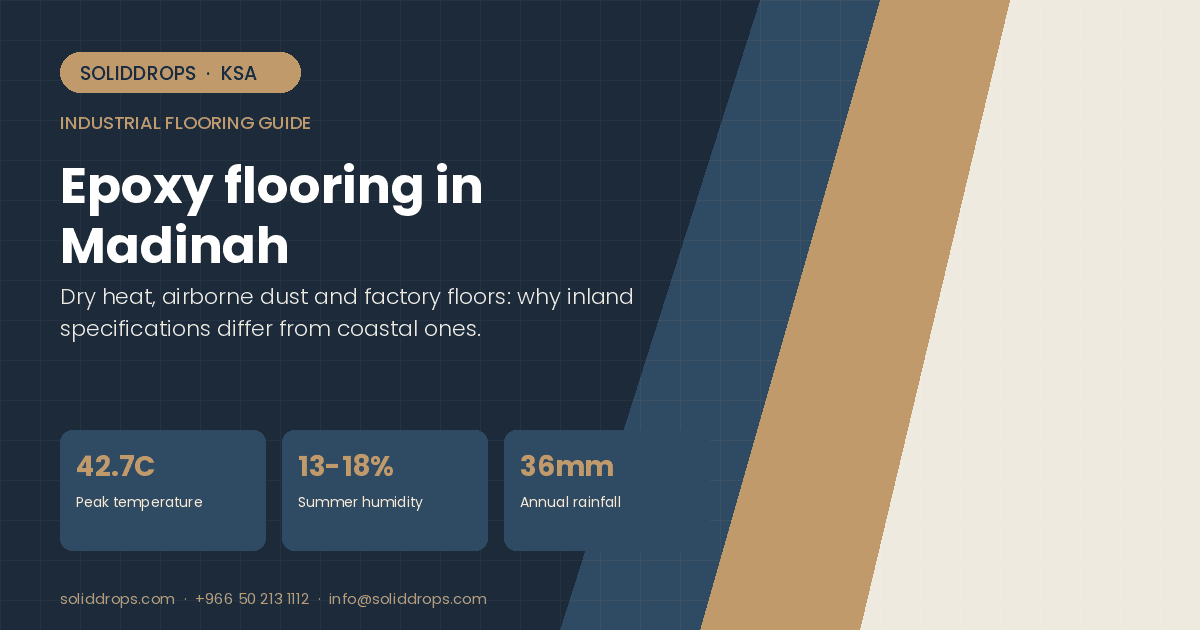
Epoxy flooring in Madinah is governed by dry heat rather than coastal humidity. Relative humidity runs 13 to 18 per cent through summer, peak temperature reaches 42.7C in August, and annual rainfall is around 36mm. That combination changes surface preparation, contamination control and cure behaviour more than it changes the resin.
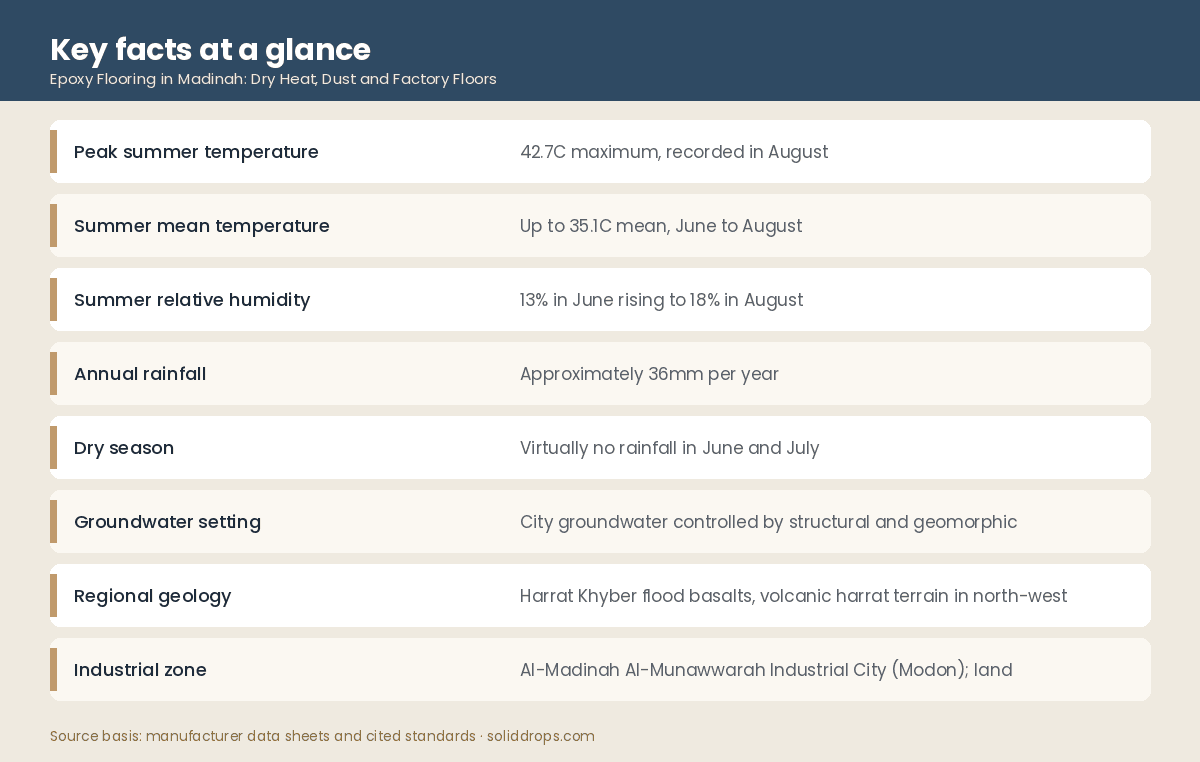
| Property | Value | Basis / standard |
|---|---|---|
| Peak summer temperature | 42.7C maximum, recorded in August | climate-data.org, Medina climate record |
| Summer mean temperature | Up to 35.1C mean, June to August | climate-data.org, Medina climate record |
| Summer relative humidity | 13% in June rising to 18% in August | climate-data.org, Medina climate record |
| Annual rainfall | Approximately 36mm per year | climate-data.org, Medina climate record |
| Dry season | Virtually no rainfall in June and July | climate-data.org, Medina climate record |
| Groundwater setting | City groundwater controlled by structural and geomorphic features: faults and wadi channels | Arabian Journal of Geosciences (Springer), Madinah groundwater study |
| Regional geology | Harrat Khyber flood basalts, volcanic harrat terrain in north-west Saudi Arabia | Peer-reviewed groundwater hydrochemistry studies, NW Saudi harrat zones |
| Industrial zone | Al-Madinah Al-Munawwarah Industrial City (Modon); land allocated for a 33,433 sq m factory | Construction Week Online; Modon industrial cities directory |
| Peak occupancy driver | Prophet's Mosque capacity increased through successive Saudi expansions to 1.8-2 million worshippers | Saudipedia; Arab News and SPA expansion reports |
Why does epoxy flooring in Madinah behave differently from the coast?
Epoxy flooring in Madinah fails for different reasons than it does in Jeddah or Dammam, and specifiers carrying a coastal template inland get caught by it. The city sits in a genuinely arid band: summer humidity of 13 per cent in June rising only to 18 per cent by August, a peak of 42.7C in August, a summer mean up to 35.1C, and roughly 36mm of rain across the whole year with June and July effectively dry.
On the coast, the enemy is water — in the air, in the slab, in the salt. In المدينة المنورة the enemy is what the dry air carries and what dryness does to the substrate. Air that thirsty pulls surface moisture out of fresh screeds and repairs quickly, which can leave a weak, dusty top layer on material that appeared sound when it was placed. Meanwhile the same air keeps fine particulate in suspension, and a resin floor is only ever as good as the last five minutes of cleanliness before the primer goes down.
Low humidity does bring one advantage. Dew point strike-through, which forces coastal crews to abandon a shift, is rarely the limiting factor here; the application window is set by temperature.
What does dry heat and dust do to a resin floor installation?
Three distinct mechanisms, all avoidable, all common.
- Contamination at the bond line. Dust settling on a prepared slab between grinding and priming is the single most frequent cause of adhesion loss inland. Vacuum immediately before priming, keep shutters closed, and prime the same shift you prepare — never prepare on Wednesday and prime on Saturday.
- Dust in the wet film. Airborne particulate landing on a levelling coat during cure leaves a gritty, matt, visually ruined surface that cannot be polished out. Air handling has to be shut down or filtered during application, and the area sealed.
- Premature drying of cementitious work. Repair mortars, screeds and self-levelling underlayments placed in 13 per cent humidity lose water to the air before hydration completes. Curing membranes or damp covering are not optional in Madinah; they are what stops you grinding off your own repair a week later.
Heat also runs the resin chemistry fast. Near a 42.7C summer peak, pot life shortens and the crew loses the wet edge. Reduce batch size, read the slab with a surface thermometer rather than trusting shade temperature, keep drums in conditioned storage, and apply in the cooler hours. The detail on system choice under heat sits in our epoxy flooring guide for Saudi Arabia.
What do Madinah's ground conditions mean for the slab?
Groundwater beneath the city is described in the published research as controlled by structural and geomorphic features — faults and wadi channels — rather than by a uniform aquifer. The wider region is harrat country: the Harrat Khyber flood basalts, volcanic terrain characteristic of north-west Saudi Arabia.
Two consequences follow. First, conditions vary between sites in a way regional averages will not predict: a slab close to a wadi channel can meet a different moisture regime from one a few hundred metres away, so per-site testing carries more weight here than any regional assumption. Second, low annual rainfall is not the same as a dry slab. Leaking services, irrigation, wash-down water and a missing or damaged damp-proof membrane all put moisture into a slab regardless of what the rain gauge says, and a resin coating over that moisture blisters in the same way it would in a wet climate.
Test the slab, record the reading, and choose the primer against the result. Where the reading is high and the programme cannot wait for the slab to dry, a moisture-tolerant or moisture-suppressing primer system is the decision point — not a gamble on the coating holding.
Which buildings in Madinah need resin flooring?
Two demand streams, wanting different things from a floor. The first is industrial: Al-Madinah Al-Munawwarah Industrial City, part of the Modon network, hosts manufacturing and service units, and Modon has allocated land for a factory of 33,433 square metres in the city — an indication of the scale of unit being built. Halls at that size need floors that take forklift traffic, point loads from racking legs and mechanical abrasion, with line marking that survives sweeping.
The second is hospitality and its support chain, driven by a Prophet’s Mosque whose capacity has been raised through successive Saudi expansions to figures reported at 1.8 to 2 million worshippers. Hotels follow, and hotels generate back-of-house floors.
Production halls and warehouses
Modon units and distribution sheds: abrasion resistance, load capacity, dust-free maintenance and durable line marking.
Food and beverage plants
Wash-down bays, process areas and cold stores where hot water and cleaning chemicals dictate the system.
Hotel back-of-house
Kitchens, wash-up, laundry and service corridors serving peak-occupancy periods.
Healthcare and clinical support
Coved, joint-free, cleanable finishes in treatment, laboratory and support areas.
Car parks and service yards
Deck coatings and anti-slip ramps exposed to thermal cycling under intense sun.
Showrooms and retail
Self-levelling finishes where appearance matters and daylight exposure calls for a UV-stable topcoat.
Which resin system suits which Madinah building?
The right column is the one that matters locally. Selection in Madinah is repeatedly decided by dust and dryness, not by the headline duty.
| System | Best for in Madinah | Key local limit |
|---|---|---|
| Epoxy coating (roller-applied) | Warehouses, production halls and workshops at the Modon industrial city | Thin film shows dust contamination readily; prime the same shift you prepare |
| Epoxy self-levelling | Showrooms, clean storage, corridors and light assembly | Airborne particulate landing during cure cannot be corrected; seal the area |
| Polyurethane concrete (urethane mortar) | Food plants, hotel kitchens, wash-down bays, cold stores | Specified where steam and hot water would debond an epoxy film |
| Epoxy screed / broadcast quartz | Heavy traffic halls and loading areas with impact risk | Aggregate profile must stay cleanable in a dusty environment |
| Cementitious self-levelling underlayment | Regulating an uneven slab before the resin build-up | Needs curing protection: 13 to 18 per cent humidity dries it too fast |
| UV-stable polyurethane topcoat | Daylit showrooms, atria, upper car park decks | Aromatic epoxy ambers under direct sun; the topcoat carries that duty |
Where hot wet processing is involved, our polyurethane concrete flooring guide covers thickness and thermal shock behaviour.
Specifying a floor for a Madinah factory or hotel?
Send the area drawings and the shutdown window available, and our technical team will match a build-up to the duty and the dust risk.
How should a Madinah flooring programme be sequenced?
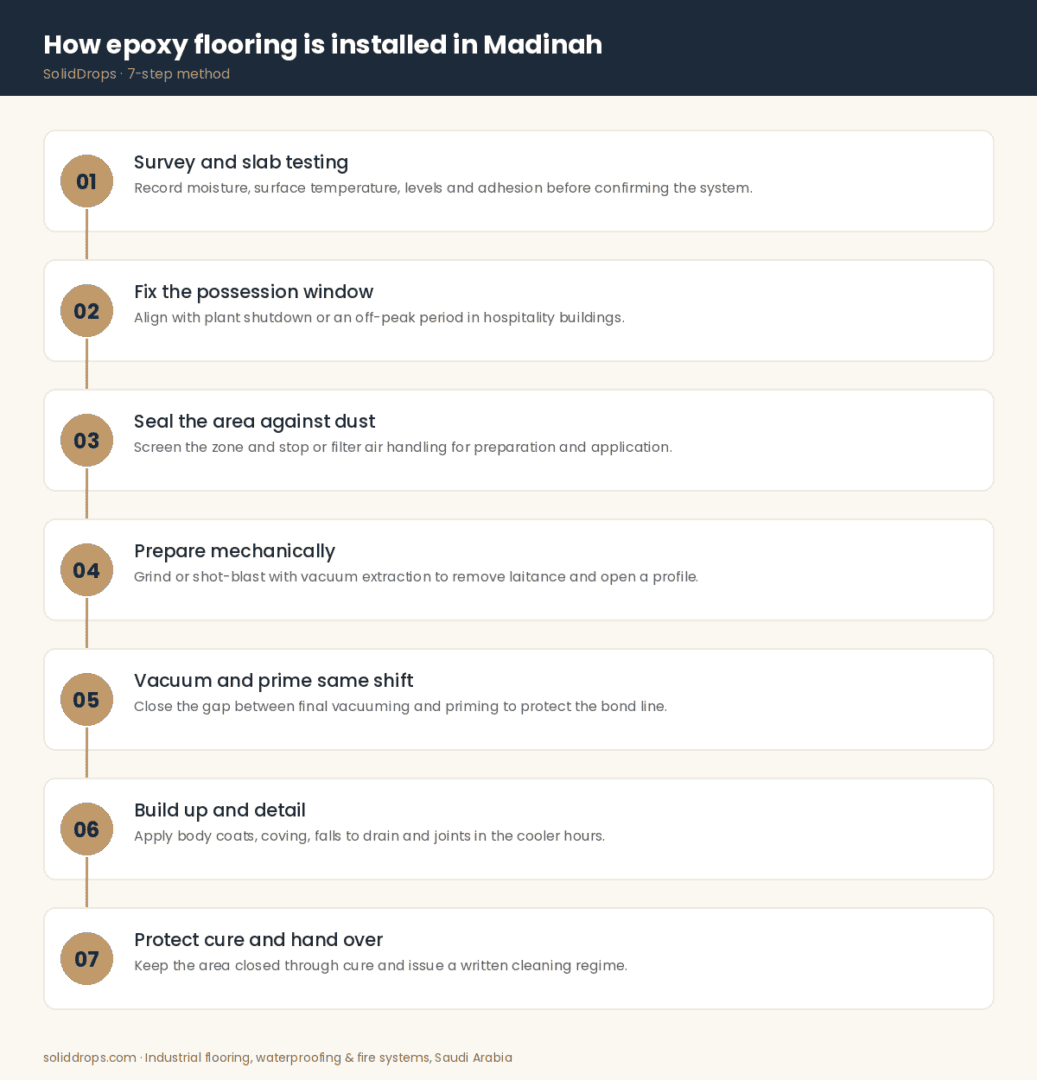
The sequence is built around two local constraints: keeping dust out of the bond line, and working a factory or hotel that would rather not stop.
- Survey and test. Slab moisture, surface temperature, levels and existing coating adhesion, recorded before a system is confirmed.
- Agree the possession window. On a Modon production unit this normally means a planned maintenance shutdown; in hospitality it means working outside peak occupancy periods.
- Seal the working area. Temporary screens, closed shutters, and air handling switched off or filtered for the duration of preparation and application.
- Prepare mechanically. Grind or shot-blast with vacuum extraction, removing laitance and opening a profile.
- Vacuum and prime the same shift. The interval between final vacuuming and priming is where Madinah floors are won or lost.
- Build up and detail. Body coats, coving, falls to drain and joint detailing, applied in the cooler hours with batch sizes matched to slab temperature.
- Cure protected, then hand over. Keep the area closed through cure, then release on data-sheet cure times with a written cleaning regime.
What goes wrong on Madinah floors?
- Dust between preparation and priming. The classic inland failure: a clean-looking slab with an invisible dust film, and a coating that peels in sheets.
- Screeds cured in open air. Repair mortar or levelling compound placed at 13 per cent humidity with no curing protection loses strength at the surface and has to be ground off.
- Assuming a dry climate means a dry slab. Service leaks and missing damp-proof membranes produce blisters regardless of rainfall.
- Standard epoxy in a wash-down bay. Hot water and cleaning chemicals in a food plant demand polyurethane concrete, not a thin coating.
- Line marking applied too early. Applied before the body coat has cured properly, marking lifts under the first pallet truck.
- Ambering in daylight. Showroom and atrium floors without a UV-stable topcoat discolour under sun through glazing.
- No maintenance regime. Grit dragged across a resin floor and never swept acts as grinding paste on the topcoat.
What drives the cost of epoxy flooring in Madinah?
Pricing is set per project after survey. The variables that move it most:
- Slab condition and repair scope. Cracks, spalling, failed previous coatings and level correction.
- Preparation method and area. Shot-blasting a production hall differs from grinding a fitted-out corridor.
- System build-up. A roller-applied coating, a broadcast screed and a polyurethane concrete floor are different orders of cost per square metre.
- Containment requirements. Sealing an area against dust in a live building adds time and temporary works.
- Shutdown window. Compressed programmes, night working and phased handover all carry a premium.
- Detailing. Coving, drains, movement joints, anti-slip zoning and line marking are priced separately.
- Delivery and mobilisation. Material delivery and crew mobilisation to Madinah are a real budget line.
Send the drawings, the area uses and photographs of the existing slab for a quotation against a defined build-up.
Who supplies and installs epoxy flooring in Madinah?
SolidDrops supplies and installs epoxy and resin flooring in Madinah, together with waterproofing, FRP hygienic wall panels, construction chemicals and fire alarm materials. Scopes run from production halls and warehouses on the Modon estate to hotel kitchens and laundries, healthcare support areas, car park decks and showrooms. Service scope and the enquiry route are set out on our epoxy flooring in Madinah page, and combined packages on flooring and waterproofing support in Madinah.
Every scope begins the same way: a survey with recorded slab moisture and temperature, a written build-up matched to the duty, then preparation and application inside a verified window. Where roofs, wet areas or below-grade tanking sit alongside the floor, our waterproofing systems guide covers the options. Teams also work Makkah, Jeddah, Riyadh, Dammam, Jubail and Tabuk; conditions in the other holy city differ enough that we treat them separately in the Makkah site conditions guide.
To review a Madinah specification, write to [email protected] or call +966 50 213 1112.
Frequently asked questions
Who supplies and installs epoxy flooring in Madinah?
SolidDrops supplies and installs epoxy and resin flooring in Madinah for production halls, warehouses, food plants, hotel back-of-house areas, healthcare support spaces, car parks and showrooms. The scope covers survey, slab testing, written build-up, preparation, application and handover. Enquiries go to [email protected] or +966 50 213 1112.
Is epoxy flooring suitable for Madinah's dry heat?
Yes. Once cured, a resin floor is unaffected by low humidity. The difficulty is during installation: summer relative humidity of 13 to 18 per cent and temperatures peaking at 42.7C shorten working time and dry cementitious repairs too quickly, so batch sizes, curing protection and application hours are adjusted accordingly.
Does dust affect epoxy flooring installation in Madinah?
Significantly. Dust settling on a prepared slab between grinding and priming is the most common cause of adhesion failure inland, and particulate landing on a wet film cannot be corrected afterwards. The area is sealed, air handling stopped or filtered, and the floor primed in the same shift it is prepared.
What flooring is best for a factory in Madinah Industrial City?
For general production and warehousing, an epoxy coating or broadcast screed sized to the traffic and point loads is usual. Where hot water, steam or aggressive cleaning chemicals are present, such as in food processing, polyurethane concrete is specified instead because it tolerates thermal shock that a thin epoxy film does not.
Does low rainfall in Madinah mean slab moisture is not an issue?
No. Annual rainfall of around 36mm says nothing about moisture inside a particular slab. Service leaks, irrigation, wash-down water and a missing damp-proof membrane all put water into concrete, and published research describes local groundwater as controlled by faults and wadi channels, so conditions vary site by site.
How long does epoxy flooring take to install in Madinah?
Duration depends on area, preparation method and the number of coats in the build-up, with cure times read from the product data sheet against measured slab temperature. Warm substrates speed cure but shorten working time. Programme dates are fixed after the survey, against the shutdown window the building can actually give.
How much does epoxy flooring cost in Madinah?
Cost is driven by slab condition and repairs, preparation method, the system build-up, dust containment in live buildings, the length of the available shutdown, detailing such as coving and drainage, and mobilisation to Madinah. No meaningful figure exists before a survey. Send drawings and slab photographs for a quotation.
Request a Madinah site survey
SolidDrops supplies and installs epoxy flooring, resin systems and waterproofing across Madinah. Email [email protected] or call +966 50 213 1112.
 Chat Online